


Health and medicine
Better tuberculosis treatment starts with a better test
ASU research could lead to faster, more effective TB treatment
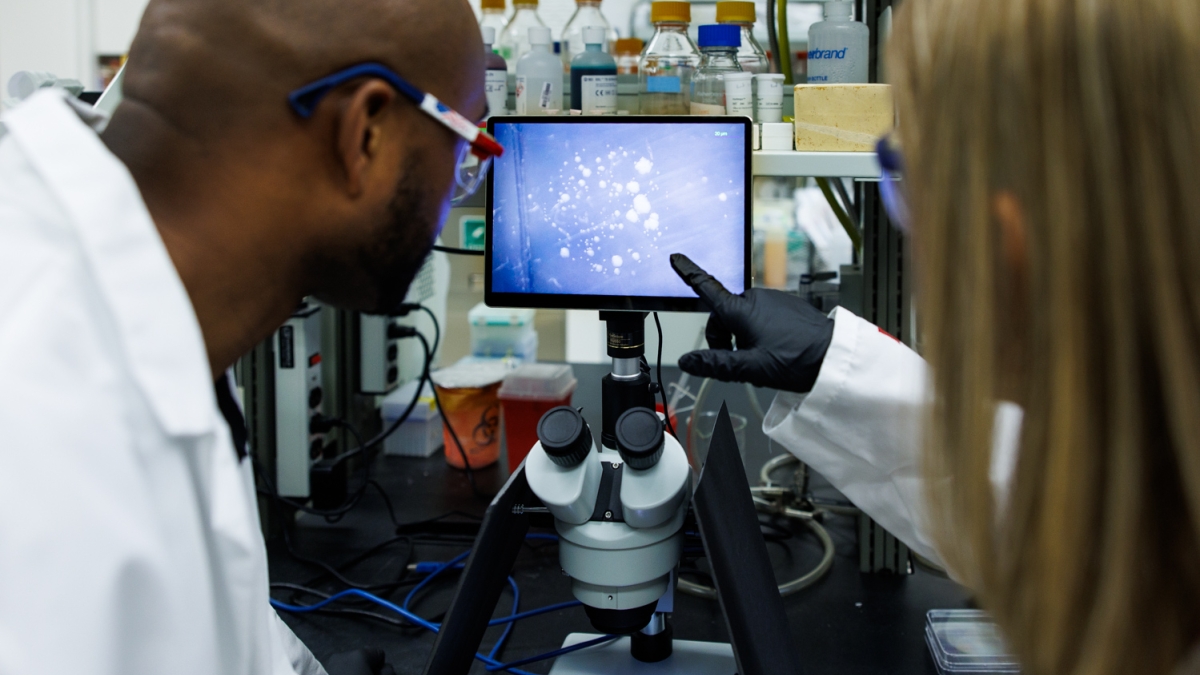
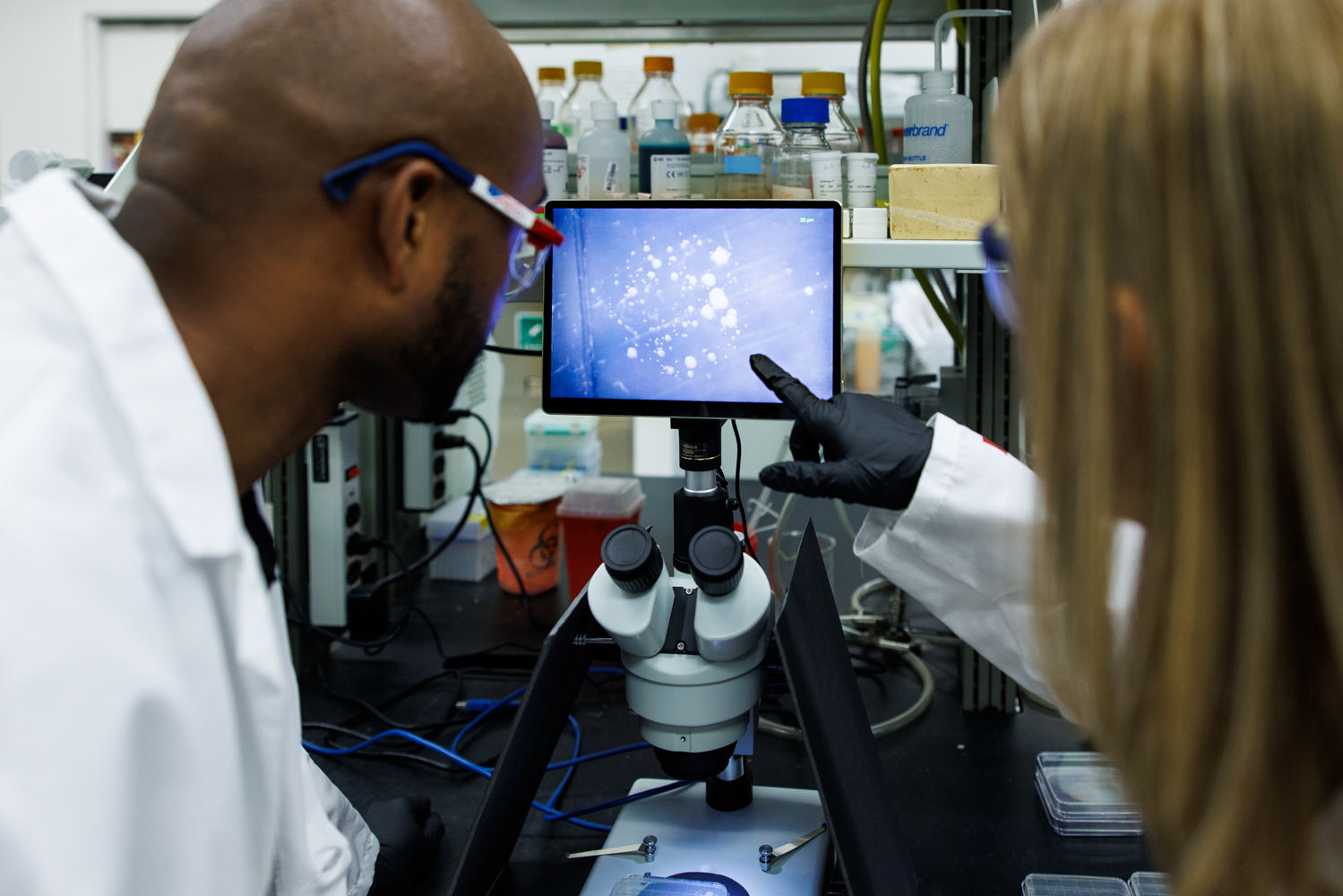
Student researcher Timothy Williams Jr. (left) and Professor Shelley Haydel look at mycobacterial colony forming units with a digital microscope. Photo by Andy DeLisle/ASU
Tuberculosis is an ancient disease that still threatens human health around the world today. This infectious disease causes over 10 million illnesses and 1.5 million deaths every year — including some close to home
“A large TB outbreak recently occurred in the Kansas City area, with 68 active cases of infectious TB disease, two deaths and more than 650 people evaluated or monitored throughout the outbreak investigation,” says Shelley Haydel, an infectious disease researcher at Arizona State University. “Despite being preventable and curable, TB can spread like wildfire. TB anywhere is a threat to people everywhere.”
Scientists developed powerful treatments for TB in the mid-1900s. But new strains of the disease evolved to resist them. These include multidrug-resistant strains that resist at least two of the most effective first-line treatments. Nearly 20% of patients with multidrug-resistant TB die within a year of starting treatment
That’s why Haydel and fellow ASU scientist Shaopeng Wang are working to develop technology that helps doctors quickly find out whether a patient’s tuberculosis is resistant to new TB drugs. Ultimately, this means faster, more effective TB treatment
Their project was recently funded with a $2.3 million grant from the National Institute of Allergy and Infectious Diseases.
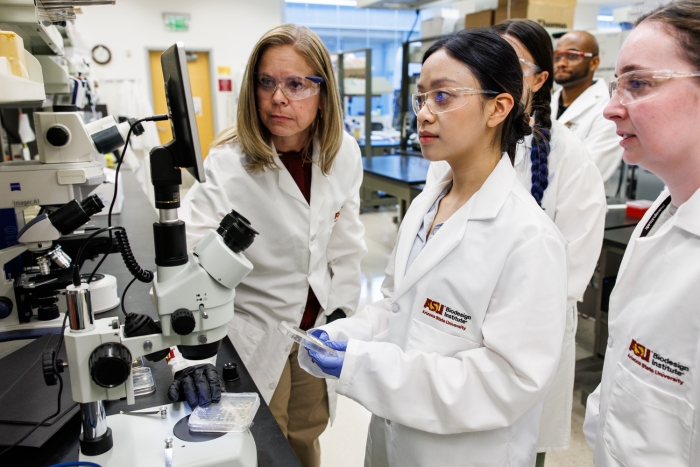
Haydel and Wang are both faculty in the Biodesign Center for Bioelectronics and Biosensors. Haydel is also a professor in the School of Life Sciences. Wang is an associate professor in the John Shufeldt School of Medicine and Medical Engineering and the School of Biological and Health Systems Engineering
“By applying advanced imaging techniques and data-driven analysis, our proposed technology has the potential to revolutionize universal TB drug susceptibility testing, particularly for new, repurposed and experimental drugs that don’t yet have molecular resistance tests,” Haydel says
Related story
ASU scientists uncover tuberculosis bacterium’s ‘heartbeat’
There are two ways to test if TB bacteria from a patient can resist different drugs, and they force medical professionals to make a tough choice. A molecular test is fast, but it can’t check for resistance to new TB drugs. A phenotypic test can check resistance more broadly but takes much longer and delays treatment
Haydel and Wang propose a new approach that greatly reduces the time needed for phenotypic test results. Their tool will combine scattering-based optical imaging with advanced deep learning to analyze bacterial growth, allowing practitioners to rapidly and accurately determine TB drug susceptibility
This capability will help doctors quickly find the best medication for specific strains of TB, so they can get the right treatment to patients faster — ultimately saving more lives
Biodesign Center for Bioelectronics and BiosensorsFacultyGrants / AwardsJohn Shufeldt School of Medicine and Medical EngineeringSDG 03 Good Health and Well-BeingBioscienceSchool of Biological and Health Systems EngineeringTempe campusHealth and medicineHealth careSchool of Life SciencesBiodesign InstituteResearchThe College of Liberal Arts and SciencesKnowledge Enterprise
Biodesign Center for Bioelectronics and Biosensors, Faculty, Grants / Awards, John Shufeldt School of Medicine and Medical Engineering, SDG 03 Good Health and Well-Being, Bioscience, School of Biological and Health Systems Engineering, Tempe campus, Health and medicine, Health care, School of Life Sciences, Biodesign Institute, Research, The College of Liberal Arts and Sciences, Knowledge Enterprise
More Health and medicine

Widespread shortages of personal protection equipment. Deep burnout among health care workers. Conflicting communications. The COVID-19 pandemic showed that responding to infectious disease…
Read this story
Health careScienceResearchCommunity partnerships
As the Arizona State University Congressional Dialogue Series with Congresswoman Yassamin Ansari began Wednesday morning, David Schwartz used three words to describe the health care system:Chaotic.…
Read this story
Healthy LivingHealth careCommunity partnerships

Addiction to prescription drugs and alcohol among older adults is rising in the U.S. but often goes undetected.In 2023, an estimated 6.4 million Medicare beneficiaries had a substance-use disorder,…
Read this story
Healthy LivingExpert Q-and-APsychology
