


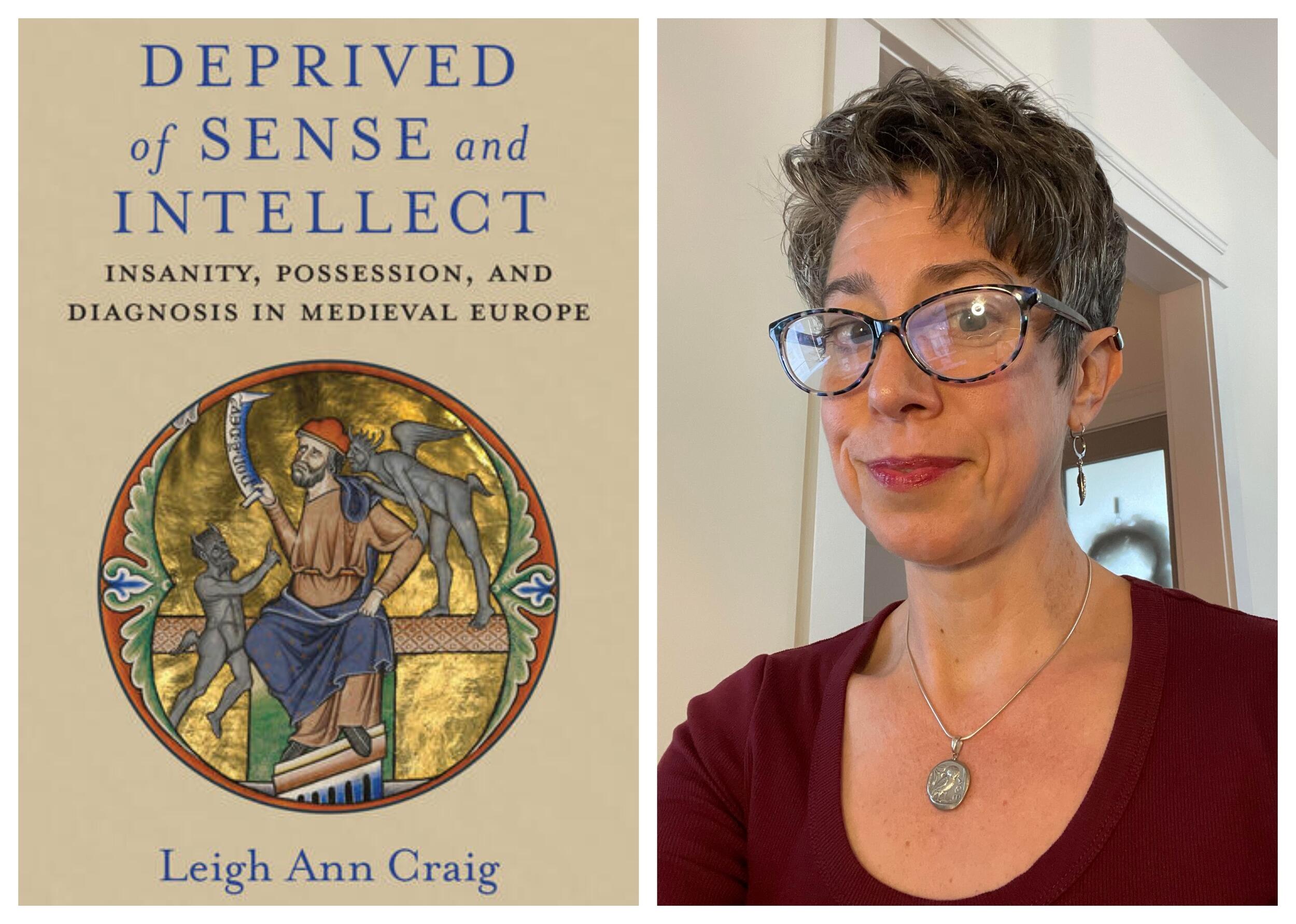
What do the Middle Ages tell us about mental health then and now? VCU historian Leigh Ann Craig has answers
In her new book, ‘Deprived of Sense and Intellect,’ she examines sanity, demons, the complexity of medieval diagnostics and modern tie-ins.
Share this story
By Sian Wilkerson
In the high and later Middle Ages, restoration of sanity to those who had lost their mind accounted for about 10% of recorded saintly miracles. But as Virginia Commonwealth University historian Leigh Ann Craig details in her latest book, “Deprived of Sense and Intellect: Insanity, Possession, and Diagnosis in Medieval Europe,” the diagnoses behind these instances of loss of mind varied
“The disease theories used by medieval people to describe behavioral problems were overlapping,” said Craig, Ph.D., an associate professor in the Department of History in the College of Humanities and Sciences
Conditions that would now be called mental illness were in that era sometimes diagnosed through the lens of humoral theory, a system of medicine first adopted by the Ancient Greeks. Those theories were “extremely complex,” Craig said, and described “interdependent problems with the solid organs and the humors, the spirit and the immaterial soul and the emotions.”
Adding to this complexity was the notion of demons, who possessed of the ability to influence mood and to move physical matter: “Demons could both invade the body in an indwelling possession, and also use these abilities from outside of the body to trigger precisely the same imbalances described in humoral theories,” Craig said. “Indeed, in 20% of the narratives about loss of mind that I examined, observers could not clearly determine whether a demon was in the mix or not.”
In “Deprived of Sense and Intellect,” published this month, Craig examines 460 of these stories through the lens of critical disability theory, exploring how medieval communities distinguished between naturally arising loss of mind and demonic harassment and possession. VCU News recently caught up with her to learn more about her research
First, tell us more about the questions at the heart of this study
“Deprived of Sense and Intellect” asks both what medieval thinkers understood a mind to be, and what signified its loss in medieval communities. But I simultaneously propose that historical distance — and our own unstable diagnostic thinking — should guide us away from any form of modern diagnostic presumption about those lost minds. Instead, we should understand loss of mind as a pattern of interpersonal tensions that sufferers and their communities shared. Medieval communities assigned those tensions to a malfunction of consciousness in a single person, and this study considers how the function and malfunction of consciousness was named and classified in medieval miracle texts, considering the valences of that terminology as it appeared in theology, medicine and law.
The study then examines how a loss of mind came to be diagnosed by medieval people as deriving either from natural causes or from the predations of demons. I discuss both the influence of regional cultures of disability, and the process by which communities came to a consensus when faced with those tensions
What are the stories you studied to come to these conclusions?
Miracle narratives are a very, very old genre. In the Christian tradition, they have roots directly in the Gospels, where Jesus healed the sick, raised the dead, restored sanity and provided food
In late Antique Christianity, the proof of sainthood — that is, that a person was so holy during life that they attained heaven immediately up their death — was twofold: First, it was proved by martyrdom, and second, by miracles, which occurred because that dead person’s name had been evoked as an intercessor with the Divine. Saints became a mainstay of Christian devotion (and remain so in the Roman Catholic and the Orthodox traditions), and for every saint, then, there were corresponding stories of the miracles they provided during their lives and after their deaths.
These stories were collected at shrines, and by 1240 had become a necessary ingredient in the Church’s affirmation (or canonization) of a new saint. Some 90% of these miracles were descriptions of some form of healing for illness, and the restoration of sanity accounts for perhaps 10% of them in the Middle Ages
What drew you to this subject?
I was drawn to this research for two reasons: The first was that while writing my first book — “Wandering Women and Holy Matrons: Women as Pilgrims in the Later Middle Ages (Studies in Medieval and Reformation Traditions, 138)” — I found evidence about quite a lot of women who were brought to shrines against their will in an attempt to treat them for behavioral issues. The diagnoses used to describe these women varied, but their behavioral issues didn’t. So how, I wondered, were they diagnosed?
The second and parallel draw lay in circumstances all around us: Since 2013, we have been in the midst of a great deal of professional and medical flux in questions of mental health. Modern diagnostics as construed by psychology and the DSM-V are syndromal (rather than based in laboratory evidence), with poor reliability scores in practice. Biomedical disciplines (such as neurology) and grant-giving organizations have consequently come to mistrust those diagnostic structures, even as insurers and practitioners rely upon them. Mental illness is very real, but also very difficult for observers to parse; and the sheer continuity of that problem was of great interest to me.
What do you hope readers will take away?
What I most hope readers will take away is an awareness that we, as historians (or as casual observers today) cannot easily quantify or assign status when it comes to this form of disability. Likewise, I hope my readers find a certain level of respect for medieval attempts to navigate that difficulty, with concern for all affected by it
Finally, I sincerely hope that it will break down the distinction we tend to emphasize in the framework of our studies between possession and natural forms of loss of mind. We tend, in passing, to treat the former diagnosis as grim superstition, and the latter diagnosis as quaint artifacts of medical ignorance. But the two situations existed in the same culture, were treated with some of the same methods, and medieval people found it difficult to distinguish between them. Meanwhile, we ourselves are presently at odds about the standards that should be applied as we attempt to diagnose or conduct research on any such condition. As such, medieval diagnostic categories were no less fraught than our own; and they were thought-structures that affected one another, and are best understood in relationship with one another.
- Books
- Faculty
