



In The FieldQualityPracticeWorkforceInnovative Research
One year on: what sustained investment in educator wellbeing can achieve

Article
By Kinex Health, in partnership with the Early Childhood Educators’ Wellbeing Project (ECEWP)
Jul 14, 2026
Save
An early look at 12-month wellbeing data from ECTARC, an Australian early childhood provider, and why it points to a bigger question the sector still needs answered
Educator wellbeing has become one of the defining conversations in early childhood education and care. Burnout, workforce shortages and the emotional and physical demands of the profession are now regular features of sector discussion. What receives far less attention is what happens when a service commits to improving educator wellbeing over the long term, and whether that investment changes anything
Over the past 12 months, ECTARC, an Australian early childhood provider, did exactly that. Working with Kinex Health, ECTARC ran a structured wellbeing program across its 9 services and head office, and surveyed its staff three times: at the start, at six months, and at twelve months. The findings provide an opportunity to examine what changed, and what did not, after twelve months
Tracking change over time
The most useful way to read wellbeing data is to follow the same people over time, rather than comparing one group of survey respondents to a different group a year later. Seventy-three staff completed both the first and the final survey, so the figures below track that matched group against themselves. That is what gives the numbers their weight
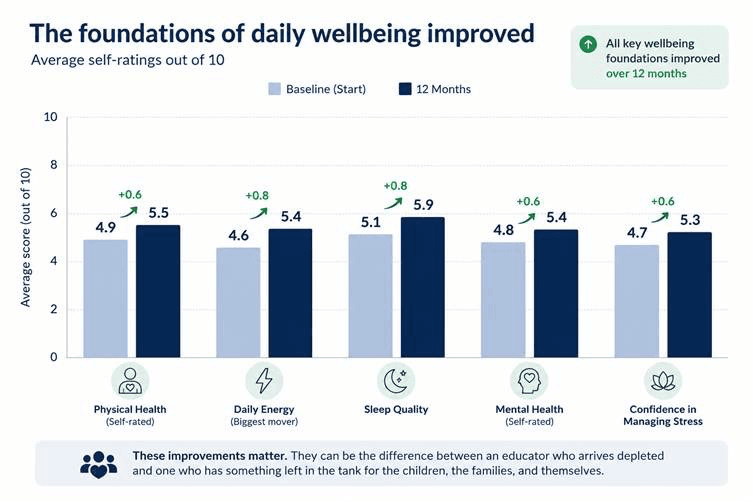
Across the year, educators reported improvements in physical health, energy levels, sleep quality, mental health and confidence in managing stress. Daily energy showed the largest improvement, while burnout measures also moved in a positive direction
Burnout, measured using the validated Maslach Burnout Inventory (MBI), also improved
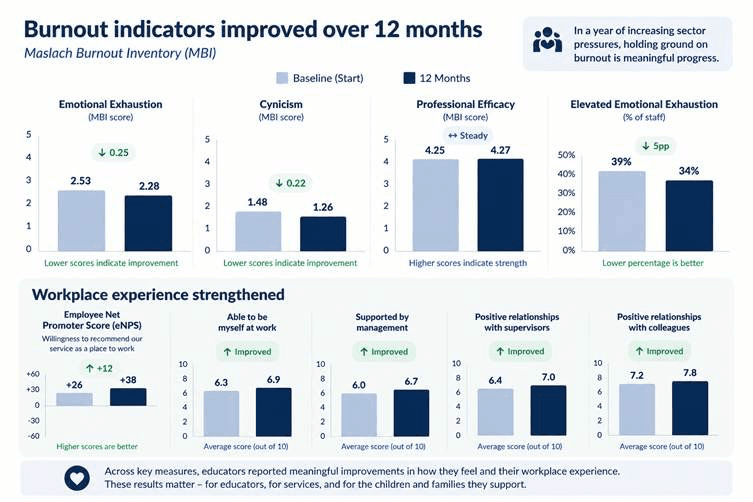
Emotional exhaustion and cynicism both eased over the 12 months, while staff members’ sense of professional efficacy remained high and steady. The proportion of staff reporting elevated emotional exhaustion fell from 39 per cent to 34 per cent. In a year of significant sector pressure, even modest improvements in burnout indicators are meaningful
The workplace experience data also strengthened. Staff became markedly more willing to recommend their centre as a great place to work, with ECTARC’s employee net promoter score improving by 46 per cent over the year. This came alongside improvements in feeling able to be themselves at work, feeling supported by management, and maintaining positive relationships with supervisors and colleagues
Not every measure improved
Honest reporting means showing the flat lines too. Psychological distress, measured by the Kessler 10 (K10), barely shifted across the year, sitting around the threshold commonly used for mild distress. Self-rated stress levels edged up slightly. And reports of daily aches and pains actually rose, a reminder that the physical demands of educator work are real and need their own attention
These findings deserve careful interpretation. The K10 reflects everything happening in a person’s life, not only their workplace, and this was not a quiet year to be an educator. Reform, scrutiny, funding uncertainty, and the sector’s presence in the headlines all weigh on people. Stability on distress, against that backdrop, is a defensible outcome. It is also a clear target for the year ahead
Interpreting the findings carefully
The important caveat to these findings is that this is data from a single provider, ECTARC, that chose to invest in wellbeing. There was no comparison group of similar services doing nothing, and no random allocation. So, while we can say with confidence that these staff members improved over the year, we cannot say for certain that the program alone caused it. Other things were happening in these services and in the sector at the same time
That distinction matters, and it is exactly why it is worth raising in a sector publication rather than burying it. Encouraging observational results like these are common in workplace wellbeing. Robust causal evidence, the kind that can actually move policy and funding decisions, is rare. The honest position is that this data raises a strong hypothesis. It does not settle it
These findings highlight the need for stronger evidence across the sector. One initiative seeking to address this gap is Project Thrive, a randomised controlled trial focused specifically on educator wellbeing
From promising results to stronger evidence
Addressing this evidence gap is the focus of Project Thrive. These findings are part of what motivated Project Thrive, the first randomised controlled trial in Australia focused specifically on educator wellbeing, run by the ECEWP, in partnership with Kinex Health
Project Thrive takes the open question, does structured wellbeing support genuinely improve outcomes for educators and services, and tests it properly. Thirty-two services across the country will take part, with a tiered model of support and a wait-list design that lets us compare like with like. Outcomes will be measured at the start, at six months, and at twelve, using the same validated tools, with follow-up case studies to understand not just whether it works but what works, for whom, and why. Because the trial has moved away from in-person delivery, services anywhere in Australia can take part, not only those near a major city.
The 12-month data above is the kind of signal that makes a trial like this worth running. Project Thrive is how the sector gets from a promising signal to evidence it can take to government with confidence
Whether the results can be replicated across the broader sector remains an open question. What these early findings demonstrate, however, is that educator wellbeing can be measured over time and that sustained investment may influence outcomes that matter not only for educators, but for children, families and services as well
Services interested in participating in Project Thrive can express interest
Project Thrive is jointly funded by theECEWPand Kinex Health, with a contribution from participating services. Full details are provided at the expression of interest stage
Don’t miss a thing
Related Articles
1
Educator Essentials: new Queensland re
Creating learning environments where children feel safe, respected and supported is central to high-quality early childhood education and care. To help educators strengthen this aspect of practice, the Queensland Department of Education has released Educator Essentials—Positive Behaviour Strategies, a new video series offering practical, evidence-informed guidance for educators working with children aged three to five years
2
More than 120 families notified as Local Contact Point established in Sydney childcare worker investigation
Before continuing to read this piece, readers should be aware that the content of this article may prove distressing, and should consider their own circumstances before continuing to engage with the piece. A list of support services has been provided at the conclusion of the article
3
Compliance isn’t safety: why the next phase of childcare reform is still asking the wrong question
Recently the education minister told the sector that the government’s reform agenda is about ensuring providers “consistently meet their obligations” under the National Quality Framework, aiming to raise the proportion of compliant services from 95 per cent to 100 per cent. It’s a reasonable-sounding target. It is also, I’d argue, the wrong one
4
One year on: what sustained investment in educator wellbeing can achieve
An early look at 12-month wellbeing data from ECTARC, an Australian early childhood provider, and why it points to a bigger question the sector still needs answered
5
Why physical security is becoming part of the ECEC child safeguarding conversation
Every child has the right to feel safe, secure and supported in early childhood education and care (ECEC) environments. While the vast majority of educators and services are deeply committed to children’s safety and wellbeing, recent safeguarding discussions have highlighted the importance of strong systems, clear processes and proactive approaches to preventing harm
Related Articles
1
Educator Essentials: new Queensland re
Creating learning environments where children feel safe, respected and supported is central to high-quality early childhood education and care. To help educators strengthen this aspect of practice, the Queensland Department of Education has released Educator Essentials—Positive Behaviour Strategies, a new video series offering practical, evidence-informed guidance for educators working with children aged three to five years
2
More than 120 families notified as Local Contact Point established in Sydney childcare worker investigation
Before continuing to read this piece, readers should be aware that the content of this article may prove distressing, and should consider their own circumstances before continuing to engage with the piece. A list of support services has been provided at the conclusion of the article
3
Compliance isn’t safety: why the next phase of childcare reform is still asking the wrong question
Recently the education minister told the sector that the government’s reform agenda is about ensuring providers “consistently meet their obligations” under the National Quality Framework, aiming to raise the proportion of compliant services from 95 per cent to 100 per cent. It’s a reasonable-sounding target. It is also, I’d argue, the wrong one
4
One year on: what sustained investment in educator wellbeing can achieve
An early look at 12-month wellbeing data from ECTARC, an Australian early childhood provider, and why it points to a bigger question the sector still needs answered
5
Why physical security is becoming part of the ECEC child safeguarding conversation
Every child has the right to feel safe, secure and supported in early childhood education and care (ECEC) environments. While the vast majority of educators and services are deeply committed to children’s safety and wellbeing, recent safeguarding discussions have highlighted the importance of strong systems, clear processes and proactive approaches to preventing harm
