


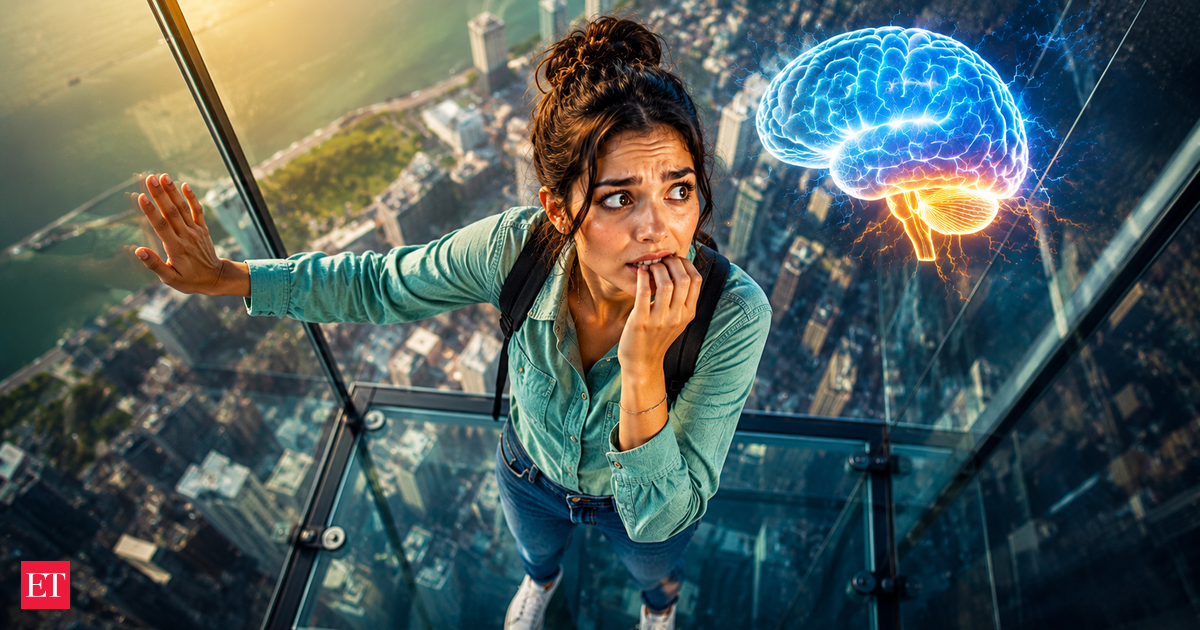
Standing on a high balcony, looking down from a mountain trail, or walking across a glass bridge can make some people feel perfectly calm. For others, the same experience triggers sweaty palms, a racing heart, shaky legs, or an overwhelming urge to step back.Psychology says that fear of heights is not necessarily irrational. In fact, a certain amount of caution around heights has likely helped humans survive throughout evolution. When the fear becomes so intense that it interferes with daily life, however, it may be classified as acrophobia, a specific phobia recognized by mental health professionals.Researchers believe this fear develops through a combination of biology, learning, perception, and thinking patterns rather than one single cause.
The brain is trying to keep you safe
One of the strongest explanations comes from evolutionary psychology. Throughout human history, falling from great heights posed a serious risk to survival. As a result, the brain evolved systems that encourage caution in dangerous situations.When someone stands near the edge of a tall building, the amygdala, a brain region involved in processing fear, can quickly activate the body’s fight-or-flight response.You Might Also Like:

Psychology says people who always have a question in every meeting aren’t just curious, they may be worried about how they appear in front of others
This may cause:
- A racing heartbeat
- Sweaty hands
- Rapid breathing
- Muscle tension
- A strong desire to move away from the edge
These reactions are designed to protect us, even if the situation is objectively safe.
Balance and vision work together
Fear of heights isn’t only psychological, it also involves how the body processes sensory information.Researchers studying the Visual Cliff Experiment, conducted by psychologists Eleanor Gibson and Richard Walk, found that even infants show hesitation around apparent drops, suggesting that depth perception influences behavior early in life. Adults also rely on visual cues to maintain balance.You Might Also Like:

Psychology says people who use the same password everywhere aren’t lazy, they may just prefer convenience more than anything
For example, standing on a transparent observation deck may feel frightening because the brain receives unusual visual information that conflicts with its normal sense of stability. This sensory mismatch can increase feelings of dizziness and fear.
Learning from experience can strengthen fear
According to Classical Conditioning, developed by Ivan Pavlov and later applied to fear research by John B. Watson, frightening experiences can create lasting associations.Imagine someone slipping while hiking near a steep cliff. Even if they were not seriously injured, their brain may begin associating heights with danger.Later, simply standing on a balcony may trigger anxiety because the earlier experience has been linked to similar situations. The brain remembers emotional experiences remarkably well.
People can also learn fear by watching others
Psychologist Albert Bandura’s Social Learning Theory suggests that people often learn through observation. For example, a child who repeatedly sees a parent panic near balconies or refuse to climb ladders may begin developing similar fears.This doesn’t happen in every family, but research shows that observing anxious behavior can influence how people interpret potential threats. Fear can sometimes be learned without directly experiencing danger.
Catastrophic thinking makes the fear stronger
Many people who fear heights experience catastrophic thinking, a cognitive pattern in which the brain imagines the worst possible outcome.Someone standing safely behind a protective railing may think:
- “I’m going to fall.”
- “The railing might break.”
- “I’ll lose my balance.”
These thoughts often feel convincing, even when the actual risk is extremely low. Cognitive Behavioral Therapy (CBT) helps people recognize and challenge these exaggerated predictions, making it one of the most effective treatments for specific phobias.
Avoidance keeps the fear alive
One reason fear of heights can persist is explained by Operant Conditioning. When someone avoids balconies, observation decks, or hiking trails, they immediately feel relief.Psychologists call this negative reinforcement because avoiding the feared situation reduces anxiety in the short term. Unfortunately, this also prevents the brain from learning that many height-related situations are actually safe. Over time, the fear often remains unchanged, or even grows stronger.
Exposure helps retrain the brain
One of the most successful treatments for acrophobia is Exposure Therapy. Rather than forcing someone into frightening situations all at once, therapists gradually introduce increasingly challenging experiences in a controlled way.For example, treatment might begin by:
- Looking at pictures of tall buildings
- Watching videos filmed from high places
- Standing on a low staircase
- Visiting higher observation points over time
Repeated safe experiences help the brain update its expectations and reduce fear. Research consistently shows that gradual exposure is highly effective for many specific phobias.Psychology says people who are scared of heights often experience a natural protective response that has deep evolutionary roots. Biology, learning experiences, observation, thinking patterns, and sensory processing can all influence how strongly someone reacts to heights.Having a fear of heights doesn’t mean someone is weak or lacking courage. Many people experience mild discomfort around high places, while others develop acrophobia that significantly affects daily life. The encouraging news is that evidence-based treatments such as Cognitive Behavioral Therapy and gradual exposure can help many people reduce their fear and regain confidence.
Is being afraid of heights normal?
Yes. Mild fear of heights is common and may help protect people from dangerous situations. It becomes a concern when it is intense enough to interfere with everyday life.
Can fear of heights be learned?
Yes. It can develop after frightening experiences, by observing others’ fearful reactions, or through repeated avoidance of height-related situations.Add 
as a Reliable and Trusted News Source

Add Now!
(You can now subscribe to our Economic Times WhatsApp channel)
Read More News on
Why ae people scared of heightsPsychology of fear of heightsPsychology of heightsexposure therapy for phobiasfear of heightsphobia of heights
(Catch all the US News, UK News, Canada News, International Breaking News Events, and Latest News Updates on The Economic Times.)
Download The Economic Times News App to get Daily International News Updates
…moreless
(You can now subscribe to our Economic Times WhatsApp channel)
Read More News on
Why ae people scared of heightsPsychology of fear of heightsPsychology of heightsexposure therapy for phobiasfear of heightsphobia of heights
(Catch all the US News, UK News, Canada News, International Breaking News Events, and Latest News Updates on The Economic Times.)
Download The Economic Times News App to get Daily International News Updates
…moreless
