


(Children & Nature Network/Nappy)
You have likely heard the saying “it takes a village to raise a child” before. Although its exact origins are unknown, it is often ascribed to an African proverb because it embodies the collective spirit of many African cultures
In simple terms, the saying suggests it takes many people — parents, teachers, extended family, siblings, neighbours, policymakers, community members — to provide a safe, healthy and nurturing environment for children to grow and develop
This can look like babysitting or otherwise directly caring for children, but can also take indirect forms such as meal trains (an organized community effort to take turns cooking and delivering meals) for the parents of a newborn or parental leave policies
Nonetheless, in a world where people feel increasingly disconnected from one another, parents are less likely to live close to extended family, may not know their neighbours and do not always feelrepresented or understood by their policymakers, what does this village look like and what is its role in supporting children and their families?
Working with local researchers in Ghana, Mozambique and the United States, I’ve tried to answer this question through qualitative interviews and focus group discussions with parents, extended family members, teachers, health professionals, community members and policymakers involved in caring for young children (ages six months to five years)
Ghana, Mozambique research
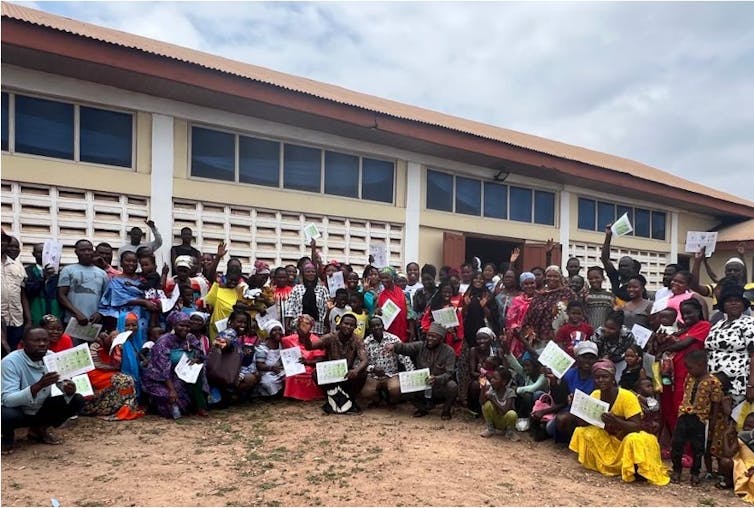
In southern coastal Ghana, we interviewed more than 80 mothers, fathers, extended family and community members in semi-rural communities to understand how young children were cared for and how parents cared for their own mental health
Parents and community members highlighted the role of social and religious gatherings in supporting parents to care for their young children. Through interactions with parents of older children and community leaders, parents described how learning about child development enabled them to be more effective in their parenting. For example, learning how important stimulation was for children’s development encouraged parents to spend more time reading and playing with their children
(Marilyn N. Ahun), Author provided (no reuse)
For mothers and fathers in rural Mozambique, their parents and health-care professionals (such as nurses and community health workers) were the primary
These parents also described the tangible ways in which their “village” supported them: children’s older siblings and uncles often played with and supervised them so parents could take care of other household tasks, while grandmothers and aunts accompanied mothers to child health-care visits and sometimes helped out with feeding and changing diapers
Parents also talked about other forms of support they received from their village, including financial assistance, emotional support and food, that enabled them to better provide for and care for their children
This type of indirect support from the village was also highlighted in Ghana, where parents discussed how the lack of opportunities to share their struggles, seek advice or receive practical help from friends and family made them feel alone
Parents’ and kids’ well-being: U.S
We know from decades of research that parents’ mental health is strongly linked to how they parent. This has important implications for both parental well-being and children’s development
In the United States, we looked at how people talk about the role of different village members in supporting children’s development
Building on an earlier study in which we asked 60 parents, teachers, health professionals and policymakers about the developmental skills needed by preschool children (aged three to five) to thrive, we looked at who participants identified as primarily responsible for promoting child development
We also considered how these respondents were promoting children’s developmental skills and the barriers they faced in doing so, as well as the helpful factors that made it easier to support children’s development
Parents were consistently identified as the ones primarily responsible for supporting child development. Yet, almost everyone we interviewed emphasized that this was a shared responsibility, with teachers, health professionals, policymakers and community members each playing distinct and complementary roles
For example, many highlighted that all adults in a child’s life (such as parents, grandparents, educators, church groups, coaches, neighbours) play an important role, since community members have different approaches that may work better with some children compared to others
Despite recognizing the importance of this communal approach, participants also acknowledged how challenging it can be to engage with or even identify the village
We are currently working on publishing these findings to contribute to ongoing societal and academic conversations about what it truly means for a village to raise a child
Leveraging, contributing to your village
So what do these findings mean for you? How can you leverage or contribute to the village to support the children and families in your life?
Before I make suggestions, I want to pause and acknowledge that finding and building community can be difficult. It requires time, intentionality and persistence
Even when all of these are present, our ability to meaningfully contribute to a village can be hampered by social and economic forces beyond our control that affect people’s sense of disconnection, like those highlighted at the beginning of the article
It’s therefore important to keep this in mind as we strive to do our part in creating safe, healthy and nurturing environments for the children in our lives to grow and develop
(Piqsels)
Practising asking for and offering help
One of the main barriers to ensuring the continuity of this village is that while many of us yearn to live in a village, we hesitate to ask for assistance or to provide it to others
To counter this, we each need to do our part in practising asking for and providing help to the families in our villages. For members of the village, this can look like setting up a meal train for a friend or co-worker who is expecting a child, volunteering at or donating to local organizations that support families, advocating for family-friendly policies and simply asking the parents in your life how you can help and support them
This last point is especially important for creating a culture in which parents feel more comfortable asking for help when needed
For example, as families prepare for the back-to-school season, contributing to your village could look like offering to tutor your neighbour’s child who is struggling in a class, donating old textbooks and stationery — or even funds — to a drive for families in need or volunteering at your local school
In these small but tangible ways, each of us can play an important role in sustaining the village that fosters children’s and families’ well-being
