


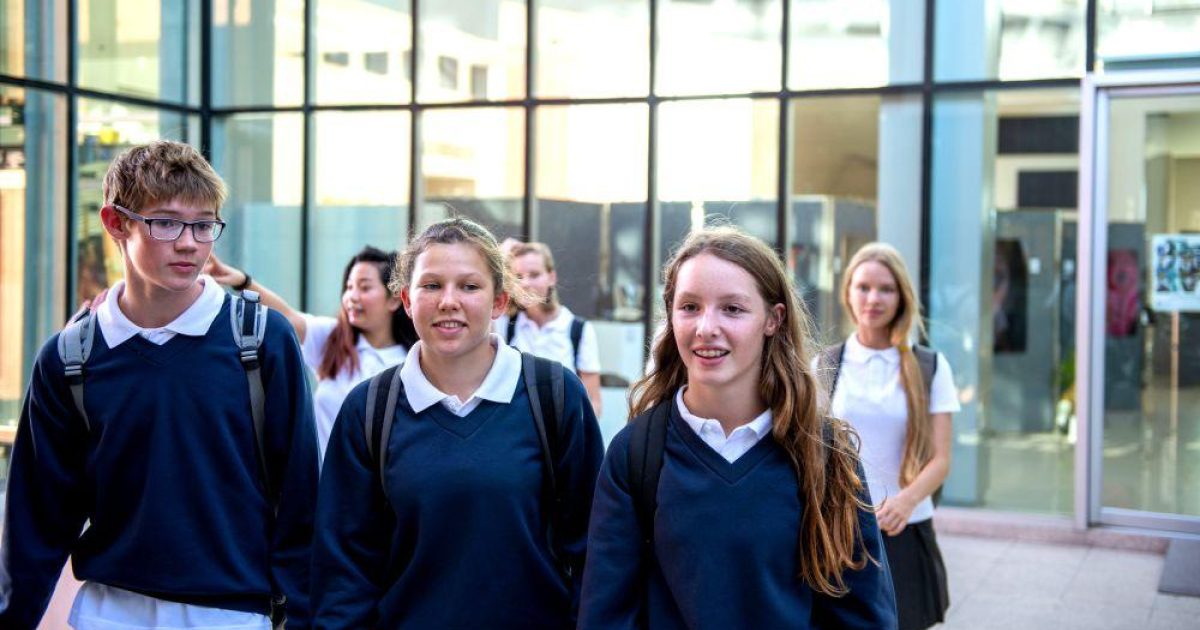
The Research Files Episode 110: Student wellbeing and secondary school transition
AudioJuly 16,20260
Hello and thanks for tuning in to this podcast from Teachermagazine, the re for Educational Research. I’m Jo Earp
Welcome everyone to Episode 110 of The Research Fileswhere we’ll be sharing findings from new research from Adelaide University in South Australia. I’m joined by 2 of the team today, lead researcher and PhD candidate Mason Zhou – so, it’s lovely to have an early career researcher on the podcast panel today – and co-researcher Professor Dot Dumuid. So, we know the transition point between primary and secondary school is an important one and it can have an impact on student wellbeing as well. As you’ll hear, their study tracked more than 20,000 students and it found a drop in wellbeing outcomes across each domain measured. Now, the particularly interesting thing about this one was there was actually a shift in South Australia where year 7 moved into high school from 2022, which was the time of the research, and so they were able to measure 2 cohorts simultaneously making that transition, and that meant they could take a closer look at what was happening in terms of the declines being age-related or not. As usual, with all our Research Files episodes, we’ll discuss the key takeaways from the study and implications for schools and educators. I hope you enjoy the episode!
Teacher Magazine (ACER) · Student wellbeing and secondary school transition
Jo Earp: Professor Dot Dumuid and Mason Zhou, welcome to The Research Files and thanks so much for sharing your experience and expertise with theTeachercommunity today. Now, before we talk about the study, it would be great to hear from both of you about your current roles there and your interest in this area of education research
Mason Zhou: Thank you for the invitation. My name is Mason. I’m now a PhD candidate at Adelaide University. My research focuses on changes in student wellbeing and behaviour during the primary to secondary school transition
Professor Dot Dumuid: And I’m Dot. Yeah, I’m a Professor at Adelaide University with an interest in how behaviour and wellbeing are connected. It’s been my pleasure to supervise Mason with his PhD, and we’ve also had some other supervisors, so Carol Maher and Sally Brinkman, and also supervisors from the education department involved in Mason’s work. And yeah, today we’ll be hearing more about what Mason’s been doing in his PhD and I’ll be listening and just supporting as I can
JE: Yeah, I mean, part ofTeacheris to help researchers disseminate the findings and it’s great to have early career researchers included in that as well. As I mentioned in the intro then, the transition – there’s lots of transitions in terms of school life, but the transition from primary to secondary school is really such an important time for students and we know that it does impact student wellbeing. I understand then that there is existing research in this area, but it’s somewhat limited. What were the aims of your study?
MZ: From the literature review, we found that there’s already some research showing that the move from primary to secondary school can be a very intensive period as you just mentioned for students. But most existing studies, they have only looked at like one or 2 time points, usually just before and just after the transition – which means the final year of the primary school and the first year of the secondary school – to see whether students were being declined or changed during this period. But what happened after the first year of the secondary school and what happened before the final year of the primary school? We know nothing about that. So that’s one key research gap. And another key research gap is that we know that wellbeing often tends to decline as students get older, right? Especially as they move into adolescence, but because the secondary school transition usually happens at the same time as they move into adolescence, it can be really difficult for us to know whether the wellbeing decline is simply because students are getting older or caused by the school transition itself. So that’s 2 key gaps.
DD: Yeah, thanks Mason, you summarised that really well. I think, I guess in summary, there were 2 main aims and the first was to track wellbeing of students over a long period of time. So, we’ve got 7 years – 3 of those are before the school transition and 4 are after. But also, as Mason said, we wanted to look at, is there anything other than just like wellbeing declining with age, that seems to happen, is there an additional drop at that transition?
JE: Yeah, we’re going to talk about the methods and the findings in some detail. But before we head into that then, as we’ve mentioned, there is existing research in this area. Can you paint a bit of a picture on what we already know about that particular transition period? What are some of the challenges for students during that time?
MZ: Yep. From the current literature, we know that the secondary school transition can have both positive and negative effects on students. And of course, most of the existing research focuses on challenges and negative impacts. So, we know that when students move from primary to secondary school, they are leaving their very familiar school environment, leaving their old friends, their close teachers, and entering a totally new environment and trying to build a new relationship with their peers and the teachers. And they also need to deal with some challenges, I think – like stricter teachers, more complex timetables, new rules, more homework and, sometimes for some students, higher expectations from teachers and their parents. So yeah, definitely, I think it’s a challenging period for students.
DD: Yeah, I think that’s it. In primary school, students seem to develop a good sense of belonging and connection and that does get disrupted when they make that transition and doesn’t necessarily transfer automatically to secondary school. So, it can just take some time to rebuild those social connections
JE: Yeah, it’s quite a different environment, isn’t it. When I think back to, you know, sort of my school days and primary and secondary and just the different environment, like you said, Mason, you know, you’re used to the one teacher thing and then you move to this whole new way of doing things and different subjects … and there’s a lot to get used to. For listeners who want to dive into this topic in more detail, including the research and related reading that we’ve just discussed there, head to the full paper for this one in theJournal of Child Psychology and Psychiatry. As usual, I’ll put a link to that in the transcript of this podcast at teachermagazine.com. If you search for it, the title of the paper is ‘Well-being decline during adolescence: school transition as a predominant driver beyond age progression’. And I think you mentioned Dot, that’s written with colleagues Carol Maher, Sally Brinkman and Juliette Coules. So, tell me about the study itself then – who was involved in this and what data did you draw on?
DD: Yeah, so you’re right, it is a combined effort with the Department for Education who actually collect these consensus data on wellbeing routinely. So, any teachers in South Australia are probably very well aware of the wellbeing and engagement collection. Yeah, it’s an annual survey that happens in, I think it’s in all government schools now and in some independent schools as well in South Australia. So, every year students have this opt-out consent where pretty much everyone’s expected, unless their parents don’t want them to or they don’t want to do it, to answer questions about their wellbeing. Last year there was more than 100,000 students from over 500 schools that were involved in that survey. Mason, you might want to talk a little bit more about the students that we included in this analysis.
MZ: Yep. So, for this study, we included over 20,000 students, who had repeated data – meaning that we could follow the same student over time; so, starting from year 4/year 5 in primary school, and tracking them through into secondary school to year 12. And so, as you can see, it’s a longitudinal design, so it can help us to have a look at the long-term picture of the trajectory of students’ wellbeing changes before and after the school transition, rather than just a snapshot
JE: Yeah. And that’s a huge data set, 20,000. So, you were analysing that data against 8 wellbeing domains?
MZ: Yeah. We look at 8 different wellbeing domains in total; so, 6 of them were about positive aspects of the wellbeing, and 2 of them were negative aspects of wellbeing. So maybe we can start with the positive ones. So, the first 3 – happiness, optimism and life satisfaction, which were really capturing how good children feel about their lives in a broad sense. And another 3 … I think it’s less about the feeling, but more about how children approach life. So, cognitive engagement is about whether students are willing to work hard, try different strategies, as they focus on their learning. Perseverance, about keeping going even when things get tough, and emotional regulation is about how well children match their emotions.
DD: Yeah, and we had some other questions too. So, the final 2 domains are asking children questions about sadness and worry. Whereas the first 6 are sort of framed in a positive way, the last 2 are framed in a negative way, looking at the negative aspects of wellbeing, which is really just as important to capture because if you’re only asking about the good stuff, you don’t really understand what might be difficult and hard for kids. So yeah, overall, there were 8 different items that we looked at in this [overall] sort of wellbeing, but also the different aspects of it.
JE: And so, all those 8 together, you’ve got that huge data set – as we mentioned, 20,000 students – that all comes up with some interesting findings indeed. So on to those, what would you say the key takeaways are from this then?
DD: I might start with this one. So yeah, I think that the key takeaway overall was that wellbeing – and overall wellbeing, if you consider them all together – it declined after that transition. And importantly, it’s not just a short-term dip just in that first year after the transition, but it took up to 2 years for the students to recover from that dip. And in terms of which of those wellbeing domains were the most impacted, we actually saw that it was in cognitive engagement and perseverance. So, the ones that have more to do with how children approach their learning and sort of stick with challenges that they face.
But, yeah, I think we might think it’s alarming, but really these are sort of average trends that we see across all the children in the data set, and there’s a lot of variation between individual children. So, it’s not that everybody experiences this decline. Some students, actually we see they thrive after the transition, and they really like the secondary school sort of environment. But then there are obviously others that really struggle and struggle a lot more than the average. Yeah, so we’re just looking at the average trends in this analysis.
MZ: I think it’s also very important to know that children’s wellbeing does tend to decline gradually with age anyway. And that’s something we see in the data more broadly. But what stands out here is that at the point of school transition, we see a much steeper drop than you would expect. I think it’s not about just a normal pattern, but it seems like, it seems to be something about transition itself – the transition itself that is driving additional decline. So, I think what this tell us overall is that the transition to high school or secondary school has a real and lasting impact on student wellbeing, first, and second it doesn’t seem to be something kids just bounce back from quickly.
JE: Yeah. Did that surprise the research team in terms of the effects persisting for more than 2 years post-transition? Because we’ve talked about none of the studies have really looked at that kind of further down the track. Did that surprise you?
MZ: Yeah, I think it did it surprise us to a certain extent because we expected to see some decline in the first year of secondary; previous research already found this thing that transition is a challenging period. And also, a lot of current transition programs also focus on the first year after the transition – such as, we have orientation days, school visits, are very common transition programs in South Australia, I think. But as I just mentioned, what stood out here was that the negative impacts continue to the second year. And for some groups, like students who live in remote and very remote areas, even longer. And this may suggest that even when students look like they have settled in during the first year, they may still be struggling as they move into the second year.
DD: I think you’re right, Mason. And it could just be that first year you’re getting used to the new environment, you know, finding their way around, learning the new routines. And that sort of takes that year. But then there’s deeper adjustments, like figuring out where they fit, who their people are, building their confidence in social and academic areas, getting more independent with things, and those sorts of adjustments just might take longer than that first year
JE: So, the message for teachers and leaders listening who are working in the years around these transition points is that, and I’ll quote direct from your paper ‘school transition is not a single event, but a prolonged adjustment process’. You’ve spoken about some of the reasons why that might be and what the possible factors are that play into that. And it’s the actual transition process rather than an age-related progression, I understand. As you say in the study, this was really a chance to ‘disentangle age effects from transition effects’.
DD: Yeah, you’re right, Jo. And if, listeners might remember if they were in South Australia in 2022, this was the year when there was a policy change in our education sector. We had 2 years starting high school at the same time. So, there were the year 8s who were like the usual existing cohort that started high school, but there were also the year 7s who would now be the new year that high school started. So, in 2022, we actually had 2 cohorts starting high school at the same time, year 8 and year 7. And it was just for that one year until from then on, it would be year 7. So that unique opportunity, I guess, gave us what we’d call a natural experiment – because we had those 2 different age groups. going through that transition at the same time, we could ask if they responded differently to that transition. And if they would respond differently, then we would think, ‘oh, maybe there’s developmental factors related to age’, things, you know, puberty, stage of puberty, that kind of thing that might be also driving that drop in wellbeing. But if they respond in the same way, then we would think it’s actually that transition that’s a key driver of the wellbeing drop. And we found the second.
So, both the younger and the older cohort had a very similar decline in wellbeing. And that just seems to indicate that there’s more than just developmental factors, but there’s something about that transition that’s behind the drop in wellbeing
JE: Wow, what a perfect little experiment point, as well. Brilliant that you were able to sort of land on that. Mason, you mentioned earlier, I think, about differences in terms of rural and remote. Did you find any differences in terms of gender as well? And also, on the location thing? How much in detail were you able to cover that? Is that something that would need some further exploration?
MZ: Yes, we did see some difference because our data allows us to examine difference by student steps. And we found that female students, they experience a more pronounced decline in wellbeing after the transition compared with the male student. And this may suggest that girls are more vulnerable during this period. And also, for the location, students living in remote and very remote areas, as I mentioned, they perform worse. But they showed a very interesting pattern, I think, because before the transition they report relatively higher wellbeing compared with students who live in the urban area. But during and after the transition, their wellbeing declined more substantially. And this decline lasts longer, continuing to the third year after the transition.
And I think these results may suggest that the transition experience may be strongly shaped by who you are, and also the environment, the local context, like the school size, community connection, culture, access to services etcetera. But at this stage, we don’t fully understand why students in remote areas appear to be more challenging, or they have a more challenging transition appearance. So, I think in the future, we need more localised and qualitative research to help us really understand what is driving these patterns.
JE: Okay, so all that sort of adds up to, and we’ve mentioned a lot of factors, and so there are people listening who are already starting to think, ‘okay, we could be looking at this, maybe we can tweak this a little bit to help these particular students…’. What are some of those implications then for practice that you’d be encouraging them to reflect on?
MZ: Yeah, I think for schools, I would summarise the implications in 2 ways. So first is, I think transition support shouldn’t stop after orientation or just a school visit, or just the first term. Our findings suggest that supports should be extended for at least the first 2 years after the transition. And that could mean planned check-ins in second year, continued wellbeing monitoring and intentional support for belonging and learning routines beyond the initial transition period. And the second one is because, as Dot mentioned, cognitive engagement and perseverance shows the biggest declines, so I think the transition support should include academic adjustment, not only the social adjustment. Students may need explicit teaching around secondary school learning strategies, like how to manage multiple subjects, planning assignments, asking for help, persisting with difficult work etcetera.
That’s all for this episode. If you enjoyed this one, please take a moment to follow our show on your podcast app, if you haven’t done that already, and leave us a review. Both of those things help more people like you to find our podcast and they’re a really big help to the team. We’ll be back with a new episode very soon
Teachermagazine is published by the Australian Council for Educational Research
Zhou, M., Maher, C., Brinkman, S., Cools, J., & Dumuid, D. (2026). Well‐being decline during adolescence: school transition as a predominant driver beyond age progression. Journal of Child Psychology and Psychiatry
In what ways do you monitor student wellbeing beyond the first term or first year of transition?
How do you identify students who may seem settled but are still experiencing challenges with wellbeing, engagement or confidence?
Do you and your colleagues explicitly teach organisational, study and help-seeking skills to help them settle in and succeed in secondary school?
