



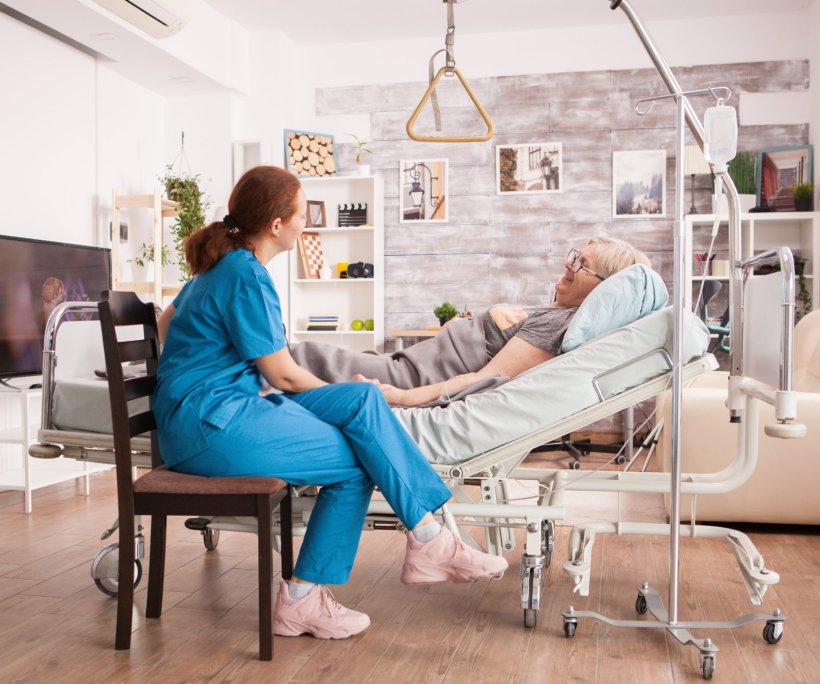
Opening the session, Joe Chou, Deputy Secretary General of TAITRA, and Dr Sang-Ju Yu, Honorary President of the Taiwan Society of Home Health Care, set the tone with a shared conviction: ‘The future of care cannot rely exclusively on hospitals,’ and that realising this future will require both innovative technology and a fundamental willingness to reimagine where – and how – care is delivered.
A 30-year growth story – and an unlikely booster
‘We can’t just keep building hospitals’, said Dr James Pollard, Clinical Director of Community Care at Cabrini Health and President of the Hospital-in-the-Home (HITH) Society of Australasia. In his view, the answer to the rising global demand for acute care does not lie in more bricks-and-mortar healthcare facilities, but in redefining what a hospital boundary means.
Over the past three decades, Australia’s HITH programme has been doing precisely that. Dr Pollard outlined the growth story of the programme since the 1990s, from its slow beginnings to its current state, which has accumulated more than one million admitted bed-days since 2020, while demonstrating reduced complications, high patient and carer satisfaction, and cost-effectiveness compared with traditional inpatient care. The Covid-19 pandemic, he said, served as a major inflection point, accelerating both capacity-driven adoption and a genuine shift in patient expectations: since the pandemic, Dr Pollard noted, patients are actively requesting at-home care rather than simply accepting it.
Despite these milestones, challenges remain – interoperability between systems, workforce scalability, sustainable funding models, and equitable access across geographies – but Dr Pollard’s overarching prediction was clear: the hospital of the future will function as a hub rather than a centre, with AI technology enabling earlier identification of patients suitable for home-based treatment. Hospital at Home, he concluded, will move from supplementary service to critical infrastructure.
Recommended article

Article • Medical Taiwan 2026
Charting the road to tomorrow’s healthcare
How can innovative technology help solve the most urgent needs in medicine? At the Medical Taiwan 2026 health and care expo in Taipei, leading manufacturers, international experts and decision-makers offered a promising glimpse into the healthcare systems of tomorrow – technology-driven, AI-enhanced and highly efficient, but also personalised and deeply humane at its core
Community care in a super-aging society
Why this shift towards home-based care is urgently needed, was illustrated by Dr Kazunari Ogura, Director of Hachinohe Family Clinic in Aomori Prefecture. He addressed the situation in Japan – currently the world’s oldest society, with 29.3% of its population aged 65 or over, a proportion projected to reach 36.3% by 2045.1 This already concerning trend is further exacerbated by a looming workforce gap: current models predict that an estimated 10.7 million medical and care workers will be needed by 2040, yet only around 9.74 million are expected to be available.2
To mitigate these developments, Dr Ogura advocated for community-centred integrated care models. By linking hospitals, nursing and long-term care providers, pharmacies, and dental practices through shared systems, these structures help older people and their families remain in their communities throughout their lives, even when facing physical, mental, social, or economic challenges.
Advances in technology play a central role in enabling this vision, the expert argued. To illustrate this point, Dr Ogura highlighted an AI-integrated bed-sensor system for monitoring of vital signs and body movements. Digital tools of this kind, he said, can extend clinical oversight into the home, supporting both patients and the overstretched workforce that cares for them.
This is not Sim City – we are dealing with real patients with very real diseases and conditions
Ron Sabar
The model delivers fewer complications than traditional hospitalisation, better patient and caregiver experience, and lower post-acute health service utilisation, including reduced emergency department attendance, hospital readmissions, and nursing facility admissions. While Dr Leff acknowledged that health systems are “hard-wired” to current, hospital-centric models and slow to change, he insisted that change is possible – and necessary. He echoed the session’s broader consensus: continuing to build more hospitals is neither financially feasible nor the right direction of travel.
Transformative potential, proven benefits
Dr Bruce Leff, Professor of Medicine at Johns Hopkins University School of Medicine and Director of the Center for Transformative Geriatric Research, offered a research perspective on Hospital at Home (HaH) that underscored both its evidence base and its transformative potential. Home-based primary care, he noted, has been shown to reduce emergency visits, hospitalisations, hospital days, and overall costs3 – and the evidence for acute home-based care is now substantial, with approximately 80 randomised controlled trials, multiple systematic reviews, and meta-analyses supporting its safety and quality. ‘If this were a drug,’ Dr Leff remarked, ‘it would be a blockbuster.’
While the term “virtual care” might lead people to underestimate home-based models, Dr Ron Sabar, founder and CMO of Sabar Health – Israel’s largest private home-hospital provider – put it bluntly: ‘This is not Sim City – we are dealing with real patients with very real diseases and conditions.’ To illustrate how far this approach has come, the expert pointed towards key figures: Sabar Health currently operates the equivalent of 3,000 beds, easily surpassing the 1,800 at Sheba Medical Centre, Israel’s largest hospital. ‘This is not the future,’ he emphasised. ‘It is here today.’
Technological advances, Dr Sabar noted, have made this scale achievable: portable ultrasound monitoring, self-testing kits, and AI-powered large language models for clinical report generation have all lowered the barriers to delivering hospital-level care in the home. Digital tools also address staff wellbeing, with equipment management systems and route optimisation helping to prevent workforce burnout. This potential, however, does not come without risks, he stressed: security and safety standards must be exceptionally high, as any failure in a home-based setting could have ‘catastrophic’ consequences.
Looking ahead, the expert outlined the conditions under which remote patient monitoring will fulfil its potential – when the home environment itself becomes a sensing platform, when social determinants of health are integrated into clinical data, and when predictive capability matures. Crucially, he argued that technologies should be validated in the home clinical setting first; only then, if proven reliable, should they be adopted into hospital practice – inverting the conventional direction of innovation.
Four perspectives, one direction
Across four countries and their distinct healthcare contexts, the session’s speakers converged on a set of common convictions: that the traditional hospital-centred model is under unsustainable pressure; that home-based acute care have left behind their experimental early days for proven benefits; and that the barriers to wider adoption – funding structures, interoperability, workforce capacity, and public and professional acceptance – are surmountable. Whether through three decades of Australian programme-building, Japanese community integration, American research rigour, or Israeli operational scale, the message from Medical Taiwan 2026 was consistent: the hospital is not disappearing, but its walls are dissolving. The home is becoming the new ward, and the systems that adapt earliest will be best placed to meet the demands of an ageing world.
Profiles:
Dr James Pollard serves as the Clinical Director of Community Care at Cabrini Health in Australia and chairs its Infection Prevention and Control Committee. He is an infectious diseases specialist deeply involved in the “Hospital-in-the-Home” (HITH) model, which delivers hospital-level care in patients’ homes. As President of the HITH Society of Australasia, Dr. Pollard has shared more than 30 years of experience in setting up and scaling home-based acute care services.
Kazunari Ogura, MD, is the Director of the ‘Hachinohe Family Clinic’ in Hachinohe City, Aomori Prefecture, Japan, and serves as a director or board member of several medical and long-term care organisations. He specialises in family medicine, dedicating himself to community-centred integrated care. In 2015, he founded Connect 8, a multi-disciplinary collaboration platform that brings together practitioners from various fields – including clinics, nursing care, long-term care, pharmacies and dental practices – and utilises ICT systems to share information, thereby establishing a model for community-based care for older people.
Bruce A. Leff, MD, is Professor of Medicine at Johns Hopkins University School of Medicine and the Director of the Center for Transformative Geriatric Research. He also holds joint appointments in the Department of Health Policy and Management at the Bloomberg School of Public Health and in Community & Public Health at the Johns Hopkins School of Nursing. Dr Leff is a pioneer of home-based acute care, especially through the Hospital at Home model: delivering hospital-level treatments in patients’ own homes to reduce the risks associated with traditional hospitalization. His research also covers multi-morbidity, risk prediction, quality measurement, and novel care delivery systems for older adults, including home-based primary care and other community-driven models.
Ron Sabar, MD, is a physician as well as founder and Chief Medical Officer of Sabar Health, Israel’s largest private home-hospital provider, with multidisciplinary teams that include doctors, nurses, social workers and therapists. He emphasizes dignity, compassion, and continuity, believing quality care is best delivered in familiar environments.
16.07.2026
More on the subject:
