


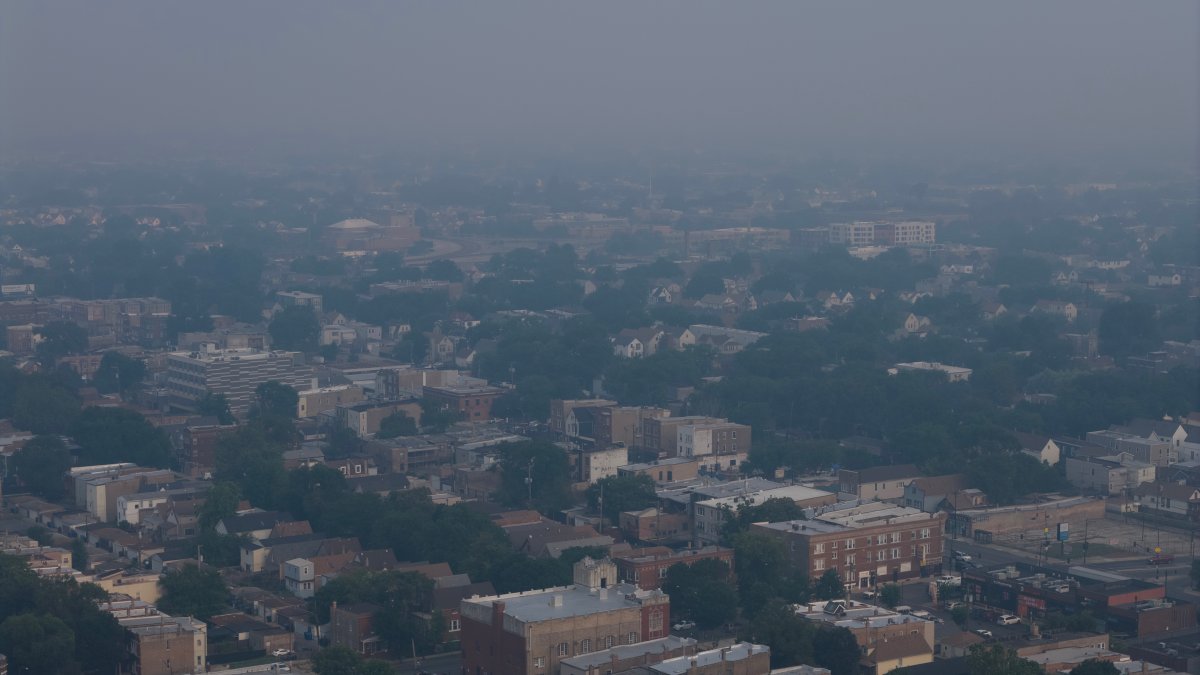

The thick, reddish brown smoke from Canadian wildfires could be seen across the Chicago area.
Air quality levels in parts of the Chicago area Thursday were off the charts as they stretched to levels NBC 5 meteorologists said haven’t been seen in years
The website used for tracking air quality, AirNow.gov, could be seen maxed out as they described Chicago-area air quality as “hazardous,” but the numbers are actually even higher than the meter appears to go
Stream NBC 5 for free, 24/7, wherever you are
WATCH HERE
As of 2 p.m., some of the worst levels recorded were on the North Shore, with areas like Northbrook hitting above 770. Highland Park, Lake Forest, Waukegan, all also reported levels above 600 and 700
Chicago sat at just under 600
According to the agency, AQI values of 301 or higher fall under the “maroon” category, which signals a “health warning of emergency conditions: everyone is more likely to be affected.”
“The higher the AQI value, the greater the level of air pollution and the greater the health concern,” AirNow.gov reported
| Daily AQI Color | Levels of Concern | Values of Index | Description of Air Quality |
|---|---|---|---|
| Green | Good | 0 to 50 | Air quality is satisfactory, and air pollution poses little or no risk. |
| Yellow | Moderate | 51 to 100 | Air quality is acceptable. However, there may be a risk for some people, particularly those who are unusually sensitive to air pollution. |
| Orange | Unhealthy for Sensitive Groups | 101 to 150 | Members of sensitive groups may experience health effects. The general public is less likely to be affected. |
| Red | Unhealthy | 151 to 200 | Some members of the general public may experience health effects; members of sensitive groups may experience more serious health effects. |
| Purple | Very Unhealthy | 201 to 300 | Health alert: The risk of health effects is increased for everyone. |
| Maroon | Hazardous | 301 and higher | Health warning of emergency conditions: everyone is more likely to be affected. |
“I’ve been here for 15 years and I’ve never seen parts of our viewing area in that hazardous category,” NBC 5 Storm Team Meteorologist Alicia Roman said. “My maps don’t even have the hazardous explanation on it, because we’ve only gotten into that ‘very unhealthy,’ purple category.”
Cities across the Great Lakes states registered air quality ranging from unhealthy to hazardous — which means it’s unhealthy for anyone, regardless of health conditions. Microscopic particles can lodge deep in the lungs and enter the bloodstream, leading to heart and lung problems and contributing to other long-term health issues.
A study published this year found that long-term exposure to tiny particles from wildfire smoke contributed to an average of 24,100 deaths a year in the lower 48 states. Long-term exposure can make existing health problems worse and lead to a range of chronic and deadly health issues, including respiratory illness, cardiovascular and neurological diseases, and premature death
In fact, the Chicago-area levels are some of the highest in the world, according toIQ Air
As of 4 p.m., the group reported Chicago’s air was the worst of any major city in the world, followed by Detroit and Minneapolis
The conditions come as a lingering high pressure system trapped smoke from dozens of fires in Canada and northern Minnesota, said Steven Freitag, a National Weather Service meteorologist in Pontiac, Michigan
The smokeforced many outdoor camps and events across the Chicago area to shift indoors. Pools and beaches in both the city and suburbs were closed due to the poor air quality levels
An air quality alert remains in effect through at least Friday night
“As we head into the evening hours [Thursday] we may continue to watch this heavy plume continuing all the way into early Friday morning before we start to see the conditions improving by Friday evening,” Roman said
Still, the NWS noted “there is some uncertainty in how far south the smoke progresses and the duration of the poor air quality.”
NWS meteorologist Jake Petr told the Associated Press that even if winds from the northwest clear skies as expected later this week, the smoky air could keep returning until the fires are out. That could take weeks or longer
Here is a live look outside now:
You can check the air quality near you here
What is PM2.5?
According to the Environmental Protection Agency, “PM stands for particulate matter (also called particle pollution): the term for a mixture of solid particles and liquid droplets found in the air.”
“Some particles, such as dust, dirt, soot, or smoke, are large or dark enough to be seen with the naked eye. Others are so small they can only be detected using an electron microscope,” the EPA states
PM2.5 in particular involves “fine inhalable particles, with diameters that are generally 2.5 micrometers and smaller.” By comparison, the average human hair strand is about 70 micrometers in diameter, or 30 times larger than these particles
PM2.5 is one of five major air pollutants regulated by the Clean Air Act, which also includes ground-level ozone, carbon monoxide, sulfur dioxide and nitrogen dioxide
What should you and shouldn’t you do?
AirNow recommends the following when level are at the “very unhealthy” category:
“When the forecast is Purple (very unhealthy), everyone needs to cut back on outdoor activities,” the agency reported
People with heart or lung disease, older adults, children and teens:
- Avoid physical activities outdoors.
Everyone else:
- Avoid strenuous outdoor activities.
- Keep outdoor activities short.
- Consider moving physical activities indoors or rescheduling them.
Air Quality10 hours ago
‘It smells like smoke:’ Video shows wall of wildfire smoke across Chicago, suburbs
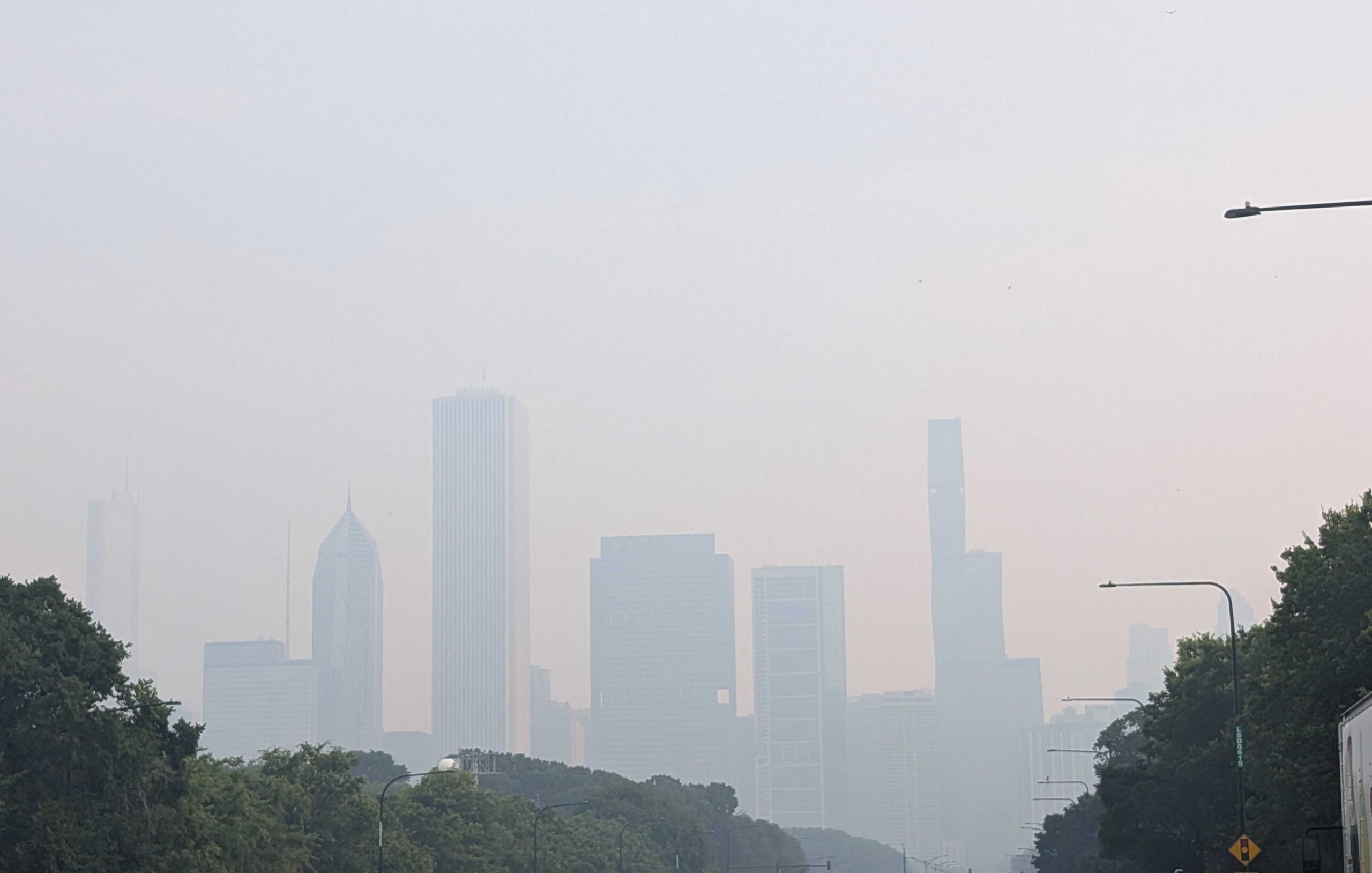
Air Quality11 hours ago
Smoke from wildfires blankets Chicago area, with skyline disappearing under hazy skies
The Associated Press contributed to this report.
