


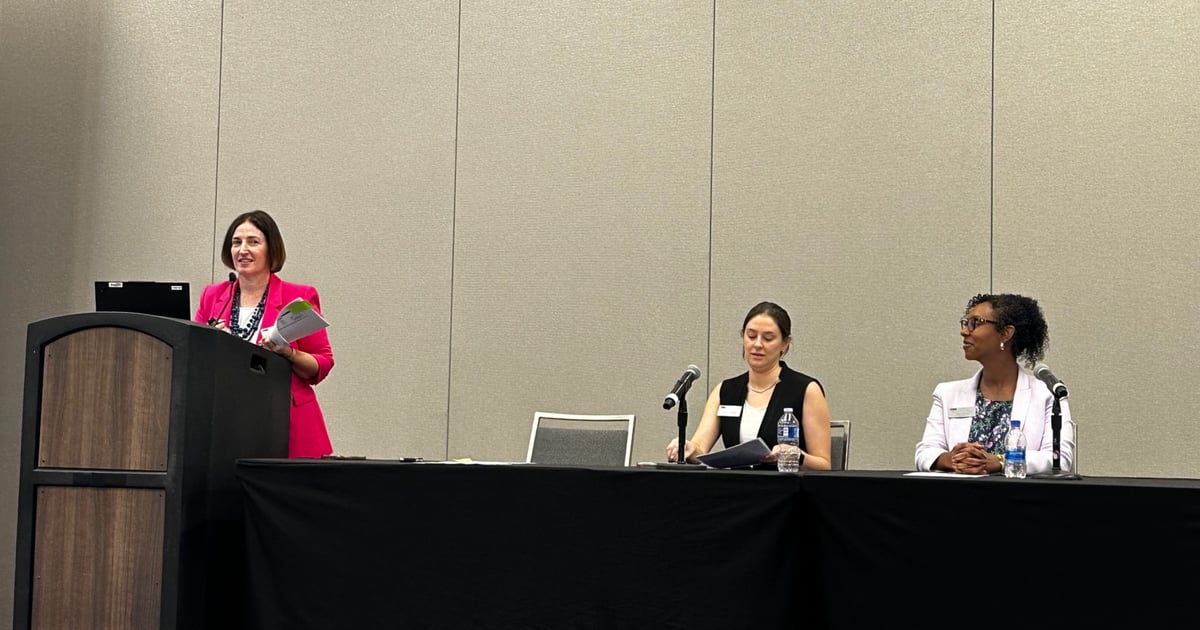
SNA leaders spoke about the upcoming proposed changes to the School Nutrition Standards during ANC 2026. Photo: Benita Gingerella
As the summer starts to wind down and back to school season is around the corner, the U.S Department of Agriculture (USDA) is getting ready to release its proposed rule to make changes to its School Nutrition Standards to reflect the latest Dietary Guidelines for American’s which were released earlier this year
Talk of the upcoming rule was on the minds of many attendees at the School Nutrition Association’s (SNA) Annual National Conference (ANC) which took place last week in Charlotte, North Carolina
During the conference, SNA leaders led a session breaking down the USDA’s rulemaking process, when we can expect to see a proposed rule published, and what could be in it
Unpacking the USDA’s rulemaking process
As part of its formal rulemaking process, prior to the release of a final rule, the USDA will first release a proposed rule where the public can provide comments on the proposed changes typically for a period of 60 days
Under the Administrative Procedure Act (APA), the USDA must take into account the comments it receives as it is coming up with its final rule
“It’s not just asking you to write a comment and have feel like it’s going to be ignored. If you take the time to customize your comment and submit it, the federal agency, in this case USDA, is required to take it into account, and that final rule is supposed to reflect the majority of comments,” said SNA VP of Government Affairs and Media Relations Elizabeth Campbell during the session
Once the comment period is over, the USDA issues its Final Rule which is binding
“The proposed rule stage is the only point where stakeholders and operators can directly influence what the final requirements look like,” said SNA’s State Policy Analyst Emily Kranias. “So, if we don’t engage at this stage, USDA moves forward without our operational realities being reflected in that final rule.”
What could be in the proposed rule
While the USDA has not shared what they are considering for the proposed rule, the SNA is able to make some predictions based on what was called out in the latest DGA’s
They are pretty confident, for example, that the proposed rule will address added sugar substitutes and that there will be another reduction in the amount of added sugars permitted in school meals
There has also been some talk surrounding requiring grains to be 100% whole grain. In terms of highly processed foods, the SNA thinks that there will be restrictions on certain food dyes and additives since the federal government has not come up with a definition for ultra-processed foods
“Because there is not a definition of highly processed food or ultra processed foods yet. Our understanding is that they are going to talk about ingredients and food dyes as a proxy to address and sugar to as a proxy to address highly processed foods,” said Campbell
Finding a way forward
The upcoming release proposed rule couldn’t come at a more financially dire time for school nutrition operators
In the SNA’sSY 2025-26 School Nutrition Trends Report, which included responses from 1,240 school meal program directors across the nation, nearly all respondents reported challenges related to costs
Ninety-nine percent of respondents cited the need for more funding for their programs with 98% reporting challenges with the cost of food, 95% reporting challenges with the cost of labor and 95% also reporting challenges with the cost of equipment. In addition, over half of respondents shared that they have “serious concern” about the financial sustainability of their program in three years
“Let’s think about the operational realities we’re facing,” said Kranias. “We know that 30 million students eat a school meal daily,” said Campbell. “We know that operators get $4.70 in federal reimbursement per meal, and that has to cover labor, equipment, all other costs related, in addition to the food.”
In addition, school nutrition operators are also still implementing the most recent updates to the School Nutrition Standards which were announced only two years ago
“School meal programs are already balancing a lot of moving pieces, including meeting current updated nutrition standards, so they also have to think about student participation, staffing, and equipment, and we know the list goes on,” says Campbell, adding that while the SNA is firmly in support of wanting to do what’s best for kids, they need financial support from Congress
“Help us figure out how we invest in the program and make sure that we’re basing things on good sound science,” she said
Making matters more complicated is the timing of the proposed rule. It was initially expected to be published in the spring, but the SNA now thinks it may be published around the start of the new school year — the busiest time for school nutrition operators
The SNA has already put in a request to Congress asking for the typical comment period of 60 days to be extended to 120 days to give school nutrition operators enough time to share their feedback once the proposed rule is published
Over the next several weeks, the SNA will keep reminding its members to be on the lookout for the release of the proposed rule and to take the time to submit a comment once it’s published
“I think sometimes we are tired, we are working really hard, and our voices are starting to get a little bit more quiet, and we need to be reminded that our voices, that the school nutrition professional voices, are important and they matter,” said Campbell
Legislation and Regulation
