


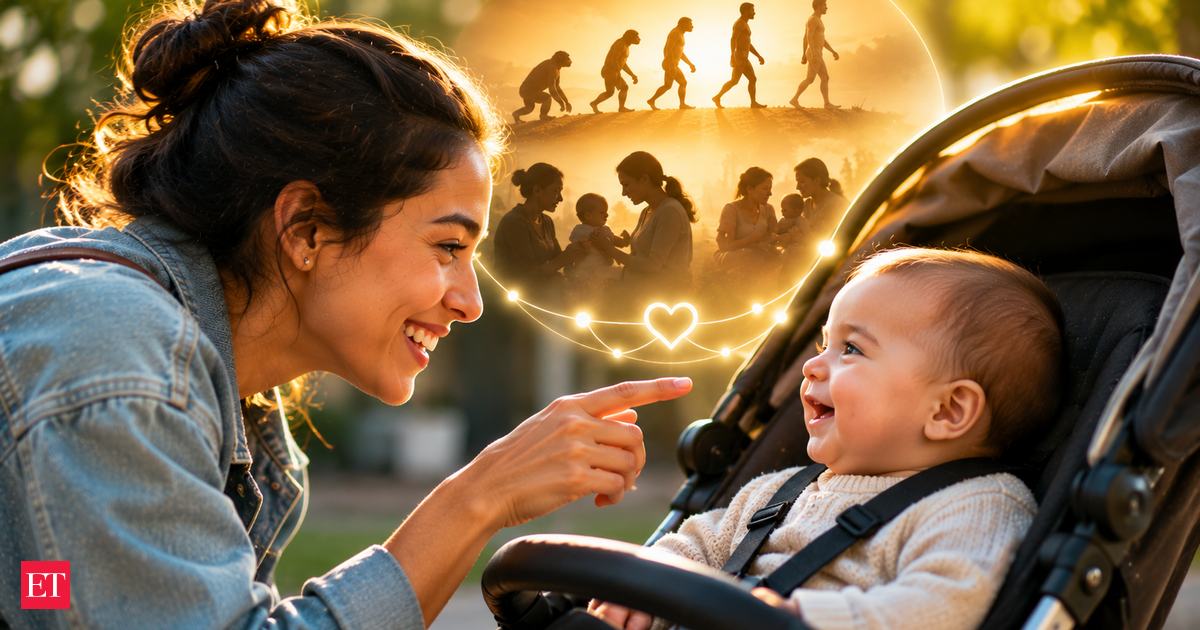
Imagine you’re standing in a grocery store when a baby looks at you, smiles, or waves. Many people instinctively smile back, make a funny face, or say hello, even though they’ve never met the child before.Psychology says this reaction is surprisingly common. It doesn’t necessarily mean someone wants children or has a naturally outgoing personality. Instead, research suggests that babies possess physical and behavioral traits that automatically capture human attention and activate emotional responses linked to caregiving, empathy, and social connection.Scientists believe these responses evolved over thousands of years because caring for infants was essential for human survival. Today, those same instincts continue to shape everyday interactions, even with babies who are complete strangers.
Babies’ faces naturally activate caregiving instincts
One of the best-known explanations comes from Konrad Lorenz’s Baby Schema (Kindchenschema) Theory. Lorenz proposed that babies share physical features that humans naturally find appealing, including:
- Large eyes
- Round cheeks
- Small noses
- Soft facial features
- Large foreheads
These characteristics automatically attract attention and encourage nurturing behavior. For example, someone walking through a park may instinctively smile at a baby in a stroller without consciously deciding to do so.You Might Also Like:

Psychology says your brain craves gossip for a surprising reason and it may have helped you to survive
Researchers have found that these infant-like features activate brain regions involved in attention and caregiving across many cultures.
Smiles are contagious
Another explanation comes from research on Emotional Contagion. Psychologists have found that people often unconsciously mimic the emotions and facial expressions of those around them.Babies frequently smile spontaneously during positive interactions. When an infant smiles at a stranger, that expression often triggers an automatic smile in return.For example, someone having a stressful day may unexpectedly smile after making eye contact with a laughing baby on a train. This emotional exchange can briefly improve both people’s moods.You Might Also Like:

Psychology says people who hate phone calls but reply instantly to texts may not be experiencing social anxiety
Empathy encourages warm social responses
People with higher levels of emotional empathy often respond quickly to emotional cues from others. A baby’s smile, laugh, or curious facial expression may naturally evoke feelings of warmth and kindness.For example, seeing a baby giggle while playing with a toy can prompt nearby adults to smile, even if they are not directly involved. Psychologists believe empathy helps people connect with others, including those they have never met.
Helping behaviors strengthen communities
According to research on Prosocial Behavior, humans are naturally motivated to engage in small acts that strengthen social relationships.Smiling at a stranger’s baby is a simple example of this. Although it lasts only a few seconds, the interaction often creates a brief positive connection between families and strangers. In many communities, these small moments help reinforce trust and friendliness in public spaces.
Babies capture our attention
Researchers have found that babies naturally attract human attention more effectively than many other visual stimuli. One reason is that infant faces signal vulnerability and dependence. For example, a crowded airport may contain hundreds of adults, yet many people immediately notice a smiling toddler walking through the terminal. The brain is especially sensitive to cues associated with caregiving.
Positive emotions broaden thinking
Psychologist Barbara Fredrickson’s Broaden-and-Build Theory suggests that positive emotions expand attention, creativity, and social connection.A brief interaction with a smiling baby may trigger feelings of joy or amusement that improve a person’s mood for several minutes afterward.Imagine someone leaving a stressful doctor’s appointment and encountering a baby who happily waves from a stroller. That simple interaction may temporarily interrupt negative emotions and create a more positive emotional state.
Smiling doesn’t always mean the same thing
Psychologists also emphasize that not everyone responds to babies in identical ways. Some people smile because they enjoy children.Others simply appreciate positive social moments. Some individuals, including those who are shy, socially anxious, or culturally reserved, may admire babies without expressing it outwardly. A person’s reaction depends on personality, culture, life experiences, and the specific situation.
Why do people automatically smile at babies?
Psychologists believe babies’ facial features and expressions activate caregiving instincts, empathy, and positive emotional responses that evolved to support infant care.
Does smiling at strangers’ babies mean someone wants children?
No. Many people smile because babies naturally trigger positive emotions, regardless of whether they want to become parents.Add 
as a Reliable and Trusted News Source

Add Now!
(You can now subscribe to our Economic Times WhatsApp channel)
Read More News on
why people smile at babiespsychology saysbaby psychologykindchenschemababy schemaempathy psychologyprosocial behavioremotional contagioncaregiving instinctevolutionary psychology.
(Catch all the US News, UK News, Canada News, International Breaking News Events, and Latest News Updates on The Economic Times.)
Download The Economic Times News App to get Daily International News Updates
…moreless
(You can now subscribe to our Economic Times WhatsApp channel)
Read More News on
why people smile at babiespsychology saysbaby psychologykindchenschemababy schemaempathy psychologyprosocial behavioremotional contagioncaregiving instinctevolutionary psychology.
(Catch all the US News, UK News, Canada News, International Breaking News Events, and Latest News Updates on The Economic Times.)
Download The Economic Times News App to get Daily International News Updates
…moreless
