



By Reema Dbouk, MD
Fact checked byMindy Valcarcel, MS
Learn more
Column
Obesity Medicine Association
Understanding the psychological impact of weight stigma on patients with obesity
July 20, 2026
4 min read
Columnby medical expert
By Reema Dbouk, MD
Fact checked byMindy Valcarcel, MS
Add topic to email alerts
Receive an email when new articles are posted on
Please provide your email address to receive an email when new articles are posted on .
Added to email alerts
You’ve successfully added to your alerts. You will receive an email when new content is published.Click Here to Manage Email Alerts
You’ve successfully added to your alerts. You will receive an email when new content is published.Click Here to Manage Email Alerts
We were unable to process your request. Please try again later. If you continue to have this issue please contact customerservice@slackinc.com.
‘);
notification.css({
‘position’: ‘fixed’,
‘top’: ’20px’,
‘right’: ’20px’,
‘background’: ‘#373D3F’,
‘color’: ‘white’,
‘padding’: ’10px 15px’,
‘border-radius’: ‘5px’,
‘z-index’: ‘9999’,
‘font-size’: ’14px’,
‘box-shadow’: ‘0 2px 8px rgba(0,0,0,0.2)’
});
$(‘body’).append(notification);
// Fade out and remove after 3 seconds
setTimeout(function () {
notification.fadeOut(300, function () {
notification.remove();
});
}, 3000);
}
//# sourceURL=social.js
Key takeaways:
- Research has shown that clinicians are a common source of weight stigma.
- Clinics should have weight-inclusive medical equipment like extra-large BP cuffs and gowns, bariatric chairs and accessible exam tables.
Weight bias and stigma have been increasingly recognized as a major barrier to effective obesity care and the mental well-being of patients
Patients with obesity often encounter judgement, negative assumptions and weight-based discrimination across many settings, including health care. Understanding the psychological and physical effects of weight bias and stigma, and how to reduce it in clinical practice, is crucial to delivering compassionate, comprehensive obesity care
Weight stigma is defined as social rejection and prejudice directed at those with excess weight. Weight bias is negative beliefs and stereotypes based on a person’s weight, and weight discrimination is unfair treatment due to one’s weight. In a nutshell, weight bias is a negative perception of someone due to their weight while weight stigma and discrimination are the societal labeling and inequity that occur because of those attitudes. Another important concept is internalized weight bias, which occurs when patients start to believe these negative stereotypes about themselves. In research studies, weight stigma is often gauged by a validated weight stigma inventory.
Although many assume that stigma occurs in public settings and in the media, they’d be surprised to learn that the more commonas demonstrated in an older study by Rebecca M. Puhl, PhD, published in Obesity in 2006
More recently, social media influence is becoming more prominent and has played a role in perpetuating stigma both against those with obesity but also against those who seek treatment for their obesity with medications. Social media exposure can contribute to social isolation, peer competition and body dysmorphia. However, it can also have a positive impact by promoting body positivity and providing a community of support. Over time, stigmatizing experiences can lead to fear of judgement, shame and blame as well as internalization of weight bias.
Current evidence demonstrates that weight stigma is a psychosocial stressor that increases the risk for mental health conditions such as depression, anxiety and eating disorders. Internalized weight bias amplifies this risk
A 2023 study published in American Journal of Preventive Medicine found that weight stigma among college students was associated with a higher risk for binge eating, purging and significant symptoms of anxiety and depression. In the study, interpersonal weight stigma was reported by 12% of students. These findings reinforce the importance of recognizing weight stigma not simply as a social issue, but as a clinically relevant factor that can meaningfully impact psychological health and treatment outcomes.
In addition to the mental health consequences, weight stigma can negatively influence health behaviors in several important ways. Research shows that those experiencing weight stigma are prone to maladaptive behaviors, including emotional and binge eating, avoidance of medical visits (likely due to fear of judgement) and poor engagement in exercise routines. For clinicians, these responses are important to recognize as adaptive reactions to stigmatizing experiences rather than evidence of noncompliance or lack of motivation.
Weight stigma can also be considered aisol, which in turn can have negative cardiometabolic effects on health and make weight reduction more difficult
As clinicians, it is important to recognize that we all possess implicit biases, which are unconscious attitudes or beliefs that can impact our behavior. These biases are influenced by our social and cultural exposures. For example, one may unconsciously perceive those with excess weight as lazy or unmotivated. Implicit biases may impact our actions (such as communication skills and treatment approaches), particularly in rushed clinical settings, and result in stigmatizing experiences for patients. Even subtle interactions can negatively affect patient trust, engagement and willingness to seek care.
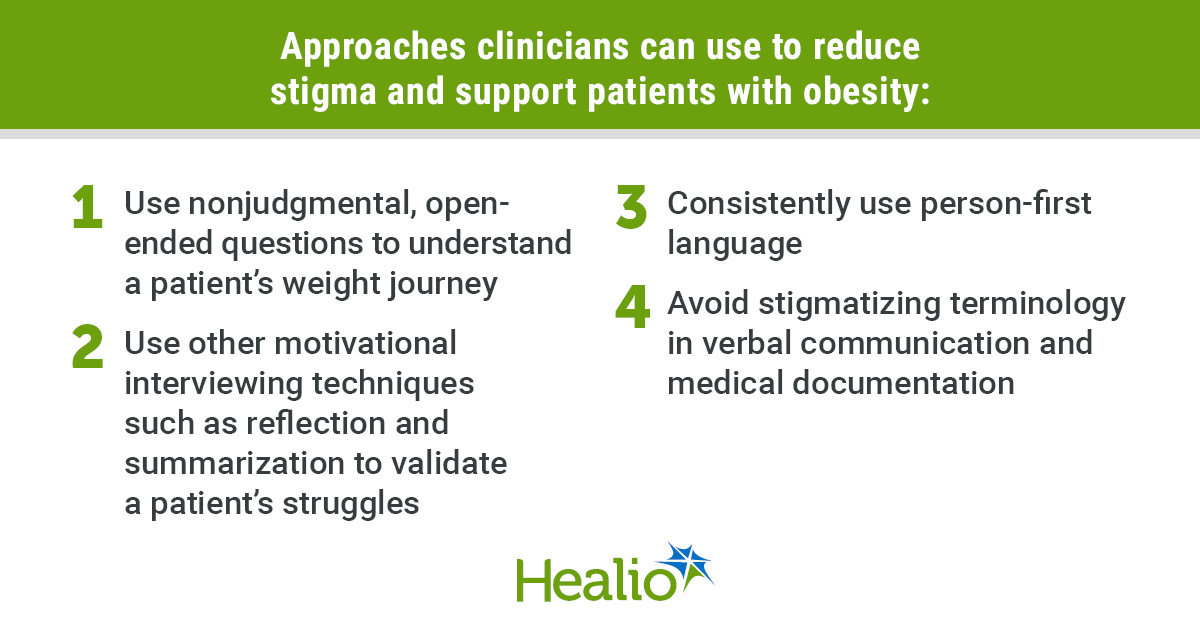
Clinicians can use several weight-inclusive approaches to reduce stigma and support patients. Use of nonjudgmental, open-ended questions to understand a patient’s weight journey can be quite effective. Other motivational interviewing techniques such as reflection and summarization can also be useful to validate a patient’s struggles with excess weight. Consistent use of person-first language is also critical. Clinicians should avoid stigmatizing terminology in both verbal communication and medical documentation.
Addressing weight stigma requires both individual and system-level changes. Structured training on implicit bias and weight-inclusive care should be standard for health care professionals. Health care settings should also prioritize obtaining appropriate equipment to care for those with obesity, including extra-large BP cuffs, bariatric chairs, oversized gowns, accessible exam tables and bathroom grab bars. In addition, patient weighing should occur in private areas rather than in the hallways or other open spaces.
Clinicians interested in addressing their own implicit biases may benefit from taking the Implicit Association Test available through Project Implicit. Increased awareness of unconscious assumptions can help providers deliver more empathetic and effective care
Ultimately, reducing weight stigma in health care requires intentional communication, supportive clinical environments and recognition of obesity as a complex chronic disease rather than a reflection of personal failure
For more information:
To learn more about the clinical impact of weight stigma, consider watching the Obesity Medicine Association (OMA) webinar by Puhl, “Weight stigma: Harmful health consequences and implication for patient care.”
To learn more about combating weight stigma in clinical settings, check out the OMA blog, “Social stigma of obesity: How to manage in a clinical setting.”
Reema Dbouk, MD,is board-certified in internal medicine and a diplomate of the American Board of Obesity Medicine.She practices as a primary care physician at Emory University School of Medicine in Atlanta, Georgia. She can be reached at rhamid2@emory.edu
Continue Reading
