


Children’s Targeted Immune-Support Nutrition Ingredients Market : Global Industry Analysis and Opportunity Assessment, 2036
Children’s Targeted Immune-Support Nutrition Ingredients Market : Global Industry Analysis and Opportunity Assessment, 2036
Buy Now
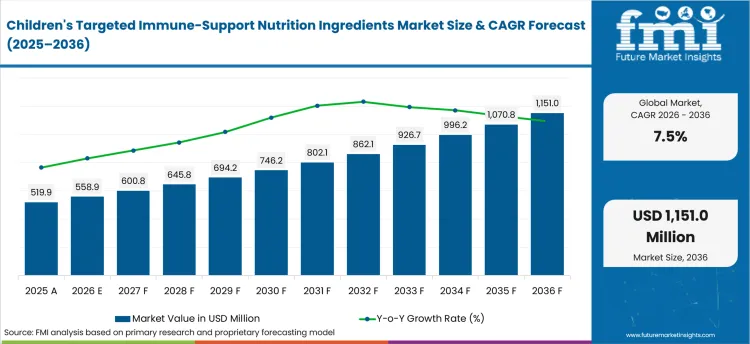
Children’s targeted immune-support nutrition ingredients market is segmented by Ingredient Type, Format, Age Band, Sales Channel, End User, and Region. Forecast period 2026 to 2036
- Market Size (2026):USD 558.9 Mn
- Forecast (2036):USD 1,151 Mn
- CAGR (2026 to 2036):7.5%
| Metric | Value |
|---|---|
| 2025 Market Size | USD 519.9 million |
| 2026 Market Size | USD 558.9 million |
| 2036 Market Size | USD 1,151 million |
| Forecast CAGR (2026-2036) | 7.5% |
| Leading Ingredient Type | Beta-Glucan |
| Beta-Glucan Share (2026) | 34.6% |
| Leading Format | Gummies |
| Gummies Share (2026) | 41.5% |
| Leading Age Band | 4 to 12 Years |
| 4 to 12 Years Share (2026) | 46.3% |
Page last updated on:July 21, 2026
Reviewed By Nandini Roy Choudhury
Methodology
How big is the Children’s Targeted Immune-Support Nutrition Ingredients Market in 2026?
USD 558.9 million in 2026 and USD 1,151 million by 2036 at a 7.5% CAGR
Demand in the children’s targeted immune-support nutrition ingredients market is anticipated to push valuation from USD 558.9 million in 2026 to USD 1,151 million by 2036, expanding at a 7.5% CAGR over the forecast period. Supplement brands are expected to need child-sized servings and clear age guidance because parents compare routine fit before repeat purchase. The May 2026 National Center for Health Statistics brief reported supplement use among 35.7% of United States youth aged 0 to 19. That active user base is projected to keep pediatric supplement demand tied to taste and dosage clarity while evidence fits children’s daily routines.
South Korean and UAE product teams are projected to prioritize claims files and import readiness before adding child-positioned immune formulas. United States and German brands are expected to stress age-fit dosage proof because repeat use and risk guidance shape how parents compare products. Formulators examine active dose and heat exposure before comparing taste load with sugar targets for a gummy or powder route. The Korea Health Functional Food Association reported 358 individually recognized functional ingredients as of December 2024 under a system that requires scientific safety and function evidence. The breadth of that review system is expected to reward cleaner dossiers while wider dietary supplement demand keeps global formulation teams attentive to local approval rules.
Summary of the Children’s Targeted Immune-Support Nutrition Ingredients Market
| Market Signal | Commercial Impact |
|---|---|
| Demand and Growth Drivers | Child-focused immune formulas are expected to compete on routine fit, age-appropriate serving design, and dosage clarity. Supplement brands are projected to prefer ingredients that explain their role simply without stretching child-directed claims.
|
| Product and Segment View | Gummies are projected to shape format decisions while beta-glucan is estimated to anchor the ingredient view. The commercial question is expected to center on how much evidence survives processing and remains understandable on pack.
|
| Geography and Growth Outlook | Country expansion is expected to separate markets by claims review while import procedures shape entry. Growth is projected to depend on whether ingredient evidence fits local market entry.
|
| Competitive Landscape | Competition is projected to center on evidence depth and dose design while processing support must work across regional rules. Ingredient breadth alone is not expected to secure a child-focused formulation brief.
|
| Analyst Perspective | The difficult part is expected to be keeping a child’s daily dose clear after an active ingredient moves into a flavored gummy or powder. Commercial advantage is projected to follow teams that connect evidence with real processing limits.
– , Principal Consultant at Future Market Insights |
Source: FMI’s proprietary forecasting model and primary research
How is the children’s targeted immune-support nutrition ingredients market segmented?
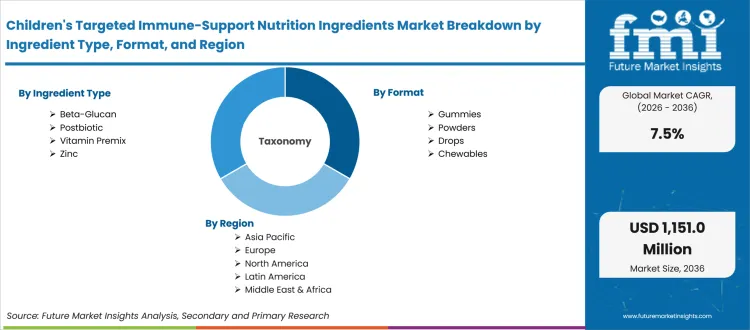
The children’s targeted immune-support nutrition ingredients industry is segmented by ingredient type, format, age band, sales channel, end user, and region
The market is segmented by ingredient type, covering beta-glucan, postbiotic, vitamin premix, and zinc. Format covers gummies, powders, drops, and chewables while age band separates 0 to 3 years, 4 to 12 years, and teens. Sales channel includes online retail, pharmacy, specialty retail, and direct brand routes. End user covers supplement brands, pediatric nutrition firms, contract manufacturers, and private labels. A January 2025 dsm-firmenich review of early-life nutrition trends linked evidence needs to tailored nutrition design. Regional coverage spans North America, Latin America, Europe, East Asia, South Asia and Pacific, and the Middle East and Africa alongside related micronutrient powder use.
What supports demand for beta-glucan within the ingredient type category?
Child-focused immune formulas need an active ingredient story that formulation teams can explain without adding complex serving instructions. Kerry updated its Wellmune evidence overview in September 2025 and kept beta-glucan tied to defined immune-support applications across life stages. That evidence base is expected to help product teams discuss use conditions while they test taste and process fit in child-oriented formats during early concept screening
- Based on ingredient type, beta-glucan is projected to account for 34.6% in 2026 due to a familiar immune-support role and broad formulation use. Glanbia Nutritionals published an April 2026 review of emerging immune ingredients that kept beta-glucan within the active ingredient conversation. Product teams are expected to compare dose and flavor effect before checking stability for wider use.
- Postbiotic ingredients are drawing demand from formulators because shelf-stable formats are expected to simplify handling in powders and gummies. Lallemand Health Solutions published a September 2025 review of postbiotics that covered formulation stability and immune-health applications across supplement formats. Related postbiotic supplement demand is projected to keep evidence quality under review.
How does the gummy format shape demand within the format category?
Parents judge child supplements through taste and serving simplicity before a brand earns repeat use. dsm-firmenich introduced a dry vitamin A form for early-life nutrition in October 2024 and linked the launch to dry and wet blending needs. Gummy formulators are therefore expected to balance sweetness with texture while evaluating color systems and active stability during early product screening before a commercial formula is approved
- By format, gummies are estimated to hold 41.5% in 2026 because familiar chewable use simplifies serving counts. Glanbia Nutritionals published an April 2026 review of gummy supplement formats and functions. Product teams are expected to keep texture and active protection visible during pilot processing trials and before commercial scale-up begins across shared production lines.
- Purchase activity for powders is anticipated to rise driven by flexible serving design and lower dependence on confectionery-style taste systems. Glanbia Nutritionals published a March 2026 review of supplement format trends that highlighted delivery choices beyond standard pills. Formulators are expected to compare powders with gummy supplement formats when sugar targets and dose size shape the brief.
What drives the 4 to 12 years age band within the age band category?
School-age products face a practical test because routines change across weekdays and travel while seasonal illness periods add another planning constraint. Cargill published a July 2024 child study update using a gummy format for its EpiCor postbiotic. Product teams are expected to study that kind of age-fit protocol before deciding whether an active ingredient fits a school-age position across repeat seasonal launches
- In 2026, the 4 to 12 years segment is expected to lead age band with 46.3% share as gummies and powders fit established family routines. The May 2026 National Center for Health Statistics brief found 13.0% of children aged 2 to 11 used two or more supplements. Formulators are expected to check overlap risk before setting daily servings.
- The 0 to 3 years segment is drawing attention from pediatric nutrition teams because early-life products need tighter dose and ingredient review. BENEO published a June 2025 preclinical study on a chicory prebiotic and HMO combination for toddler gut health. Related children’s health supplements are anticipated to keep age-fit evidence central to product screening.
How do product teams evaluate online retail within the sales channel category?
Online pages let parents compare ingredient purpose and serving instructions before placing a child supplement into a household routine. Glanbia Nutritionals published a February 2026 review of Asian supplement trends that emphasized preventive health and trusted sales channels. Digital product teams are expected to pair education with clear age guidance because online comparison exposes gaps in dose explanation quickly during product selection
- By sales channel, online retail is forecast to represent 32.8% in 2026 driven by search-led comparison and repeat order tools. AESGP’s November 2025 report found 70% of surveyed supplement consumers checked vitamin and mineral levels per daily dose. Brand teams are expected to make dose information easy to find before asking parents to subscribe.
- Pharmacy demand is expected to remain relevant for child-positioned products because parents often value a health professional’s explanation before first use. Synadiet reported in February 2026 that pharmacy represented 55% of French supplement sales. Formulators serving pharmacy-led brands are projected to emphasize clear labels and technical responses alongside broader functional ingredient formulation.
How are supplement brands positioned within the end user category?
Supplement brands turn immune ingredients into daily-use products. Their teams must connect evidence with taste and texture before the serving design is fixed. IFF published an October 2025 microbiome review that linked evidence-first probiotic work to formats people use in daily life. Brand teams are expected to assess whether an ingredient claim remains understandable after flavor and format choices are fixed for a commercial launch
- Supplement brands are projected to lead the end user category with 57.4% share in 2026 due to direct control over formula stories and retail education. Glanbia Nutritionals published a May 2025 review of micronutrients used in immune products. Product development teams are expected to use such evidence reviews when comparing premixes with stand-alone actives.
- Contract manufacturers are expected to favor ingredients that arrive with clear specifications and practical process support because shared lines create tight change-control needs. dsm-firmenich completed a USD 10 million modernization of its Schenectady premix facility in March 2026. The investment is anticipated to keep blending control and service response visible within broader food supplement ingredients sourcing.
What are the drivers, restraints, and opportunities in the children’s targeted immune-support nutrition ingredients market?
Near-term purchases are projected to reflect pediatric evidence requirements and cautious claim rules while format-ready immune ingredients create a route to differentiation
- Driver: Child-focused product teams are expected to prioritize ingredients that combine age-fit evidence with practical dosage guidance and acceptable taste.
- Restraint: Cautious health guidance is anticipated to slow broad immunity positioning when healthy children already meet nutrient needs through balanced diets.
- Opportunity: Shelf-stable postbiotics and flexible premixes are projected to open formulation routes across gummies and powders that need simpler process control.
Product teams are expected to look for evidence that connects a nutrient or active ingredient to an age group and a practical serving routine. UNICEF reported in August 2025 that periodic high-dose vitamin A supplementation reduces all-cause mortality among deficient children by 12% to 24%. The public-health result does not support broad claims for every product. It does show why formulators are projected to separate evidence by nutrient status and age before checking the intended use setting for a child-focused launch.
Healthy-child guidance is anticipated to keep claim review cautious when brands frame everyday products around immunity. The May 2026 National Center for Health Statistics brief reported that 5.9% of children aged 0 to 1 used two or more supplements. Formula teams are expected to review nutrient overlap before recommending routine use across adjacent products. Clearer serving limits and careful label wording are projected to lower the risk of confusing parents who combine several child products.
Format limits are expected to create room for ingredients that keep evidence and stability intact during real production. dsm-firmenich and Lallemand Health Solutions announced a synbiotic partnership for early-life nutrition in April 2024. Product teams are projected to compare HMO and probiotic combinations with conventional immune actives during concept work. The commercial opening is anticipated to favor ingredient manufacturers that explain processing boundaries clearly while functional food applications broaden the number of formulation settings under review.
Which country CAGRs are profiled in the children’s targeted immune-support nutrition ingredients market?
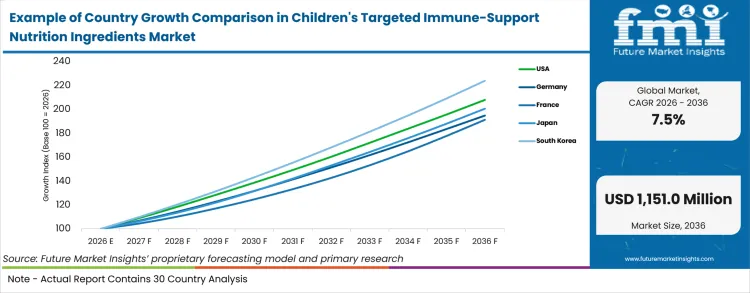
| Country | CAGR |
|---|---|
| United States | 7.6% |
| Germany | 6.9% |
| France | 6.7% |
| Japan | 7.2% |
| South Korea | 8.4% |
| Saudi Arabia | 8.8% |
| UAE | 9.3% |
Source: FMI’s proprietary forecasting model and primary research
How do country-level CAGRs compare in the children’s targeted immune-support nutrition ingredients market?
Country growth is expected to reflect how supplement brands navigate dose guidance and claims review while pharmacy trust and import procedures shape local entry. UAE and Saudi Arabia are projected to reward complete entry files while South Korea is anticipated to stress recognized functional ingredients. The United States is expected to remain format-diverse while Japan and Germany are forecast to favor careful dosage explanation. AESGP’s November 2025 report drew on 6,000 respondents across five European countries and found clear attention to daily-dose information. France is projected to keep pharmacy advice visible while related immune health supplements require clearer evidence at the point of selection.
- United States child supplement shelves mix gummies and powders alongside chewables and liquids across mass retail and direct brand channels. The United States children’s targeted immune-support nutrition ingredients sector is projected to record 7.6% CAGR during the assessment period, driven by format choice and supplement use among school-age families. The May 2026 National Center for Health Statistics brief reported supplement use among 41.9% of children aged 2 to 11. FDA’s Office of Dietary Supplement Programs keeps labeling and safety oversight visible for brands serving this group. Formulation teams are expected to favor ingredients that arrive with age-fit evidence and clear stability guidance before a new format moves beyond pilot production.
- Germany gives dosage review a central place in supplement decisions because health professionals and regulators place close attention on nutrient exposure. Product teams are expected to treat upper-level guidance as a formulation boundary before building a child-positioned range. Adoption of children’s immune-support nutrition ingredients in Germany is estimated to expand at 6.9% CAGR through 2036, supported by pharmacy trust and cautious dose framing. BfR proposed in December 2025 a maximum of 100 µg iodine per recommended daily intake for supplements aimed at people aged 15 years and older.
- French supplement brands work through a retail system where pharmacy advice still shapes many first purchases and repeat choices. Synadiet reported in February 2026 that pharmacy represented 55% of French supplement sales in 2025. Children’s immune-support ingredient demand in France is forecast to rise at 6.7% CAGR over the forecast period, supported by trusted advice and clear product explanation. Synadiet and French food-safety authorities keep ingredient composition and claim boundaries visible during product review. Brands are expected to value formulation partners that can answer pharmacist questions without turning a child wellness product into an overextended immunity claim.
- Japan’s nutrition system places trained professionals close to public guidance and everyday dietary decisions. The Ministry of Health, Labour and Welfare reported 153 registered dietitian training schools in 2024. Children’s targeted immune-support ingredient demand in Japan is anticipated to advance at 7.2% CAGR through 2036, driven by careful serving design and evidence-led product review. MHLW and the Consumer Affairs Agency shape the information environment that supplement brands must navigate. Product teams are expected to favor ingredients that fit precise serving instructions and restrained health communication before wider placement begins across pharmacy and specialty retail channels during local launch review.
- South Korea combines a formal functional ingredient system with active product development in jellies and powders alongside chewable formats. The Korea Health Functional Food Association reported 68 authorized functional ingredient types in its September 2025 brochure. Local product teams are expected to use that recognized framework when screening child-positioned immune concepts. Children’s targeted immune-support nutrition ingredient demand in South Korea is anticipated to advance at 8.4% CAGR through 2036 and is supported by recognized ingredients with strict claim review. MFDS oversight is projected to keep evidence files central while functional food applications widen the context for taste and format work. Korean brands are expected to choose partners that can respond quickly during specification review.
- Saudi Arabia has tightened the public-health environment around food marketing aimed at children and adolescents. SFDA’s 2025 Journey of Change states that marketing restrictions cover people under 18 years in this policy area. Product teams are expected to treat child-directed wording and evidence files as early project inputs. Saudi Arabia’s market outlook is anticipated to advance at 8.8% CAGR over the assessment period, driven by formal product review and pharmacy-led health purchasing. SFDA remains the central local actor for food and supplement control. Ingredient manufacturers are projected to benefit when regulatory support starts before artwork and claim language are fixed.
- UAE import procedures make documentation quality visible before a child supplement reaches a pharmacy shelf. UAE children’s targeted immune-support nutrition ingredient demand is forecast to rise at 9.3% CAGR over the forecast period, supported by premium pharmacy access and formal import review. Cabinet Resolution No. 40 of 2025 set a fee of 1% of invoice value for covered import permits, with the higher applicable value used for tariff-covered products. Emirates Drug Establishment is expected to keep permit files and shipment documentation central to market entry. Local pharmacy groups and import agents are projected to prefer ingredient partners that respond quickly when a dossier changes between formula approval and commercial shipment.
Who are the notable companies in the children’s targeted immune-support nutrition ingredients market?
Cargill, Kerry, dsm-firmenich, IFF, Glanbia Nutritionals, Novonesis A/S, Lallemand Health Solutions, Morinaga Milk Industry Co., Ltd., ADM, and BENEO GmbH are the notable companies shaping this market
Competition is projected to center on evidence depth and dose design while taste support must connect with process stability and local regulatory response. An October 2025 official microbiome review connected evidence-first probiotic work with formats people use in daily life and broader functional ingredient formulation. That approach reflects the practical screen facing child-focused formulas because a good active ingredient still needs to survive flavor systems and processing. Premix teams are expected to compete on serving accuracy while biotic specialists are anticipated to differentiate through age-fit evidence. Global service reach is projected to help multi-country launches while local technical response remains central during label review and plant trials.
- Cargill and Kerry are projected to compete where supplement brands want immune active ingredients with published evidence and practical application help. Their commercial position is projected to depend on how clearly evidence translates into child-sized servings and familiar formats consistently.
- Premix briefs are anticipated to bring dsm-firmenich and Glanbia Nutritionals into closer comparison. Product teams are expected to separate them by dose control and powder behavior while food supplement ingredients sourcing shapes formula revisions across regional account programs and local technical reviews.
- IFF and Novonesis A/S are projected to receive attention in microbiome-led briefs alongside Morinaga Milk Industry. Their relevance is expected to reflect strain or HMO evidence and age positioning while formulation guidance remains clear during child-directed product development and review.
- ADM and BENEO GmbH are anticipated to compete alongside Lallemand Health Solutions across postbiotic and prebiotic concepts that connect with probiotic briefs. Supplement brands are expected to compare evidence with gummy or powder processing support before moving a concept into commercial scale across regional production sites.
Competitive Benchmarking: Children’s Targeted Immune-Support Nutrition Ingredients Market
| Company | Immune Ingredient Fit | Child-Age Evidence | Specification Support | Service Reach |
|---|---|---|---|---|
| Cargill | High | High | High | Global |
| Kerry | High | High | High | Global |
| dsm-firmenich | High | High | High | Global |
| IFF | High | High | High | Global |
| Glanbia Nutritionals | High | Medium | High | Global |
| Novonesis A/S | High | High | High | Global |
| Lallemand Health Solutions | High | High | High | Global |
| Morinaga Milk Industry Co., Ltd. | High | High | High | Global |
| ADM | High | Medium | High | Global |
| BENEO GmbH | Medium | High | High | Global |
Source: Future Market Insights competitive analysis, 2026. Ratings reflect relative portfolio relevance and workflow fit. Service capability and geographic reach shape the remaining comparison.
Key Developments in the Children’s Targeted Immune-Support Nutrition Ingredients Market
- In May 2025, BENEO entered a strategic partnership with WACKER to launch the human milk oligosaccharide 2′-fucosyllactose for global commercialization. WACKER produces the ingredient in Europe through precision fermentation while BENEO manages commercial access.
- In September 2025, Novonesis received National Science Foundation funding for work on cell-free biomanufacturing of human milk oligosaccharides with Stanford University and the University of California Davis. The project focuses on longer and more complex HMO structures.
- In March 2026, dsm-firmenich announced new HMO regulatory approvals across China and the Southeast Asian markets of Malaysia and Thailand. The update included commercial authorization for 3′-sialyllactose in China and four additional approvals across Malaysia and Thailand.
- In May 2026, Morinaga Milk reported joint research with Matsumoto City Hospital on Bifidobacterium infantis M-63 during the weaning period. The company said the related paper appeared in Pediatric Research in April 2026.
Key Players in the Children’s Targeted Immune-Support Nutrition Ingredients Market
Immune Active and Postbiotic Ingredients
- Cargill
- Kerry
- ADM
Premix and Micronutrient Systems
- dsm-firmenich
- Glanbia Nutritionals
Probiotic and Early-Life Biotics
- IFF
- Novonesis A/S
- Lallemand Health Solutions
- Morinaga Milk Industry Co., Ltd.
- BENEO GmbH
Children’s Targeted Immune-Support Nutrition Ingredients Market – Report Scope
| Coverage field | Report scope |
|---|---|
| Market breakdown | Ingredient Type, Format, Age Band, Sales Channel, End User, and Region |
| Quantitative Units | Revenue in USD Million, CAGR in % |
| Market Definition | Ingredients sold to supplement brands, pediatric nutrition firms, contract manufacturers, and private labels for child-positioned products that support immune-related nutrition. |
| Regions Covered | North America, Latin America, Europe, East Asia, South Asia and Pacific, Middle East and Africa |
| Countries Covered | United States, Germany, France, Japan, South Korea, Saudi Arabia, UAE, and 30+ countries |
| Key Companies Profiled | Cargill, Kerry, dsm-firmenich, IFF, Glanbia Nutritionals, Novonesis A/S, Lallemand Health Solutions, Morinaga Milk Industry Co., Ltd., ADM, and BENEO GmbH |
| Forecast Period | 2026 to 2036 |
| Approach | Hybrid methodology combining bottom-up product and account evidence with top-down country and category reconciliation. |
Source: Future Market Insights – analysis driven by proprietary forecasting models and primary research
Children’s Targeted Immune-Support Nutrition Ingredients Market – Research Methodology
| Method | Approach |
|---|---|
| Primary Research | FMI structures interviews around decisions made by supplement brand teams and formulators while contract manufacturers and regulatory advisers explain scale-up constraints. Interview guides test dose design and format limits before examining claims review needs and service response. |
| Desk Research | Desk research reviews official government guidance and association data while regulatory service pages and company evidence provide current commercial context. Cabinet fee rules are reviewed alongside BfR dosage recommendations. Each source is used for the claim it directly supports and is checked against its publication context. |
| Market Sizing and Forecasting | The sizing model starts with ingredient sales into child-positioned immune formulas and reconciles those estimates against segment mix and country conditions before using account interviews. Bottom-up product evidence is reconciled with top-down country checks so the model does not rely on a single demand signal or one channel assumption. |
| Data Validation | FMI validates the model through repeated comparison of interview findings and company disclosures while regulatory evidence is checked against official country statistics. Segment shares are reviewed against formulation use and channel behavior while country CAGRs are checked against local entry rules and category signals. Evidence from different source types is reconciled before final estimates are accepted. The validation step also tests whether each market claim follows from the source used to support it. |
Source: Future Market Insights (FMI) analysis, based on proprietary forecasting model and primary research
Children’s Targeted Immune-Support Nutrition Ingredients Market by Segments
Children’s Targeted Immune-Support Nutrition Ingredients Market segmented by Ingredient Type:
- Beta-Glucan
- Postbiotic
- Vitamin Premix
- Zinc
Children’s Targeted Immune-Support Nutrition Ingredients Market segmented by Format:
- Gummies
- Powders
- Drops
- Chewables
Children’s Targeted Immune-Support Nutrition Ingredients Market segmented by Age Band:
- 0 to 3 Years
- 4 to 12 Years
- Teens
Children’s Targeted Immune-Support Nutrition Ingredients Market segmented by Sales Channel:
- Online Retail
- Pharmacy
- Specialty Retail
- Direct Brand
Children’s Targeted Immune-Support Nutrition Ingredients Market segmented by End User:
- Supplement Brands
- Pediatric Nutrition Firms
- Contract Manufacturers
- Private Labels
Children’s Targeted Immune-Support Nutrition Ingredients Market by Region:
- North America
- United States
- Canada
- Latin America
- Brazil
- Mexico
- Argentina
- Europe
- Germany
- France
- United Kingdom
- Italy
- Spain
- East Asia
- China
- Japan
- South Korea
- South Asia and Pacific
- India
- Australia
- New Zealand
- Middle East and Africa
- UAE
- Saudi Arabia
- South Africa
Research
- AESGP. (2025, November). Food supplements in Europe: Market overview and consumer behaviour insights. Association of the European Self-Care Industry.
- AESGP. (2026, January). New study shows 82% of consumers value food supplements for health and well-being. Association of the European Self-Care Industry.
- BENEO. (2025, May). BENEO and WACKER launch human milk oligosaccharide with global strategic partnership. BENEO.
- BENEO. (2025, June). New preclinical study highlights unique combination of chicory-derived prebiotics and human milk oligosaccharide (HMO) for advancing toddler gut health. BENEO.
- Cargill. (2024, July). EpiCor® postbiotic shown to help support children’s immune health in recent clinical trial. Cargill.
- Centers for Disease Control and Prevention. (2026, April). Vitamin D | Infant and Toddler Nutrition. CDC.
- dsm-firmenich. (2024, April). dsm-firmenich and Lallemand Health Solutions unite to launch synergistic synbiotic solutions for early life nutrition. dsm-firmenich.
- dsm-firmenich. (2024, October). dsm-firmenich introduces breakthrough dry vitamin A form to support early life nutrition. dsm-firmenich.
- dsm-firmenich. (2025, January). Scientific innovation based on natural inspiration: Emerging trends in early life nutrition. dsm-firmenich.
- dsm-firmenich. (2026, March). dsm-firmenich completes $10m upgrade on Schenectady (US) site. dsm-firmenich.
- dsm-firmenich. (2026, March). dsm-firmenich strengthens HMO offering in Asia with new regulatory approvals. dsm-firmenich.
- United Arab Emirates Cabinet. (2025, April). Cabinet Resolution No. (40) of 2025 Regarding the Service Fees Provided by the Emirates Drug Establishment. UAE Legislation.
- German Federal Institute for Risk Assessment. (2025, December). Update (2025): maximum levels proposed for iodine in foods including food supplements. BfR.
- Glanbia Nutritionals. (2025, May). The top 7 micronutrients in immune-supporting products. Glanbia Nutritionals.
- Glanbia Nutritionals. (2026, February). Top supplement trends in Asia for 2026. Glanbia Nutritionals.
- Glanbia Nutritionals. (2026, March). Top 5 supplement trends for 2026. Glanbia Nutritionals.
- Glanbia Nutritionals. (2026, April). Top emerging ingredients in immune supplements for 2026. Glanbia Nutritionals.
- Glanbia Nutritionals. (2026, April). Gummy supplement trends: Formats, flavours, and functions for 2026. Glanbia Nutritionals.
- IFF. (2025, October). Exploring the Microbiome: The Key to Unlocking The Health Potential. IFF.
- Korea Health Functional Food Association. (2025, September). Korea Health Functional Food. KHFF.
- Kerry. (2025, September). Wellmune®: Tailored immune support when it matters most. Kerry.
- Lallemand Health Solutions. (2025, September). Postbiotics in Human Health: A New Frontier in Microbiome Science. Lallemand Health Solutions.
- Ministry of Health, Labour and Welfare. (2025, March). Nutrition Policy in Japan to Leave No One Behind. MHLW.
- Morinaga Milk Industry Co., Ltd. (2026, May). Bifidobacterium infantis M-63 may support bowel habits and the gut environment in infants and toddlers during the weaning period. Morinaga Milk Industry Co., Ltd.
- National Center for Health Statistics. (2026, May). Dietary Supplement Use: United States, August 2021-August 2023. NCHS.
- Novonesis. (2025, September). NSF awards Novonesis funding to advance cell-free biomanufacturing of human milk oligosaccharides. Novonesis.
- Saudi Food and Drug Authority. (2025, October). The Journey of Change. SFDA.
- Synadiet. (2026, February). Santé mentale, numérique, pouvoir d’achat, compléments alimentaires : la santé du quotidien devient une priorité pour les Français. Synadiet.
- UNICEF Data. (2025, August). Vitamin A Deficiency in Children. UNICEF.
This bibliography is provided for reader reference and uses primary government, standards-body, official trade body, and company
This Report Answers
- What are the estimated children’s targeted immune-support nutrition ingredients market values in 2026 and 2036?
- What CAGR is projected for the children’s targeted immune-support nutrition ingredients market from 2026 to 2036?
- Which segments are projected to shape demand across ingredient type, format, age band, sales channel, and end user?
- Which formulation and evidence pressures are expected to support purchase activity for child-focused immune ingredients?
- How are country CAGRs projected to differ across the seven profiled countries?
- Which companies compete across the main ingredient, evidence, format, technical support, and service dimensions?
- How does FMI validate forecasts using its hybrid bottom-up and top-down methodology?
- What should supplement brands address before broader account expansion or a long-term sourcing commitment?
- How are claims review, dosage files, and regulatory requirements expected to affect ingredient manufacturer selection?
Frequently Asked Questions
What is driving growth in the Children’s Targeted Immune-Support Nutrition Ingredients Market?
Growth is expected to be driven by child-friendly formats, routine-focused use, and stronger demand for age-appropriate immune nutrition. Clear dosage guidance is projected to support repeat purchase
Who are the key players in the Children’s Targeted Immune-Support Nutrition Ingredients Market?
Key players include Cargill, Kerry, dsm-firmenich, IFF, Glanbia Nutritionals, and Novonesis. Competition is projected to center on evidence and format support
What is a significant restraint in the Children’s Targeted Immune-Support Nutrition Ingredients Market?
Lengthy evidence review and cautious child-directed claims remain a significant restraint. Adoption is anticipated to slow when dosage and stability files remain thin
Why should supplement brand executives track the Children’s Targeted Immune-Support Nutrition Ingredients Market?
Executives should track the market because child-focused immune products depend on trust, format acceptance, and careful claim framing. Ingredient selection can affect product launch speed and repeat account confidence
What business problem do these ingredients address?
They help brands build child-positioned products that connect immune-support nutrition with convenient daily formats. They also support clearer product stories around serving size, taste and age suitability
What should formulation teams evaluate before approving an immune-support ingredient?
Teams should evaluate age-fit evidence, dose accuracy, taste effect, processing stability, and compatibility with gummies, powders, drops, or chewables. Label wording and regional claim review should also be checked before scale-up
What limits return on investment for supplement brands and contract manufacturers?
Return on investment can weaken when ingredients require reformulation, create taste challenges, or lack clear documentation for child-focused claims. Delayed regulatory review can also reduce launch timing advantages
Which formats are expected to shape product development?
Gummies are expected to remain important because they fit familiar child routines, while powders support flexible serving design. Drops and chewables are also relevant where age band, dose size and parent preference shape product briefs
How do suppliers build long-term account confidence in this market?
Suppliers build confidence by offering clear specifications, application guidance and responsive technical support. Repeat business is expected to depend on consistent performance across formats and regions
Table of Content
- Key Takeaways
- Market Size and CAGR
- Top Growth Driver
- Fastest Growing Segment
- Leading Region
- Key Companies
- Emerging Opportunities
- Executive Summary
- Global Market Outlook
- Demand-side Trends
- Supply-side Trends
- Technology Roadmap Analysis
- Analysis and Recommendations
- Analyst Perspective (What is happening? Why now? What should investors know?)
- Key Questions Answered
- How large is the market?
- What is the CAGR?
- What are key trends?
- Which region dominates?
- Who are the leaders?
- Market Overview
- Market Coverage / Taxonomy
- Market Definition / Scope / Limitations
- Research Methodology
- Chapter Orientation
- Analytical Lens and Working Hypotheses
- Market Structure, Signals, and Trend Drivers
- Benchmarking and Cross-market Comparability
- Market Sizing, Forecasting, and Opportunity Mapping
- Research Design and Evidence Framework
- Desk Research Programme (Secondary Evidence)
- Expert Input and Fieldwork (Primary Evidence)
- Tooling, Models, and Reference Databases
- Data Engineering and Model Build
- Quality Assurance and Audit Trail
- Market Background
- Market Dynamics (Drivers, Restraints, Opportunity, Trends)
- Scenario Forecast (Optimistic, Likely, Conservative)
- Impact Analysis
- AI Impact
- Sustainability Impact
- Regulatory Impact
- Technology Impact
- Consumer / Buyer Analysis
- Purchase Drivers
- Adoption Barriers
- Buyer Journey
- Opportunity Map Analysis
- Product Life Cycle Analysis
- Supply Chain Analysis
- Investment Feasibility Matrix
- Value Chain Analysis
- PESTLE and Porter’s Analysis
- Regulatory Landscape
- Regional Parent Market Outlook
- Production and Consumption Statistics
- Import and Export Statistics
- Global Market Analysis and Forecast, 2021 to 2036
- Historical Market Size Value (USD Million) Analysis, 2021 to 2025
- Current and Future Market Size Value (USD Million) Projections, 2026 to 2036
- Y-o-Y Growth Trend Analysis
- Absolute $ Opportunity Analysis
- Global Market Pricing Analysis, 2021 to 2036
- Global Market Analysis and Forecast, By Ingredient Type, 2021 to 2036
- Introduction / Key Findings
- Historical Market Size Value (USD Million) Analysis By Ingredient Type, 2021 to 2025
- Current and Future Market Size Value (USD Million) Analysis and Forecast By Ingredient Type, 2026 to 2036
- Beta-Glucan
- Postbiotic
- Vitamin Premix
- Zinc
- Y-o-Y Growth Trend Analysis By Ingredient Type, 2021 to 2025
- Absolute $ Opportunity Analysis By Ingredient Type, 2026 to 2036
- Global Market Analysis and Forecast, By Format, 2021 to 2036
- Introduction / Key Findings
- Historical Market Size Value (USD Million) Analysis By Format, 2021 to 2025
- Current and Future Market Size Value (USD Million) Analysis and Forecast By Format, 2026 to 2036
- Gummies
- Powders
- Drops
- Chewables
- Y-o-Y Growth Trend Analysis By Format, 2021 to 2025
- Absolute $ Opportunity Analysis By Format, 2026 to 2036
- Global Market Analysis and Forecast, By Age Band, 2021 to 2036
- Introduction / Key Findings
- Historical Market Size Value (USD Million) Analysis By Age Band, 2021 to 2025
- Current and Future Market Size Value (USD Million) Analysis and Forecast By Age Band, 2026 to 2036
- 4 to 12 Years
- 0 to 3 Years
- Teens
- Y-o-Y Growth Trend Analysis By Age Band, 2021 to 2025
- Absolute $ Opportunity Analysis By Age Band, 2026 to 2036
- Global Market Analysis and Forecast, By Sales Channel, 2021 to 2036
- Introduction / Key Findings
- Historical Market Size Value (USD Million) Analysis By Sales Channel, 2021 to 2025
- Current and Future Market Size Value (USD Million) Analysis and Forecast By Sales Channel, 2026 to 2036
- Online Retail
- Pharmacy
- Specialty Retail
- Direct Brand
- Y-o-Y Growth Trend Analysis By Sales Channel, 2021 to 2025
- Absolute $ Opportunity Analysis By Sales Channel, 2026 to 2036
- Global Market Analysis and Forecast, By End User, 2021 to 2036
- Introduction / Key Findings
- Historical Market Size Value (USD Million) Analysis By End User, 2021 to 2025
- Current and Future Market Size Value (USD Million) Analysis and Forecast By End User, 2026 to 2036
- Supplement Brands
- Pediatric Nutrition Firms
- Contract Manufacturers
- Private Labels
- Y-o-Y Growth Trend Analysis By End User, 2021 to 2025
- Absolute $ Opportunity Analysis By End User, 2026 to 2036
- Global Market Analysis and Forecast, By Region, 2021 to 2036
- Introduction
- Historical Market Size Value (USD Million) Analysis By Region, 2021 to 2025
- Current Market Size Value (USD Million) Analysis and Forecast By Region, 2026 to 2036
- North America
- Latin America
- Western Europe
- Eastern Europe
- East Asia
- South Asia and Pacific
- Middle East & Africa
- Market Attractiveness Analysis By Region
- North America Market Analysis and Forecast, By Country, 2021 to 2036
- Historical Market Size Value (USD Million) Trend Analysis By Market Taxonomy, 2021 to 2025
- Market Size Value (USD Million) Forecast By Market Taxonomy, 2026 to 2036
- By Country
- USA
- Canada
- By Ingredient Type
- By Format
- By Age Band
- By Sales Channel
- By End User
- By Country
- Market Attractiveness Analysis
- By Country
- By Ingredient Type
- By Format
- By Age Band
- By Sales Channel
- By End User
- Key Takeaways
- Latin America Market Analysis and Forecast, By Country
- Historical Market Size Value (USD Million) Trend Analysis By Market Taxonomy, 2021 to 2025
- Market Size Value (USD Million) Forecast By Market Taxonomy, 2026 to 2036
- By Country
- Brazil
- Mexico
- Chile
- Rest of Latin America
- By Ingredient Type
- By Format
- By Age Band
- By Sales Channel
- By End User
- By Country
- Market Attractiveness Analysis
- By Country
- By Ingredient Type
- By Format
- By Age Band
- By Sales Channel
- By End User
- Key Takeaways
- Western Europe Market Analysis and Forecast, By Country
- Historical Market Size Value (USD Million) Trend Analysis By Market Taxonomy, 2021 to 2025
- Market Size Value (USD Million) Forecast By Market Taxonomy, 2026 to 2036
- By Country
- Germany
- UK
- Italy
- Spain
- France
- Nordic
- BENELUX
- Rest of Western Europe
- By Ingredient Type
- By Format
- By Age Band
- By Sales Channel
- By End User
- By Country
- Market Attractiveness Analysis
- By Country
- By Ingredient Type
- By Format
- By Age Band
- By Sales Channel
- By End User
- Key Takeaways
- Eastern Europe Market Analysis and Forecast, By Country
- Historical Market Size Value (USD Million) Trend Analysis By Market Taxonomy, 2021 to 2025
- Market Size Value (USD Million) Forecast By Market Taxonomy, 2026 to 2036
- By Country
- Russia
- Poland
- Hungary
- Balkan & Baltic
- Rest of Eastern Europe
- By Ingredient Type
- By Format
- By Age Band
- By Sales Channel
- By End User
- By Country
- Market Attractiveness Analysis
- By Country
- By Ingredient Type
- By Format
- By Age Band
- By Sales Channel
- By End User
- Key Takeaways
- East Asia Market Analysis and Forecast, By Country
- Historical Market Size Value (USD Million) Trend Analysis By Market Taxonomy, 2021 to 2025
- Market Size Value (USD Million) Forecast By Market Taxonomy, 2026 to 2036
- By Country
- China
- Japan
- South Korea
- By Ingredient Type
- By Format
- By Age Band
- By Sales Channel
- By End User
- By Country
- Market Attractiveness Analysis
- By Country
- By Ingredient Type
- By Format
- By Age Band
- By Sales Channel
- By End User
- Key Takeaways
- South Asia and Pacific Market Analysis and Forecast, By Country
- Historical Market Size Value (USD Million) Trend Analysis By Market Taxonomy, 2021 to 2025
- Market Size Value (USD Million) Forecast By Market Taxonomy, 2026 to 2036
- By Country
- India
- ASEAN
- Australia & New Zealand
- Rest of South Asia and Pacific
- By Ingredient Type
- By Format
- By Age Band
- By Sales Channel
- By End User
- By Country
- Market Attractiveness Analysis
- By Country
- By Ingredient Type
- By Format
- By Age Band
- By Sales Channel
- By End User
- Key Takeaways
- Middle East & Africa Market Analysis and Forecast, By Country
- Historical Market Size Value (USD Million) Trend Analysis By Market Taxonomy, 2021 to 2025
- Market Size Value (USD Million) Forecast By Market Taxonomy, 2026 to 2036
- By Country
- Kingdom of Saudi Arabia
- Other GCC Countries
- Türkiye
- South Africa
- Other African Union
- Rest of Middle East & Africa
- By Ingredient Type
- By Format
- By Age Band
- By Sales Channel
- By End User
- By Country
- Market Attractiveness Analysis
- By Country
- By Ingredient Type
- By Format
- By Age Band
- By Sales Channel
- By End User
- Key Takeaways
- Key Countries Market Analysis
- USA
- Pricing Analysis
- Market Share Analysis, 2025
- By Ingredient Type
- By Format
- By Age Band
- By Sales Channel
- By End User
- Canada
- Pricing Analysis
- Market Share Analysis, 2025
- By Ingredient Type
- By Format
- By Age Band
- By Sales Channel
- By End User
- Mexico
- Pricing Analysis
- Market Share Analysis, 2025
- By Ingredient Type
- By Format
- By Age Band
- By Sales Channel
- By End User
- Brazil
- Pricing Analysis
- Market Share Analysis, 2025
- By Ingredient Type
- By Format
- By Age Band
- By Sales Channel
- By End User
- Chile
- Pricing Analysis
- Market Share Analysis, 2025
- By Ingredient Type
- By Format
- By Age Band
- By Sales Channel
- By End User
- Germany
- Pricing Analysis
- Market Share Analysis, 2025
- By Ingredient Type
- By Format
- By Age Band
- By Sales Channel
- By End User
- UK
- Pricing Analysis
- Market Share Analysis, 2025
- By Ingredient Type
- By Format
- By Age Band
- By Sales Channel
- By End User
- Italy
- Pricing Analysis
- Market Share Analysis, 2025
- By Ingredient Type
- By Format
- By Age Band
- By Sales Channel
- By End User
- Spain
- Pricing Analysis
- Market Share Analysis, 2025
- By Ingredient Type
- By Format
- By Age Band
- By Sales Channel
- By End User
- France
- Pricing Analysis
- Market Share Analysis, 2025
- By Ingredient Type
- By Format
- By Age Band
- By Sales Channel
- By End User
- India
- Pricing Analysis
- Market Share Analysis, 2025
- By Ingredient Type
- By Format
- By Age Band
- By Sales Channel
- By End User
- ASEAN
- Pricing Analysis
- Market Share Analysis, 2025
- By Ingredient Type
- By Format
- By Age Band
- By Sales Channel
- By End User
- Australia & New Zealand
- Pricing Analysis
- Market Share Analysis, 2025
- By Ingredient Type
- By Format
- By Age Band
- By Sales Channel
- By End User
- China
- Pricing Analysis
- Market Share Analysis, 2025
- By Ingredient Type
- By Format
- By Age Band
- By Sales Channel
- By End User
- Japan
- Pricing Analysis
- Market Share Analysis, 2025
- By Ingredient Type
- By Format
- By Age Band
- By Sales Channel
- By End User
- South Korea
- Pricing Analysis
- Market Share Analysis, 2025
- By Ingredient Type
- By Format
- By Age Band
- By Sales Channel
- By End User
- Russia
- Pricing Analysis
- Market Share Analysis, 2025
- By Ingredient Type
- By Format
- By Age Band
- By Sales Channel
- By End User
- Poland
- Pricing Analysis
- Market Share Analysis, 2025
- By Ingredient Type
- By Format
- By Age Band
- By Sales Channel
- By End User
- Hungary
- Pricing Analysis
- Market Share Analysis, 2025
- By Ingredient Type
- By Format
- By Age Band
- By Sales Channel
- By End User
- Kingdom of Saudi Arabia
- Pricing Analysis
- Market Share Analysis, 2025
- By Ingredient Type
- By Format
- By Age Band
- By Sales Channel
- By End User
- Türkiye
- Pricing Analysis
- Market Share Analysis, 2025
- By Ingredient Type
- By Format
- By Age Band
- By Sales Channel
- By End User
- South Africa
- Pricing Analysis
- Market Share Analysis, 2025
- By Ingredient Type
- By Format
- By Age Band
- By Sales Channel
- By End User
- USA
- Market Structure Analysis
- Competition Dashboard
- Competition Benchmarking
- Market Share Analysis of Top Players
- By Regional
- By Ingredient Type
- By Format
- By Age Band
- By Sales Channel
- By End User
- Emerging Startups
- Innovation Benchmarking
- Competition Analysis
- Competition Deep Dive
- Cargill
- Overview
- Product Portfolio
- Profitability by Market Segments
- Sales Footprint
- Strategy Overview
- Marketing Strategy
- Product Strategy
- Channel Strategy
- Kerry
- dsm-firmenich
- IFF
- Glanbia Nutritionals
- Novonesis A/S
- Lallemand Health Solutions
- Morinaga Milk Industry Co. Ltd.
- ADM
- Cargill
- Case Studies
- Success Stories
- Recent Developments
- Competition Deep Dive
- Assumptions & Acronyms Used
List of Tables
- Table 1: Global Market Value (USD Million) Forecast by Region, 2021 to 2036
- Table 2: Global Market Value (USD Million) Forecast by Ingredient Type, 2021 to 2036
- Table 3: Global Market Value (USD Million) Forecast by Format, 2021 to 2036
- Table 4: Global Market Value (USD Million) Forecast by Age Band, 2021 to 2036
- Table 5: Global Market Value (USD Million) Forecast by Sales Channel, 2021 to 2036
- Table 6: Global Market Value (USD Million) Forecast by End User, 2021 to 2036
- Table 7: North America Market Value (USD Million) Forecast by Country, 2021 to 2036
- Table 8: North America Market Value (USD Million) Forecast by Ingredient Type, 2021 to 2036
- Table 9: North America Market Value (USD Million) Forecast by Format, 2021 to 2036
- Table 10: North America Market Value (USD Million) Forecast by Age Band, 2021 to 2036
- Table 11: North America Market Value (USD Million) Forecast by Sales Channel, 2021 to 2036
- Table 12: North America Market Value (USD Million) Forecast by End User, 2021 to 2036
- Table 13: Latin America Market Value (USD Million) Forecast by Country, 2021 to 2036
- Table 14: Latin America Market Value (USD Million) Forecast by Ingredient Type, 2021 to 2036
- Table 15: Latin America Market Value (USD Million) Forecast by Format, 2021 to 2036
- Table 16: Latin America Market Value (USD Million) Forecast by Age Band, 2021 to 2036
- Table 17: Latin America Market Value (USD Million) Forecast by Sales Channel, 2021 to 2036
- Table 18: Latin America Market Value (USD Million) Forecast by End User, 2021 to 2036
- Table 19: Western Europe Market Value (USD Million) Forecast by Country, 2021 to 2036
- Table 20: Western Europe Market Value (USD Million) Forecast by Ingredient Type, 2021 to 2036
- Table 21: Western Europe Market Value (USD Million) Forecast by Format, 2021 to 2036
- Table 22: Western Europe Market Value (USD Million) Forecast by Age Band, 2021 to 2036
- Table 23: Western Europe Market Value (USD Million) Forecast by Sales Channel, 2021 to 2036
- Table 24: Western Europe Market Value (USD Million) Forecast by End User, 2021 to 2036
- Table 25: Eastern Europe Market Value (USD Million) Forecast by Country, 2021 to 2036
- Table 26: Eastern Europe Market Value (USD Million) Forecast by Ingredient Type, 2021 to 2036
- Table 27: Eastern Europe Market Value (USD Million) Forecast by Format, 2021 to 2036
- Table 28: Eastern Europe Market Value (USD Million) Forecast by Age Band, 2021 to 2036
- Table 29: Eastern Europe Market Value (USD Million) Forecast by Sales Channel, 2021 to 2036
- Table 30: Eastern Europe Market Value (USD Million) Forecast by End User, 2021 to 2036
- Table 31: East Asia Market Value (USD Million) Forecast by Country, 2021 to 2036
- Table 32: East Asia Market Value (USD Million) Forecast by Ingredient Type, 2021 to 2036
- Table 33: East Asia Market Value (USD Million) Forecast by Format, 2021 to 2036
- Table 34: East Asia Market Value (USD Million) Forecast by Age Band, 2021 to 2036
- Table 35: East Asia Market Value (USD Million) Forecast by Sales Channel, 2021 to 2036
- Table 36: East Asia Market Value (USD Million) Forecast by End User, 2021 to 2036
- Table 37: South Asia and Pacific Market Value (USD Million) Forecast by Country, 2021 to 2036
- Table 38: South Asia and Pacific Market Value (USD Million) Forecast by Ingredient Type, 2021 to 2036
- Table 39: South Asia and Pacific Market Value (USD Million) Forecast by Format, 2021 to 2036
- Table 40: South Asia and Pacific Market Value (USD Million) Forecast by Age Band, 2021 to 2036
- Table 41: South Asia and Pacific Market Value (USD Million) Forecast by Sales Channel, 2021 to 2036
- Table 42: South Asia and Pacific Market Value (USD Million) Forecast by End User, 2021 to 2036
- Table 43: Middle East & Africa Market Value (USD Million) Forecast by Country, 2021 to 2036
- Table 44: Middle East & Africa Market Value (USD Million) Forecast by Ingredient Type, 2021 to 2036
- Table 45: Middle East & Africa Market Value (USD Million) Forecast by Format, 2021 to 2036
- Table 46: Middle East & Africa Market Value (USD Million) Forecast by Age Band, 2021 to 2036
- Table 47: Middle East & Africa Market Value (USD Million) Forecast by Sales Channel, 2021 to 2036
- Table 48: Middle East & Africa Market Value (USD Million) Forecast by End User, 2021 to 2036
List of Figures
- Figure 1: Global Market Pricing Analysis
- Figure 2: Global Market Value (USD Million) Forecast 2021-2036
- Figure 3: Global Market Value Share and BPS Analysis by Ingredient Type, 2026 and 2036
- Figure 4: Global Market Y-o-Y Growth Comparison by Ingredient Type, 2026-2036
- Figure 5: Global Market Attractiveness Analysis by Ingredient Type
- Figure 6: Global Market Value Share and BPS Analysis by Format, 2026 and 2036
- Figure 7: Global Market Y-o-Y Growth Comparison by Format, 2026-2036
- Figure 8: Global Market Attractiveness Analysis by Format
- Figure 9: Global Market Value Share and BPS Analysis by Age Band, 2026 and 2036
- Figure 10: Global Market Y-o-Y Growth Comparison by Age Band, 2026-2036
- Figure 11: Global Market Attractiveness Analysis by Age Band
- Figure 12: Global Market Value Share and BPS Analysis by Sales Channel, 2026 and 2036
- Figure 13: Global Market Y-o-Y Growth Comparison by Sales Channel, 2026-2036
- Figure 14: Global Market Attractiveness Analysis by Sales Channel
- Figure 15: Global Market Value Share and BPS Analysis by End User, 2026 and 2036
- Figure 16: Global Market Y-o-Y Growth Comparison by End User, 2026-2036
- Figure 17: Global Market Attractiveness Analysis by End User
- Figure 18: Global Market Value (USD Million) Share and BPS Analysis by Region, 2026 and 2036
- Figure 19: Global Market Y-o-Y Growth Comparison by Region, 2026-2036
- Figure 20: Global Market Attractiveness Analysis by Region
- Figure 21: North America Market Incremental Dollar Opportunity, 2026-2036
- Figure 22: Latin America Market Incremental Dollar Opportunity, 2026-2036
- Figure 23: Western Europe Market Incremental Dollar Opportunity, 2026-2036
- Figure 24: Eastern Europe Market Incremental Dollar Opportunity, 2026-2036
- Figure 25: East Asia Market Incremental Dollar Opportunity, 2026-2036
- Figure 26: South Asia and Pacific Market Incremental Dollar Opportunity, 2026-2036
- Figure 27: Middle East & Africa Market Incremental Dollar Opportunity, 2026-2036
- Figure 28: North America Market Value Share and BPS Analysis by Country, 2026 and 2036
- Figure 29: North America Market Value Share and BPS Analysis by Ingredient Type, 2026 and 2036
- Figure 30: North America Market Y-o-Y Growth Comparison by Ingredient Type, 2026-2036
- Figure 31: North America Market Attractiveness Analysis by Ingredient Type
- Figure 32: North America Market Value Share and BPS Analysis by Format, 2026 and 2036
- Figure 33: North America Market Y-o-Y Growth Comparison by Format, 2026-2036
- Figure 34: North America Market Attractiveness Analysis by Format
- Figure 35: North America Market Value Share and BPS Analysis by Age Band, 2026 and 2036
- Figure 36: North America Market Y-o-Y Growth Comparison by Age Band, 2026-2036
- Figure 37: North America Market Attractiveness Analysis by Age Band
- Figure 38: North America Market Value Share and BPS Analysis by Sales Channel, 2026 and 2036
- Figure 39: North America Market Y-o-Y Growth Comparison by Sales Channel, 2026-2036
- Figure 40: North America Market Attractiveness Analysis by Sales Channel
- Figure 41: North America Market Value Share and BPS Analysis by End User, 2026 and 2036
- Figure 42: North America Market Y-o-Y Growth Comparison by End User, 2026-2036
- Figure 43: North America Market Attractiveness Analysis by End User
- Figure 44: Latin America Market Value Share and BPS Analysis by Country, 2026 and 2036
- Figure 45: Latin America Market Value Share and BPS Analysis by Ingredient Type, 2026 and 2036
- Figure 46: Latin America Market Y-o-Y Growth Comparison by Ingredient Type, 2026-2036
- Figure 47: Latin America Market Attractiveness Analysis by Ingredient Type
- Figure 48: Latin America Market Value Share and BPS Analysis by Format, 2026 and 2036
- Figure 49: Latin America Market Y-o-Y Growth Comparison by Format, 2026-2036
- Figure 50: Latin America Market Attractiveness Analysis by Format
- Figure 51: Latin America Market Value Share and BPS Analysis by Age Band, 2026 and 2036
- Figure 52: Latin America Market Y-o-Y Growth Comparison by Age Band, 2026-2036
- Figure 53: Latin America Market Attractiveness Analysis by Age Band
- Figure 54: Latin America Market Value Share and BPS Analysis by Sales Channel, 2026 and 2036
- Figure 55: Latin America Market Y-o-Y Growth Comparison by Sales Channel, 2026-2036
- Figure 56: Latin America Market Attractiveness Analysis by Sales Channel
- Figure 57: Latin America Market Value Share and BPS Analysis by End User, 2026 and 2036
- Figure 58: Latin America Market Y-o-Y Growth Comparison by End User, 2026-2036
- Figure 59: Latin America Market Attractiveness Analysis by End User
- Figure 60: Western Europe Market Value Share and BPS Analysis by Country, 2026 and 2036
- Figure 61: Western Europe Market Value Share and BPS Analysis by Ingredient Type, 2026 and 2036
- Figure 62: Western Europe Market Y-o-Y Growth Comparison by Ingredient Type, 2026-2036
- Figure 63: Western Europe Market Attractiveness Analysis by Ingredient Type
- Figure 64: Western Europe Market Value Share and BPS Analysis by Format, 2026 and 2036
- Figure 65: Western Europe Market Y-o-Y Growth Comparison by Format, 2026-2036
- Figure 66: Western Europe Market Attractiveness Analysis by Format
- Figure 67: Western Europe Market Value Share and BPS Analysis by Age Band, 2026 and 2036
- Figure 68: Western Europe Market Y-o-Y Growth Comparison by Age Band, 2026-2036
- Figure 69: Western Europe Market Attractiveness Analysis by Age Band
- Figure 70: Western Europe Market Value Share and BPS Analysis by Sales Channel, 2026 and 2036
- Figure 71: Western Europe Market Y-o-Y Growth Comparison by Sales Channel, 2026-2036
- Figure 72: Western Europe Market Attractiveness Analysis by Sales Channel
- Figure 73: Western Europe Market Value Share and BPS Analysis by End User, 2026 and 2036
- Figure 74: Western Europe Market Y-o-Y Growth Comparison by End User, 2026-2036
- Figure 75: Western Europe Market Attractiveness Analysis by End User
- Figure 76: Eastern Europe Market Value Share and BPS Analysis by Country, 2026 and 2036
- Figure 77: Eastern Europe Market Value Share and BPS Analysis by Ingredient Type, 2026 and 2036
- Figure 78: Eastern Europe Market Y-o-Y Growth Comparison by Ingredient Type, 2026-2036
- Figure 79: Eastern Europe Market Attractiveness Analysis by Ingredient Type
- Figure 80: Eastern Europe Market Value Share and BPS Analysis by Format, 2026 and 2036
- Figure 81: Eastern Europe Market Y-o-Y Growth Comparison by Format, 2026-2036
- Figure 82: Eastern Europe Market Attractiveness Analysis by Format
- Figure 83: Eastern Europe Market Value Share and BPS Analysis by Age Band, 2026 and 2036
- Figure 84: Eastern Europe Market Y-o-Y Growth Comparison by Age Band, 2026-2036
- Figure 85: Eastern Europe Market Attractiveness Analysis by Age Band
- Figure 86: Eastern Europe Market Value Share and BPS Analysis by Sales Channel, 2026 and 2036
- Figure 87: Eastern Europe Market Y-o-Y Growth Comparison by Sales Channel, 2026-2036
- Figure 88: Eastern Europe Market Attractiveness Analysis by Sales Channel
- Figure 89: Eastern Europe Market Value Share and BPS Analysis by End User, 2026 and 2036
- Figure 90: Eastern Europe Market Y-o-Y Growth Comparison by End User, 2026-2036
- Figure 91: Eastern Europe Market Attractiveness Analysis by End User
- Figure 92: East Asia Market Value Share and BPS Analysis by Country, 2026 and 2036
- Figure 93: East Asia Market Value Share and BPS Analysis by Ingredient Type, 2026 and 2036
- Figure 94: East Asia Market Y-o-Y Growth Comparison by Ingredient Type, 2026-2036
- Figure 95: East Asia Market Attractiveness Analysis by Ingredient Type
- Figure 96: East Asia Market Value Share and BPS Analysis by Format, 2026 and 2036
- Figure 97: East Asia Market Y-o-Y Growth Comparison by Format, 2026-2036
- Figure 98: East Asia Market Attractiveness Analysis by Format
- Figure 99: East Asia Market Value Share and BPS Analysis by Age Band, 2026 and 2036
- Figure 100: East Asia Market Y-o-Y Growth Comparison by Age Band, 2026-2036
- Figure 101: East Asia Market Attractiveness Analysis by Age Band
- Figure 102: East Asia Market Value Share and BPS Analysis by Sales Channel, 2026 and 2036
- Figure 103: East Asia Market Y-o-Y Growth Comparison by Sales Channel, 2026-2036
- Figure 104: East Asia Market Attractiveness Analysis by Sales Channel
- Figure 105: East Asia Market Value Share and BPS Analysis by End User, 2026 and 2036
- Figure 106: East Asia Market Y-o-Y Growth Comparison by End User, 2026-2036
- Figure 107: East Asia Market Attractiveness Analysis by End User
- Figure 108: South Asia and Pacific Market Value Share and BPS Analysis by Country, 2026 and 2036
- Figure 109: South Asia and Pacific Market Value Share and BPS Analysis by Ingredient Type, 2026 and 2036
- Figure 110: South Asia and Pacific Market Y-o-Y Growth Comparison by Ingredient Type, 2026-2036
- Figure 111: South Asia and Pacific Market Attractiveness Analysis by Ingredient Type
- Figure 112: South Asia and Pacific Market Value Share and BPS Analysis by Format, 2026 and 2036
- Figure 113: South Asia and Pacific Market Y-o-Y Growth Comparison by Format, 2026-2036
- Figure 114: South Asia and Pacific Market Attractiveness Analysis by Format
- Figure 115: South Asia and Pacific Market Value Share and BPS Analysis by Age Band, 2026 and 2036
- Figure 116: South Asia and Pacific Market Y-o-Y Growth Comparison by Age Band, 2026-2036
- Figure 117: South Asia and Pacific Market Attractiveness Analysis by Age Band
- Figure 118: South Asia and Pacific Market Value Share and BPS Analysis by Sales Channel, 2026 and 2036
- Figure 119: South Asia and Pacific Market Y-o-Y Growth Comparison by Sales Channel, 2026-2036
- Figure 120: South Asia and Pacific Market Attractiveness Analysis by Sales Channel
- Figure 121: South Asia and Pacific Market Value Share and BPS Analysis by End User, 2026 and 2036
- Figure 122: South Asia and Pacific Market Y-o-Y Growth Comparison by End User, 2026-2036
- Figure 123: South Asia and Pacific Market Attractiveness Analysis by End User
- Figure 124: Middle East & Africa Market Value Share and BPS Analysis by Country, 2026 and 2036
- Figure 125: Middle East & Africa Market Value Share and BPS Analysis by Ingredient Type, 2026 and 2036
- Figure 126: Middle East & Africa Market Y-o-Y Growth Comparison by Ingredient Type, 2026-2036
- Figure 127: Middle East & Africa Market Attractiveness Analysis by Ingredient Type
- Figure 128: Middle East & Africa Market Value Share and BPS Analysis by Format, 2026 and 2036
- Figure 129: Middle East & Africa Market Y-o-Y Growth Comparison by Format, 2026-2036
- Figure 130: Middle East & Africa Market Attractiveness Analysis by Format
- Figure 131: Middle East & Africa Market Value Share and BPS Analysis by Age Band, 2026 and 2036
- Figure 132: Middle East & Africa Market Y-o-Y Growth Comparison by Age Band, 2026-2036
- Figure 133: Middle East & Africa Market Attractiveness Analysis by Age Band
- Figure 134: Middle East & Africa Market Value Share and BPS Analysis by Sales Channel, 2026 and 2036
- Figure 135: Middle East & Africa Market Y-o-Y Growth Comparison by Sales Channel, 2026-2036
- Figure 136: Middle East & Africa Market Attractiveness Analysis by Sales Channel
- Figure 137: Middle East & Africa Market Value Share and BPS Analysis by End User, 2026 and 2036
- Figure 138: Middle East & Africa Market Y-o-Y Growth Comparison by End User, 2026-2036
- Figure 139: Middle East & Africa Market Attractiveness Analysis by End User
- Figure 140: Global Market – Tier Structure Analysis
- Figure 141: Global Market – Company Share Analysis
Thank you!
You will receive an email from our Business Development Manager. Please be sure to check your SPAM/JUNK folder too
