


Abstract
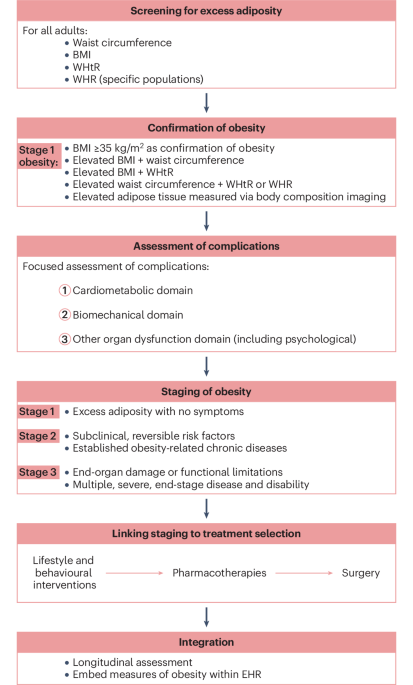
Obesity is a chronic, adiposity-based disease with increasing global prevalence and multiple, competing definitions. Traditionally, body mass index (BMI) has been the primary tool for diagnosis, although it does not completely reflect adipose tissue mass, distribution or associated organ dysfunction. In the past 2 years, major professional societies (including the European Association for the Study of Obesity (EASO), the Lancet Diabetes & Endocrinology Commission, the American College of Cardiology (ACC) and the American Association of Clinical Endocrinologists (AACE)) have advanced new diagnostic frameworks that move beyond BMI to incorporate multimodal assessment of adiposity and its clinical consequences. By integrating anthropometric precision with standardized complication assessment, these frameworks support earlier identification of risk, improved prognostication and more equitable, patient-centred obesity care. However, the way in which the new guidelines should be integrated into routine clinical care remains unclear. Here we synthesize current evidence across anthropometric measures of obesity and body composition imaging. We clarify the diagnostic performance, limitations and relevance of these measures across diverse populations. We compare areas of convergence and divergence among the new guidelines, particularly the shift towards defining clinical obesity on the basis of both excess adiposity and evidence of organ dysfunction or functional impairment.
Key points
The diagnosis of obesity is shifting from body mass index-based definitions to multimodal assessments integrating adiposity, adipose tissue distribution and obesity-related complications
Waist-based measures improve the detection of central adiposity across diverse populations
Emerging frameworks and guidelines from major international professional societies and organizations redefine clinical obesity as a heterogeneous, chronic disease that extends beyond body size alone
Implementation of emerging frameworks introduces challenges in standardization, re
Access through your institution
Buy or subscribe
This is a preview of subscription content, access
Access options
Access through your institution
- Purchase on SpringerLink
- Instant access to the full article PDF.
39,95 €
Prices may be subject to local taxes which are calculated during checkout
References
Emmerich, S. D., Fryar, C. D., Stierman, B. & Ogden, C. L. Obesity and severe obesity prevalence in adults: United States, August 2021–August 2023. NCHS Data Briefhttps://doi.org/10.15620/cdc/159281 (2024)
Yuen, M. M. A. Health complications of obesity: 224 obesity-associated comorbidities from a mechanistic perspective. Gastroenterol. Clin. North Am.52, 363–380 (2023)
GBD 2021 Adult BMI Collaborators. Global, regional, and national prevalence of adult overweight and obesity, 1990–2021, with forecasts to 2050: a forecasting study for the Global Burden of Disease Study 2021. Lancet405, 813–838 (2025)
Kivimäki, M. et al. Body-mass index and risk of obesity-related complex multimorbidity: an observational multicohort study. Lancet Diabetes Endocrinol.10, 253–263 (2022)
Afshin, A. et al. Health effects of overweight and obesity in 195 countries over 25 years. N. Engl. J. Med.377, 13–27 (2017)
Kushner, R. F. & Ryan, D. H. Assessment and lifestyle management of patients with obesity: clinical recommendations from systematic reviews. JAMA312, 943–952 (2014)
American Diabetes Association Professional Practice Committee. Obesity and weight management for the prevention and treatment of type 2 diabetes: standards of care in diabetes–2025. Diabetes Care48 (Suppl. 1), S167–S180 (2025)
Arra, E. et al. VA/DoD Clinical Practice Guideline for the Management of Adult Overweight and Obesity (OBE)https://www.healthquality.va.gov/HEALTHQUALITY/guidelines/CD/obesity/OBE-CPG_2025-Guideline_final_20251105.pdf (2025)
Jakicic, J. M. et al. Physical activity and excess body weight and adiposity for adults: American College of Sports Medicine consensus statement. Med. Sci. Sports Exerc.56, 2076–2091 (2024)
Sung, H. et al. Global patterns in excess body weight and the associated cancer burden. CA Cancer J. Clin.69, 88–112 (2019)
Willett, W. C., Dietz, W. H. & Colditz, G. A. Guidelines for healthy weight. N. Engl. J. Med.341, 427–434 (1999)
Gagnon, E. et al. Disentangling the impact of gluteofemoral versus visceral fat accumulation on cardiometabolic health using sex-stratified Mendelian randomization. Atherosclerosis386, 117371 (2023)
Lotta, L. A. et al. Integrative genomic analysis implicates limited peripheral adipose storage capacity in the pathogenesis of human insulin resistance. Nat. Genet.49, 17–26 (2017)
Powell-Wiley, T. M. et al. Obesity and cardiovascular disease: a scientific statement from the American Heart Association. Circulation143, e984–e1010 (2021)
Low, N. Y. et al. Comparing the performance of body mass index, waist circumference and waist-to-height ratio in predicting Malaysians with excess adiposity. Ann. Hum. Biol.49, 299–304 (2022)
European Association for the Study of Obesity. A new framework for the diagnosis, staging and management of obesity in adults. EASOhttps://easo.org/a-new-framework-for-the-diagnosis-staging-and-management-of-obesity-in-adults/ (2024)
Busetto, L. et al. A new framework for the diagnosis, staging and management of obesity in adults. Nat. Med.30, 2395–2399 (2024)
Rubino, F. et al. Definition and diagnostic criteria of clinical obesity. Lancet Diabetes Endocrinol.13, 221–262 (2025)
Kittleson, M. M. et al. 2025 ACC scientific statement on the management of obesity in adults with heart failure: a report of the American college of cardiology. J. Am. Coll. Cardiol.86, 1953–1975 (2025)
Gilbert, O. et al. 2025 concise clinical guidance: an ACC expert consensus statement on medical weight management for optimization of cardiovascular health: a report of the American College of Cardiology Solution Set Oversight Committee. J. Am. Coll. Cardiol.86, 536–555 (2025)
Nadolsky, K. et al. American Association of Clinical Endocrinology consensus statement: algorithm for the evaluation and treatment of adults with obesity/adiposity-based chronic disease — 2025 update. Endocr. Pract.31, 1351–1394 (2025)
Centers for Disease Control and Prevention. Adult BMI categories. CDChttps://www.cdc.gov/bmi/adult-calculator/bmi-categories.html (2024)
Moyer, V. A. et al. Screening for and management of obesity in adults: U.S. Preventive Services Task Force recommendation statement. Ann. Intern. Med. 157, 373–378 (2012)
Fitzpatrick, S. L. & Stevens, V. J. Adult obesity management in primary care, 2008-2013. Prev. Med.99, 128–133 (2017)
Sommer, I. et al. The performance of anthropometric tools to determine obesity: a systematic review and meta-analysis. Sci. Rep.10, 12699 (2020)
Wong, J. C., O’Neill, S., Beck, B. R., Forwood, M. R. & Khoo, S. K. Comparison of obesity and metabolic syndrome prevalence using fat mass index, body mass index and percentage body fat. PLoS ONE16, e0245436 (2021)
Okorodudu, D. O. et al. Diagnostic performance of body mass index to identify obesity as defined by body adiposity: a systematic review and meta-analysis. Int. J. Obes.34, 791–799 (2010)
Elmaleh-Sachs, A. et al. Obesity management in adults: a review. JAMA330, 2000–2015 (2023)
Xia, X. et al. Roles of general and central adiposity in cardiometabolic multimorbidity: revisiting the obesity paradox using a multistate model. Obesity32, 810–821 (2024)
Emdin, C. A. et al. Genetic association of waist-to-hip ratio with cardiometabolic traits, type 2 diabetes, and coronary heart disease. JAMA317, 626–634 (2017)
Ahmed, K. Y. et al. Cardiometabolic outcomes among adults with abdominal obesity and normal body mass index. JAMA Netw. Open8, e2537942 (2025)
Jensen, M. D. et al. 2013 AHA/ACC/TOS guideline for the management of overweight and obesity in adults: a report of the American College of Cardiology/American Heart Association Task Force on Practice Guidelines and The Obesity Society. Circulation129 (Suppl. 2), S102–S138 (2014)
Cornier, M. A. et al. Assessing adiposity: a scientific statement from the American Heart Association. Circulation124, 1996–2019 (2011)
Hales, C. M. et al. Differences in obesity prevalence by demographic characteristics and urbanization level among adults in the United States, 2013–2016. JAMA319, 2419–2429 (2018)
WHO Expert Consultation. Appropriate body-mass index for Asian populations and its implications for policy and intervention strategies. Lancet363, 157–163 (2004)
Misra, A. Ethnic-specific criteria for classification of body mass index: a perspective for Asian Indians and American Diabetes Association position statement. Diabetes Technol. Ther.17, 667–671 (2015)
Caleyachetty, R. et al. Ethnicity-specific BMI cut-offs for obesity based on type 2 diabetes risk in England: a population-based cohort study. Lancet Diabetes Endocrinol.9, 419–426 (2021)
Zhu, S. et al. Race-ethnicity-specific waist circumference cutoffs for identifying cardiovascular disease risk factors. Am. J. Clin. Nutr.81, 409–415 (2005)
Aragaki, A. K. et al. Development and validation of BMI-specific waist circumference thresholds in postmenopausal women: a prospective cohort study. Ann. Intern. Med.178, 1073–1084 (2025)
Garvey, W. T. et al. American Association of Clinical Endocrinologists and American College of Endocrinology comprehensive clinical practice guidelines for medical care of patients with obesity. Endocr. Pract.22 (Suppl. 3), 1–203 (2016)
Apoof Obesity 3rd edn (The Obesity Society, 2025)
Arnett, D. K. et al. 2019 ACC/AHA guideline on the primary prevention of cardiovascular disease: a report of the American College of Cardiology/American Heart Association task force on clinical practice guidelines. J. Am. Coll. Cardiol.74, e177–e232 (2019)
Rosenzweig, J. L. et al. Primary prevention of ASCVD and T2DM in patients at metabolic risk: an endocrine society* clinical practice guideline. J. Clin. Endocrinol. Metab.104, 3939–3985 (2019)
Bajaj, S. S. et al. Body mass index thresholds for Asians: a race correction in need of correction? Ann. Intern. Med.177, 1127–1129 (2024)
Parker, E. D., Pereira, M. A., Stevens, J. & Folsom, A. R. Association of hip circumference with incident diabetes and coronary heart disease: the Atherosclerosis Risk in Communities study. Am. J. Epidemiol.169, 837–847 (2009)
Yusuf, S. et al. Obesity and the risk of myocardial infarction in 27,000 participants from 52 countries: a case-control study. Lancet366, 1640–1649 (2005)
Volgman, A. S. et al. Atherosclerotic cardiovascular disease in South Asians in the United States: epidemiology, risk factors, and treatments: a scientific statement from the American Heart Association. Circulation138, e1–e34 (2018)
Barzi, F. et al. The discrimination of dyslipidaemia using anthropometric measures in ethnically diverse populations of the Asia-Pacific region: the Obesity in Asia Collaboration. Obes. Rev.11, 127–136 (2010)
Elsayed, E. F. et al. Waist-to-hip ratio and body mass index as risk factors for cardiovascular events in CKD. Am. J. Kidney Dis.52, 49–57 (2008)
Lear, S. A., James, P. T., Ko, G. T. & Kumanyika, S. Appropriateness of waist circumference and waist-to-hip ratio cut-offs for different ethnic groups. Eur. J. Clin. Nutr.64, 42–61 (2010)
Chou, C. Y. et al. Association between waist-to-hip ratio and chronic kidney disease in the elderly. Intern. Med. J.38, 402–406 (2008)
da Silva, W. A. et al. Which adiposity marker is most strongly associated with all-cause and cause-specific mortality? A prospective study of 158,699 Mexican adults. Int. J. Obes.49, 1792–1799 (2025)
Borruel, S. et al. Surrogate markers of visceral adiposity in young adults: waist circumference and body mass index are more accurate than waist–hip ratio, model of adipose distribution, and visceral adiposity index. PLoS ONE9, e114112 (2014)
Ashwell, M., Gunn, P. & Gibson, S. Waist-to-height ratio is a better screening tool than waist circumference and BMI for adult cardiometabolic risk factors: systematic review and meta-analysis. Obes. Rev.13, 275–286 (2012)
Schneider, H. J. et al. The predictive value of different measures of obesity for incident cardiovascular events and mortality. J. Clin. Endocrinol. Metab.95, 1777–1785 (2010)
Gibson, S. & Ashwell, M. A simple cut-off for waist-to-height ratio (0.5) can act as an indicator for cardiometabolic risk: recent data from adults in the health survey for England. Br. J. Nutr.123, 681–690 (2020)
NCD Risk Factor Collaboration (NCD-RisC). General and abdominal adiposity and hypertension in eight world regions: a pooled analysis of 837 population-based studies with 7.5 million participants. Lancet404, 851–863 (2024)
National Institute for Health and Care Excellence. Overweight and obesity management NICE guideline (NG246). NICEhttps://www.nice.org.uk/guidance/ng246 (2025)
Swainson, M. G. et al. Prediction of whole-body fat percentage and visceral adipose tissue mass from five anthropometric variables. PLoS ONE12, e0177175 (2017)
Patel, A. V. et al. Is waist to height ratio better at assessing cause-specific mortality risk than body mass index or waist circumference? A prospective analysis in a large U.S.-based cohort. PLoS ONE20, e0328760 (2025)
Peng, Y., Li, W., Wang, Y., Bo, J. & Chen, H. Cut-off points and boundary values of the waist-to-height ratio as an indicator of cardiovascular risk factors in Chinese adults from the PURE study. PLoS ONE10, e0144539 (2015)
Bohr, A. D., Laurson, K. & McQueen, M. B. A novel cutoff for the waist-to-height ratio predicting metabolic syndrome in young American adults. BMC Public Health16, 295 (2016)
Ostrominski, J. W. et al. Adiposity-related anthropometrics and clinical outcomes in heart failure with mildly reduced or preserved ejection fraction: a participant-level pooled analysis of randomized clinical trials. J. Am. Coll. Cardiol.86, 1760–1777 (2025)
Li, S., Fu, Z. & Zhang, W. Association of anthropometric measures with all-cause and cause-specific mortality in US adults: revisiting the obesity paradox. BMC Public Health24, 929 (2024)
Zong, X. et al. Establishing international optimal cut-offs of waist-to-height ratio for predicting cardiometabolic risk in children and adolescents aged 6–18 years. BMC Med.21, 442 (2023)
Ezzatvar, Y., Izquierdo, M., Ramírez-Vélez, R., Del Pozo Cruz, B. & García-Hermoso, A. Accuracy of different cut-offs of the waist-to-height ratio as a screening tool for cardiometabolic risk in children and adolescents: a systematic review and meta-analysis of diagnostic test accuracy studies. Obes. Rev.23, e13375 (2022)
Muñoz-Hernando, J. et al. Diagnosis accuracy of waist-to-height ratio to predict cardiometabolic risk in children with obesity. Pediatr. Res.93, 1294–1301 (2023)
Busetto, L. et al. The identification of potential treatment targets to reduce the risk of obesity-related complications: a step toward a treat-to-target approach in obesity management. Obes. Sci. Pract.11, e70094 (2025)
le Roux, C. W. et al. A treat-to-target approach for obesity management: a post hoc analysis of the SURMOUNT-5 trial. Diabetes Obes. Metab.28, 3355–3366 (2026)
Zong, X. et al. Utility of waist-to-height ratio, waist circumference and body mass index in predicting clustered cardiometabolic risk factors and subclinical vascular phenotypes in children and adolescents: a pooled analysis of individual data from 14 countries. Diabetes Metab. Syndr.18, 103042 (2024)
Lu, Y. et al. Waist-to-height ratio, waist circumference, body mass index, waist divided by height and the risk of cardiometabolic multimorbidity: a national longitudinal cohort study. Nutr. Metab. Cardiovasc. Dis.31, 2644–2651 (2021)
Alcantara, J. M. A., Idoate, F. & Labayen, I. Medical imaging in the assessment of cardiovascular disease risk. Curr. Opin. Clin. Nutr. Metab. Care26, 440–446 (2023)
Baum, T. et al. MR-based assessment of body fat distribution and characteristics. Eur. J. Radiol.85, 1512–1518 (2016)
Buitinga, M., Veeraiah, P., Haans, F. & Schrauwen-Hinderling, V. B. Ectopic lipid deposition in muscle and liver, quantified by proton magnetic resonance spectroscopy. Obesity31, 2447–2459 (2023)
Darge, K., Anupindi, S. A. & Jaramillo, D. MR imaging of the abdomen and pelvis in infants, children, and adolescents. Radiology261, 12–29 (2011)
Smith-Bindman, R. et al. Medical imaging and pediatric and adolescent hematologic cancer risk. N. Engl. J. Med.393, 1269–1278 (2025)
Marin, J. R. et al. Optimizing advanced imaging of the pediatric patient in the emergency department: technical report. Pediatrics154, e2024066855 (2024)
Taylor, J. L., Holland, D. J., Coombes, J. S. & Keating, S. E. Accuracy of dual-energy X-ray absorptiometry for assessing longitudinal change in visceral adipose tissue in patients with coronary artery disease. Int. J. Obes.45, 1740–1750 (2021)
Maskarinec, G. et al. Subcutaneous and visceral fat assessment by DXA and MRI in older adults and children. Obesity30, 920–930 (2022)
Klopfenstein, B. J. et al. Comparison of 3 T MRI and CT for the measurement of visceral and subcutaneous adipose tissue in humans. Br. J. Radiol.85, e826–e830 (2012)
Marquardt, J. P. et al. Subcutaneous and visceral adipose tissue reference values from the Framingham Heart Study thoracic and abdominal CT. Invest. Radiol.60, 95–104 (2025)
Wald, D. et al. Automatic quantification of subcutaneous and visceral adipose tissue from whole-body magnetic resonance images suitable for large cohort studies. J. Magn. Reson. Imaging36, 1421–1434 (2012)
Ashby-Thompson, M. et al. Validity of dual-energy X-ray absorptiometry for estimation of visceral adipose tissue and visceral adipose tissue change after surgery-induced weight loss in women with severe obesity. Obesity30, 1057–1065 (2022)
Kracht, C. L., Katzmarzyk, P. T. & Staiano, A. E. Comparison of abdominal visceral adipose tissue measurements in adolescents between magnetic resonance imaging and dual-energy X-ray absorptiometry. Int. J. Obes.45, 104–108 (2021)
Neeland, I. J. et al. Visceral and ectopic fat, atherosclerosis and cardiometabolic disease: a position statement. Lancet Diabetes Endocrinol.7, 715–725 (2019)
Murata, H. et al. Comparison between DXA and MRI for the visceral fat assessment in athletes. Int. J. Sports Med.43, 625–631 (2022)
Bredella, M. A. et al. Comparison of DXA and CT in the assessment of body composition in premenopausal women with obesity and anorexia nervosa. Obesity18, 2227–2233 (2010)
Prado, C. M. et al. Methodological standards for body composition—an expert-endorsed guide for research and clinical applications: levels, models, and terminology. Am. J. Clin. Nutr.122, 384–391 (2025)
Bennett, J. P. et al. Assessment of clinical measures of total and regional body composition from a commercial 3-dimensional optical body scanner. Clin. Nutr.41, 211–218 (2022)
Tian, I. Y. et al. A device-agnostic shape model for automated body composition estimates from 3D optical scans. Med. Phys.49, 6395–6409 (2022)
Wong, M. C. et al. Monitoring body composition change for intervention studies with advancing 3D optical imaging technology in comparison to dual-energy X-ray absorptiometry. Am. J. Clin. Nutr.117, 802–813 (2023)
Lee, J. J., Freeland-Graves, J. H., Pepper, M. R., Stanforth, P. R. & Xu, B. Prediction of android and gynoid body adiposityl-energy X-ray absorptiometry. J. Am. Coll. Nutr.34, 367–377 (2015)
Kennedy, S. et al. Optical imaging technology for body size and shape analysis: evaluation of a system designed for personal use. Eur. J. Clin. Nutr.74, 920–929 (2020)
Farina, G. L., Orlandi, C., Lukaski, H. & Nescolarde, L. Digital single-image smartphone assessment of total body fat and abdominal fat using machine learning. Sensors22, 8365 (2022)
Sullivan, K. et al. Agreement between a 2-dimensional digital image-based 3-compartment body composition model and dual energy X-ray absorptiometry for the estimation of relative adiposity. J. Clin. Densitom.25, 244–251 (2022)
Majmudar, M. D. et al. Smartphone camera based assessment of adiposity: a validation study. NPJ Digit. Med.5, 79 (2022)
Porterfield, F., Shapoval, V., Langlet, J., Samouda, H. & Stanford, F. C. Digital biometry as an obesity diagnosis tool: a review of current applications and future directions. Life14, 947 (2024)
Guo, F., Moellering, D. R. & Garvey, W. T. The progression of cardiometabolic disease: validation of a new cardiometabolic disease staging system applicable to obesity. Obesity22, 110–118 (2014)
Sharma, A. M. & Kushner, R. F. A proposed clinical staging system for obesity. Int. J. Obes.33, 289–295 (2009)
Aasheim, E. T. et al. Assessment of obesity beyond body mass index to determine benefit of treatment. Clin. Obes.1, 77–84 (2011)
Mechanick, J. I. et al. Clinical practice guidelines for the perioperative nutrition, metabolic, and nonsurgical support of patients undergoing bariatric procedures — 2019 update. Obesity28, O1–O58 (2020)
Lingvay, I., Cohen, R. V., le Roux, C. W. & Sumithran, P. Obesity in adults. Lancet404, 972–987 (2024)
Friedman, A. N. et al. Obstacles and opportunities in managing coexisting obesity and CKD: report of a scientific workshop cosponsored by the National Kidney Foundation and The Obesity Society. Obesity30, 2340–2350 (2022)
Furth, S. L. et al. The relationship between obesity and chronic kidney disease: conclusions from a kidney disease: improving global outcomes (KDIGO) controversies conference. Kidney Int.109, 442–464 (2026)
Rico-Fontalvo, J. et al. SEN, SLANH and SEEDO consensus report on obesity-related kidney disease: proposal for a new classification. Kidney Int.108, 572–583 (2025)
Harborg, S. et al. New horizons: epidemiology of obesity, diabetes mellitus and cancer prognosis. J. Clin. Endocrinol. Metab.109, 924–935 (2024)
Liu, X. Y. et al. Validation of the 2024 European Association for the Study of Obesity diagnostic criteria: a comprehensive assessment of obesity-related mortality risks. Diabetes Obes. Metab.27, 2405–2417 (2025)
Dicker, D., Karpati, T., Promislow, S. & Reges, O. Implications of the European Association for the Study of Obesity’s new framework definition of obesity: prevalence and association with all-cause mortality. Ann. Intern. Med.178, 1065–1072 (2025)
León-Mengíbar, J. et al. Impact of the new EASO obesity definition on the detection of atheromatosis in subjects with low-to-moderate cardiovascular risk. Front. Endocrinol.16, 1689960 (2025)
Xu, M. et al. Contributions of clinical obesity and preclinical obesity to the all-cause mortality risk: findings from the UK Biobank cohort. Diabetes Metab. Res. Rev.41, e70095 (2025)
Hwang, J. H. & Laiteerapong, N. Beyond BMI: the impact of the new Lancet Commission diagnostic criteria on prevalence of obesity in the United States. Obesity34 (Suppl. 1), 29–42 (2026)
Flegal, K. M. Redefining obesity—too much is never enough. JAMA Netw. Open8, e2537637 (2025)
Aryee, E. K., Zhang, S., Selvin, E. & Fang, M. Prevalence of obesity with and without confirmation of excess adiposity among US adults. JAMA333, 1726–1728 (2025)
Park, D., Lee, D. H., Kim, R., Shin, M. J. & Subramanian, S. V. Prevalence of clinical obesity in US adults based on a newly proposed definition. JAMA Netw. Open8, e2533806 (2025)
Fourman, L. T. et al. Implications of a new obesity definition among the All of Us cohort. JAMA Netw. Open8, e2537619 (2025)
Heeren, F. A. N. et al. Application of the Lancet Commission criteria for the diagnosis of obesity to a clinical trials population: the LEAP trial. Obesity34, 58–64 (2025)
Bajaj, S. S. et al. Racial and ethnic differences between waist circumference and BMI in identifying obesity. Diabetes Care49, e79–e81 (2026)
Samson, S. L. et al. American Association of Clinical Endocrinology consensus statement: comprehensive type 2 diabetes management algorithm — 2023 update. Endocr. Pract.29, 305–340 (2023)
US Food and Drug Administration. Approved drug products with therapeutic equivalence evaluations. FDAhttps://www.fda.gov/drugs/drug-approvals-and-databases/approved-drug-products-therapeutic-equivalence-evaluations-orange-book (2026)
Perdomo, C. M., Cohen, R. V., Sumithran, P., Clément, K. & Frühbeck, G. Contemporary medical, device and surgical therapies for obesity in adults. Lancet401, 1116–1130 (2023)
Mahon, L. R., Bianco, J., Xiong, M. & Rothberg, A. Development and validation of a measure identifying patients with obesity by BMI without an official diagnosis. J. Clin. Endocrinol. Metab.111, 811–819 (2026)
American Diabetes Association Professional Practice Committee. Obesity and weight management for the prevention and treatment of diabetes: standards of care in diabetes—2026. Diabetes Care49 (Suppl. 1), S166–S182 (2026)
Ndumele, C. E. et al. A synopsis of the evidence for the science and clinical management of cardiovascular-kidney-metabolic (CKM) syndrome: a scientific statement from the American Heart Association. Circulation148, 1636–1664 (2023)
Lin, J. C., Tandar, C. E., Bajaj, S. S. & Stanford, F. C. Diagnostic performance of BMI and waist circumference in detecting excess adiposity. Obesity34, 811–818 (2026)
Chin, G. C., Potter, A. W. & Friedl, K. E. Body mass index is a barrier to obesity treatment. Front. Endocrinol.15, 1444568 (2024)
Steering Committee of the WHO Western Pacific Region, IASO & IOTF. Asia-Pacific Perspective: Redefining Obesity and Its Treatment.https://iris.who.int/server/api/core/bitstreams/53228dc6-9520-421b-b5a2-f826967090cb/content (2000)
Acknowledgements
F.C.S. served on the Lancet Diabetes & Endocrinology Commission on the definition and diagnostic criteria of clinical obesity
Author information
Authors and Affiliations
Warren Alpert Medical School, Brown University, Providence, RI, USA
Clara E. Tandar
Perelman School of Medicine, University of Pennsylvania, Philadelphia, PA, USA
John C. Lin
Neuroendocrine Unit, Boston Area Nutrition Obesity Research Center, MGH Weight Center, Massachusetts General Hospital, Boston, MA, USA
Fatima C. Stanford
Department of Medicine, Harvard Medical School, Harvard University, Boston, MA, USA
Fatima C. Stanford
Department of Pediatrics, Harvard Medical School, Harvard University, Boston, MA, USA
Fatima C. Stanford
Authors
- Clara E. TandarView author publications
Search author on:PubMed Google Scholar
- John C. LinView author publications
Search author on:PubMed Google Scholar
- Fatima C. StanfordView author publications
Search author on:PubMed Google Scholar
Contributions
C.E.T. and J.C.L. contributed to all aspects of the article. F.C.S. contributed substantially to discussion of the content and reviewed and/or edited the manuscript before submission
Ethics declarations
Competing interests
The authors declare no competing interests
Peer review
Peer review information
Nature Reviews Endocrinology thanks Javier Gómez-Ambrosi, Barbara McGowan, Jøran Hjelmesæth and the other, anonymous, reviewer(s) for their contribution to the peer review of this work
Additional information
Publisher’s note Springer Nature remains neutral with regard to jurisdictional claims in published maps and institutional affiliations
Rights and permissions
Springer Nature or its licensor (e.g. a society or other partner) holds exclusive rights to this article under a publishing agreement with the author(s) or other rightsholder(s); author self-archiving of the accepted manuscript version of this article is solely governed by the terms of such publishing agreement and applicable law
About this article
Cite this article
Tandar, C.E., Lin, J.C. & Stanford, F.C. Diagnosis, staging and management of obesity: a synthesis of contemporary guidelines.
Nat Rev Endocrinol (2026). https://doi.org/10.1038/s41574-026-01279-0
Accepted:26 June 2026
Published:21 July 2026
Version of record:21 July 2026
DOI
:https://doi.org/10.1038/s41574-026-01279-0
