


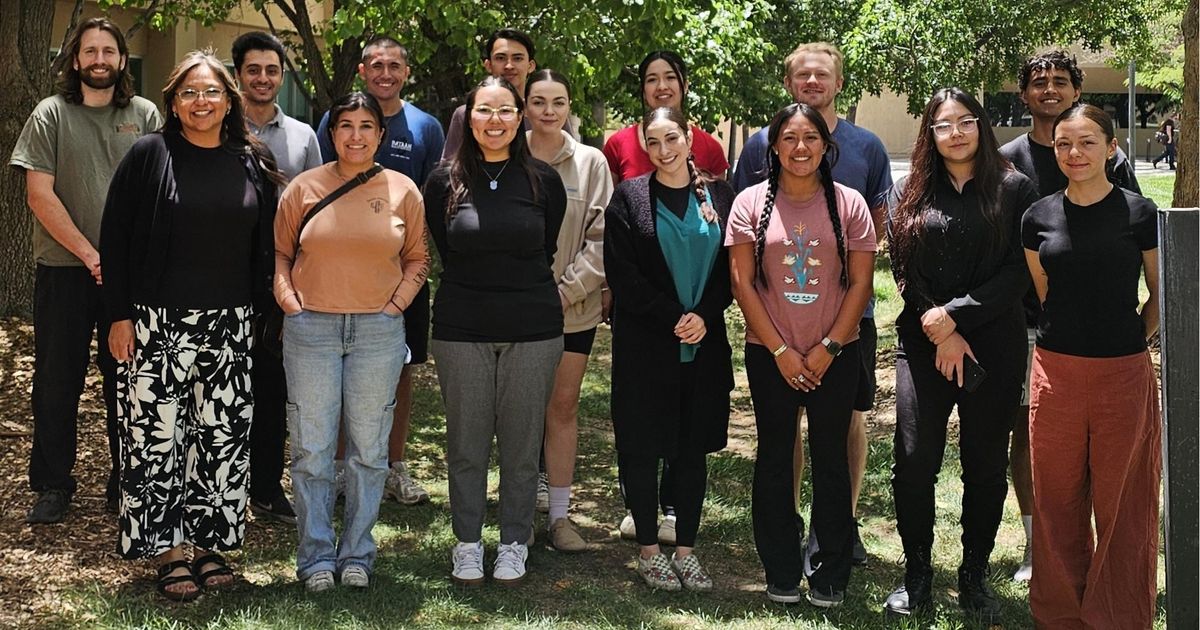
For more than 20 years, the New Mexico Clinical Education Program (ClinEd) has inspired and empowered hundreds of undergraduate and post-baccalaureate students to become the next generation of rural healthcare providers.
ClinEd is one of many Communities to Careers (C2C) healthcare pathway programs hosted by The University of New Mexico Health Sciences Office for Diversity, Equity & Inclusion – created to prepare participants to serve rural and underserved communities throughout the state
I’m excited to take my knowledge from the classroom into a physical clinical setting and to see what it takes to truly care for patients, connect with them, and strengthen my emotional intelligence
– Ingrid Luevano, Student & ClinEd Participant
Students accepted into the ClinEd program are assigned to a clinic and shadow under the supervision of a healthcare provider for six weeks. Focus areas include:
- Community outreach and patient education
- Intake procedures, physical exams, diagnoses, and treatments
- Emergency medical services
- Laboratory, pharmacy, and x-ray
- Administration, business management, and medical records
Alongside the day-to-day administration of the clinic, students are also immersed within the communities themselves. The ClinEd program introduces and reaffirms to students the principles of cultural humility and patient-centered models of care
A ClinEd Love Story
Rina Patel Trujillo, DO, and Miguel Trujillo, MD, were among the first students to go through the ClinEd program when it was established in 2002. They met in a UNM research program a year before receiving their ClinEd assignments
Miguel – who grew up in Española – was placed at a clinical site in Columbus. Rina – who grew up in Gallup – was placed at a clinical site in Española
From Left: Miguel Trujillo, MD, and Rina Patel Trujillo, DO
Rina recollected her experience staying at Miguel’s family home during her time in ClinEd
“They [Miguel’s parents] lived right across the street from the hospital,” she said. “I just had a great clinical experience. I went to all the little towns here in northern New Mexico with the provider that I was working with. Fast forward twenty plus years, she now refers her patients to me.”
Miguel recalled his own memories with his supervisory clinician while shadowing in Columbus
“It was rural, and it was great,” he said. “I got to learn a lot about southern New Mexico. What I learned there, it’s not always necessarily about what you have. It’s about how you approach medicine and how you communicate with patients, and what your relationship is with patients.”
Patient-centered care in a rural setting resonated deeply with both ClinEd alumni, whose relationship grew alongside their medical careers, eventually leading to their marriage and family
From Left: Rina Patel Trujillo, DO, and Miguel Trujillo, MD
Today, the Trujillos not only serve together as rural healthcare physicians at Presbyterian Española Hospital, but also as preceptors for current ClinEd participants; sharing their firsthand experiences both serving and living in a rural community
“We see our patients at Walmart, we see them at grocery stores, we see them at parties. We are truly in this community with them,” Rina said. “ClinEd showed us that it doesn’t have to be ‘Patient number 1, patient number 2, patient number 3. It could be ‘Patient David, patient Syl patient. We get to know our patients, and we are continuously building these relationships that mean something.”
A New Generation of Learners: The ClinEd Experience Comes Full Circle
Ingrid Luevano, student & ClinEd participant
One of Rina’s incoming ClinEd participants is Ingrid Luevano, a pre-med student from Santa Fe who graduated May 2026 from the University of Portland. She applied to the UNM program with the hopes of gaining hands-on, community-centered clinical experience to serve rural and underserved populations. Now she will have that opportunity at Presbyterian Española Hospital
“I’ve heard great things about [Rina Patel Trujillo, DO]. I want to learn how she connects with patients as a compassionate healthcare provider,” Luevano said. “I’m excited to take my knowledge from the classroom into a physical clinical setting and to see what it takes to truly care for patients, connect with them, and strengthen my emotional intelligence. I value curiosity, respect, reliability, teamwork, and a commitment to service, and I hope to demonstrate and further develop these qualities through this experience to reinforce my desire to pursue a healthcare career in the long run.”
Being a first-generation student with family originating from Mexico, Luevano explained that she wants to bring kindness into her work with underserved communities. Additionally, Luevano wanted to send a message to students who come from similar backgrounds as herself:
“No matter what opportunity it is, just take it, even if you’re scared,” she said. “You never know what it’s going to be like until you’re there and you get to experience it. Every door that opens is an opportunity for you to grow and to explore different areas.”
Lasting words of encouragement to students interested in pursuing health careers in underserved areas across New Mexico also come from Rina and Miguel
“Step outside your comfort zone and seek the experience that might be completely new or foreign to you,” Miguel said. “Make yourself a little bit uncomfortable at times. It’ll just help you grow so much. Put yourself in a different situation, a unique situation. That way you can learn a new perspective of the world. Albuquerque and Santa Fe are very different from Columbus and Espanola, New Mexico.”
“Keep an open mind,” Rina added. “You never know where your experiences will take you.”
To get involved with the UNM Health Sciences Office for Diversity, Equity & Inclusion’s ClinEd Program, emailHSC-Diversity@salud.unm.edu, call 505-272-2728, orclick here for more information
Banner and Thumbnail Images:Participants in the 2026 ClinEd program, hosted by The University of New Mexico Health Sciences Office for Diversity, Equity & Inclusion
Categories:Patient Care,
Education,
Community,
News You Can Use,
Diversity,
Communities to Careers
