


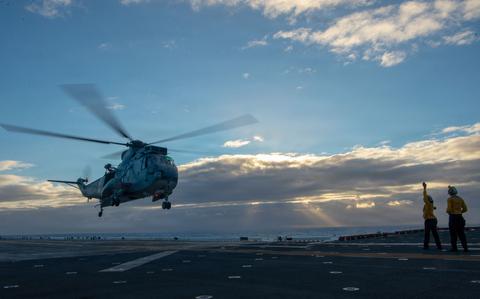
A Peru Pisco, departs from the USS Essex during an amphibious assault drill on Oahu, Hawaii, during the Rim of the Pacific exercise on July 26, 2026. (Kenyatta Headley/U.S. Navy)
Personnel from the 30 nations participating in the six-week Rim of the Pacific exercise in Hawaii completed more than 500 maritime drills, flew 2,400 sorties and sank two decommissioned warships, its commander said Wednesday
RIMPAC, which concludes Friday, featured more than 5,000 realistic “scenario-based problem sets” intended to strengthen combined-force readiness across the domains of sea, air, cyber and amphibious, Vice Adm. Jeffrey Jablon of U.S. Pacific Fleet told reporters during a conference
More than 30,000 personnel, 31 surface ships, five submarines and about 190 aircraft took part, said Jablon, who commands RIMPAC’s combined task force
Units from Australia, Canada, Italy, Japan, New Zealand, Spain and the U.S. Navy, Air Force, and Army were involved in targeting and sinking the two ship hulls at sea
The former USS Mobile Bay, a Ticonderoga-class guided missile cruiser, was sunk on July 12. The ship had been decommissioned three years ago after 36 years of service
The cruiser was hit by torpedoes from the Canadian submarine HMCS Corner Brook; missiles from a High Mobility Artillery Rocket System, or HIMARS, operated jointly by U.S. and Japanese soldiers; and Spike guided missiles fired from a pair of U.S. Army AH-64 Apache helicopters
The former USS Peleliu, a Tarawa-class amphibious assault ship, was sunk July 17. It was decommissioned 11 years ago after 35 years of service
The hulk was struck by Harpoon missiles fired by the Los Angeles-class submarine USS Columbia, the Japan Maritime Self-Defense Force’s guided-missile destroyer JS Kongo and the Spanish frigate ESPS Alvaro De Bazan
Both ships went down in waters 15,000 feet deep more than 50 nautical miles off the northern coast of the Hawaiian island of Kauai 3rd Fleet, which organizes the biennial drills
Spanish frigate ESPS Alvaro De Bazan launches a Harpoon missile at the hulk of decommissioned amphibious assault ship USS Peleliu during a combined sinking exercise in the Pacific Ocean as part of the Rim of the Pacific exercise on July 17, 2026. (Spanish navy)
High surf churned up by passing Hurricane Fausto changed a scheduled amphibious assault on beaches at Bellows Air Force Station on Oahu’s windward side to an air assault instead. The troops came ashore July 25-26 in helicopters rather than large landing craft
Jablon deemed the modified operation a success
“Our culminating amphibious operations, led by Peru, validated integrated planning, ship-to-shore movement, and combined effects across the maritime, air and land domains,” he told reporters
Peru’s leadership of the amphibious task force was a first for any Latin American navy, Jablon said
This year’s drills also showcased “historic leadership milestones,” he said
For the first time, South Korea commanded the exercise’s combined-force maritime component. And, for the first time, the Philippine coast guard participated with an offshore patrol vessel, Jablon said
Experimentation during the exercise focused on fully integrating 3D printing with autonomous drone delivery of components to ships at sea
The amphibious assault ship USS Essex achieved a first when a 10-foot-long fully autonomous Typhoon water surface drone found the ship at sea and docked in its well deck while the Essex was moving at 10 knots
Aboard the ship, 3D-printed parts delivered by the Typhoon were unloaded, replaced with other cargo to be sent ashore
In another milestone experiment, San Diego-based Firestorm Labs successfully deployed its containerized xCell 3D printing platform aboard the Essex, operating times in waves up to 12 feet high
The platform produced more than a thousand parts for the Navy, Marines, Coast Guard and the Army while underway
Navy
Asia/Pacific
Hawaii
Wyatt Olson
Wyatt Olson
Wyatt Olson is based in the Honolulu bureau, where he has reported on military and security issues in the Indo-Pacific since 2014. He was Stars and Stripes’ roving Pacific reporter from 2011-2013 while based in Tokyo. He was a freelance writer and journalism teacher in China from 2006-2009.
