


[Sportschosun, Jang Jong-ho] A recent animal study has found that tirzepatide, which is increasingly being used as an obesity treatment, improves weight, fatty liver and blood sugar levels, but does not sufficiently reduce inflammation and fibrosis in adipose tissue
A research team led by Professor Seo Mi-hye of the Department of Endocrinology and Metabolism at Soonchunhyang University Seoul Hospital, together with Professors Park Hyung-gyu and Seo Kyo-il, reported the findings in a paper published in the Korean Endocrine Society journal, ‘Endocrinology and Metabolism.’ The paper is titled ‘Persistent Adipose Inflammation Despite Metabolic Recovery Reveals Tissue-Specific Immunomodulation by Tirzepatide.’
Working with Professor Jo Gye-won’s team at the Soonchunhyang Institute of Biomedical Science (SIMS), Seo’s team administered tirzepatide to mice made obese through a high-fat diet for 25 days. They then closely compared changes in inflammation and fibrosis in adipose tissue with those in liver tissue through tissue staining, gene expression analysis and flow cytometry
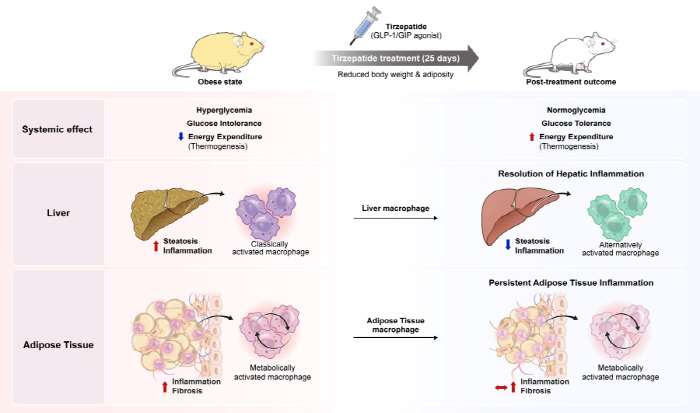
The results showed that obese mice treated with tirzepatide experienced significant reductions in body weight and body fat, while energy expenditure also increased. Hyperglycemia and impaired glucose tolerance also returned to normal levels, confirming anti-obesity and anti-diabetic effects. In contrast, in adipose tissue, immune cell infiltration, collagen accumulation and activation of fibrosis-related signaling pathways remained unchanged even after weight loss
The same pattern was observed in an additional experiment involving severely obese mice, even when body weight was reduced by more than 20 percent. Under the same conditions, inflammation and fibrosis in liver tissue improved markedly, indicating that the same drug can produce different responses depending on the tissue
While liver macrophages responded to the drug with reduced inflammation, macrophages residing in adipose tissue were already activated by chronic metabolic stress and showed a weaker response to treatment. The research team interpreted this difference as a factor behind the persistence of inflammation in adipose tissue
Professor Seo Mi-hye said, “Tirzepatide is an effective drug for improving body weight and blood sugar, but this study confirmed that inflammation and fibrosis in adipose tissue are not sufficiently resolved by weight loss alone.” She added, “Further research is needed to determine what changes occur in tissue remodeling, including inflammation and fibrosis in adipose tissue, during long-term administration.”
Jang Jong-ho, bellho@sportschosun.com
