


Abstract
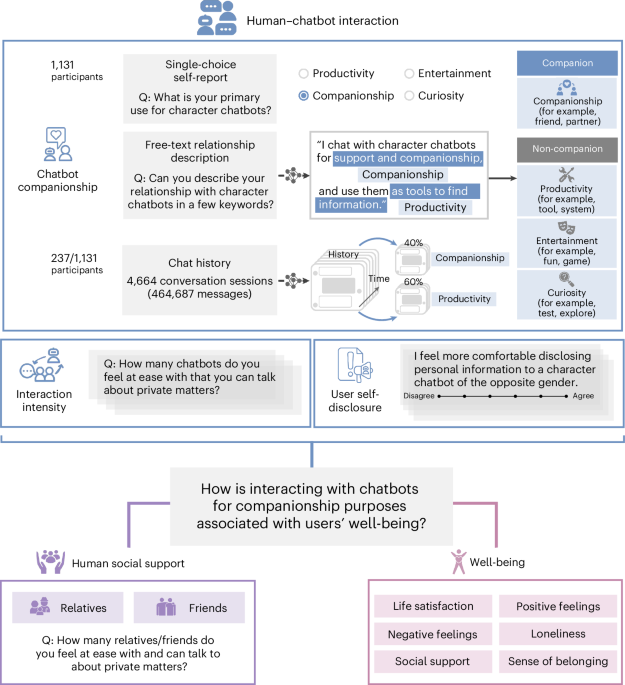
As large-language-model-enhanced chatbots become increasingly expressive and socially responsive, many users begin forming companionship-like bonds with them. This study investigates how using AI companions relates to psychological well-being. We collected self-reported data from 1,131 US adults who use Character.AI, including survey responses and 4,664 chat sessions (464,687 messages) from 237 participants. By triangulating self-reported usage, relationship descriptions and real chat histories, we identify patterns of engagement and associated outcomes. Smaller social networks were associated with reporting companionship as the primary chatbot use (β = −0.03; 95% confidence interval (CI), (−0.05, −0.01)), which in turn was associated with lower well-being (β = −0.48; 95% CI, (−0.70, −0.25)). For self-reported companionship usage, this association was stronger when interactions were intensive (β = −0.31; 95% CI, (−0.56, −0.06)) and highly disclosive (β = −0.38; 95% CI, (−0.63, −0.14)). These results suggest that the association between AI companionship and well-being is not uniform and depends on users’ offline social environments and how chatbots are used.
This is a preview of subscription content, access
Access options
Access through your institution
- Purchase on SpringerLink
- Instant access to the full article PDF.
39,95 €
Prices may be subject to local taxes which are calculated during checkout
Data availability
The de-identified quantitative data are available via GitHub at https://github.com/SALT-NLP/AI-companionship-well-being. For the qualitative data, raw chat history data are not publicly available because they contain potentially sensitive personal information and were collected under consent agreements that do not permit data sharing. Even after de-identification, the conversational nature of the data poses a substantial risk of participant re-identification. To support interpretation and verification of the qualitative findings while preserving participant privacy, we provide de-identified and processed materials as well as the prompts we used in the Supplementary Information, including all the prompts (Supplementary Information sections 1.11–1.15), evaluation procedures for the topic modelling pipeline (Supplementary Information section 1.4.1), chatbot–user conversation topics (Supplementary Information section 1.5) and self-disclosure topics (Supplementary Information section 1.6), as well as positive and negative influence topics derived from topic modelling (Supplementary Information section 1.7), illustrated with paraphrased excerpts from participant self-report survey responses. We also include the topic model figure (Fig. 4) to show the categories derived from the data and their relative volumes.
Code availability
The code that supports the findings of this study is availablebeing
References
Erikson, E. H. Identity: Youth and Crisis Vol. 7 (Norton, 1968)
Cobb, S. Social support as a moderator of life stress. Biopsychosoc. Sci. Med.38, 300–314 (1976)
CAS
Google ScholarHouse, J. S. Work Stress and Social Support Addison-Wesley Series on Occupational Stress (Addison-Wesley, 1983)
Lin, N., Ensel, W. M., Simeone, R. S. & Kuo, W. Social support, stressful life events, and illness: a model and an empirical test. J. Health Soc. Behav.20, 108–119 (1979)
Holt-Lunstad, J., Smith, T. B. & Layton, J. B. Social relationships and mortality risk: a meta-analytic review. PLoS Med.7, 1000316 (2010)
Baumeister, R. F. & Leary, M. R. The need to belong: desire for interpersonal attachments as a fundamental human motivation. Interpers. Dev.117, 57–89 (2017)
Bowlby, J. Attachment and Loss Vol. 79 (Random House, 1969)
Deci, E. L. & Ryan, R. M. The ‘what’ and ‘why’ of goal pursuits: human needs and the self-determination of behavior. Psychol. Inq.11, 227–268 (2000)
Myers, D. G. The funds, friends, and faith of happy people. Am. Psychol.55, 56–67 (2000)
Prager, K. J. & Buhrmester, D. Intimacy and need fulfillment in couple relationships. J. Soc. Pers. Relat.15, 435–469 (1998)
La Rocco, J. M. & Jones, A. P. Co-worker and leader support as moderators of stress–strain relationships in work situations. J. Appl. Psychol.63, 629–634 (1978)
Williams, A. W., Ware, J. E. & Donald, C. A. A model of mental health, life events, and social supports applicable to general populations. J. Health Soc. Behav.22, 324–336 (1981)
Rook, K. S. The negative side of social interaction: impact on psychological well-being. J. Pers. Soc. Psychol.46, 1097–1108 (1984)
Hudson, N. W., Lucas, R. E. & Donnellan, M. B. Are we happier with others? An investigation of the links between spending time with others and subjective well-being. J. Pers. Soc. Psychol.119, 672–694 (2020)
Mehl, M. R., Vazire, S., Holleran, S. E. & Clark, C. S. Eavesdropping on happiness: well-being is related to having less small talk and more substantive conversations. Psychol. Sci.21, 539–541 (2010)
Milek, A. et al. ‘Eavesdropping on happiness’ revisited: a pooled, multisample replication of the association between life satisfaction and observed daily conversation quantity and quality. Psychol.Sci.29, 1451–1462 (2018)
Fiorillo, D. & Sabatini, F. Quality and quantity: the role of social interactions in self-reported individual health. Soc. Sci. Med.73, 1644–1652 (2011)
Diener, E. & Seligman, M. E. Very happy people. Psychol. Sci.13, 81–84 (2002)
Watanabe, J.-I., Atsumori, H. & Kiguchi, M. Informal face-to-face interaction improves mood state reflected in prefrontal cortex activity. Front. Hum. Neurosci.10, 194 (2016)
Watson, D., Clark, L. A. & Tellegen, A. Development and validation of brief measures of positive and negative affect: the PANAS scales. J. Pers. Soc. Psychol.54, 1063–1070 (1988)
Kraut, R. et al. Internet paradox: a social technology that reduces social involvement and psychological well-being? Am. Psychol.53, 1017–1031 (1998)
Ellison, N. B., Steinfield, C. & Lampe, C. The benefits of Facebook ‘friends’: social capital and college students’ use of online social network sites. J. Comput. Mediat. Commun.12, 1143–1168 (2007)
Valenzuela, S., Park, N. & Kee, K. F. Is there social capital in a social network site? Facebook use and college students’ life satisfaction, trust, and participation. J. Comput. Mediat. Commun.14, 875–901 (2009)
Hollan, J. & Stornetta, S. Beyond being there. In Proc. SIGCHI Conference on Human Factors in Computing Systems (eds Bauersfeld, P. et al.) 119–125 (Association for Computing Machinery, 1992)
Park, J. S. et al. Generative agents: interactive simulacra of human behavior. In Proc. 36th Annual ACM Symposium on User Interface Software and Technology (eds Follmer, S. et al.) 1–22 (Association for Computing Machinery, 2023)
Park, J. S. et al. Generative agent simulations of 1,000 people. Preprint at https://arxiv.org/abs/2411.10109 (2024)
Pataranutaporn, P. et al. AI-generated characters for supporting personalized learning and well-being. Nat. Mach. Intell.3, 1013–1022 (2021)
Pataranutaporn, P. et al. Future you: a conversation with an AI-generated future self reduces anxiety, negative emotions, and increases future self-continuity. In 2024 IEEE Frontiers in Education Conference (FIE) 1–10 (IEEE, 2024)
Jiang, Q., Zhang, Y. & Pian, W. Chatbot as an emergency exist: mediated empathy for resilienceess. Manage.59, 103074 (2022)
Li, H. & Zhang, R. Finding love in algorithms: deciphering the emotional contexts of close encounters with AI chatbots. J. Comput. Mediat. Commun.29, 015 (2024)
Ta-Johnson, V. P. et al. Assessing the topics and motivating factors behind human–social chatbot interactions: thematic analysis of user experiences. JMIR Hum. Factors9, 38876 (2022)
Brandtzaeg, P. B., Skjuve, M. & Følstad, A. My AI friend: how users of a social chatbot understand their human–AI friendship. Hum. Commun. Res.48, 404–429 (2022)
Guingrich, R. E. & Graziano, M. S. Chatbots as social companions: how people perceive consciousness, human likeness, and social health benefits in machines. In Oxford Intersections: AI in Society (eds Hacker, P. & Shevlin, H.) (Oxford Academic, 2025)
Pathak, A. AI chatbots and interpersonal communication: a study on uses and gratification amongst youngsters. IIS Univ. J. Arts13, 355–366 (2024)
Roose, K. Can A.I. be blamed for a teen’s suicide? New York Timeshttps://www.nytimes.com/2024/10/23/technology/characterai-lawsuit-teen-suicide.html (23 October 2024)
Ta, V. et al. User experiences of social support from companion chatbots in everyday contexts: thematic analysis. J. Med. Internet Res.22, 16235 (2020)
Skjuve, M., Følstad, A., Fostervold, K. I. & Brandtzaeg, P. B. My chatbot companion—a study of human–chatbot relationships. Int. J. Hum. Comput. Stud.149, 102601 (2021)
Loveys, K., Fricchione, G., Kolappa, K., Sagar, M. & Broadbent, E. Reducing patient loneliness with artificial agents: design insights from evolutionary neuropsychiatry. J. Med. Internet Res.21, 13664 (2019)
Gasteiger, N., Loveys, K., Law, M. & Broadbent, E. Friends from the future: a scoping review of research into robots and computer agents to combat loneliness in older people. Clin. Interv. Aging16, 941–971 (2021)
De Freitas, J., Oğuz-Uğuralp, Z., Uğuralp, A. K. & Puntoni, S. AI companions reduce loneliness. J. Consum. Res.52, 1126–1146 (2025)
Maples, B., Cerit, M., Vishwanath, A. & Pea, R. Loneliness and suicide mitigation for students using GPT3-enabled chatbots. npj Ment. Health Res.3, 4 (2024)
Smith, M. G., Bradbury, T. N. & Karney, B. R. Can generative AI chatbots emulate human connection? A relationship science perspective. Perspect. Psychol. Sci.20, 1081–1099 (2025)
Croes, E. A., Antheunis, M. L., Goudbeek, M. B. & Wildman, N. W. ‘I am in your computer while we talk to each other’: a content analysis on the use of language-based strategies by humans and a social chatbot in initial human–chatbot interactions. Int. J. Hum. Comput. Interact.39, 2155–2173 (2023)
Sharma, M. et al. Towards understanding sycophancy in language models. In Proc. International Conference on Learning Representations (eds Kim, B. et al.) 110–144 (ICLR, 2024)
Malmqvist, L. Sycophancy in large language models: causes and mitigations. In Intelligent Computing—Proceedings of the Computing Conference (ed. Arai, K.) 61–74 (Springer, 2025)
Gerken, T. Update that made ChatGPT ’dangerously’ sycophantic pulled. BBChttps://www.bbc.com/news/articles/cn4jnwdvg9qo (30 April 2025)
Sycophancy in GPT-4o: what happened and what we’re doing about it. OpenAIhttps://openai.com/index/sycophancy-in-gpt-4o/ (29 April 2025)
Krook, J. Manipulation and the AI act: large language model chatbots and the danger of mirrors. Preprint at https://arxiv.org/abs/2503.18387 (2025)
Rosenberg, L. The manipulation problem: conversational AI as a threat to epistemic agency. Preprint at https://arxiv.org/abs/2306.11748 (2023)
Chen, Q., Yin, C. & Gong, Y. Would an AI chatbot persuade you: an empirical answer from the elaboration likelihood model. Inf. Technol. People38, 937–962 (2025)
Ischen, C., Araujo, T., Noort, G., Voorveld, H. & Smit, E. ‘I am here to assist you today’: the role of entity, interactivity and experiential perceptions in chatbot persuasion. J. Broadcast. Electron. Media64, 615–639 (2020)
Kerr, I. R. Bots, babes and the californication of commerce. Univ. Ottawa L. Tech. J.1, 285–325 (2003)
Fang, C. M. et al. How AI and human behaviors shape psychosocial effects of chatbot use: a longitudinal randomized controlled study. Preprint at https://arxiv.org/abs/2503.17473 (2025)
Turkle, S. Alone Together: Why We Expect More from Technology and Less from Each Other (Basic Books, 2011)
Laestadius, L., Bishop, A., Gonzalez, M., Illenčík, D. & Campos-Castillo, C. Too human and not human enough: a grounded theory analysis of mental health harms from emotional dependence on the social chatbot Replika. New Media Soc.26, 5923–5941 (2024)
Hill, K. She is in love with ChatGPT. New York Timeshttps://www.nytimes.com/2025/01/15/technology/ai-chatgpt-boyfriend-companion.html (15 January 2025)
Pentina, I., Hancock, T. & Xie, T. Exploring relationship development with social chatbots: a mixed-method study of replika. Comput. Hum. Behav.140, 107600 (2023)
Macía, L., Jauregui, P. & Estevez, A. Emotional dependence as a predictor of emotional symptoms and substance abuse in individuals with gambling disorder: differential analysis by sex. Public Health223, 24–32 (2023)
Castillo-Gonzáles, M., Mendo-Lázaro, S., León-del-Barco, B., Terán-Andrade, E. & López-Ramos, V.-M. Dating violence and emotional dependence in university students. Behav. Sci.14, 176 (2024)
Tomaz Paiva, T., Silva Lima, K. & Gomes Cavalcanti, J. Psychological abuse, self-esteem and emotional dependence of women during the COVID-19 pandemic. Cienc. Psicol.16, 1–15 (2022)
Landymore, F. Teens are forming intense relationships with AI entities, and parents have no idea. Futurismhttps://futurism.com/the-byte/teens-relationships-ai (3 December 2024)
Dupré, M. H. Character.AI is hosting pedophile chatbots that groom users who say they’re underage. Futurismhttps://futurism.com/character-ai-pedophile-chatbots (13 November 2024)
Dupré, M. H. Character.AI is hosting pro-anorexia chatbots that encourage young people to engage in disordered eating. Futurismhttps://futurism.com/character-ai-eating-disorder-chatbots (25 November 2024)
Upton-Clark, E. Character.AI is under fire for hosting pro-anorexia chatbots. Fast Companyhttps://www.fastcompany.com/91241586/character-ai-is-under-fire-for-hosting-pro-anorexia-chatbots (6 December 2024)
Dupré, M. H. AI chatbots are encouraging teens to engage in self-harm. Futurismhttps://futurism.com/ai-chatbots-teens-self-harm (7 December 2024)
Xiang, C. ’He would still be here’: man dies by suicide after talking with AI chatbot, widow says. Vicehttps://www.vice.com/en/article/man-dies-by-suicide-after-talking-with-ai-chatbot-widow-says/ (30 March 2023)
Dupré, M. H. Character.AI promises changes after revelations of pedophile and suicide bots on its service. Futurismhttps://futurism.com/character-ai-pedophile-suicide-bots (14 November 2024)
Weaver, M. AI chatbot ‘encouraged’ man who planned to kill queen, court told. Guardianhttps://www.theguardian.com/uk-news/2023/jul/06/ai-chatbot-encouraged-man-who-planned-to-kill-queen-court-told (6 July 2023)
Adam, D. Supportive? Addictive? Abusive? How AI companions affect our mental health. Nature641, 296–298 (2025)
Xie, Z., Hui, H. & Wang, L. Will virtual companionship enhance subjective well-being—a comparison of cross-cultural context. Int. J. Soc. Robot.16, 2153–2167 (2024)
Liu, A. R., Pataranutaporn, P. & Maes, P. Chatbot companionship: a mixed-methods study of companion chatbot usage patterns and their relationship to loneliness in active users. Preprint at https://arxiv.org/abs/2410.21596 (2024)
Chu, M. D., Gerard, P., Pawar, K., Bickham, C. & Lerman, K. Illusions of intimacy: emotional attachment and emerging psychological risks in human–AI relationships. Preprint at https://arxiv.org/abs/2505.11649 (2025)
Farzan, M., Ebrahimi, H., Pourali, M. & Sabeti, F. Artificial intelligence-powered cognitive behavioral therapy chatbots, a systematic review. Iran. J. Psychiatry20, 102–110 (2025)
Wang, Y. et al. Evaluating an LLM-powered chatbot for cognitive restructuring: insights from users and mental health professionals. ACM Trans. Comput. Healthcarehttps://doi.org/10.1145/3820038 (Association for Computing Machinery, 2026)
Omarov, B., Narynov, S. & Zhumanov, Z. Artificial intelligence-enabled chatbots in mental health: a systematic review. Comput. Mater. Contin.74, 5105–5122 (2023)
Li, H., Zhang, R., Lee, Y.-C., Kraut, R. E. & Mohr, D. C. Systematic review and meta-analysis of AI-based conversational agents for promoting mental health and well-being. NPJ Digit. Med.6, 236 (2023)
Brandtzaeg, P. B. & Følstad, A. Why people use chatbots. In International Conference on Internet Science (eds Kompatsiaris, I. et al.) 377–392 (Springer, 2017)
Wiederhold, B. K. The rise of AI companions and the quest for authentic connection. Cyberpsychol. Behav. Soc. Netw.27, 524–526 (2024)
Lim, M. Y. Memory models for intelligent social companions. In Human–Computer Interaction: The Agency Perspective (eds. Zacarias, M. & de Oliveira, J. V.) 241–262 (Springer, 2012)
Merrill Jr, K., Kim, J. & Collins, C. AI companions for lonely individuals and the role of social presence. Commun. Res. Rep.39, 93–103 (2022)
Chaturvedi, R., Verma, S., Das, R. & Dwivedi, Y. K. Social companionship with artificial intelligence: recent trends and future avenues. Technol. Forecast. Soc. Change193, 122634 (2023)
Pham, C. M., Hoyle, A., Sun, S., Resnik, P. & Iyyer, M. TopicGPT: a prompt-based topic modeling framework. In Proc. 2024 Conference of the North American Chapter of the Association for Computational Linguistics: Human Language Technologies (Volume 1: Long Papers) (eds Duh, K. et al.) 2956–2984 (Association for Computational Linguistics, 2024)
Ledbetter, A. M. Measuring online communication attitude: instrument development and validation. Commun. Monogr.76, 463–486 (2009)
Lubben, J. et al. Performance of an abbreuropean community-dwelling older adult populations. Gerontologist46, 503–513 (2006)
Su, R., Tay, L. & Diener, E. The development and validation of the Comprehensive Inventory of Thriving (CIT) and the Brief Inventory of Thriving (BIT). Appl. Psychol. Health Well Being6, 251–279 (2014)
Umberson, D. & Karas Montez, J. Social relationships and health: a flashpoint for health policy. J.Health Soc. Behav.51, 54–66 (2010)
Berkman, L. F. & Syme, S. L. Social networks, host resistance, and mortality: a nine-year follow-up study of Alameda County residents. Am. J. Epidemiol.109, 186–204 (1979)
Cohen, S. Social relationships and health. Am. Psychol.59, 676–684 (2004)
Leo-Liu, J. Loving a ‘defiant’ AI companion? The gender performance and ethics of social exchange robots in simulated intimate interactions. Comput. Hum. Behav.141, 107620 (2023)
Danaher, J. & McArthur, N. Robot Sex: Social and Ethical Implications (MIT Press, 2017)
Baxter, L. A. Relationships as dialogues. Pers. Relat.11, 1–22 (2004)
Purington, A., Taft, J. G., Sannon, S., Bazarova, N. N. & Taylor, S. H. “Alexa is my new bff”: social roles, user satisfaction, and personification of the Amazon Echo. In Proc. 2017 CHI Conference Extended Abstracts on Human Factors in Computing Systems (eds Mark, G. et al.) 2853–2859 (Association for Computing Machinery, 2017)
Kraut, R. et al. Internet paradox revisited. J. Soc. Issues58, 49–74 (2002)
Teppers, E., Luyckx, K., Klimstra, T. A. & Goossens, L. Loneliness and facebook motives in adolescence: a longitudinal inquiry into directionality of effect. J. Adolesc.37, 691–699 (2014)
Lee, K.-T., Noh, M.-J. & Koo, D.-M. Lonely people are no longer lonely on social networking sites: the mediating role of self-disclosure and social support. Cyberpsychol. Behav. Soc. Netw.16, 413–418 (2013)
Tian, Q. Social anxiety, motivation, self-disclosure, and computer-mediated friendship: a path analysis of the social interaction in the blogosphere. Commun. Res.40, 237–260 (2013)
Weidman, A. C. et al. Compensatory internet use among individuals higher in social anxiety and its implications for well-being. Pers. Individ. Differ.53, 191–195 (2012)
Hood, M., Creed, P. A. & Mills, B. J. Loneliness and online friendships in emerging adults. Pers. Individ.Differ.133, 96–102 (2018)
Verduyn, P., Ybarra, O., Résibois, M., Jonides, J. & Kross, E. Do social network sites enhance or undermine subjective well-being? A critical review. Soc. Issues Policy Rev.11, 274–302 (2017)
Roberts, J. A. & David, M. E. Instagram and Tiktok flow states and their association with psychological well-being. Cyberpsychol. Behav. Soc. Netw.26, 80–89 (2023)
Bazarova, N. N. Public intimacy: disclosure interpretation and social judgments on Facebook. J. Commun.62, 815–832 (2012)
Utz, S. The function of self-disclosure on social network sites: not only intimate, but also positive and entertaining self-disclosures increase the feeling of connection. Comput. Hum. Behav.45, 1–10 (2015)
Deters, F. G. & Mehl, M. R. Does posting Facebook status updates increase or decrease loneliness? An online social networking experiment. Soc. Psychol. Pers. Sci.4, 579–586 (2013)
Luo, M. & Hancock, J. T. Self-disclosure and social media: motivations, mechanisms and psychological well-being. Curr. Opin. Psychol.31, 110–115 (2020)
Bickmore, T. & Cassell, J. Relational agents: a model and implementation of building user trust. In Proc. SIGCHI Conference on Human Factors in Computing Systems (eds Jacko, J. A. & Sears, A.) 396–403 (Association for Computing Machinery, 2001)
Jiang, L. C., Bazarova, N. N. & Hancock, J. T. The disclosure–intimacy link in computer-mediated communication: an attributional extension of the hyperpersonal model. Hum. Commun. Res.37, 58–77 (2011)
Vogel, D. L. & Wester, S. R. To seek help or not to seek help: the risks of self-disclosure. J. Couns. Psychol.50, 351 (2003)
Chen, H. Antecedents of positive self-disclosure online: an empirical study of US college students’ Facebook usage. Psychol. Res. Behav. Manage.10, 147–153 (2017)
Lin, H. & Qiu, L. Sharing emotion on Facebook: network size, density, and individual motivation. In CHI’12 Extended Abstracts on Human Factors in Computing Systems (eds Konstan, J. A. et al.) 2573–2578 (Association for Computing Machinery, 2012)
Gil-Or, O., Levi-Belz, Y. & Turel, O. The ‘Facebook-self’: characteristics and psychological predictors of false self-presentation on Facebook. Front. Psychol.6, 99 (2015)
Reece, A. G. & Danforth, C. M. Instagram photos reveal predictive markers of depression. EPJ Data Sci.6, 15 (2017)
Balani, S. & De Choudhury, M. Detecting and characterizing mental health related self-disclosure in social media. In Proc. 33rd Annual ACM Conference Extended Abstracts on Human Factors in Computing Systems (eds Begole, B. et al.) 1373–1378 (Association for Computing Machinery, 2015)
Morina, N., Kip, A., Hoppen, T. H., Priebe, S. & Meyer, T. Potential impact of physical distancing on physical and mental health: a rapid narrative umbrella review of meta-analyses on the link between social connection and health. BMJ Open11, 042335 (2021)
Holt-Lunstad, J. Social connection as a critical factor for mental and physical health: evidence, trends, challenges, and future implications. World Psychiatry23, 312–332 (2024)
Godard, R. & Holtzman, S. Are active and passive social media use related to mental health, wellbeing, and social support outcomes? A meta-analysis of 141 studies. J. Comput. Mediat. Commun.29, 055 (2024)
Zhang, R. et al. The dark side of AI companionship: a taxonomy of harmful algorithmic behaviors in human–AI relationships. In Proc. 2025 CHI Conference on Human Factors in Computing Systems (eds Yamashita, N. et al.) 1–17 (Association for Computing Machinery, 2025)
Madianou, M. Nonhuman humanitarianism: when ‘AI for good’ can be harmful. Inf. Commun. Soc.24, 850–868 (2021)
Weidinger, L. et al. Ethical and social risks of harm from language models. Preprint at https://arxiv.org/abs/2112.04359 (2021)
Ernala, S. K., Burke, M., Leavitt, A. & Ellison, N. B. Mindsets matter: how beliefs about Facebook moderate the association between time spent and well-being. In Proc. 2022 CHI Conference on Human Factors in Computing Systems (eds Barbosa, S. D. J. et al.) 1–13 (Association for Computing Machinery, 2022)
Vanden Abeele, M. M. et al. Does Facebook use predict college students’ social capital? A replication of Ellison, Steinfield, and Lampe’s (2007) study using the original and more recent measures of Facebook use and social capital. Commun. Stud.69, 272–282 (2018)
Burke, M., Kraut, R. & Marlow, C. Social capital on Facebook: differentiating uses and users. In Proc. SIGCHI Conference on Human Factors in Computing Systems (eds Tan, D. et al.) 571–580 (Association for Computing Machinery, 2011)
Collins, N. L. & Miller, L. C. Self-disclosure and liking: a meta-analytic review. Psychol. Bull.116, 457–475 (1994)
Oswald, D. L., Clark, E. M. & Kelly, C. M. Friendship maintenance: an analysis of individual and dyad behaviors. J. Soc. Clin. Psychol.23, 413–441 (2004)
Hendrick, S. S. Self-disclosure and marital satisfaction. J. Pers. Soc. Psychol.40, 1150–1159 (1981)
Zell, A. L. & Moeller, L. Are you happy for me…on Facebook? The potential importance of ‘likes’ and comments. Comput. Hum. Behav.78, 26–33 (2018)
Ellis, D. & Cromby, J. Emotional inhibition: a discourse analysis of disclosure. Psychol. Health27, 515–532 (2012)
Lu, W. & Hampton, K. N. Beyond the power of networks: differentiating network structure from social media affordances for perceived social support. New Media Soc.19, 861–879 (2017)
Yang, D., Yao, Z., Seering, J. & Kraut, R. The channel matters: self-disclosure, reciprocity and social support in online cancer support groups. In Proc. 2019 Chi Conference on Human Factors in Computing Systems (eds Brewster, S. A. et al.) 1–15 (Association for Computing Machinery, 2019)
Acknowledgements
We thank O. Shaikh, Y. Zhang, C. Si, L. Popowski, T. Piccardi, H. Zhu, R. Louie, C. Ziems, J. Huang and W. Liang for their helpful feedback on this work. We also thank members of the Stanford SALT lab and the Stanford CS 224C course for their suggestions at different stages of this project. This work is supported in part by grants from the NSF CAREER IIS-2247357 (D.Y.), ONR N00014-24-1-2532 (D.Y.), Sloan Foundation (D.Y.) and NIMH R01MH139114-01 (D.Y.). D.Z. is supported in part by the Paul and Daisy Soros Fellowship for New Americans. R.K. is supported by NIMH 60663.1.1090827.
Author information
Authors and Affiliations
Department of Computer Science, Stanford University, Stanford, CA, USA
Yutong Zhang, Dora Zhao & Diyi Yang
Department of Communication, Stanford University, Stanford, CA, USA
Jeffrey T. Hancock
School of Computer Science, Carnegie Mellon University, Pittsburgh, PA, USA
Robert Kraut
Authors
- Yutong ZhangView author publications
Search author on:PubMed Google Scholar
- Dora ZhaoView author publications
Search author on:PubMed Google Scholar
- Jeffrey T. HancockView author publications
Search author on:PubMed Google Scholar
- Robert KrautView author publications
Search author on:PubMed Google Scholar
- Diyi YangView author publications
Search author on:PubMed Google Scholar
Contributions
Y.Z. and D.Z. designed the study, collected the data and conducted the data analysis with guidance from D.Y. R.K. and J.T.H. provided guidance on the interpretation of results. Y.Z. wrote the manuscript, and all authors contributed to manuscript revisions
Ethics declarations
Competing interests
The authors declare no competing interests
Peer review
Peer review information
Nature Human Behaviour thanks Minjin Rheu, Tianling Xie and the other, anonymous, reviewer(s) for their contribution to the peer review of this work
Additional information
Publisher’s note Springer Nature remains neutral with regard to jurisdictional claims in published maps and institutional affiliations
Supplementary information
Supplementary Information (download PDF )
Supplementary Tables 1–10, Discussion and Prompts
Reporting Summary (download PDF )
Rights and permissions
Springer Nature or its licensor (e.g. a society or other partner) holds exclusive rights to this article under a publishing agreement with the author(s) or other rightsholder(s); author self-archiving of the accepted manuscript version of this article is solely governed by the terms of such publishing agreement and applicable law
About this article
Cite this article
Zhang, Y., Zhao, D., Hancock, J.T. et al. Interaction with AI companions and psychological well-being.
Nat Hum Behav (2026). https://doi.org/10.1038/s41562-026-02516-2
Received:27 June 2025
Accepted:03 June 2026
Published:04 August 2026
Version of record:04 August 2026
DOI
:https://doi.org/10.1038/s41562-026-02516-2
