


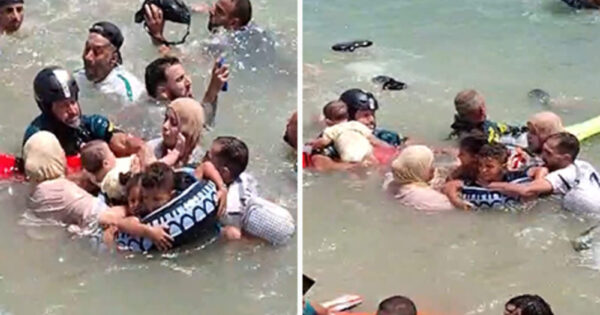
Young children and babies with families were among the 60,000 who entered Ceuta from Morocco last week.
Dripping wet and shivering, many arrived on the shores of the Spanish enclave with the promise of a better life only to be repatriated by the authorities the following day.
News reports earlier this week stated some 88 deaths were registered from this migrant crisis, with numbers expecting to increase according to the Spanish authorities.
A La Linea resident who was in Ceuta for a funeral of a loved one described Thursday’s incident in great detail.
“I was at the crematorium when I started receiving phone calls from my family members asking if we were okay,” she said.
“I started receiving news links of what looked like Ceuta being overcome by thousands of people entering by the sea and
She describes the moment she walked out of the crematorium only to find thousands of young men and boys walking around seeking shelter, food and asking to use mobile phones to help contact their parents and let them know they had reached safely.
“We knew this was not a normal incident and, before things worsened, we went to the supermarket on our way home,” she said.
“There were young boys, some of them maybe around eight or nine years old, on their own, stood there dripping wet, shivering and looking for food.”
“People were offering to get them food or drink, and one person insisted they call their parents to let them know they were safe.”
“I could not believe what I was seeing, but I felt so upset and seeing such young children being allowed to cross into Ceuta on their own.”
“I know there was a feeling of impotence and anger among all of us who came across these young boys because we could not believe they had been waved through into Ceuta without any thought for their safety or wellbeing.”
Although the reasons for last week’s incident are not yet known, Morocco’s Interior ministry said on Sunday that the mass crossings were fuelled by misinformation on social media, human trafficking networks and misinterpretation of a Spanish ruling banning immediate returns of migrants intercepted at sea.
Throughout the past week there have been news interviews with those who entered Ceuta but were ready to go back home.
Many young men interviewed claimed there is nothing to return to in Morocco, while others said they were encouraged to swim into Ceuta for a better life only to find that there was no food or shelter for them so they were ready to go back home.
But the migrant crisis last week provoked 22 European Union member states to call for coordinated border action and Italy to suspend passport-free Schengen travel with Spain.
“On the way to the port on Friday we just saw hundreds, if not thousands, of people just hanging out on the streets with nowhere to go,” the La Linea resident said.
“Many sat on steps and on pavements or just walked around the Ceuta town centre looking for something to do or something to eat.”
“By this time, we saw an increase in military presence coordinating droves of people back to the land border with Morocco.”
“And while at the port they always check our documents on leaving Ceuta, these felt a lot more stringent than they have in the past.”
The conversation soon turned to what fuels the migrant crisis every year.
For years, I have spent hours in Gibraltar’s Magistrates’ Court following the stories of migrants who have arrived on our shores and were subsequently detained by the local authorities until their repatriation.
They spend months, and in some cases years, detained in Windmill Hill pending their deportation while Gibraltar’s law enforcement authorities work with their Moroccan counterparts.
During their court appearances, I have heard so many reasons for making this treacherous journey across the Strait.
These include a better economic future for themselves, some looking for safety, some following the journey of a loved one who has already made their way into mainland Europe or, in one case, a group who claimed to have gone fishing off the North African coastline but were met with trouble at sea and were pushed across the Strait of Gibraltar.
Many were barely adults, others were teenagers and classed as juveniles in Gibraltar’s legal system and, in some rare cases, there were those who were in their 30s or 40s.
The lucky ones have the opportunity to remain in safety until their return, meanwhile many do not survive the journey across.
Over the years, I have received messages on Facebook and on Instagram from families of young men trying find their loved ones with whom they have lost contact.
Desperate pleas of trying to find their partners, cousins, brothers who said goodbye as they departed Morocco never to be heard from again.
The reasons for these crossings have always been nuanced, but to see last week’s incident weaponised by far-right politicians sets a dangerous rhetoric.
At the weekend, Chief Minister Fabian Picardo spoke to Times Radio expressing the Rock’s solidarity with the people of Ceuta, the families of those who died and the Spanish authorities responding to the emergency.
“This is not a moment for political opportunism or alarmist rhetoric,” he said.
“It is a moment for solidarity, responsible leadership and a clear focus on the human lives that have been lost.”
