


This article has been updated to include the full scope of the cost of the hospital.
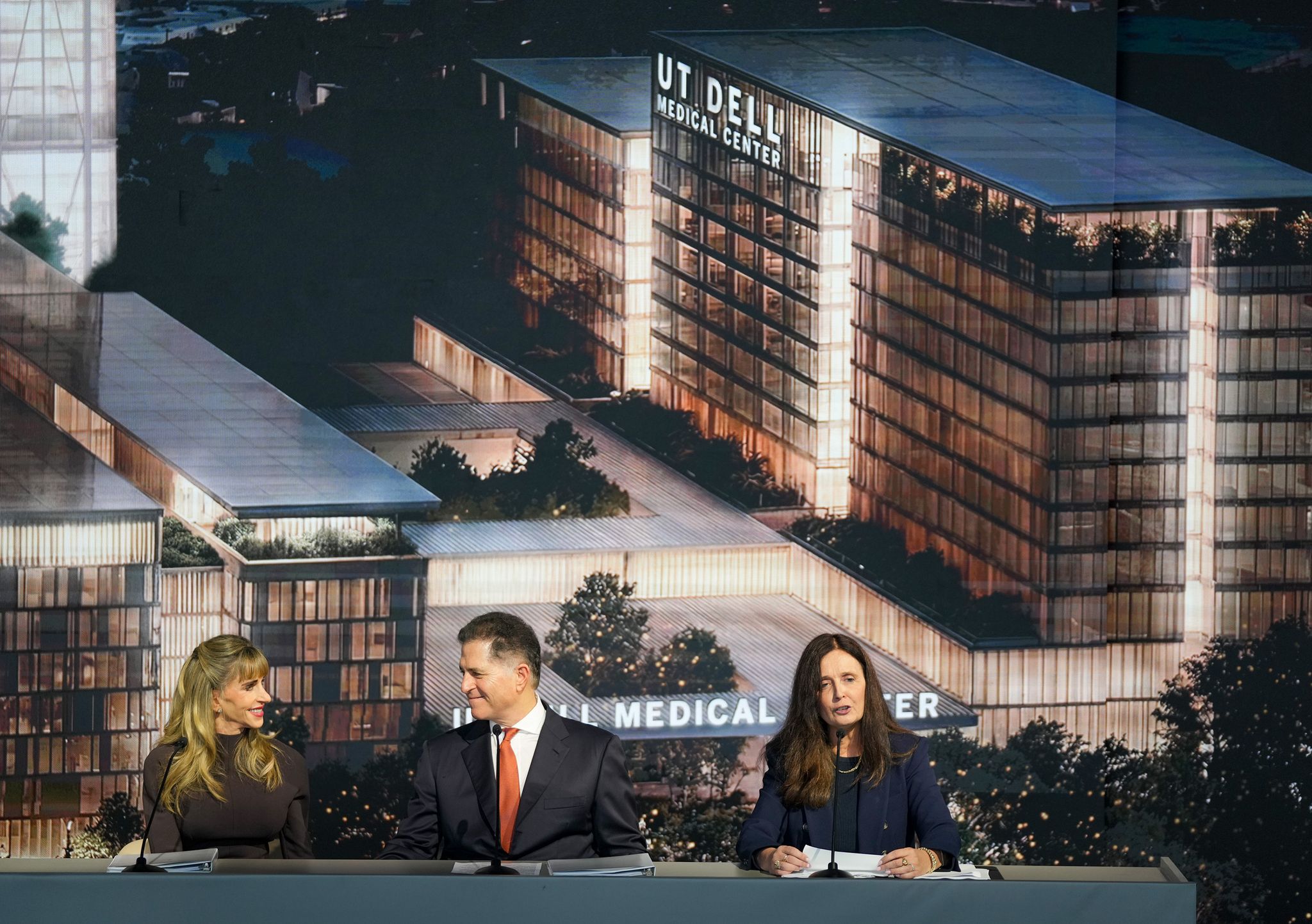
On Wednesday, the University of Texas System Board of Regents’ Facilities Planning and Construction Committee will adopt a timeline and budget for phase one of the much-awaited artificial intelligence-native hospital, UT Dell Medical Center.
Article continues below this ad
Construction on the $5 billion hospital is expected to begin this fall, and initial site preparation could begin within a month after board approval of this first phase, which does not include the actual building but includes design and site preparation as well as equipment that takes time to arrive such as MRIs. The committee’s agenda includes information such as a timeline and the cost of the project, which has not yet been disclosed publicly.
The hospital will include both specialty care and an MD Anderson Cancer Center Central Texas location. UT announced the project in 2023 as a $2.5 billion investment to expand access to high-quality healthcare for Central Texas and bring thousands of jobs to Austin, but when a new site chosen and the hospitals were combined into one, the price tag went up to an estimated $5 billion.
In April, the Michael and Susan Dell Foundation gave UT more than $750 million to build the UT Dell Campus for Advanced Research and the UT Dell Medical Center on the university’s former West Pickle Research Campus in North Austin. The 27-acre site on West Braker Lane and MoPac Boulevard will become the new research campus, not the former Erwin Center, as initially anticipated
Article continues below this ad
“Enabled by a historic philanthropic commitment from Michael and Susan Dell, this once-in-a generation investment will bring together clinical care, research, advanced computing, and medical education in a purpose-built environment,” the project description in the agenda book reads. “The campus is envisioned as a unified ecosystem that connects prevention, diagnosis, treatment, education, and discovery, positioning U.T. Austin at the forefront of innovation while advancing its vision for an integrated academic health system.”
This will be the first hospital in Central Texas fully owned by UT. Dell Medical School has affiliations with Ascension Seton hospitals, including Ascension Medical Center, Dell Children’s Medical Center and Dell Seton Medical Center. Medical students, residents and fellows with the school train at Ascension Seton hospitals.
The campus will include a 2.5 million-gross-square-feet medical center to provide advanced, specialized care for inpatient and outpatient care, the agenda states. Final completion is expected in December 2030
How much will the new UT hospital cost?
The committee’s agenda has the initial preparation phase for hospital slated to cost the system $1 billion for the early site preparation:
Article continues below this ad
- $650 million in project development
- $100 million in architectural services and design
- $52 million in management work by UT officials
- $60 million in fixed equipment
- $50 million in furniture and moveable equipment
- $2.8 million in outside project management
- $85.2 million in contingency
The $1 billion bond is expected to be repaid from clinical revenues, according to the agenda
In addition to UT System’s investment and the Dell’s historic gift, UT has also received $100 million from Tench and Simone Coxe, the owners of Austin FC, for the project. After the Dells’, UT launched a 10-10-10 planto raise $10 billion in 10 years to make UT Dell Medical Center a top 10 hospital nationwide
How long will it take to build the new UT hospital?
Assuming regents vote to accept the plan at their meeting this week, UT could begin construction in September, according to the agenda.
Article continues below this ad
Substantial completion is expected in July 2030, and final completion is expected in December 2030.
A groundbreaking ceremony is expected to take place this fall
What will be inside the new UT hospital?
The new medical center will take up 27 acres of a 300-acre site initially. In addition to cancer care, UT Dell Medical Center will have complex care unlike what Austin currently has, including multi-organ specialties, advanced cardiology and neurosciences, said Dell Medical School Dean Claudia Lucchinetti
Article continues below this ad
The UT Dell Medical Center will become a health care destination, Lucchinetti said, “that will be measured by the impact it makes, the lives it changes and the health discoveries made.”
The campus is being built with artificial intelligence in mind. Much of the AI infrastructure will operate without the patients realizing it. AI in the background will help nurses, therapists and doctors make care feel more seamless and ease their workloads by reducing the time spent entering data into computer systems or evaluating patient health data,said Hongfang Liu, the chair of the Department of Quantitative and Systems Health Sciences and the Carolyn and Kenneth Shine Endowed Chair of Artificial Intelligence.
That can mean setting up alerts when a patient’s vital signs or other health measurements dip or rise. It can mean having AI listen and count a person’s coughs to see if they are getting worse or better. Doctors’ offices already are using AI to take patient notes to save typing time. Those notes still need to be reviewed by a doctor for accuracy
Article continues below this ad
