


Elections & Campaigns, Health Care & Wellness
MAHA Political Endorsements Target August Republican Primaries
August 11, 2026 | Katherine Tschopp
- MAHA political endorsements are targeting Republican candidates in August primaries across 13 states, with the organization currently holding a 66 percent success rate among state-level candidates after 26 wins and 13 losses.
- MAHA state legislative candidates are focusing on medical freedom legislation and food safety reforms, with endorsed lawmakers having championed bills to eliminate ultra-processed foods and artificial dyes in states like Arizona, Kentucky, North Carolina, Tennessee, and Texas.
- Robert F Kennedy Jr health policy priorities are being promoted through his “Take Back Your Health” tour, which strategically stops in competitive election districts to support MAHA-backed candidates in battleground states including Michigan, Pennsylvania, and Wisconsin.
- State Republican primary elections in August will test MAHA’s momentum in Kansas, Michigan, Tennessee, and Wisconsin, as the organization works to influence over 6,000 state legislative races and 36 gubernatorial elections scheduled for November.
- Polling shows that while 68 percent of MAHA voters support restricting harmful food additives, 42 percent prioritize lowering health care costs as their top issue, suggesting economic concerns may outweigh food safety reforms in voter decision-making this fall.
With the 100-day countdown to November’s midterm elections underway, the D.C.-based MAHA Institute is ramping up their endorsements of both state and federal Republican candidates. The MAHA Institute is working in tandem with MAHA Action, a 501(c)(4) organization founded in 2024 to advance Health and Human Services (HHS) Secretary Robert F. Kennedy Jr.’s public health agenda. In February, Tony Lyons, president of MAHA Action, announced the group’s intention to support Trump-backed candidates in pursuit of “the best possible outcome for public health, for the issues that MAHA has been backing over the last year.” This coordinated effort reflects the growing political influence of MAHA-aligned organizations as they seek to shape the future of public health policy on both state and national levels.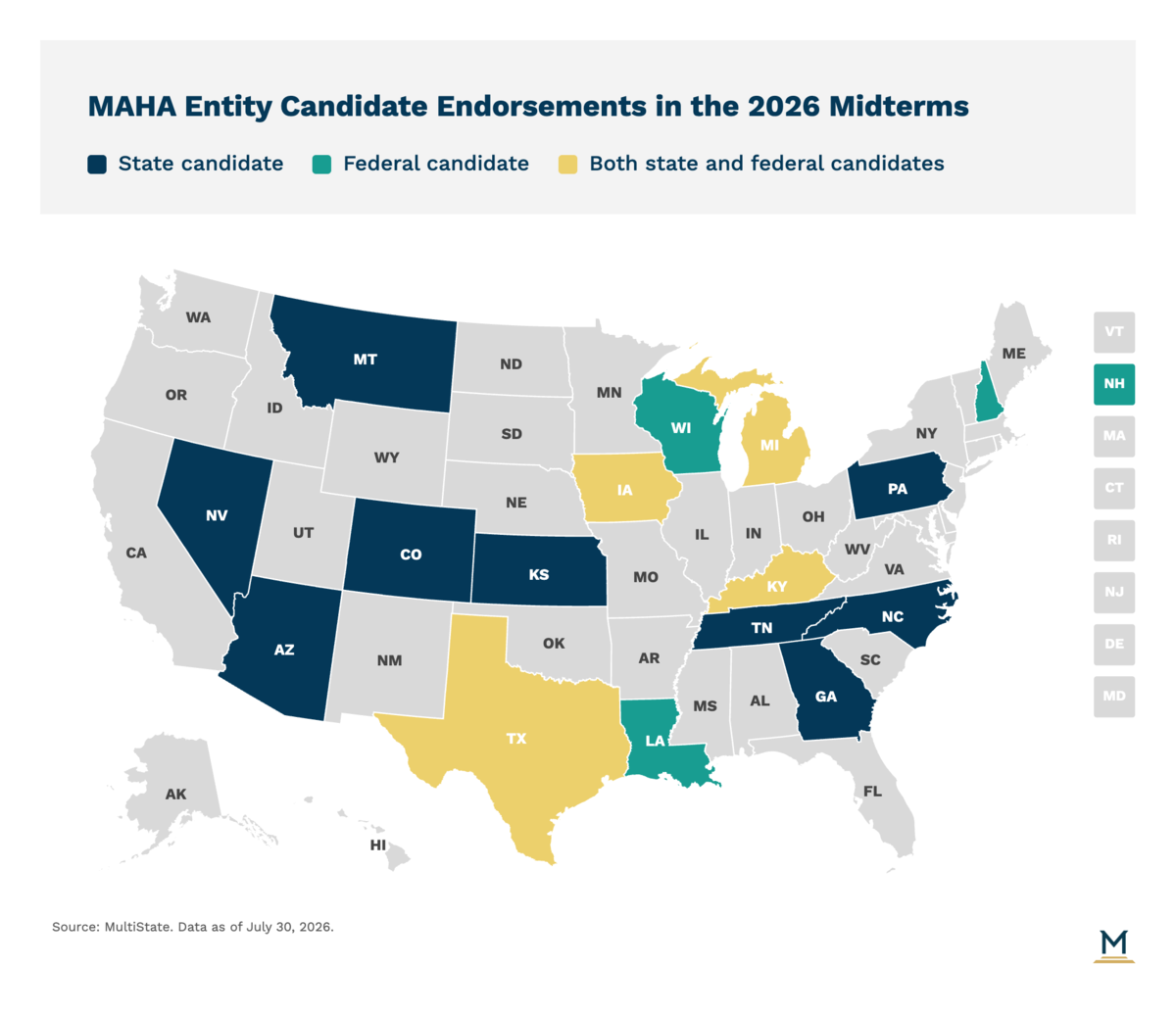
How Are MAHA Endorsements Shaping Primary Races?
Where Do MAHA and Trump Endorsements Align or Diverge?
The alignment between MAHA and Trump endorsements is shaping the landscape of upcoming Congressional races. Both MAHA Action and President Trump have thrown their support behind candidates such as Joe Mitchell (IA-02), Tom Barrett (MI-07), Brandon Herrera (TX-23), and Michael Alfonso (WI-07). In Louisiana, Representative Julia Letlow (R), who secured backing from both MAHA and Trump, won the Republican party’s Senate nomination in a June runoff after defeating incumbent Senator Bill Cassidy (R) in the May 16 primary.
What Is the Success Rate for MAHA-Backed Candidates?
Iowa’s Republican gubernatorial primary marked one of the first clear splits between Trump and MAHA endorsements, as well as a rare direct contest between their respective candidates. In a closely fought race, MAHA-backed Zach Lahn emerged victorious over Trump-endorsed Randy Feenstra. Lahn’s campaign focused on core MAHA priorities, including agriculture, medical freedom, pesticide regulation, water quality, and addressing rising cancer rates—central themes of the MAHA platform. While this win was celebrated as a major milestone for MAHA, the overall primary success rate for MAHA-endorsed state candidates currently stands at about 66 percent, with 26 wins and 13 losses to date. In contrast, MAHA candidates in Ohio’s May primary achieved a lower 50 percent success rate. As of this writing, the two MAHA groups have endorsed just over 50 state-level candidates nationwide.
Which Issues Define MAHA’s Endorsement Strategy?
Who Are the Leading Medical Freedom Candidates?
A large portion of MAHA’s endorsements are for candidates who prioritize medical freedom and informed consent. These contenders seek to empower patients, rather than politicians, in making health care decisions by reducing government involvement in medical mandates. Notable medical freedom legislative candidates include Charlice Byrd (HD 20, GA), Courtney Crawford (HD 5, KS), Jamie Thompson (HD 28, MI), James DeSana (HD 29, MI), John Louallen (HD 78, TN), Michele Reneau (HD 27, TN), and Will Bolton (HD 23, TN). MAHA is also giving its stamp of approval to candidates for key state executive branch positions: Zach Lahn (Governor, IA), Philip Sarnecki (Governor, KS), John James (Governor, MI), Monty Fritts (Governor, TN), Warren Petersen (Attorney General, AZ), Alexander Kolodin (Secretary of State, AZ), Mayes Middleton (Secretary of State, TX), and Nate Sheets (Agricultural Commissioner, TX).
How Is MAHA Influencing Food and Nutrition Policy?
A spring MAHA poll conducted by Politico found that more than half of respondents consider food-related issues, such as eliminating ultra-processed foods (UPFs) and artificial dyes, and restricting unhealthy foods from being eligible for SNAP benefits, to be core principles of the MAHA movement. This strong public support has translated into a wave of candidate endorsements. Notable MAHA-endorsed lawmakers who championed food nutrition legislation in 2025 and 2026 include: Sen. Leo Biasiucci (AZ HB 2164), Rep. Steven Doan (KY HB 439, HB 277), Rep. Jonathan Almond (NC HB 874), Rep. Michele Reneau (TN HB 1853), Rep. Lacey Hull (TX HB 1637, HB 25), Sen. Mayes Middleton (TX SB 379), and Rep. Stan Gerdes (TX HB 2955, HB 5243). Their efforts reflect a growing legislative momentum to address nutrition and food safety at the state level.
Defining Key Terms
MAHA (Make America Healthy Again)
MAHA stands for “Make America Healthy Again,” a public health movement and political initiative championed by Health and Human Services Secretary Robert F. Kennedy Jr. The movement focuses on medical freedom, eliminating ultra-processed foods and artificial additives from the food supply, reducing government involvement in health care mandates, and addressing chronic disease rates. MAHA Action, a 501(c)(4) organization founded in 2024, works alongside the MAHA Institute to endorse political candidates who support these health policy priorities.
What Do Polls Reveal About MAHA Voters’ Priorities?
Results from another MAHA poll conducted this spring by the Kaiser Family Foundation (KFF) revealed that like most Americans, for MAHA voters, cost may be the biggest determinant in their voting decisions this fall. Seventy-three percent of MAHA voters said lowering health costs should be a top priority for the federal government. Respondent support for regulating additives in food products also decreases by over 10 points, from 75 percent to 62 percent, when including the consideration that food prices may potentially rise due to increased regulation. While 68 percent of MAHA respondents believe restricting harmful additives in food should be a top priority for the federal government, when asked to select a single top issue, 42 percent chose lowering the cost of health care — double the 21 percent of voters who chose restricting food additives.
What’s Next for MAHA in the August Primaries and Beyond?
Despite uncertain polling on the impact MAHA voters will play in this year’s midterm elections, the Trump Administration is hedging its bets on HHS Secretary Robert F. Kennedy Jr.’s ability to galvanize the voting bloc like he achieved in 2024. This year, Kennedy launched his “Take Back Your Health” tour, which, while promoting his MAHA initiative, is also scheduling stops in competitive election districts with their respective candidates, such as in California, Colorado, Michigan, Ohio, Pennsylvania, and Wisconsin. Kennedy is expected to continue traveling across the country this election season, emphasizing the Trump Administration’s optimism that strong voter support for MAHA will translate into Republican victories in November.
As voters in 13 states will head to the polls in the primary-heavy month of August, MAHA candidates may be able to increase their success rate. MAHA candidates in Kansas, Michigan, Tennessee, and Wisconsin will soon learn their fates. This November will see 36 gubernatorial elections and over 6,000 state legislative races. MultiState continues to track and monitor election activity at the state level. For more information, use our re
Track Elections and Other Political Activity
Federal and state elections and redistricting can have significant policy and regulatory implications for businesses and organizations. If your organization would like to further track federal and state elections, please contact us
Frequently Asked Questions
Which states have MAHA-endorsed candidates running in August 2026 Republican primaries?
Kansas, Michigan, Tennessee, and Wisconsin have MAHA-endorsed candidates competing in August 2026 Republican primary elections. These primaries are part of a primary-heavy month across 13 states that could significantly impact MAHA’s overall candidate success rate, which currently stands at approximately 66 percent for state-level races
What medical freedom legislation have MAHA-endorsed candidates sponsored in 2025 and 2026?
MAHA-endorsed lawmakers have championed food nutrition legislation in 2025 and 2026, including Arizona HB 2164 (Sen. Leo Biasiucci), Kentucky HB 439 and HB 277 (Rep. Steven Doan), North Carolina HB 874 (Rep. Jonathan Almond), Tennessee HB 1853 (Rep. Michele Reneau), and Texas HB 1637, HB 25, SB 379, HB 2955, and HB 5243 (Reps. Lacey Hull and Stan Gerdes, Sen. Mayes Middleton)
How successful have MAHA political endorsements been in 2026 Republican primaries so far?
MAHA-endorsed state candidates have won approximately 66 percent of their races, with 26 wins and 13 losses as of August 2026. Notable victories include Zach Lahn’s gubernatorial primary win in Iowa over Trump-endorsed Randy Feenstra and Julia Letlow’s Senate nomination in Louisiana, though MAHA candidates in Ohio’s May primary achieved only a 50 percent success rate
What are the top policy priorities for MAHA voters according to recent polling?
Lowering health care costs is the top priority for MAHA voters, with 73 percent saying it should be a federal government priority and 42 percent selecting it as their single most important issue. While 68 percent believe restricting harmful food additives should be a top priority, support for regulating food additives drops from 75 percent to 62 percent when voters consider potential food price increases from increased regulation
Which gubernatorial and statewide candidates has MAHA Action endorsed for 2026?
MAHA Action has endorsed candidates for governor including Zach Lahn (Iowa), Philip Sarnecki (Kansas), John James (Michigan), and Monty Fritts (Tennessee). The organization has also endorsed candidates for other statewide executive positions: Warren Petersen for Arizona Attorney General, Alexander Kolodin for Arizona Secretary of State, Mayes Middleton for Texas Secretary of State, and Nate Sheets for Texas Agricultural Commissioner
Authors
Katherine Tschopp
Senior Associate
