


If a veterinarian could use a smartphone camera and artificial intelligence to grade tumors, it could be done more readily in remote areas or without expensive diagnostic equipment
Two Virginia-Maryland College of Veterinary Medicine students focused their attention on this possibility during the Summer Veterinary Student Research Program, an annual offering at the veterinary college that enables students to take a deeper dive into biomedical research, exploring vital research topics under the mentorship of faculty while potentially setting a new career path for at least some of the participating students
The topics covered by the 11 participating students ranged from infectious diseases to oncology to public health.
All but one of the summer research students is enrolled in the Doctor of Veterinary Medicine (DVM) degree program at Virginia Tech.
Layla Watkins from St. George’s University School of Veterinary Medicine in Grenada also took part in the summer research program, investigating the safety of neutrophil-derived antimicrobial peptide for the potential treatment of equine uterine infections, with Rebecca Funk and Jessica Gilbertie serving as her faculty mentors
“Now in its 19th year, our long-standing Summer Veterinary Student Research Program provides DVM students with a mentored research experience, spanning biomedical, clinical, and public health fields,” said S. Ansar Ahmed, director of the program and professor of immunology at the veterinary college. “In addition, weekly seminars with DVM scientists from academia, government, and industry offer mentorship, professional development, and exposure to diverse career paths. “
The summer research program is supported by a T35 grant from the National Institutes of Health with additional funding from Boehringer Ingelheim. The college provided programmatic and administrative support
“Since the summer research program was founded nearly two decades ago with support from the NIH , industry, and the college, we have trained over 100 DVM students, many of whom have incorporated research into their professional career,” Ahmed said.
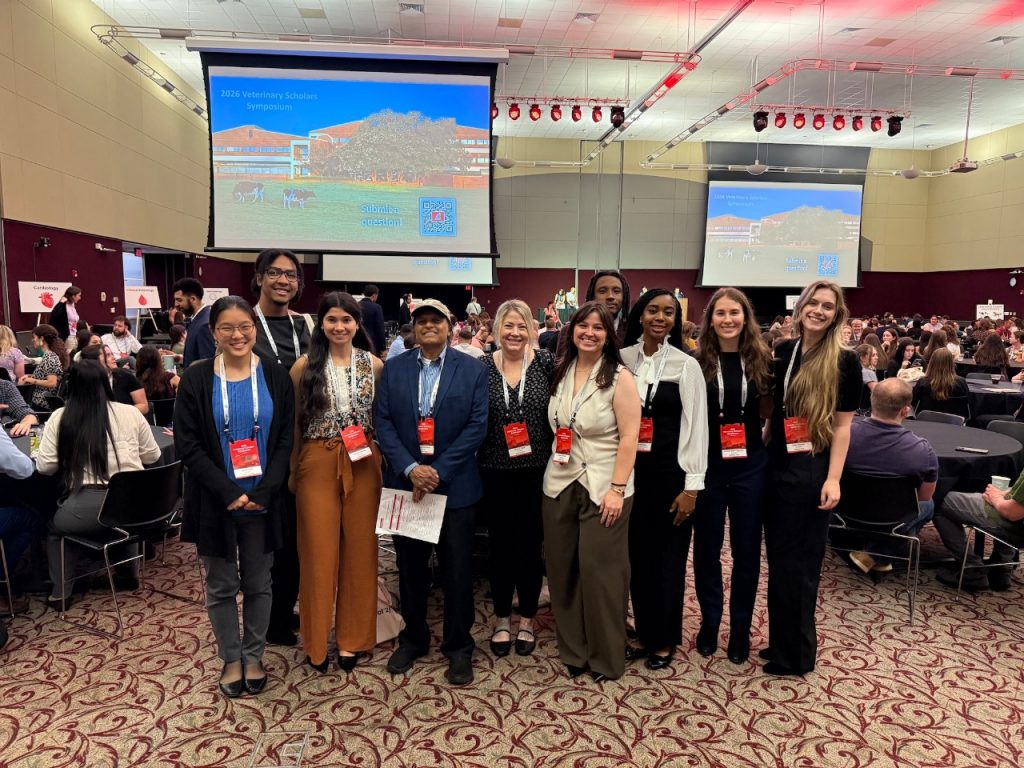
A few days after presenting to peers and faculty at the veterinary college earlier this month, participating students also presented their research at the Veterinary Scholars Symposium at North Carolina State, which hosted over 800 participants, providing additional research and networking exposure to our students.
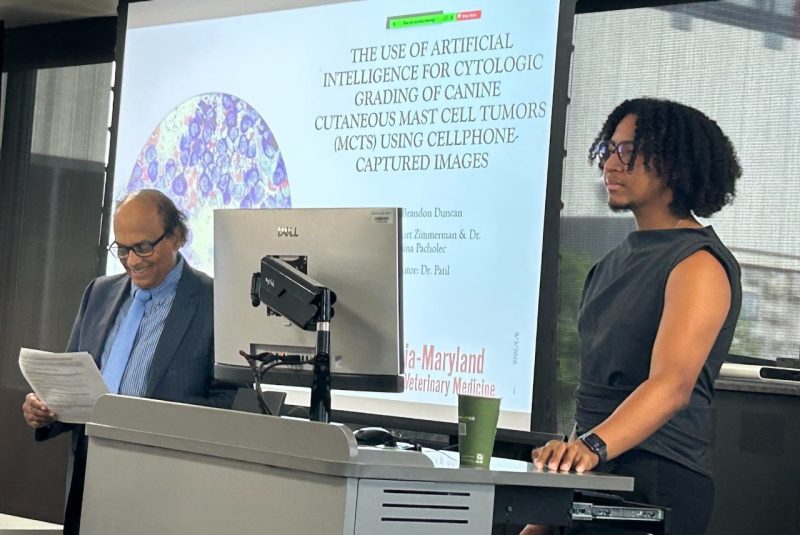
Brandon Duncan and Lydia Nesser, each of the Class of 2029, chose to focus on how something nearly everyone possesses, a smartphone, coupled with AI could help veterinarians diagnose tumors more easily.
Duncan, mentored by Kurt Zimmerman, focused on canine mast cell tumors, one of the most common cancers in dogs but also one of the trickiest to grade without a full biopsy.
Duncan set out to see whether a type of AI modeled loosely on how the brain recognizes patterns could make that same call from cytology images alone
Working with 28 archived cases dating to 2016, Duncan photographed stained cytology slides through a microscope adapter attached to an iPhone. The first model topped out at 67.8 percent accuracy, but a second model, trained on more cases and evaluated patient by patient rather than photo by photo, reached 82.1% accuracy, within about 10 percentage points of the accuracy of modern pathology
“We do expect that if we have a higher case load, we would be able to yield higher numbers,” Duncan said, noting that the jump between the two models suggests more data, not a better algorithm, may be the clearest path forward.
Duncan said he was inspired for this research because his first dog, Diamond, passed away from a high-grade cutaneous mast cell tumor
“I believe my findings highlight that AI can identify details on smartphone images, and that it will provide more insight into what key features are of tumors, to help us in identifying, prognosing, and planning for tumors,” said Duncan, who added that AI has actually been used for the last 20 years in some branches of medicine
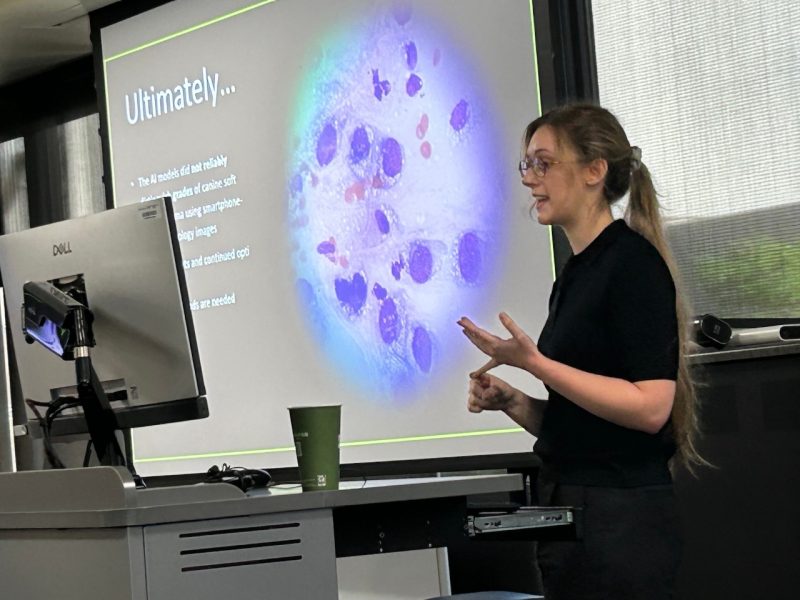
Nesser, mentored by Christina Pacholec, tackled soft tissue sarcomas, tumors that come in three grades and are notoriously difficult to classify even under a pathologist’s microscope.
Nesser pulled 24 cases from the Virginia Tech Animal Laboratory Services archive, evenly split across all three grades, and photographed them with a Google Pixel phone at three magnification levels.
Asked to distinguish between three grades, the model performed no better than chance, correct about a third of the time. But when Nesser simplified the task to just grade one versus grade three, accuracy climbed to near 60 percent
A closer look at the data showed the real limiting factor wasn’t the AI architecture — it was the small number of individual tumors available to train it
“More photographs of the same tumor don’t expose the model to new biology; only more tumors do,” Nesser said
A follow-up experiment using a different AI model called DinoBloom — pretrained on more than 380,000 cytology images and built to analyze every image from a case together rather than one at a time — pushed three-class accuracy from roughly 34 percent to about 50 percent, though Nesser cautioned the two approaches weren’t tested under identical conditions
Other summer research projects presented are listed below
Ryane Cronk, Class of 2027: Tested whether a vaccine sprayed in the nose helps dairy calves breathe easier and keeps their gut bacteria healthy on farms. Mentors: Sebastian Umana Sedo and Francisco Carvallo
Katherine Freeman, Class of 2029: Studied histotripsy, a sound-wave treatment, to see if it can help dogs with bone cancer in their limbs feel better without surgery. Mentor: Joanne Tuohy
Aislynn Grantz, Class of 2029: Tested whether drugs related to triclabendazole (normally used against parasites) could also fight fungal infections, using lab dishes to measure how well they worked. Mentor: Kirsten Nielson
Sarah Hou, Class of 2029: Looked at immune cells called T cells in mouse bone tumors treated with histotripsy, using special software to count and classify them. Mentors: Sheryl Coutermarsh-Ott, Joanne Tuohy, Alayna Hay, and Eli Vlaisavljevich
Dani Ingallis, Class of 2027: Used a wearable fitness tracker (FitBark 2) to measure how much dogs of different sizes move during a normal walk. Mentor: Orsolya Balogh
Tiana O’Neill, Class of 2029: Studied small proteins found on the skin of dogs with itchy allergic skin disease to better understand what causes their symptoms. Mentors: Jessica Gilbertie and Ivan Ravera
Lydia Periconi, Class of 2029: Studied mother-daughter cow pairs to learn how a cattle virus (bovine leukemia virus) spreads between generations and between herd mates. Mentors: Laura Hungerford, John Currin, and Kevin Lahmers
Malik Torres, Class of 2027: Studied how a cystic fibrosis drug combo affects a harmful bacteria’s ability to survive and cause damage in patients’ lungs. Mentor: Erin Gloag
“The need for veterinarian-scientists has never been greater to improve animal and human health,” Ahmed said. “Research-trained veterinarians are uniquely positioned to address complex challenges at the animal-human-environment interface, including emerging and re-emerging zoonotic diseases, antimicrobial resistance, food security, and the development of novel diagnostics, therapeutics, and preventive strategies for both infectious and non-infectious diseases.”
Contact:
540-231-9005
