


Mental health as a design imperative
Station layout — from bunks to common spaces — plays a critical role in firefighter recovery, resilience and performance
August 14, 2026 01:13 PM •
FireRescue1 Contributors
By Fire Chief Matt Sabo
Firefighters operate in environments defined by disrupted sleep, cumulative stress and repeated exposure to trauma. For decades, however, fire station design prioritized apparatus and response over recovery and behavioral health
Traditional layouts often introduced unintended stressors: noise intrusion, lack of privacy, limited decompression space and constant operational visibility. These conditions can degrade sleep, increase cognitive fatigue and limit long-term resilience
Modern station design must address these realities directly. The built environment should not only support response but also actively support recovery, emotional regulation and psychological sustainability
Concord Township’s new station
The Concord Township Fire Department in Lake County, Ohio, recently moved into a new fire station, but more importantly, we moved into a new philosophy. Our new Station 1 provided an opportunity to align our physical environment with what we now know about firefighter mental health, human performance, recovery and long-term resilience
Photo/Cory Klein Photography
The Concord Township Fire Department serves approximately 20,000 residents across 25 square miles in a largely residential community that includes a full-service hospital, multiple physician offices, skilled nursing facilities, assisted living communities, nursing homes and residential mental health facilities. With a roster of 53 personnel operating from two stations and nine firefighters on duty daily, our operational footprint reflects the demands of a modern suburban department with a significant EMS call volume.
Our former Station #1 was dedicated in 1966. At approximately 6,400 square feet, the station had long exceeded its intended capacity. Some apparatus were stored off site in other Township buildings, increasing response time for those apparatus, and our command vehicles were kept outdoors, which presented some challenges during our northeast Ohio winters. Additionally, gear storage was compressed and adjacent to the diesel exhaust of the apparatus. Fitness space was minimal. Contaminant control was limited by architectural realities that predated our understanding of occupational cancer risk and behavioral health stress exposure.
In short, the building functioned, but it did not perform for our people
Mental health considerations in station design
Before we detail Station 1, it is important to outline key design principles that support firefighter mental health and resilience
- Sleep protection: Sleep disruption is one of the most significant threats to firefighter health and performance. Station design should minimize noise, control lighting and reduce unnecessary interruptions. Private or semi-private bunking arrangements and separation from high-traffic areas support meaningful recovery.
- Psychological decompression spaces: Firefighters require spaces that are distinct from operational areas where they can mentally reset. Quiet rooms, access to natural light, and separation from alarms and radios allow for cognitive and emotional recovery.
- Common space design and social balance: Kitchens, dayrooms and shared spaces play a critical role in cohesion and morale. These areas should support connection without overcrowding or constant interruption. Design should allow firefighters to engage socially while still offering options for withdrawal when needed.
- Privacy and control: Not all recovery is social. Providing individual space allows firefighters to regulate their level of interaction, which is essential following high-stress incidents.
- Reducing cognitive load: Clear circulation patterns, intuitive layouts and organized storage reduce daily friction. Lower baseline stress preserves mental energy for emergency response.
- Environmental cues: Lighting, acoustics and spatial layout signal how a space should be used — whether for readiness, recovery or connection. Intentional design reinforces behavioral expectations.
Applying these principles to Station 1
Move-in day was instructive. Despite tripling our square footage to 23,000, the space filled quickly, not because it was oversized, but because it was finally sized appropriately for modern fire service operations
The new station includes:
- A dedicated watch office
- Fire prevention offices
- Conference and training space
- Expanded apparatus bay spacing
- Secure EMS storage
- A maintenance shop
- Hazmat response materials and hose storage
- A training tower and mezzanine
- Dedicated gear storage
- A purpose-built decontamination suite
Each addition reduced friction in daily workflow. Equipment is accessible. Training is integrated into the environment. Supplies are secure and organized. Circulation patterns are deliberate
In performance-based professions, friction costs energy. When unnecessary obstacles are removed from routine tasks, cognitive and physical res sense, becomes a force multiplier
Sleep, recovery and behavioral health in practice
For decades, fire stations were designed around apparatus first and people second. We chose to reverse that priority
Each firefighter now has a private bunk. Two bunks share one restroom and shower space, reducing disruption and improving sleep hygiene. Off-going personnel can rest without being interrupted by the oncoming shift
We have also placed deliberate emphasis on behavioral health. The stigma surrounding mental health in the fire service developed over decades of cultural neglect. While policy changes are important, environment influences behavior at a deeper level
Access to outdoor areas also plays an important role in overall well-being. Whether through a patio or designated exterior space, personnel can step outside, get fresh air, and briefly disconnect from the demands of the station. Even short periods spent outdoors have been shown to support stress reduction, improve mood and enhance recovery — benefits that are especially valuable in a high-tempo emergency services environment
These design elements communicate something powerful: Recovery matters. Privacy matters. You matter
Designing common spaces for connection and recovery
Common spaces are central to firehouse culture. Thoughtful design ensures these areas support both connection and recovery rather than contributing to fatigue or overstimulation
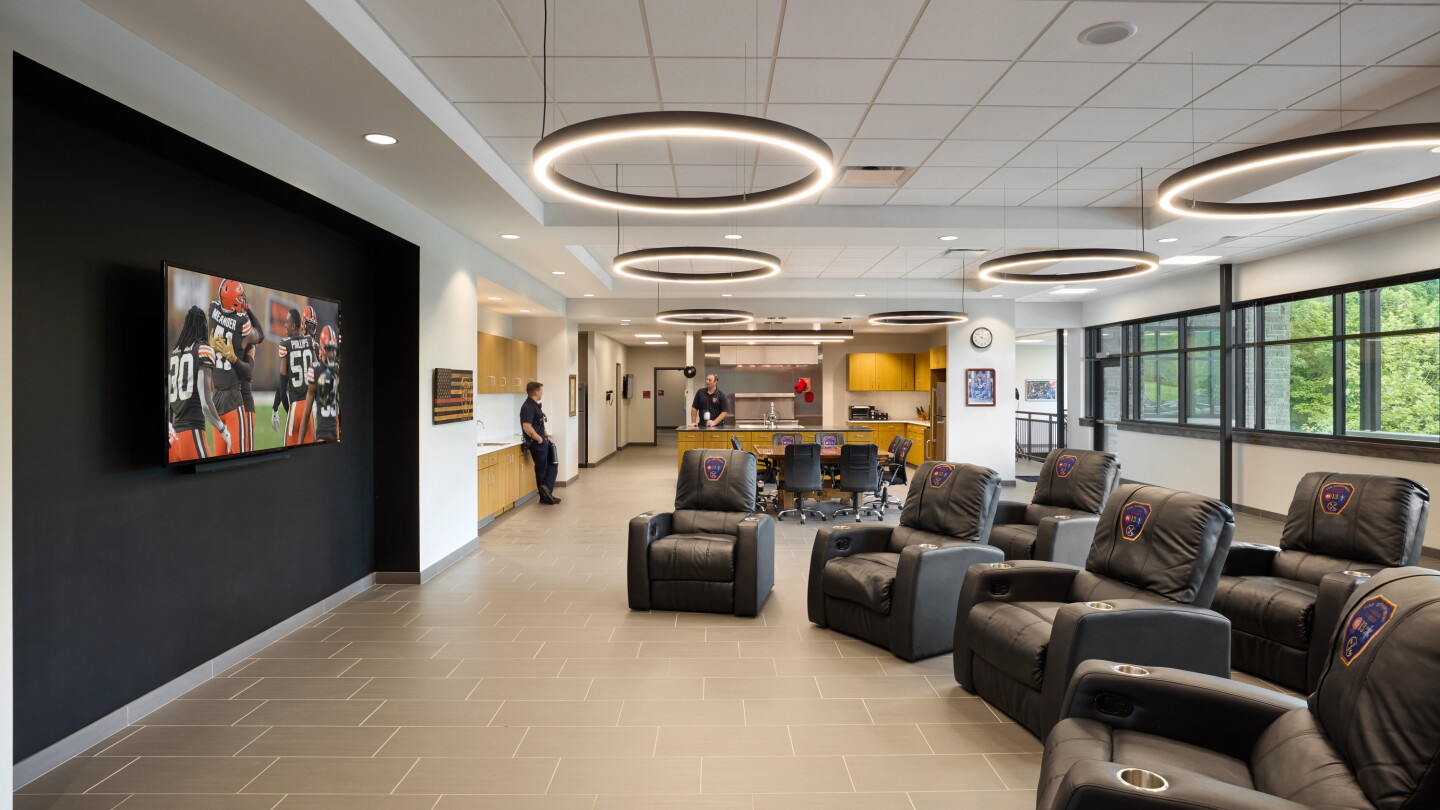
At Station 1, the kitchen, dayroom and dining areas were intentionally designed as a single open-concept space to serve as the heart of the station. In a profession where crews regularly face high-stress incidents and unpredictable demands, the importance of a well-designed common space cannot be overstated. This area is more than just a place to eat — it is a space that fosters connection, conversation and informal peer support, all of which are critical components of both individual well-being and team cohesion.
Our department continues to prioritize gathering for shared meals, reinforcing a culture of camaraderie and trust. These daily interactions provide an opportunity for crews to decompress, reflect on calls, and check in on one another in a natural and supportive environment. The open layout enhances visibility and accessibility, encouraging spontaneous interaction rather than isolation
The flexibility of the space allows furniture to be easily rearranged, accommodating larger group settings during holidays or special occasions when families are welcomed into the station. Including families in these moments strengthens the broader support system that is essential to long-term resilience in the fire service
Equally important, this common area is intentionally shielded from the noise and activity of the apparatus bay. By creating a quieter, more comfortable environment, the design supports both mental and physical recovery between calls. This separation allows personnel to step away from the operational tempo, reset and return to service ready to perform at a high level
Ultimately, the thoughtful design of this shared space reflects a commitment to the health, wellness and connectedness of our members, recognizing that strong relationships and opportunities for recovery are foundational to delivering exceptional service to the community
Fitness as operational and mental resilience
The new fitness room is approximately 500 square feet larger than our previous facility and intentionally separated from administrative spaces. In the former station, limited space and proximity discouraged consistent use. In the new station, participation increased almost immediately
Research in occupational performance consistently demonstrates that physical fitness supports injury reduction, cardiovascular resilience, stress tolerance, cognitive clarity, emotional stability and career longevity
Human performance in the fire service is measured in seconds, strength, endurance and composure. Fitness space is not an amenity; it is protective infrastructure
Designing for contaminant control
The fire service now operates with a clear understanding: Cancer prevention is not optional. It is operational doctrine
The new station allowed us to establish true zoning between “hot,” “warm” and “cold” spaces. We now operate with:
- A dedicated decontamination room
- Gear extractor and dryer
- Meiko mask washer
- Cres-Guard heat/humidity cabinet for gear, uniforms and medical equipment
- Cres-Guard heat/UV cabinet for electronics
- Dedicated washer and dryer for apparatus bay linens
Turnout gear and contaminated uniforms no longer go home. Dedicated locker rooms and on-site laundry support this behavioral shift. This protects not only our firefighters but also their families from secondary exposure
Importantly, design enabled compliance. When decontamination equipment is accessible and logically located within workflow, utilization increases. Behavioral expectations must be reinforced by environmental support
Community health and resilience hub
The additional space in our new station dramatically expanded our ability to engage the public in proactive health and safety programming. The building was designed not only to house firefighters but also to welcome residents
Today, we regularly host CPR/AED certification classes, pet first aid and CPR courses, babysitting safety classes, public fire prevention programs, joint initiatives with our Township Recreation Department and community outreach events
We intentionally bring the community into the fire station so they can experience their investment in this building. Public safety facilities should not feel closed or inaccessible. They should be transparent, welcoming and active. This visibility builds trust and reinforces community resilience
Purpose as a protective factor
When firefighters teach CPR, lead safety courses and interact with residents outside of crisis moments, it reinforces meaning. Research in occupational psychology consistently identifies purpose as a protective factor against burnout, compassion fatigue and psychological distress
Emergency response exposes firefighters to trauma. Prevention and education reconnect them to empowerment and positive impact
The building supports both
Human performance is not limited to physical conditioning or sleep optimization. It includes psychological sustainability — the ability to remain engaged, motivated and emotionally healthy over the course of a career. By expanding our community programming, we strengthened not only public preparedness but also firefighter purpose — and purpose fuels resilience
From structure to culture
What we learned in this transition is simple: Architecture shapes behavior. Behavior shapes culture. Culture shapes performance
- When decontamination spaces are intuitive, compliance improves.
- When bunks are private, sleep improves.
- When fitness space is inviting, participation increases.
- When training space is integrated, learning becomes routine.
- When community members are welcomed inside, trust deepens.
The building itself did not create resilience but rather removed barriers to it
Designing for the firefighter we expect
We expect strength, judgment, composure and endurance from our members. The spaces in which they live and work should reflect that expectation
A fire station is not simply a storage facility for apparatus. It is a performance environment, a recovery center and a behavioral health support system
When design, leadership and culture align, the result is not just a better building, it is a stronger organization and, ultimately, a stronger community
ABOUT THE AUTHORMatt Sabo serves as fire chief for the Concord Township Fire Department in Lake County, Ohio. He joined Concord Township in 1999 and has progressed from firefighter/paramedic to EMS coordinator, lieutenant and ultimately chief. Sabo guided the design and construction of the new 22,600-square-foot Station 1, breaking ground in February 2022 and opening for service in October 2023. Sabo has a bachelor’s degree in public safety management
First Responder Wellness WeekHealth & WellnessStation Design
FireRescue1 Contributors
