


Mental Health
Doctors and women who’ve had it call for more attention on postpartum psychosis
August 16, 20265:00 AM ET
By
Deborah Becker
Boston-area trial draws attention to post-partum psychosis
Listen·5:035:03
Transcript
- Download
- Embed
<iframe src="https://www.npr.org/player/embed/nx-s1-5931964/nx-s1-9885172" width="100%" height="290" frameborder="0" scrolling="no" title="NPR embedded audio player"> - Transcript
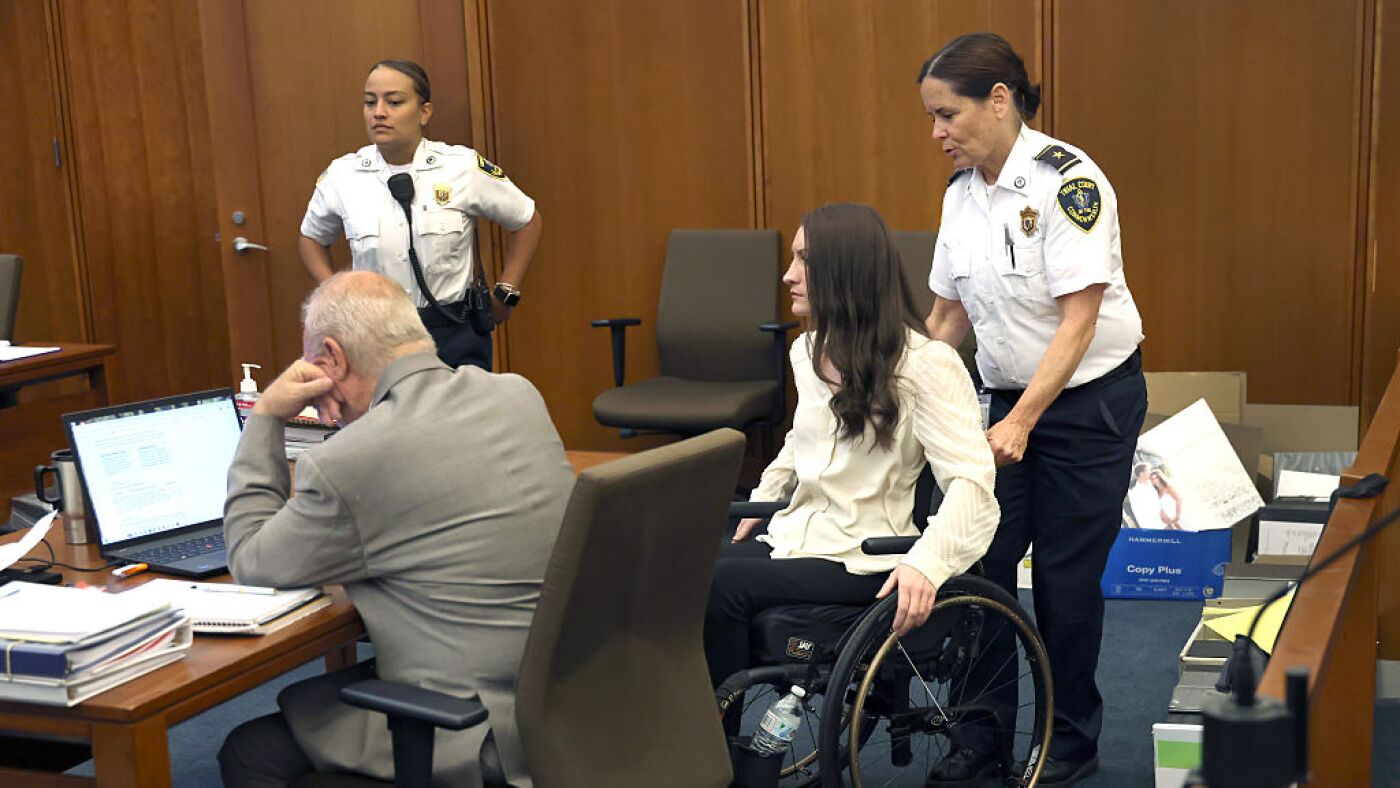
Lindsay Clancy is charged with murdering her children. Her defense argues she was suffering from severe postpartum mental illness.
David L. Ryan/The Boston Globe/hide caption
toggle caption
David L. Ryan/The Boston Globe/Getty Images
If you or someone you know is in crisis, please call, text or chat with the Suicide and Crisis Lifeline at 988, or contact the Crisis Text Line by texting TALK to 741741
The trial of a Boston-area mother charged with murdering her three small children in 2023 is leading to calls to improve postpartum mental health care. While the prosecution paints her as a deliberate killer, Lindsay Clancy’s defense team argues she was in the grips of severe postpartum psychosis, and didn’t receive proper medical care
The unrelenting national attention on the Clancy trial has been difficult for people who’ve had postpartum psychosis, says Meghan Cliffel who experienced the disorder and is now a mental health advocate. She says many women believe that sheer luck prevented a similar disaster from happening to them
For ongoing coverage of the Lindsay Clancy trial, visit WBUR
Advocates like Cliffel say the case highlights gaps in mental health care for new mothers and the urgent need for more research and public education about a rarely discussed but severe illness. Doctors emphasize, if diagnosed correctly, it’s treatable and patients can go on to live normal lives

Shots – Health News
She Wanted To Be The Perfect Mom, Then Landed In A Psychiatric Unit
‘In a deluded reality’
Cliffel’s psychosis started suddenly, when she was riding the subway home from her job in New York City in December, 2015, she says. She began to believe people were watching and following her. She thought other passengers on the train were part of a group trying to harm her and her daughters, who were 2 years old and 8 months old at the time
Meghan Cliffel
Meghan Cliffelhide caption
toggle caption
Meghan Cliffel
“My brain is essentially taking all of these little details and knitting them together into this new alternate sense of terrifying truth wherein the entire city is out to get me and my girls,” Cliffel recalls
“It’s wild how quickly it happened, and also how logically I was acting, but in a deluded reality,” Cliffel says
Her mind took an even darker turn when she got home. Cliffel says she thought the refrigerator was spewing poisonous gas, and people on television were threatening her. She didn’t divulge her thoughts to her husband because she wasn’t sure whether he was in on the plot
At one point, she describes feeling overcome by paranoia and believing that if she made it to the roof of her apartment building and proved she was willing to jump, she would be safe. She punched her husband and then ran to the door of their apartment building, saying, “I just need to go to the roof.”
Her husband called 9-1-1
When the police arrived, they took Cliffel to a psychiatric ward
During her 12-day hospitalization, a psychiatrist convinced her to take medications to treat mania and psychosis, helping her, as she described it, “reattach to reality.” But the ordeal was frightening and bewildering for Cliffel, who still didn’t know what had caused her behavior
Hospital staff said she might have bipolar disorder and recommended more psychiatric care once she was discharged. Two months later, Cliffel finally got a diagnosis: postpartum psychosis
“That moment of somebody naming it was so helpful to me,” she says
A ‘massively missed’ disorder
Postpartum psychosis affects moms in an estimated 1-2 out of every 1,000 births, according to several studies, drawing from a range of data sources. This is uncommon compared to other mental health issues new moms face — postpartum depression, for example, is estimated to affect about 10% of mothers. But it is higher than some other health problems that get more attention, advocates note. For instance, the rate of sudden infant death syndrome in the U.S. is lower, at about 0.4 per 1,000 births.

Shots – Health News
‘A Lifeline’ For Doctors Helps Them Treat Postpartum Depression
“We know that we don’t train our doctors in it, that it’s massively missed,” says Dr. Veerle Bergink, a psychiatrist and director of the Women’s Mental Health Center at Icahn School of Medicine at Mount Sinai. And patients often have difficulty finding appropriate care, she adds
One major obstacle to getting a clear diagnosis is that postpartum psychosis is not listed as a distinct diagnosis in the Diagnostic and Statistical Manual of Mental Disorders, or DSM, the main handbook used to identify mental health conditions, says Dr. Susan Hatters Friedman, a reproductive and forensic psychiatrist at Case Western Reserve University. The handbook currently treats it as a subset of other mental health conditions that can occur within weeks after giving birth
Advocates, such as the group Postpartum Support International, continue to push for postpartum psychosis to be listed as a distinct diagnosis in the DSM-5, which is published by the American Psychiatric Association. The argument against inclusion is that there are not enough consistent studies to determine whether postpartum psychosis is part of an underlying mental health issue such as bipolar disorder or schizophrenia
However, researchers argue in a 2025 consensus statement that there is evidence it is distinct from those other psychiatric diagnoses and patients would benefit from it being evaluated as a separate condition. They see evidence that it falls within the bipolar spectrum, yet still argue it is unique. Doctors believe it is triggered by hormonal shifts, lack of sleep and a family history of mental health conditions
“This is the scariest mental illness that I know of,” Hatters Friedman says. “You have these symptoms happening rapidly, you may or may not have any mental health history or any mental health literacy, and you’ve got this dependent little person with you — and it’s not listed in the DSM. So doctors might not recognize what’s going on.”
Struggles and unclear diagnoses
Lindsay Clancy’s attorneys say she was suffering from insomnia, anxiety and depression in the lead up to the killings. She sought treatment, meeting with psychiatrists and therapists, attending an outpatient hospital program and spending five days in McLean Hospital for inpatient psychiatric care
Clancy was prescribed several psychiatric medications. One provider testified that she suggested to Clancy that she might have a mood disorder, or “underlying bipolar disorder,” but did not appear to have postpartum psychosis
Doctors like Bergink, who has treated hundreds of women with postpartum psychosis, say misdiagnoses are common. Bergink was not involved in Clancy’s care or her trial, but says Clancy’s symptoms echo a familiar pattern
“She was manic after delivery and it was not treated, and medication made it worse,” says Bergink, who is a leading researcher on this topic. “For me, it’s a very classical, typical story of a woman with postpartum psychosis not being diagnosed, not being treated.”
Police have testified about internet use on Clancy’s phone and computer that indicate searches for psychosis, hallucinations and ways to kill herself. She tried to take her own life after killing her children and remains paralyzed from the waist down
Clancy’s defense argues she is not criminally liable because of her mental state. The prosecution says that she deliberately planned to kill her kids. They claim that night she was coherent enough to send her husband Patrick out to pick up dinner to give her enough time to strangle the children before he could intervene
A call for more medical training
Many doctors aren’t trained to recognize the symptoms of postpartum psychosis, or help patients who may be confused by what’s happening to them and fearful of admitting to thoughts that could jeopardize custody of their children
Symptoms include anxiety, hypervigilance, confusion and mania, and taking on activities that might be considered strange. Perinatal mental health experts say the symptoms can wax and wane so they might initially be dismissed. But certain behaviors can be clues
“Why would someone who just delivered a baby throw a party for 50 people, or clean a whole house or run a marathon ?” says Bergink. “If it feels really weird, then it’s probably not OK.”
Typically new mothers see an OB/GYN for a check up six weeks after giving birth. Other providers such as pediatricians, doulas and midwives also should be educated about postpartum psychosis because they are often in contact with mothers right after they give birth, argues perinatal psychiatrist Dr. Uruj Kamal Haider, medical director of Massachusetts Psychiatry Access Program for Moms
She says those providers could help determine whether someone is just sleep-deprived and adjusting to their new family or experiencing a psychiatric emergency
“The health care system is fractured, but we can work around it,” Kamal Haider says. “Educating the village and these other providers is important because they are seeing these women before the six-week follow up visit.”
Psychiatry residents should also be trained on postpartum psychosis, she says, and right now they are not
If a mom gets the right diagnosis, there are treatments. For Cliffel, the mood stabilizer lithium, helped her get better. Studies suggest that drug, sometimes combined with other medications, eases symptoms for 98% of patients. Electroconvulsive therapy also has been shown to be effective, but is not widely available
Kamal Haider advises patients to advocate for effective treatment and make sure they’re getting enough time with their providers, especially their psychiatrists
Haider says families should be aware of the subtle warning signs indicating that postpartum mental health issues could escalate
“There does not have to be full blown auditory or visual hallucinations for a mom to be psychotic,” she says. “The mom may just present as paranoid or confused or just very irritable and that can escalate very quickly especially with intense sleep deprivation.”
Meghan Cliffel with her husband and three children in 2026.
Meghan Cliffelhide caption
toggle caption
Meghan Cliffel
Change is slow
Two decades ago, postpartum psychosis was at the center of the trial of another mother, Andrea Yates, who was charged with killing her five children in Texas. Yates was eventually found not guilty by reason of insanity and remains committed to a state mental health facility
Hatters Friedman was in psychiatric training at the time of the 2002 trial and says she began pushing for more research into postpartum psychosis back then. She says there is still a lack of clarity about this condition
“I do think there has been some more community knowledge since then, but not as much as we need, for sure,” Hatters Friedman says
Research is stymied, Kamal Haider says, because there is a lack of infrastructure in the U.S. to study new moms and infants simultaneously. Other countries, like the U.K., she says, have dedicated “mother and baby units” where researchers can observe how a mother is caring for her child and how the baby is responding
Bergink and Hatters Friedman say high-profile trials like Clancy’s may increase awareness about postpartum mental health, but change can be slow
Mom and mental health advocate Meghan Cliffel wonders why others only seem concerned about the condition in the wake of an unspeakable tragedy
“You care about this now when it’s the center of this dramatic and tragic trial, but you don’t care about this enough,” she says, because real concern would be “creating a system of care that is not just centered around the baby, but is actually centered around the family’s wellbeing.”
Advocates say more support for mothers and new families, high quality child care and more maternal and paternal child care leave could help ease the stress for new families
Four years after Cliffel’s ordeal with postpartum psychosis, she had a third child. She is thriving, with therapy, psychiatric care and medication she took for a year after birth. Her children are now 13, 11 and 6 years old
Re 988 and the Samaritans Statewide Hotline (call or text) at 1-877-870-HOPE (4673). The National Maternal Mental Health Hotline can be reached at 1-833-TLC-MAMA
- postpartum psychosis
- Lindsay Clancy
