


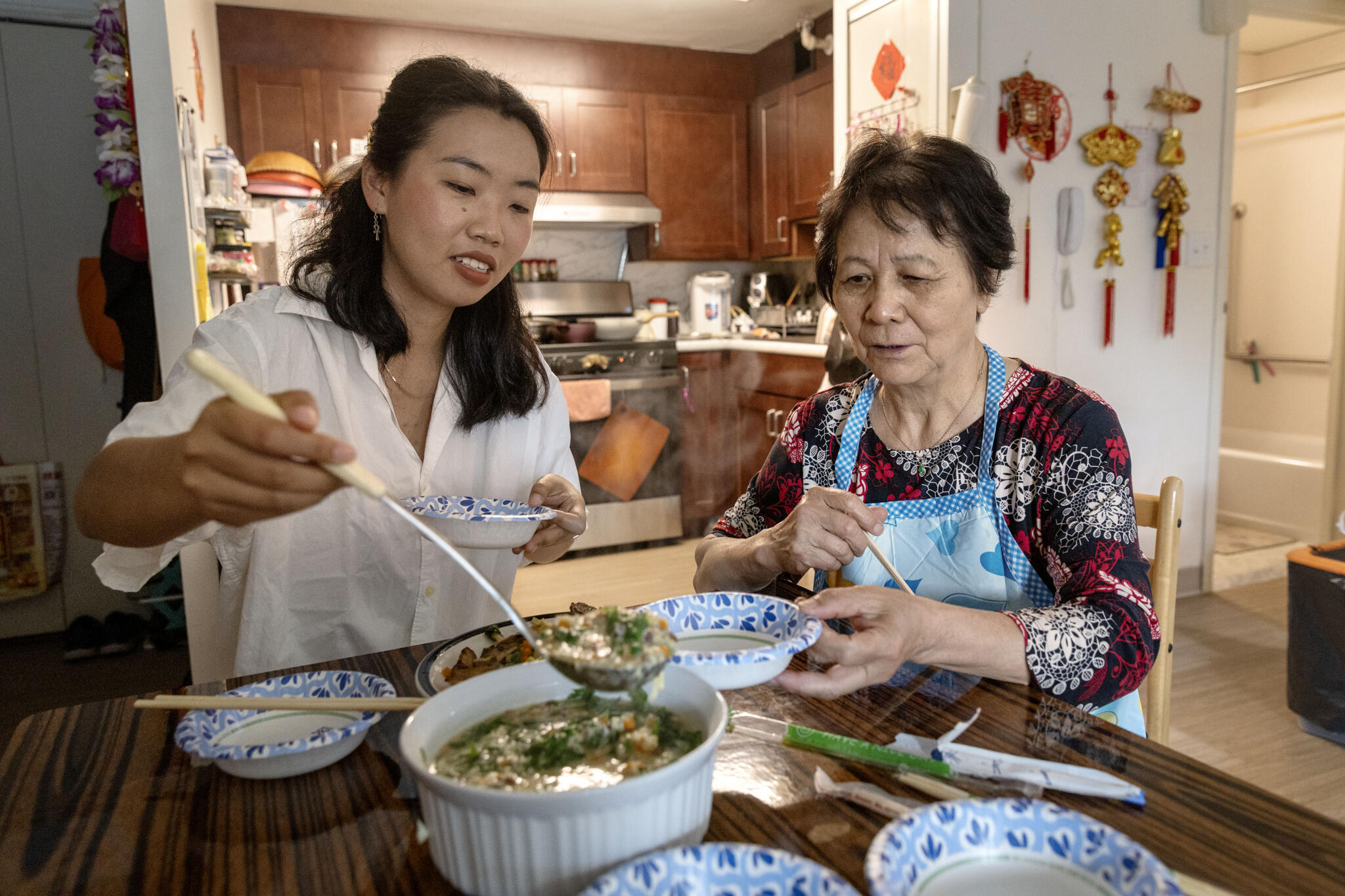
In a small kitchen in Chinatown, Lifang Li was making lunch. Artist and friend Yolanda Yang watched as Li put some boiled vegetables into a hot frying pan and stirred a pot of Chinese yam soup on another burner
“Auntie Fang is good at multitasking,” Yang said. “When I visited her last time, she did the same thing.”
Yang calls Li “Auntie” as a sign of respect. WBUR spoke to Li with interpretation from Yang. Li is among 10 elders included in a recent project created by Yang called “Aunties’ Cookbook: Self-Care in Migration.” The cookbook’s colorful pages include their recipes and stories, in English and Chinese. Yang said she wanted to highlight the work each auntie does for her community
“Senior women who live in Chinatown, they actually participate in a very big part of thinking how Chinatown can be a better home for everybody,” Yang said
Yang meets many aunties through her work at the Pao Arts Center. She sees the aunties’ advocacy connected to what’s on their kitchen tables. Self-care in their culture is less about individual needs and more about the collective health of their communities
“As I spent time with these Chinatown aunties, I learned that the issues they advocate for — green spaces, clean air, healthy soil, affordable Chinese supermarkets, language access, and neighborhood preservation — are deeply connected to what appears on their kitchen tables,” Yang wrote in an email to WBUR. “Through recipes, I begin to see how caring for a neighborhood and caring for a meal are part of the same practice of sustaining life.”
A sizable group of Chinatown elders are really politically engaged, said Lydia Lowe, a longtime activist and the director of the non-profit Chinatown Community Land Trust
“Chinatown is one of the more active neighborhoods in the city, despite all obstacles that we face,” she said
Collateral damage
The neighborhood was established in the 1870s when Chinese laborers were brought to break up a strike at a local shoe factory. Then the Chinese Exclusion Act of 1882 effectively banned most legal immigration of Chinese laborers to the States until the 1940s. Lowe said people have always lived in Chinatown, but it was still mostly considered an industrial area
“That’s why we don’t have trees here. That’s why we don’t have a lot of the things that you see in other neighborhoods,” she said. “It’s mostly paved surfaces. It’s mostly highways and hospital institutions and things that were seen as good for the economy for the city. But there was no thought given to the people who live here.”
More change came starting in the 1950s when the original elevated Central Artery and the Mass Pike were constructed through parts of the neighborhood. Thousands of residents were displaced as their homes were demolished to make room for construction
“People talk about how they woke up one morning and whole streets were razed,” she said. “And kids who grew up during that time, they talk about playing in the rubble of their friends’ homes.”
The neighborhood continued to change when businesses in the city’s zoned red light district known as the Combat Zone moved into parts of Chinatown. All of this history directly relates to how residents live in Chinatown today. Data show that Chinatown has some of the worst pollution in the state — a 2022 study found that Chinatown had the highest measurements of pollution particles known to increase health risks like heart disease and other respiratory ailments. And according to data from the city of Boston, as of 2024, a little over 6% of Chinatown had tree cover, making it one of the hottest neighborhoods.
‘Protect Chinatown’
Lifang Li knows all of this, and that’s why she works to improve the community she loves. After all, this was her first stop when she came to Boston more than two decades ago
“Since we were new here and didn’t know our way around, we came to Chinatown because we could talk to other Chinese people and know where to go to ask for directions or other help,” she said. “So we need to protect Chinatown.”
Language is a big reason Yuqing He settled in the neighborhood. She’s also featured in Yang’s cookbook. On a recent weekday, she prepared fried rice with vegetables and a Cantonese sausage she loves
As she cooked, she talked about how she came to Massachusetts more than two decades ago so her husband could help run her brother-in-law’s restaurant. Yolanda Yang translated for us. She said she lived first in Lawrence and then Lowell. As she got older, she needed more care, including regular dialysis for kidney disease
“Whenever I had to go to the doctor, my daughter would have to take time off work to accompany me,” she said
Her doctor eventually suggested she move to Boston to make care easier. She applied for an apartment and moved to Chinatown two years ago
“But there’s no need for that now,” she said. “Now I can take public transportation to the doctor on my own; it’s so convenient.”
Chinatown has doctors who speak He’s native language. Community activist Lydia Lowe said the neighborhood has a concentration of services and organizations for people who don’t speak English
“I think a lot of times if you ask people why do they want to live in Chinatown or why is it important for them, they’ll say — in Chinese — you know, ‘It’s convenient. It’s convenient for my life,'” she said. “But it’s really more than convenience. It’s really pretty essential for that day-to-day survival.”
Life has improved for He. She had a kidney transplant, so she feels better. She now spends her days learning English, dancing with other seniors at the Pao Arts Center, and advocating for a better Chinatown, including with the Chinese Progressive Association
“Every bit of effort helps,” she said. “The more people who come together, the more strength we have as a community. Unity is strength.”
And the activism by these women and others in the neighborhood is working. The city recently found new ways to plant some trees without digging up sidewalks. And according to a recent newsletter from the Chinatown Progressive Association, cooling features and other improvements are set to be made at Reggie Wong Memorial Park and other locations
But the work isn’t done, said Lifang Li. Back in her kitchen, she carefully prepared dishes she knows by heart. She’s on a limited income and often visits a local food pantry. She also has high blood pressure, and her husband has lung cancer. So she cut back on salt and added extra vegetables, including Chinese melon that brought back memories of home
After cooking, Li planned to attend a community meeting on affordable housing hosted by the Castle Square Tenants Association. She said she wants people to know her neighborhood’s history, but to also thrive here today
“There’s a lot of acceptance here,” she said. “I hope everyone who comes here can settle in, gradually feel at ease, and find stable work and study, and get their daily needs, and be able to settle down.”
Yolanda Yang says Chinatown is more than just a place to get hot pot and boba tea. She says she wants people to read the cookbook and think about how they can help make Chinatown more equitable for all
“Each dish becomes a small entry point into understanding how everyday decisions can ripple outward, shaping families, neighborhoods, and the environments we share,” she wrote to WBUR. “The aunties remind us that meaningful change often begins with ordinary, repeated acts of care.”
Food Culture
