


Abstract
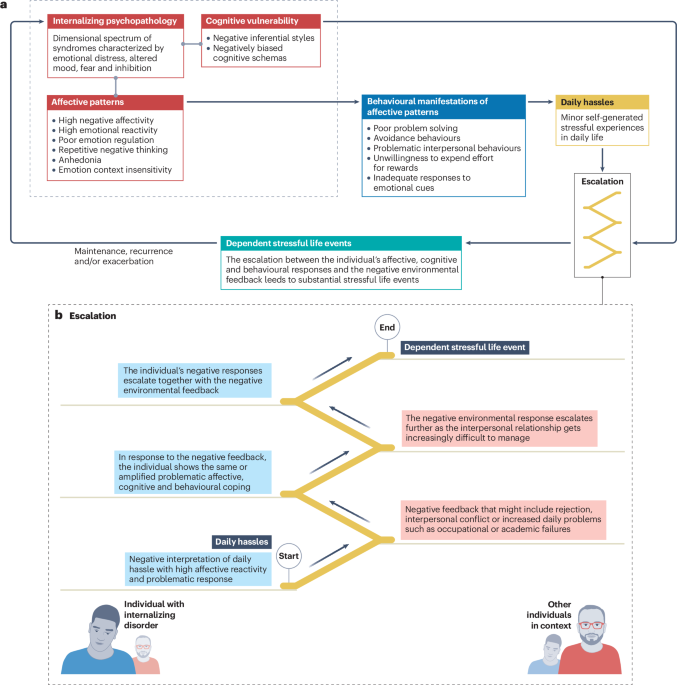
The stress generation model suggests that people with internalizing disorders are at increased risk of engaging in behaviours that lead to stressful events. Although stress generation has been shown to contribute directly to chronicity and impairment across mental health conditions, a unifying framework charting how internalizing disorders translate into self-generated stress is needed to understand how stress-generating processes unfold mechanistically. In this Perspective, we present a process model of stress generation that details how affective, behavioural and cognitive factors in people with or at risk of internalizing psychopathology translate into stressful life events. Specifically, we outline a process that develops from alterations in affective functioning to problematic daily behaviours that can — particularly among individuals with high cognitive vulnerability — escalate into self-generated stressful life events. We describe how transdiagnostic factors associated with internalizing psychopathology might trigger escalating feedback loops between the individual and their interpersonal environment. Our model introduces multiple points of intervention that can make targeting stress generation a feasible goal for reducing the impairment and chronicity associated with internalizing disorders.
This is a preview of subscription content, access
Access options
Access through your institution
- Purchase on SpringerLink
- Instant access to the full article PDF.
39,95 €
Prices may be subject to local taxes which are calculated during checkout
Subjects
- Human behaviour
- Psychiatric disorders
- Psychology
References
Brown, G. W. & Harris, T. Social Origins of Depression (Free Press, 1978)
Hammen, C. Stress and depression. Annu. Rev. Clin. Psychol.1, 293–319 (2005)
Kendler, K. S., Karkowski, L. M. & Prescott, C. A. Stressful life events and major depression: risk period, long-term contextual threat, and diagnostic specificity. J. Nerv. Ment. Dis.186, 661–669 (1998)
Monroe, S. M. & Reid, M. W. Life stress and major depression. Curr. Dir. Psychol. Sci.18, 68–72 (2009)
Vrshek-Schallhorn, S. et al. Chronic and episodic interpersonal stress as statistically unique predictors of depression in two samples of emerging adults. J. Abnorm. Psychol.124, 918–932 (2015)
Hammen, C. Generation of stress in the course of unipolar depression. J. Abnorm. Psychol.100, 555–561 (1991)
Hammen, C. Stress generation in depression: reflections on origins, research, and future directions. J. Clin. Psychol.62, 1065–1082 (2006)
Starr, L. R. et al. Towards next-generation stress generation research: expert consensus methodological guidelines. J. Psychopathol. Clin. Sci.135, 581–600 (2026)
Kercher, A. & Rapee, R. M. A test of a cognitive diathesis—stress generation pathway in early adolescent depression. J. Abnorm. Child Psychol.37, 845–855 (2009)
Rudolph, K. D., Flynn, M., Abaied, J., Groot, A. & Thompson, R. J. Why is past depression the best predictor of future depression? Stress generation as a mechanism of depression continuity in girls. J. Clin. Child Adolesc. Psychol.38, 473–485 (2009)
Perlstein, S. & Waller, R. Integrating the study of personality and psychopathology in the context of gene–environment correlations across development. J. Personal.90, 47–60 (2022)
Rnic, K. et al. The vicious cycle of psychopathology and stressful life events: a meta-analytic review testing the stress generation model. Psychol. Bull.149, 330–369 (2023)
Scott, L. N. et al. Affective dynamics across internalizing and externalizing dimensions of psychopathology. Clin. Psychol. Sci.8, 412–427 (2020)
Arslan, I. B., Lucassen, N., van Lier, P. A. C., de Haan, A. D. & Prinzie, P. Early childhood internalizing problems, externalizing problems and their co-occurrence and (mal)adaptive functioning in emerging adulthood: a 16-year follow-up study. Soc. Psychiatry Psychiatr. Epidemiol.56, 193–206 (2021)
Chen, R. X., Santee, A. C., Chang, K. K. & Starr, L. R. Positive affect dampening prospectively predicts changes in chronic life stress, but not episodic stress generation among adolescents. J. Psychopathol. Behav. Assess.https://doi.org/10.1007/s10862-023-10083-3 (2023)
Conway, C. C., Hammen, C. & Brennan, P. A. Expanding stress generation theory: test of a transdiagnostic model. J. Abnorm. Psychol.121, 754–766 (2012)
Burcusa, S. L. & Iacono, W. G. Risk for recurrence in depression. Clin. Psychol. Rev.27, 959–985 (2007)
Klein, D. N. & Allmann, A. E. Course of depression: persistence and recurrence. In Handbook of Depression and its Treatment (eds Gotlib, I. H. & Hammen, C. L.) 3rd edn, 64–83 (Guilford, 2014)
Kessler, R. C. et al. Epidemiology of depression. In Handbook of Depressionand its Treatment (eds Gotlib, I. H. & Hammen, C. L.) 3rd edn, 7–24 (Guilford, 2014)
Cui, X.-J. & Vaillant, G. E. Does depression generate negative life events? J. Nerv. Ment. Dis.185, 145–150 (1997)
Chan, P. T., Doan, S. N. & Tompson, M. C. Stress generation in a developmental context: the role of youth depressive symptoms, maternal depression, the parent–child relationship, and family stress. J. Family Psychol.28, 32–41 (2014)
Starr, L. R., Hammen, C., Brennan, P. A. & Najman, J. M. Relational security moderates the effect of serotonin transporter gene polymorphism (5-HTTLPR) on stress generation and depression among adolescents. J. Abnorm. Child Psychol.41, 379–388 (2013)
Flynn, M. & Rudolph, K. D. Stress generation and adolescent depression: contribution of interpersonal stress responses. J. Abnorm. Child. Psychol.39, 1187–1198 (2011)
Harkness, K. L., Lumley, M. N. & Truss, A. E. Stress generation in adolescent depression: the moderating role of child abuse and neglect. J. Abnorm. Child Psychol.36, 421–432 (2008)
Huang, M. & Starr, L. R. Interpersonal childhood adversity and stress generation in adolescence: moderation by HPA axis multilocus genetic variation. Dev. Psychopathol.32, 865–878 (2020)
Daley, S. E., Rizzo, C. J. & Gunderson, B. H. The longitudinal relation between personality disorder symptoms and depression in adolescence: the mediating role of interpersonal stress. J. Personal. Disord.20, 352–368 (2006)
Shahar, G. & Priel, B. Active vulnerability, adolescent distress, and the mediating/suppressing role of life events. Personal. Individ. Diff.35, 199–218 (2003)
Maciejewski, D., van Sprang, E., Spinhoven, P. & Penninx, B. Longitudinal associations between negative life events and depressive symptoms — a 9-year longitudinal study on between-person and within-person effects and the role of family history. J. Personal. Soc. Psychol.121, 707 (2021)
Starrs, C. J. et al. Stress generation and vulnerability in adolescents in mainland China. Int. J. Cogn. Ther.3, 345–357 (2010)
Cohen, J. R. et al. Negative attachment cognitions and emotional distress in mainland Chinese adolescents: a prospective multiwave test of vulnerability-stress and stress generation models. J. Clin. Child Adolesc. Psychol.42, 531–544 (2013)
Starr, L. R., Hammen, C., Brennan, P. A. & Najman, J. M. Serotonin transporter gene as a predictor of stress generation in depression. J. Abnorm. Psychol.121, 810–818 (2012)
Hammen, C. & Shih, J. H. in Risk Factors in Depression (eds Dobson, K. S. & Dozois, D. J. A.) 409–428 (Elsevier, 2008)
Harkness, K. & Washburn, D. Stress generation. In Stress: Concepts, Cognition, Emotion, and Behavior 331–338 (Academic, 2016)
Liu, R. T. Stress generation: future directions and clinical implications. Clin. Psychol. Rev.33, 406–416 (2013)
Liu, R. T. & Alloy, L. B. Stress generation in depression: a systematic review of the empirical literature and recommendations for future study. Clin. Psychol. Rev.30, 582–593 (2010)
Hammen, C. L. in Oxford Handbook of Stress and Mental Health (eds Harkness, K. L. & Hayden, E. P.) 409–428 (Elsevier/Academic, 2020)
Liu, R. T. et al. A systematic review and Bayesian meta-analysis of 30 years of stress generation research: clinical, psychological, and sociodemographic risk and protective factors for prospective negative life events. Psychol. Bull.150, 1021–1069 (2024)
Kupfer, D. J., Frank, E. & Wamhoff, J. Mood disorders: update on prevention of recurrence. In Interpersonal Factors in the Origin and Course of Affective Disorders (eds Mundt, M. J. et al.) 289–302 (Gaskell/Royal College of Psychiatrists, 1996)
Post, R. M. Transduction of psychosocial stress into the neurobiology of recurrent affective disorder. Am. J. Psychiatry149, 999–1010 (1992)
Diagnostic and Statistical Manual of Mental Disorders (DSM5) 5th edn (American Psychiatric Association, 2013)
Monroe, S. M. & Harkness, K. L. Why recurrent depression should be reconceptualized and redefined. Curr. Dir. Psychol. Sci.32, 204–211 (2023)
Harkness, K. L., Monroe, S. M., Simons, A. D. & Thase, M. The generation of life events in recurrent and non-recurrent depression. Psychol. Med.29, 135–144 (1999)
Ingram, R.E. & Siegle, G. J. Methodological issues in the study of depression. In Handbook of Depression (eds Gotlib, I. H. & Hammen, C. L.) 2nd edn, 69–92 (Guilford, 2009)
Kessler, R. C., Chiu, W. T., Demler, O. & Walters, E. E. Prevalence, severity, and comorbidity of 12-month DSM-IV disorders in the National Comorbidity Survey Replication. Arch. Gen. Psychiatry62, 617–627 (2005)
Meyer, A. E. & Curry, J. F. Pathways from anxiety to stressful events: an expansion of the stress generation hypothesis. Clin. Psychol. Rev.57, 93–116 (2017)
Plana-Ripoll, O. et al. Exploring comorbidity within mental disorders among a Danish national population. JAMA Psychiatry76, 259–270 (2019)
Dozois, D. J. A., Wilde, J. & Dobson, K. S. Depressive disorders. In Handbook of Assessment and Treatment Planning for Psychological Disorders 3rd ed. (eds. Antony, M. M. & Barlow, D. H.) 335–378 (Guilford, 2020)
Clark, L. A. & Watson, D. Tripartite model of anxiety and depression: psychometric evidence and taxonomic implications. J. Abnorm. Psychol.100, 316–336 (1991)
Connolly, N. P., Eberhart, N. K., Hammen, C. L. & Brennan, P. A. Specificity of stress generation: a comparison of adolescents with depressive, anxiety, and comorbid diagnoses. Int. J. Cogn. Ther.3, 368–379 (2010)
Daley, S. E., Hammen, C., Burge, D. & Davila, J. Predictors of the generation of episodic stress: a longitudinal study of late adolescent women. J. Abnorm. Psychol.106, 251–259 (1997)
Goldstein, B. L. et al. Patterns of stress generation differ depending on internalizing symptoms, alcohol use, and personality traits in early adulthood: a five year longitudinal study. Anxiety Stress Coping34, 612–625 (2021)
Harkness, K. L. & Luther, J. Clinical risk factors for the generation of life events in major depression. J. Abnorm. Psychol.110, 564–572 (2001)
Goodman, F. R., Birg, J. A., Daniel, K. E. & Kashdan, T. B. Stress generation in social anxiety and depression: a two-study community assessment. J. Affect. Disord.329, 285–292 (2023)
Harrison, T. J., Ginsburg, G. S., Smith, I. C. & Orlando, C. M. Youth stress generation: an examination of the role of anxiety, anxiety symptoms and cognitive distortions. Anxiety Stress Coping36, 304–319 (2023)
Phillips, A. C., Carroll, D. & Der, G. Negative life events and symptoms of depression and anxiety: stress causation and/or stress generation. Anxiety Stress Coping28, 357–371 (2015)
Uliaszek, A. A. et al. A longitudinal examination of stress generation in depressive and anxiety disorders. J. Abnorm. Psychol.121, 4–15 (2012)
Joiner, T. E., Wingate, L. R., Gencoz, T. & Gencoz, F. Stress generation in depression: three studies on its resilience, possible mechanism, and symptom specificity. J. Soc. Clin. Psychol.24, 236–253 (2005)
Moriishi, C. & Maeda, S. Stress generation in social anxiety: a longitudinal study of the role of post-event processing. Cogn. Ther. Res.49, 631–639 (2025)
Schneider, R. L., Long, E. E., Arch, J. J. & Hankin, B. L. The relationship between stressful events, emotion dysregulation, and anxiety symptoms among youth: longitudinal support for stress causation but not stress generation. Anxiety Stress Coping34, 157–172 (2021)
Ringwald, W. R. et al. Stress dynamics that maintain posttraumatic stress disorder across 20 years. Psychol. Med.55, e151 (2025)
Maniates, H., Stoop, T. B., Miller, M. W., Halberstadt, L. & Wolf, E. J. Stress-generative effects of posttraumatic stress disorder: transactional associations between posttraumatic stress disorder and stressful life events in a longitudinal sample. J. Traum. Stress.31, 191–201 (2018)
Hammen, C. & Brennan, P. A. Interpersonal dysfunction in depressed women: impairments independent of depressive symptoms. J. Affect. Disord.72, 145–156 (2002)
Adrian, C. & Hammen, C. Stress exposure and stress generation in children of depressed mothers. J. Consult. Clin. Psychol.61, 354 (1993)
Feurer, C., Hammen, C. L. & Gibb, B. E. Chronic and episodic stress in children of depressed mothers. J. Clin. Child Adolesc. Psychol.45, 270–278 https://doi.org/10.1080/15374416.2014.963859 (2016)
Bahji, A., Forth, E., Hargreaves, T. & Harkness, K. Genetic markers of the stress generation model: a systematic review. Psychiatry Res.304, 114139 (2021)
Kring, A. M. & Sloan, D. M. Emotion Regulation and Psychopathology: A Transdiagnostic Approach to Etiology and Treatment (Guilford, 2011)
Lesnick, J. & Mendle, J. Rejection sensitivity and negative urgency: a proposed framework of intersecting risk for peer stress. Dev. Rev.62, 100998 (2021)
Watson, D. & Clark, L. A. Negative affectivity: the disposition to experience aversive emotional states. Psychol. Bull.96, 465–490 (1984)
Clark, L. A., Watson, D. & Mineka, S. Temperament, personality, and the mood and anxiety disorders. J. Abnorm. Psychol.103, 103 (1994)
Lahey, B. B. Public health significance of neuroticism. Am. Psychol.64, 241–256 (2009)
Bolger, N. & Schilling, E. A. Personality and the problems of everyday life: the role of neuroticism in exposure and reactivity to daily stressors. J. Personal.59, 355–386 (1991)
Aldao, A., Nolen-Hoeksema, S. & Schweizer, S. Emotion-regulation strategies across psychopathology: a meta-analytic review. Clin. Psychol. Rev.30, 217–237 (2010)
Santee, A. C. et al. Risk and protective factors for stress generation: a meta-analytic review. Clin. Psychol. Rev.103, 102299 (2023)
Leary, M. R. & Hoyle, R. H. Handbook of Individual Differences in Social Behavior (Guilford, 2009)
Harrison, T. J. et al. Irritability and stress: prospective, bidirectional relationships in adolescence. J. Affect. Disord.372, 598–607 (2025)
Zimmermann, P., Mohr, C. & Spangler, G. Genetic and attachment influences on adolescents’ regulation of autonomy and aggressiveness. J. Child Psychol. Psychiatry50, 1339–1347 (2009)
Santee, A. C., Pai, T., Carolus, A. E. & Starr, L. R. Does emotion differentiation predict stress generation among adolescents? J. Psychopathol. Clin. Sci.135, 601–611 (2026)
Gross, J. J. Emotion regulation: current status and future prospects. Psychol. Inq.26, 1–26 (2015)
Richardson, C. M. E. Emotion regulation in the context of daily stress: impact on daily affect. Personal. Individ. Diff.112, 150–156 (2017)
Tortella-Feliu, M., Balle, M. & Sesé, A. Relationships between negative affectivity, emotion regulation, anxiety, and depressive symptoms in adolescents as examined through structural equation modeling. J. Anxiety Disord.24, 686–693 (2010)
Shapero, B. G., Abramson, L. Y. & Alloy, L. B. Emotional reactivity and internalizing symptoms: moderating role of emotion regulation. Cogn. Ther. Res.40, 328–340 (2016)
McLaughlin, K. A., Hatzenbuehler, M. L., Mennin, D. S. & Nolen-Hoeksema, S. Emotion dysregulation and adolescent psychopathology: a prospective study. Behav. Res. Ther.49, 544–554 (2011)
Hofmann, S. G., Sawyer, A. T., Fang, A. & Asnaani, A. Emotion dysregulation model of mood and anxiety disorders. Depression Anxiety29, 409–416 (2012)
Elliot, A. J., Thrash, T. M. & Murayama, K. A longitudinal analysis of self-regulation and well-being: avoidance personal goals, avoidance coping, stress generation, and subjective well-being. J. Personal.79, 643–674 (2011)
Stroud, C. B., Sosoo, E. E. & Wilson, S. Rumination, excessive reassurance seeking, and stress generation among early adolescent girls. J. Early Adolescence38, 139–163 (2018)
McLaughlin, K. A. & Nolen-Hoeksema, S. Rumination as a transdiagnostic factor in depression and anxiety. Behav. Res. Ther.49, 186–193 (2011)
Aldao, A. & Nolen-Hoeksema, S. The influence of context on the implementation of adaptive emotion regulation strategies. Behav. Res. Ther.50, 493–501 (2012)
Marx, E. M., Williams, J. M. & Claridge, G. C. Depression and social problem solving. J. Abnorm. Psychol.101, 78 (1992)
Romano, M., Moscovitch, D. A., Ma, R. & Huppert, J. D. Social problem solving in social anxiety disorder. J. Anxiety Disord.68, 102152 (2019)
Davila, J., Hammen, C., Burge, D., Paley, B. & Daley, S. E. Poor interpersonal problem solving as a mechanism of stress generation in depression among adolescent women. J. Abnorm. Psychol.104, 592–600 (1995)
Nolen-Hoeksema, S., Wisco, B. E. & Lyubomirsky, S. Rethinking rumination. Persp. Psychol. Sci.3, 400–424 (2008)
Drost, J., van der Does, W., van Hemert, A. M., Penninx, B. W. J. H. & Spinhoven, P. Repetitive negative thinking as a transdiagnostic factor in depression and anxiety: a conceptual replication. Behav. Res. Ther.63, 177–183 (2014)
Shaw, Z. A., Conway, C. C. & Starr, L. R. Distinguishing transdiagnostic versus disorder-specific pathways between ruminative brooding and internalizing psychopathology in adolescents: a latent variable modeling approach. Res. Child. Adolesc. Psychopathol.49, 1319–1331 (2021)
Hamilton, J. L. et al. Cognitive vulnerabilities as predictors of stress generation in early adolescence: pathway to depressive symptoms. J. Abnorm. Child Psychol.41, 1027–1039 (2013)
Stroud, C. B., Sosoo, E. E. & Wilson, S. Normal personality traits, rumination, and stress generation among early adolescent girls. J. Personal.57, 131–142 (2015)
Watkins, E. Rumination. In Treatment of Psychosocial Risk Factors in Depression (eds Dozois, D. J. A. & Dobson, K. S.) 305–331 (American Psychological Association, 2023)
Watkins, E. R. Rumination-focused Cognitive-behavioral Therapy for Depression (Guilford, 2018)
LeMoult, J. & Joormann, J. Depressive rumination alters cortisol decline in major depressive disorder. Biol. Psychol.100, 50–55 (2014)
Borkovec, T. D., Ray, W. J. & Staber, J. Worry: a cognitive phenomenon intimately linked to affective, physiological, and interpersonal behavioral processes. Cogn. Ther. Res.22, 561–576 (1998)
Brozovich, F. & Heimberg, R. G. An analysis of post-event processing in social anxiety disorder. Clin. Psychol. Rev.28, 891–903 (2008)
Flynn, A. J. & Yoon, K. L. Post-event processing in social anxiety: a scoping review. J. Anxiety Disord.109, 102947 (2025)
Dugas, M. J. & Ladouceur, R. Treatment of GAD: targeting intolerance of uncertainty in two types of worry. Behav. Modif.24, 635–657 (2000)
Lyubomirsky, S. & Nolen-Hoeksema, S. Effects of self-focused rumination on negative thinking and interpersonal problem solving. J. Personal. Soc. Psychol.69, 176–190 (1995)
Lyubomirsky, S., Tucker, K. L., Caldwell, N. D. & Berg, K. Why ruminators are poor problem solvers: clues from the phenomenology of dysphoric rumination. J. Personal. Soc. Psychol.77, 1041–1060 (1999)
Watkins, E. & Moulds, M. Distinct modes of ruminative self-focus: impact of abstract versus concrete rumination on problem solving in depression. Emotion5, 319–328 (2005)
Adam, E. K. et al. Prospective associations between the cortisol awakening response and first onsets of anxiety disorders over a six-year follow-up. Psychoneuroendocrinology44, 47–59 (2014)
Moulds, M. L., Kandris, E., Starr, S. & Wong, A. C. The relationship between rumination, avoidance and depression in a non-clinical sample. Behav. Res. Ther.45, 251–261 (2007)
Hamilton, J. L. et al. Trait affect, emotion regulation, and the generation of negative and positive interpersonal events. Behav. Ther.48, 435–447 (2017)
Pizzagalli, D. A. Depression, stress, and anhedonia: toward a synthesis and integrated model. Annu. Rev. Clin. Psychol.10, 393–423 (2014)
Treadway, M. T. & Zald, D. H. Reconsidering anhedonia in depression: lessons from translational neuroscience. Neurosci. Biobehav. Rev.35, 537–555 (2011)
Taylor, C. T., Hoffman, S. N. & Khan, A. J. Anhedonia in anxiety disorders. In Anhedonia: Preclinical, Translational, and Clinical Integration (ed. Pizzagalli, D. A.) 201–218 (Springer, 2022)
Bylsma, L. M. Emotion context insensitivity in depression: toward an integrated and contextualized approach. Psychophysiology58, e13715 (2021)
Rottenberg, J., Gross, J. J. & Gotlib, I. H. Emotion context insensitivity in major depressive disorder. J. Abnorm. Psychol.114, 627 (2005)
Rottenberg, J. & Hindash, A. C. Emerging evidence for emotion context insensitivity in depression. Curr. Opin. Psychol.4, 1–5 (2015)
Christensen, M. C., Ren, H. & Fagiolini, A. Emotional blunting in patients with depression. Part II: relationship with functioning, well-being, and quality of life. Ann. Gen. Psychiatry21, 20 (2022)
Raes, F., Smets, J., Nelis, S. & Schoofs, H. Dampening of positive affect prospectively predicts depressive symptoms in non-clinical samples. Cogn. Emot.26, 75–82 (2012)
Wolkenstein, L., Sommerhoff, A. & Voss, M. Positive emotion dysregulation in posttraumatic stress disorder. J. Anxiety Disord.86, 102534 (2022)
Mackin, D. M. et al. Reward processing and future life stress: stress generation pathway to depression. J. Abnorm. Psychol.128, 305–314 (2019)
Christensen, M. C., Ren, H. & Fagiolini, A. Emotional blunting in patients with depression. Part I: clinical characteristics. Ann. Gen. Psychiatry21, 10 (2022)
Santee, A. C. & Starr, L. R. Examining linear and nonlinear associations between negative emotional reactivity to daily events and depression among adolescents. Clin. Psychol. Sci.10, 675–689 (2022)
Ottenbreit, N. D. & Dobson, K. S. Avoidance and depression: the construction of the cognitive–behavioral avoidance scale. Behav. Res. Ther.42, 293–313 (2004)
Quigley, L., Wen, A. & Dobson, K. S. Avoidance and depression vulnerability: an examination of avoidance in remitted and currently depressed individuals. Behav. Res. Ther.97, 183–188 (2017)
Martell, C. R., Dimidjian, S. & Herman-Dunn, R. Behavioral Activation for Depression: a Clinician’s Guide (Guilford, 2021)
Zaki, J. & Williams, W. C. Interpersonal emotion regulation. Emotion13, 803–810 (2013)
Starr, L. R., Santee, A. C. & Huang, M. Dependency and excessive reassurance seeking. In Treatment of Psychosocial Risk Factors in Depression (eds Dozois, D. J. A. & Dobson, K. S.) 133–155 (American Psychological Association, 2023)
Hames, J. L., Hagan, C. R. & Joiner, T. E. Interpersonal processes in depression. Annu. Rev. Clin. Psychol.9, 355–377 (2013)
Alden, L. E. & Bieling, P. Interpersonal consequences of the pursuit of safety. Behav. Res. Ther.36, 53–64 (1998)
Beck, J. G. Interpersonal Processes in the Anxiety Disorders: Implications for Understanding Psychopathology and Treatment (American Psychological Association, 2010)
Van Orden, K. A., Joiner, T. E. Jr The inner and outer turmoil of excessive reassurance seeking: from self-doubts to social rejection. In Self and Relationships: Connecting Intrapersonal and Interpersonal Processes (eds Vohs, K. D. & Finkel, E. J.) 104–129 (Guilford, 2006)
Coyne, J. C. Toward an interactional description of depression. Psychiatry J. Study Interpers. Process.39, 28–40 (1976)
Joiner, T. E. Jr. & Metalsky, G. I. Excessive reassurance seeking: delineating a risk factor involved in the development of depressive symptoms. Psychol. Sci.12, 371–378 (2001)
Joiner, T. E. Jr, Metalsky, G. I., Katz, J. & Beach, S. R. H. Depression and excessive reassurance-seeking. Psychol. Inq.10, 269–278 (1999)
Starr, L. R. & Davila, J. Excessive reassurance seeking, depression, and interpersonal rejection: a meta-analytic review. J. Abnorm. Psychol.117, 762–775 (2008)
Coyne, J. C. Depression and the response of others. J. Abnorm. Psychol.85, 186–193 (1976)
Eberhart, N. K. & Hammen, C. L. Interpersonal predictors of stress generation. Personal. Soc. Psychol. Bull.35, 544–556 (2009)
Starr, L. R. When support seeking backfires: co-rumination, excessive reassurance seeking, and depressed mood in the daily lives of young adults. J. Soc. Clin. Psychol.34, 436–457 (2015)
Gibb, B. E. & Coles, M. E. Cognitive vulnerability–stress models of psychopathology. In Development of Psychopathology: a Vulnerability–Stress Perspective (eds Hankin, B. L. & Abela, J. R. Z.) 104–135 (Sage, 2005)
Alloy, L. B., Abramson, L. Y., Walshaw, P. D. & Neeren, A. M. Cognitive vulnerability to unipolar and bipolar mood disorders. J. Soc. Clin. Psychol.25, 726–754 (2006)
Beck, A. T. Cognitive models of depression. Clin. Adv. Cogn. Psychother. Theory Appl.14, 29–61 (2002)
LeMoult, J., Kircanski, K., Prasad, G. & Gotlib, I. H. Negative self-referential processing predicts the recurrence of major depressive episodes. Clin. Psychol. Sci.5, 174–181 (2017)
LeMoult, J. & Gotlib, I. H. Depression: a cognitive perspective. Clin. Psychol. Rev.69, 51–66 (2019)
Calvete, E., Orue, I. & Hankin, B. L. Early maladaptive schemas and social anxiety in adolescents: the mediating role of anxious automatic thoughts. J. Anxiety Disord.27, 278–288 (2013)
Dostal, A. L. & Pilkington, P. D. Early maladaptive schemas and obsessive-compulsive disorder: a systematic review and meta-analysis. J. Affect. Disord. Rep.336, 42–51 (2023)
Dozois, D. J. & Beck, A. T. Negative thinking in depression: cognitive products and schema structures. In Treatment of Psychosocial Risk Factors in Depression (eds Dozois, D. J. A. & Dobson, K. S.) 207–232 (American Psychological Association, 2023)
Tariq, A., Quayle, E., Lawrie, S. M., Reid, C. & Chan, S. W. Relationship between early maladaptive schemas and anxiety in adolescence and young adulthood: a systematic review and meta-analysis. J. Affect. Disord.295, 1462–1473 (2021)
Janovsky, T., Rock, A. J., Thorsteinsson, E. B., Clark, G. I. & Murray, C. V. The relationship between early maladaptive schemas and interpersonal problems: a meta-analytic review. Clin. Psychol. Psychother.27, 408–447 (2020)
Epel, E. S. et al. More than a feeling: a unified view of stress measurement for population science. Front. Neuroendocrinol.49, 146–169 (2018)
Chentsova-Dutton, Y. E. & Ryder, A. G. Internalizing disorders as shape-shifters: understanding individual and cultural heterogeneity in the presentation of symptoms. Psychol. Rev.https://doi.org/10.1037/rev0000577 (2025)
Fried, E. I. Moving forward: how depression heterogeneity hinders progress in treatment and research. Expert. Rev. Neurotherapeutics17, 423–425 (2017)
Galatzer-Levy, I. R. & Bryant, R. A. 636,120 ways to have posttraumatic stress disorder. Persp. Psychol. Sci.8, 651–662 (2013)
Goldberg, D. The heterogeneity of “major depression”. World Psychiatry10, 226–228 (2011)
Hankin, B. L. Personality and depressive symptoms: stress generation and cognitive vulnerabilities to depression in a prospective daily diary study. J. Soc. Clin. Psychol.29, 369–401 (2010)
Sears, M. S., Niles, A. N. & Repetti, R. L. Emotional and social reactivity as mechanisms of stress generation: a momentary assessment study. J. Soc. Clin. Psychol.37, 201–230 (2018)
Wright, A. G., Aslinger, E. N., Bellamy, B., Edershile, E. A. & Woods, W. C. Daily stress and hassles. In The Oxford Handbook Of Stress And Mental Health (eds Harkness, K. L. & Hayden, E. P.) 27–44 (Oxford Academic, 2019)
Scher, C. D., Ingram, R. E. & Segal, Z. V. Cognitive reactivity and vulnerability: empirical evaluation of construct activation and cognitive diatheses in unipolar depression. Clin. Psychol. Rev.25, 487–510 (2005)
Schneiders, J. et al. Mood reactivity to daily negative events in early adolescence: relationship to risk for psychopathology. Dev. Psychol.42, 543–554 (2006)
O’Neill, S. C., Cohen, L. H., Tolpin, L. H. & Gunthert, K. C. Affective reactivity to daily interpersonal stressors as a prospective predictor of depressive symptoms. J. Soc. Clin. Psychol.23, 172–194 (2004)
Seeds, P. M. & Dozois, D. J. A. Prospective evaluation of a cognitive vulnerability–stress model for depression: the interaction of schema self-structures and negative life events. J. Clin. Psychol.66, 1307–1323 (2010)
Auerbach, R. P., Richardt, S., Kertz, S. & Eberhart, N. K. Cognitive vulnerability, stress generation, and anxiety: symptom clusters and gender differences. Int. J. Cogn. Ther.5, 50–66 (2012)
Shih, J. H., Abela, J. R. Z. & Starrs, C. Cognitive and interpersonal predictors of stress generation in children of affectively ill parents. J. Abnorm. Child Psychol.37, 195–208 (2009)
Hankin, B. L. & Abramson, L. Y. Development of gender differences in depression: an elaborated cognitive vulnerability–transactional stress theory. Psychol. Bull.127, 773–796 (2001)
Ward, A., Lyubomirsky, S., Sousa, L. & Nolen-Hoeksema, S. Can’t quite commit: rumination and uncertainty. Personal. Soc. Psychol. Bull.29, 96–107 (2003)
Llera, S. J. & Newman, M. G. Worry impairs the problem-solving process: results from an experimental study. Behav. Res. Ther.135, 103759 (2020)
Baker, S. R. Towards an idiothetic understanding of the role of social problem solving in daily event, mood and health experiences: a prospective daily diary approach. Br. J. Health Psychol.11, 513–531 (2006)
Fredrickson, B. L. What good are positive emotions? Rev. Gen. Psychol.2, 300–319 (1998)
Fredrickson, B. L. The role of positive emotions in positive psychology: the broaden-and-build theory of positive emotions. Am. psychologist56, 218 (2001)
Aron, A., Lewandowski, G., Branand, B., Mashek, D. & Aron, E. Self-expansion motivation and inclusion of others in self: an updated review. J. Soc. Personal. Relat.39, 3821–3852 (2022)
Barrett, L. F. Emotions are real. Emotion12, 413–429 (2012)
Clore, G. L. & Huntsinger, J. R. How emotions inform judgment and regulate thought. Trends Cogn. Sci.11, 393–399 (2007)
Harkness, K. L. & Monroe, S. M. The assessment and measurement of adult life stress: basic premises, operational principles, and design requirements. J. Abnorm. Psychol.125, 727–745 (2016)
Monroe, S. M. Modern approaches to conceptualizing and measuring human life stress. Annu. Rev. Clin. Psychol.4, 33–52 (2008)
Kessler, R. C. The effects of stressful life events on depression. Annu. Rev. Psychol.48, 191–214 (1997)
Gelman, A. & Stern, H. The difference between “significant” and “not significant” is not itself statistically significant. Am. Statist.60, 328–331 (2006)
Achenbach, T. M. The classification of children’s psychiatric symptoms: a factor-analytic study. Psychol. Monogr.80, 1–37 (1966)
Evans-Lacko, S. & Knapp, M. Global patterns of workplace productivity for people with depression: absenteeism and presenteeism costs across eight diverse countries. Soc. Psychiatry Psychiatr. Epidemiol.51, 1525–1537 (2016)
Greenberg, P. E., Stiglin, L. E., Finkelstein, S. N. & Berndt, E. R. The economic burden of depression in 1990. J. Clin. Psychiatry54, 405 (1993)
Murray, C. J. L. et al. Disability-adjusted life years (DALYs) for 291 diseases and injuries in 21 regions, 1990–2010: a systematic analysis for the Global Burden of Disease Study 2010. Lancet380, 2197–2223 (2012)
World Health Organization. The Global Burden of Disease: 2004 Updatehttps://www.who.int/publications/i/item/9789241563710 (World Health Organization, 2008)
Rapaport, M. H., Clary, C., Fayyad, R. & Endicott, J. Quality-of-life impairment in depressive and anxiety disorders. Am. J. Psychiatry162, 1171–1178 (2005)
Hamilton, J. L. & Alloy, L. B. Physiological markers of interpersonal stress generation in depression. Clin. Psychol. Sci.5, 911–929 (2017)
Alloy, L. B., Liu, R. T. & Bender, R. E. Stress generation research in depression: a commentary. Int. J. Cogn. Ther.3, 380–388 (2010)
Barlow, D. H., Allen, L. B. & Choate, M. L. Toward a unified treatment for emotional disorders. Behav. Ther.35, 205–230 (2004)
Beck, A. T. & Dozois, D. J. Cognitive therapy: current status and future directions. Annu. Rev. Med.62, 397–409 (2011)
Markowitz, J. C. & Weissman, M. M. Interpersonal psychotherapy: past, present and future. Clin. Psychol. Psychother.19, 99–105 (2012)
Dozois, D. J. & Dobson, K. S. Treatment of Psychosocial Risk Factors in Depression (American Psychological Association, 2023)
Linehan, M. M. Cognitive-BehavioralTreatment of Borderline Personality Disorder (Guilford, 1992)
Jones, J. D. et al. Personalized depression prevention reduces dependent stressors among adolescents: results from a randomized controlled trial. J. Clin. Child Adolesc. Psychol.54, 113–126 (2025)
Author information
Authors and Affiliations
Department of Psychology, University of Rochester, Rochester, NY, USA
Lisa R. Starr
Department of Psychology, University of Western Ontario, London, Ontario, Canada
David J. A. Dozois
Department of Psychology, University of British Columbia, Vancouver, British Columbia, Canada
Katerina Rnic & Joelle LeMoult
Department of Psychiatry, University of Rochester Medical Center, Rochester, NY, USA
Angela C. Santee
Authors
- Lisa R. StarrView author publications
Search author on:PubMed Google Scholar
- David J. A. DozoisView author publications
Search author on:PubMed Google Scholar
- Katerina RnicView author publications
Search author on:PubMed Google Scholar
- Angela C. SanteeView author publications
Search author on:PubMed Google Scholar
- Joelle LeMoultView author publications
Search author on:PubMed Google Scholar
Contributions
L.R.S. conceived the Perspective, led the conceptualization, and coordinated the writing of the manuscript. All authors co-developed the conceptual framework, wrote sections of the manuscript and provided critical feedback and revisions. All authors approved the final version of the manuscript
Ethics declarations
Competing interests
The authors declare no competing interests
Peer review
Peer review information
Nature Reviews Psychology thanks Fallon R. Goodman and the other, anonymous, reviewer(s) for their contribution to the peer review of this work
Additional information
Publisher’s note Springer Nature remains neutral with regard to jurisdictional claims in published maps and institutional affiliations
Rights and permissions
Springer Nature or its licensor (e.g. a society or other partner) holds exclusive rights to this article under a publishing agreement with the author(s) or other rightsholder(s); author self-archiving of the accepted manuscript version of this article is solely governed by the terms of such publishing agreement and applicable law
About this article
Cite this article
Starr, L.R., Dozois, D.J.A., Rnic, K. et al. A process model of stress generation in internalizing disorders.
Nat Rev Psychol (2026). https://doi.org/10.1038/s44159-026-00607-5
Accepted:04 August 2026
Published:21 August 2026
Version of record:21 August 2026
DOI
:https://doi.org/10.1038/s44159-026-00607-5
