


pacific
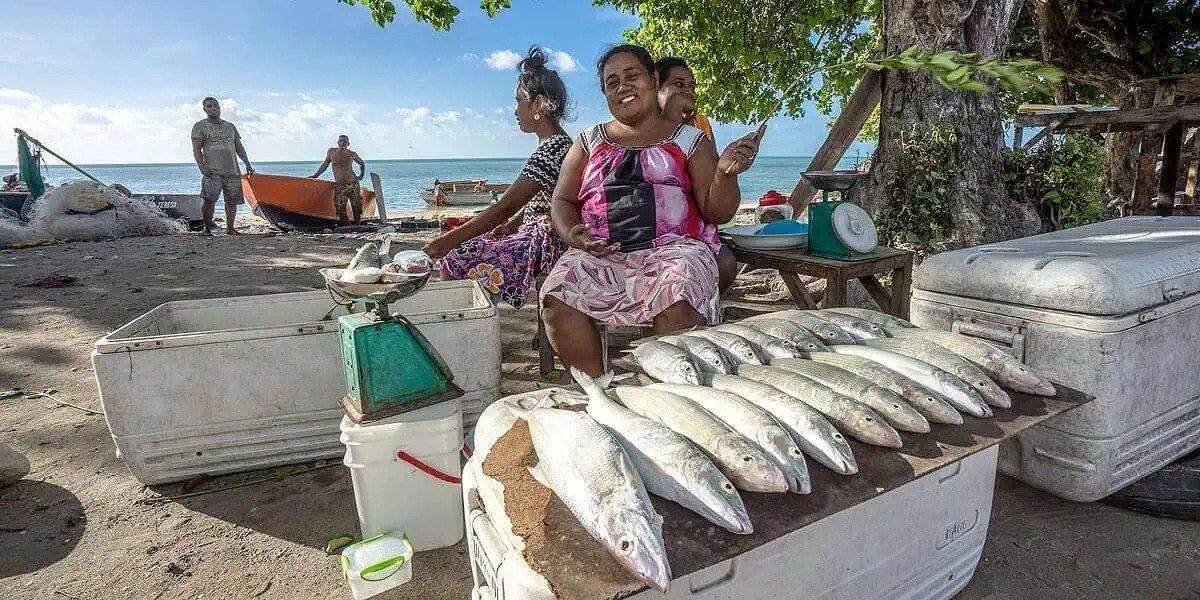
Kiribati villagers smile from their local fish catch, one of the few sources of healthy food production in the Micronesian nation. Image: ADB Pacific operation division.
Kiribati is looking to strengthen food security levels through a program of climate-resilient agriculture, fisheries management and an offshore horticultural estate amid its scarce land, limited freshwater and a reliance on imported food
The 2020-2030 Kiribati Agriculture Strategy aims to establish a long-term framework for increasing local food production and healthier diets
The low-lying coral atoll Pacific nation has scarce arable land in addition to poor soil fertility and limited freshwater re
Only around 2.5 per cent of its total land area – standing around just 340 square kilometres – is suitable for cultivation
“Food security is fundamentally constrained by itsgeography and high climate vulnerability,” the Asian Development Bank’s Insights analysis reported under its Pacific operations division
The ADB reports on the vulnerability of Kiribati, Tuvalu and the Marshall Islands to severe climate-crisis risks
Domestic food production has been “insufficient” to meet demand, Kiribati government data indicates, particularly in South Tarawa on the Tarawa Atoll where more than half of the nation’s 138,000 residents live in its capital
Food imports were valued at around $A55 million, with rice and raw sugar accounting for 19 per cent of those imports, which highlights the state’s relying dependence on imported staple foods that includes ultra-processed products
Food imports have consistently accounted for more than one-third of total merchandise imports, according to ADB data from the international research Centre for Collective Learning
The dependence on imported food has contributed to a nutrition dilemma in Kiribati amid limited access to locally-produced, nutrient-dense foods
“Nutrition indicators demonstrate a clear double burden of under-nutrition that is combined with overweight and obesity,” the ADB Insights analysis said in its report
Almost half of Kiribati’s population is considered obese, while the Micronesian state faces a 44 percent probability of premature death from noncommunicable diseases among people aged between 30 to 70 years of age, according to the Kiribati National Statistics Office
Child malnutrition also persists in Kiribati and within similar Micronesian cultures
Around 15 percent of children under five years of age are reported to be stunted and 3.5 per cent are wasted, an acute undernutrition,according to the Kiribati National Statistics Office that comes from a United Nations Children’s Fund Global Nutrition Report
Households spend an average of $A5.60 per person per day on food, representing around half of total daily expenditure in what is a serious concern for Kiribati
Diets are said to be marginally more diverse in rural areas of the atolls, but the overall nutritional quality remains relatively poor
Kiribati’s policy response has been anchored in the 2020-2030 Kiribati Agriculture Strategy and complemented by noncommunicable disease strategies and its high taxes on sugar-sweetened beverages and nutrition programs
The government says its policies aim to promote household food security, an increase in local food production, a reduction on reliance on imported foods and integrating nutritional education and vitamin A supplementation, community health services, and water and sanitation programs
“Current programs also include community-based food production, fisheries management, and climate-resilient food security initiatives,” the ADB Insights analysis said
The United Nations Development Program, the United Nations Children’s Fund, and the Food and Agriculture Organisation of the United Nations are supporting sustainable coastal fisheries, local agriculture and behavioural change towards healthier diets in Kiribati
Home gardens, school feeding programs and the promotion of resilient traditional crops are also part of the response along with that work of the UN’s three development partners
However, implementation remains constrained by the Kiribati’s geography of 32 atolls and one remoted raised coral island, and their limited re
“Limited arable land, poor soil quality, and scarce freshwater severely restrict agricultural productivity,” the ADB Insights analysis found
Climate change is damaging crops, fisheries and water systems through drought, sea-level rise and saltwater intrusion
High transport costs and geographic isolation add to the pressure, while weak institutional and human reits monitoring and delivery
Around 41 per cent of the population is affected from food insecurity, according to the Kiribati National Statistics Office
The proposed response includes climate-smart agriculture, drought-resistant crops, improved irrigation and soil management, integrated farming systems and stronger value chains
Early warning systems, climate-resilient infrastructure and targeted farmer support are intended to also improve resilience to climate variability
The government is also considering targeted social protection measures including cash payouts for supplemental food towards children under five years of age, small grants for nutritional gardening, and subsidies for nutritious food products
A key initiative is the development of the 5,500-acre Natoavatu Estate in Fiji as a new large-scale horticultural hub
The estate is intended to produce high-demand fruits and vegetables that are difficult to cultivate in Kiribati and serve as an offshore production base to complement local agriculture
“With targeted investment, the estate is expected to support commercial-scale, climate-resilient farming, alongside efficient logistics and cold-chain systems,” the ADB Insights analysis said
