


||
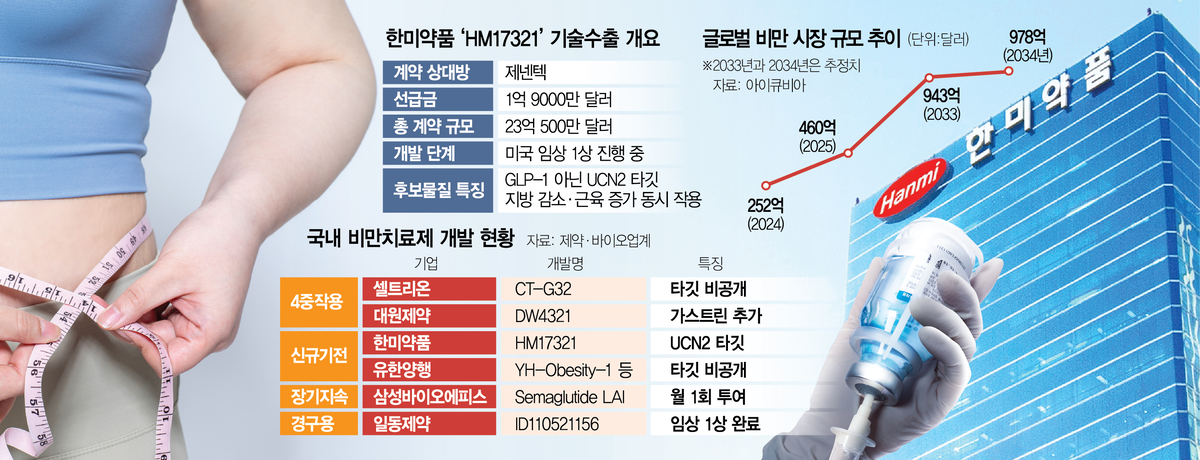
Hanmi Pharmaceutical’s latest drug candidate stands out for not being based on glucagon-like peptide-1 (GLP-1), the dominant approach in the obesity treatment market. While GLP-1-based treatments have proven strong weight-loss effects, they have also shown limits, such as loss of lean body mass and gastrointestinal side effects, fueling interest in new mechanisms that could address these shortcomings. With the inconvenience of injections also persisting, experts believe that future competitiveness in the obesity market will be shaped not only by weight-loss efficacy but also by minimizing side effects and improving patient access.
From Single-Acting GLP-1 to Multi-Acting Treatments
The global obesity treatment market is projected to grow to $97.8 billion (about 135 trillion won) by 2034, according to pharmaceutical market research firm IQVIA on the 24th. Accordingly, the direction of obesity drug development is trending toward greater diversification — from a focus on single-acting GLP-1 agonists to dual and triple agonists, new mechanisms such as amylin, and oral and long-acting formulations
The obesity treatment market opened when Novo Nordisk’s ‘Wegovy,’ a single-acting treatment that targets only the GLP-1 receptor, received approval from the U.S. Food and Drug Administration (FDA) in June 2021. Eli Lilly then demonstrated stronger weight-loss effects than Wegovy through ‘Mounjaro,’ a dual agonist that simultaneously targets GLP-1 and GIP, expanding the obesity drug development race toward multi-acting agonists that regulate several metabolic pathways at once
Currently, triple agonists that add glucagon to GLP-1 and GIP are seen as the next-generation contenders. Glucagon has the effect of increasing energy expenditure and metabolic rate, so it is expected to further boost the weight-loss effect of GLP-1 and GIP treatments. Novo Nordisk and Eli Lilly are each developing triple agonists that add glucagon
Korean companies are aiming beyond triple agonists. Celltrion has developed ‘CT-G32,’ a quadruple agonist, and is set to announce preclinical results this November, while Daewon Pharmaceutical presented preclinical results for ‘DW4321,’ a quadruple agonist that adds gastrin, at the American Diabetes Association meeting this June
Eyes on New Approaches Beyond GLP-1
While multi-acting agonists extend the efficacy of the existing GLP-1 class, treatments that use entirely different biological pathways are also being developed. A prime example is ‘HM17321,’ which Hanmi Pharmaceutical licensed to Genentech and which targets urocortin 2 (UCN2) rather than GLP-1. Unlike the GLP-1 class, which reduces weight through appetite suppression and blood-sugar control, HM17321 uses the physiological functions of UCN2 to affect energy metabolism, appetite and the cardiovascular system, aiming to reduce fat and build muscle at the same time.
A Hanmi Pharmaceutical official explained, “The GLP-1 class shows meaningful weight-loss effects, but it has the limitation that a reduction in lean body mass accompanies the treatment process. HM17321 has meaningful weight-loss and muscle-building effects on its own, and it can also be used in combination with the GLP-1 class.”
Global big pharma is also accelerating the development of obesity drugs with new mechanisms. Eli Lilly is conducting a trial of ‘eloralintide,’ which mimics amylin, and a trial of ‘bimagrumab (activin type II receptor),’ a muscle-preserving agent for non-diabetic obese patients. Novo Nordisk is also preparing to launch CagriSema, which combines the amylin-class ‘cagrilintide’ with its existing Wegovy to preserve muscle. In Korea, Yuhan Corporation’s ‘YH-Obesity-1’ and ‘YH-Obesity-2,’ for which the company aims to secure lead candidates within the year, are known as obesity treatments with mechanisms differentiated from GLP-1.
Oral and Long-Acting Formulations as Another Axis: Dosing Convenience
As obesity treatments expand from the GLP-1 class into various mechanisms, research to improve dosing convenience is also active. With Novo Nordisk and Eli Lilly confirming the market potential of oral treatments through their oral obesity drugs ‘Wegovy Pill’ and ‘Founda’ respectively, demand is also expected to remain steady for once-monthly injections that reduce the number of doses in consideration of adherence
Daewoong Pharmaceutical is conducting research to apply its ‘microneedle patch’ technology — which delivers drugs painlessly through a once-weekly patch — to obesity drugs. Ildong Pharmaceutical is also preparing a Phase 2 trial of ‘ID110521156,’ a once-daily oral GLP-1 obesity treatment candidate. Samsung Bioepis has teamed up with G2GBIO to begin preclinical research to extend the dosing cycle of a Wegovy-equivalent substance from once weekly to once monthly
Kim Hyo-young, a researcher at Spark Biopharma, wrote in a report titled “Recent Trends and Future Prospects in the Development of Treatments for Obesity and Metabolic Diseases,” contributed to the Biological Research Information Center, “The future winner will not be the company with the largest weight-loss rate. It is likely to be the company that secures a balance of long-term safety, quality of weight loss, dosing convenience, manufacturing stability and insurance access.”
#HanmiPharmaceutical#ObesityDrug#GLP1#HM17321#Wegovy#Mounjaro#Biopharma
Companies in this story
Hanmi Pharmaceutical
128940.KS · BioAI KEY Company Analysis →
Original reporting by Han Min-gu for Seoul Economic Daily
AI-translated from Korean. Quotes from foreignxact original wording
View Korean originalTranslation Policy
More →
Most Read This Week
1-5
- 1US and China Race to Build the Post-ASML Chip Machine
- 2Trump Jr.’s ‘MAGA Marketplace’ Faces Delisting After Stock Plunges 99%
- 3Taiwan’s TSMC Completes 1.6-nm Chip, Eyes Q4 Mass Production
- 4Typhoon Saudel Heads North, May Reach Korea
- 5Mirae Asset Weighs Buyout of U.S. Retail Broker Public.com
← Back to Home
