


As the kids head back to school with all their new school supplies, new clothes, new hair cut- styles, new athletic gear, new attitudes, we need not forget a school lunch

Ann Margaret Kane
Eating lunch — especially a healthy, balanced meal — offers major benefits for children’s physical health, brain function, and academic performance according to the Center for Disease Control and Science Insights. To be more specific these powered lunches can offer many benefits that go beyond the brain that include the following:
• Supports learning
• Promotes healthy growth and development
• Maintains a healthy body weight
• Boosts immunity and overall health
• Improves behavior and focus
• Encourages healthy eating habits
• Reduces food insecurity
• Improves diet quality
School lunch is critical to student health and wellbeing, especially for children from low-income households — and ensures that students have nutrition they need throughout the day to learn, according to the Food Research and Action Center. Research shows that receiving free or reduced-price school lunches reduces food insecurity, obesity rates, and poor health. In addition, the new school meal nutrition standards are having a positive impact on student food selection and consumption, especially for fruits and vegetables. But to bag lunch or eat lunch in school is a question many parents ponder. Recent data from 2024 reveals- About 4 in 10 or 40% of U.S. schoolchildren bring lunch from home, rather than eating a school-provided lunch.
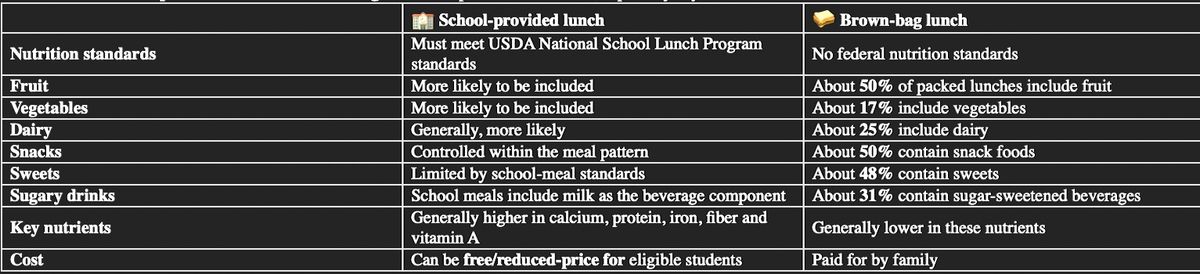
Bringing lunch from home doesn’t necessarily mean the lunch is healthier. Research has found that packed lunches often contain fewer fruits, vegetables and dairy products than school lunches. A systematic review found that lunches from home commonly included fruits (~50%), but vegetables (~17%) and dairy (~25%) were much less common; sweets and snacks were also frequent. Reviews indicated lower amounts of calcium, protein, iron, fiber and vitamin A and higher amounts of carbohydrates and saturated fat.
The federal school lunch program in the United States was formalized with the National School Lunch Program (NSLP) under the National School Lunch Act of 1946, with the goal of providing “nutritious meals” in public and non-profit private schools. fns.usda.gov School lunch programs have become a cornerstone of U.S. public education, bridging nutrition and learning for millions of students each day. Over subsequent decades, the program expanded and adapted in response to shifts in child nutrition science, federal funding, and socioeconomic trends. A larger 2024 review of research found a similar pattern: of school lunches were about 50% included fruit, 17% veg, 25% dairy, 50% snacks, 48% sweets, 31% sugar-sweetened beverages. Wak County Public Schools serve roughly 160,000 students in 204 schools.
A healthy school lunch is easiest to build with five parts: protein, whole grain, fruit, vegetable, and water or milk. The best lunch is also one your child will actually eat
If you mean the USDA guidelines for the National School Lunch Program (NSLP), there are several parts. The most important are the meal-pattern requirements, nutrition limits, and household eligibility rules
USDA school lunch meal requirements For a reimbursable lunch, schools generally must offer these five components:
• Fruit
• Vegetables
• Grains
• Meat or meat alternate
• Fluid milk
There are also calorie ranges, saturated-fat limits, sodium limits, and requirements concerning whole grains and vegetable subgroups
Cost and time are also factors when purchasing and preparing a brown-bagged lunch. For example, a paid lunch costs about $4 per student and reduced is .40 cents as opposed to our brown bagging which can cost upwards of $5 when including a beverage. Plus, time is commitment on mom’s and child’s part especially to make lunches healthier as opposed to quick- fixes like macaroni and cheese to name a few processed favorites. Here’s a sample of some home-packed lunch favorites and healthier versions.
Typical home-packed lunch vs healthy packed lunch
For example, a common packed lunch might look like: Sandwich + chips/crackers + cookie + fruit + juice/soda
A healthier version would be: Whole-grain sandwich + fruit + vegetable + yogurt/cheese + water
As my kids were growing up I always assured that they had a fruit or vegetable in their lunches. Now older, they are conditioned to pack produce into their own brown bagged lunches
Add protein component to pair with carbohydrate. Find some more fiber — fruits, veggies, whole grain
• Protein supports growth and keeps kids full
• Fiber-rich carbs provide steady energy (fruit, whole grains)
• Healthy fats help with brain development and satiety
• Fruits + veggies add vitamins, minerals and color
Packing a peanut butter and jelly sandwich on whole grain bread is a good main health lunch course. Try warps with lean meats and some veggie. For sides you can opt for orange slices, small apples, grapes, baby carrots, celery, and broccoli holds well. Also include some low fat dairy with a yogurt in ice pack and healthy carb low fat granola
Good measurable outcomes
Healthy school lunches do more than provide food. They help students receive the nutrients they need for healthy growth with key nutrients and development and can support better diet quality, attendance, classroom readiness, and academic success. Providing meals that are both nutritious and appealing can also encourage more students to participate in school meal programs- fewer reports of hunger
Participation and reach in 202 remains large-scale: according to the Food Research & Action Center (FRAC), nearly 29.4 million children participated in the NSLP on a typical day in the 2023–24 school year, including 21.1 million children receiving free or reduced-price lunches. Another recent data point from the National Center for Education Statistics (NCES) School Pulse Panel shows that in the 2024-25 school year, 91 percent of public schools participated in USDA meal programs, In Wake County Public School Systems about 68,200 students qualify for free and reduced lunches across the district. About 60, 000 of those qualifying students typically use the program or 88%.
Both Wake Forest Charter Academy (Grades- K-8) and Wake Forest High School offer free and reduced lunches and are still processing applications through September
How to complete a school lunch application — free/reduced meals
Every child deserves access to healthy meals at school. If your family qualifies, your student can receive breakfast and lunch at a discounted rate or even for free. Your application matters! Even if your child doesn’t eat school meals every day, applying for meal benefits may help your family and your school
When more families apply and qualify:
• Your school may receive more funding for books, teachers, and academic programs
• These funds provide additional teachers and staff for the school, which means more services for students, including materials and supplies. These are valuable re
• Paper applications will always be available throughout all of our schools, and at Central Office, or you can call 919-588-3535 or 919-856-2920 to have one mailed to you
• Students can receive school meal benefits regardless of the immigration status of household members, and information provided by the household will not be used for immigration-related purposes
How to apply online
You can apply online anytime during the school year. The application is available in multiple languages, and it’s mobile-friendly
Meal benefits expiration date from last school year will continue for the first 30 school days of the new year, based on your child’s school calendar. To keep receiving free or reduced-price meals, families must submit a new application each school year
New school year applications open on July 1:
• Year-round track 1 and 2: August 17
• Modified: Sept. 8
• Year-round track 3: Sept. 10
• Year-round track 4: Sept. 11
• Knightdale High, North Wake College and Career Academy, Vernon Malone College and Career Academy, Wake Early College of Health and Science, Wake Early College of Information and Biotechnologies: Sept. 17
• Leadership Academies: Sept. 17
• STEM Early College: Sept. 17
• Traditional: Oct. 6
Questions about applying for free and reduced meals:
• (919) 856-2920 (English)
• (919) 588-3535 (English and Spanish)
• cnsmealbenefits@wcpss.net
• Free and Reduced-Price Benefits Office fax number: (919) 856-3704
The household size and income criteria will be used to determine student eligibility for free and reduced-price meal benefits. Children from households whose income is at or below the levels shown are eligible for free or reduced-price meals. Children who are members of households that are eligible to receive Supplemental Nutrition Assistance Program (SNAP) benefits or Cash Assistance (CA) are automatically eligible for free meals. SNAP/CA families will be certified by the determining official through direct certification. Foster children that are the legal responsibility of a social services agency or court are considered categorically eligible for free meal benefits regardless of the income of the household with whom they reside. Wake Forest High School administration adds that more Wake County Schools are piloting both school lunch and breakfast programs.
In short: A healthy lunch is not just about fueling the body — it’s about fueling the mind, supporting growth and helping children succeed academically and socially
So what are you waiting for? Get packing for that healthier brown bagged lunch or purchase ready for a paid school lunch. Lastly if income eligible, complete an online application
Sustenance contributes to school success!
Ann Margaret Kane is a registered dietician and writes about nutrition
Story Tags
