



Barbershop health screenings help reduce blood pressure in Indianapolis communities
Indiana University Indianapolis is supporting an IU Health program that connects people to healthcare screenings and follow-up care through trusted neighborhood spaces
Aug 26, 2026
Marvin Taylor, right, owner of All in the Wrists Barbershop, hosts a program in his shop that provides access to free blood pressure checks and care for people in the neighborhood. Operated by the Office of Health Communities at IU Health, the program is supported by researchers at Indiana University Indianapolis. Photo by Liz Kaye, Indiana University
A small business owner in Indianapolis for over a decade, Marvin Taylor is a familiar face to the people who frequent the neighborhood outside his All in the Wrists Barbershop at 22nd and Meridian streets, only a few blocks north of Indiana University Indianapolis
The downtown location has also given him a close-up view of the health challenges those friends and neighbors face
That is why Taylor’s shop plays host to a unique program that provides access to free blood pressure monitoring, on-site blood sugar checks and other health assistance services offered through a partnership between IU and IU Health
“Barbershops are a hub of the community; this is where people come to congregate and talk,” Taylor said. “So when a friend of mine asked me if I wanted to provide a small space for blood pressure readings, I was all in; I thought it was a great idea.”
Care in the community
The program is run by community health workers from IU Health’s Office of Healthy Communities, with support from IU researchers in the HEALeR Collaborative, a partnership that brings research and evaluation expertise to health system initiatives. The Office of Healthy Communities is led by Dr. Brownsyne Tucker Edmonds, chief health impact officer at IU Health and a professor of obstetrics, gynecology and pediatrics at the IU School of Medicine
Medgine Louis Cadet, a community health worker at IU Health, checks a customer’s blood pressure at All in the Wrists barbershop in Indianapolis. Photo by Liz Kaye, Indiana University
“Blood pressure is what they call the ‘silent killer,’ because most people don’t have symptoms until it’s out of control,” said Erika Cheng, an associate professor at the IU Fairbanks School of Public Health and the executive director of the HEALeR Collaborative
“We found that so many people in these spaces were diagnosed with high blood pressure for the very first time. Some were close to a hypertensive emergency and had no idea.”
On a Tuesday afternoon in Taylor’s barbershop, Carla Logrono from the HEALeR Collaborative sat at a table near the front door with Medgine Louis Cadet, a community health worker at IU Health
As a clinical research technician at the IU School of Medicine, Logrono invites people who get their blood pressure checked to participate in a research study with a subset of program participants. She also interviews participants to find out if the program meets their needs or how it might run even more effectively
“We want to grow this program, and the way we do that is by coming into shops like Marvin’s where people are comfortable to address any kinks in the process,” she said. “Then you can create a standardized approach for different areas of the community, whether it be a farmers market, a storefront or a salon.”
Real people, real results
In just two years since the launch of the program, Cheng said community health workers have screened nearly 2,000 people at barbershops, including All in the Wrists and other locations across Indianapolis
“A lot of my clients get their blood pressure checked, and then it snowballs,” Taylor said. “I used to have to go out and say, ‘Hey, come get your blood pressure checked.’ Now people are saying, ‘Hey, when are the blood pressure people coming?’”
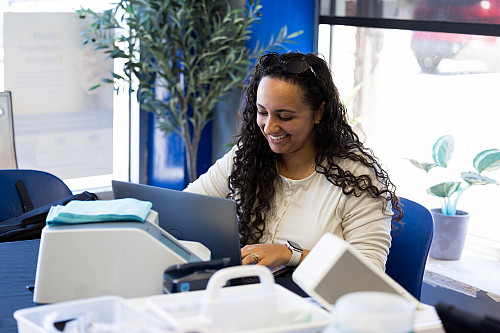
Carla Logrono, a clinical research technician at the IU School of Medicine, supports the blood pressure program through the HEALeR Collaborative. Photo by Liz Kaye, Indiana University
Taylor also shares stories of people on the brink of a health crisis who were able to access life-saving care due to a simple blood pressure check at the shop. One client who was not aware of her hypertension was diagnosed with severe high blood pressure, as well as a related condition causing a dangerously low heart rate. After being admitted to the hospital, she was fitted with a pacemaker. She credits the program with saving her life
“I’ve seen this program work: people who have gotten their numbers down, people who are taking care of themselves,” Taylor said. “If we can just save one person, I think we’re doing a good job.”
Of individuals who’ve had their blood pressure checked, Cheng’s team said that 74% were hypertensive — and that only one in four was previously aware of their status
Beyond community-based screening, IU Health also provides tools to help patients manage hypertension over time, including home blood pressure cuffs and remote monitoring. Through its primary-care blood pressure program, patients can record readings at home, which are monitored by a virtual care team that can follow up when readings require attention
An evaluation by the HEALeR Collaborative found that after completing the four-month program, nearly two out of three participants had their blood pressure under control. That rate was 12 percentage points higher than among similar patients receiving usual care. On average, participants also saw their systolic blood pressure — the top number — drop by more than 10 points and their diastolic blood pressure — the bottom number — drop more than 6 points
The program works because it doesn’t just provide people numbers; it offers them access to re
Expanding access
HEALeR’s goal is to evaluate the effectiveness of the barbershop program — as well as other efforts from IU Health’s Office of Healthy Communities — to understand what works and where investments can have the greatest impact, Cheng said
Erika Cheng. Photo courtesy of the Fairbanks School of Public Health
“Healthcare workers are trained to deliver care in real time,” she said. “They don’t always have the time, capacity or specialized expertise to systematically evaluate that work — to understand not only what they are doing, but whether it’s working, for whom and why. That’s where HEALeR can step in and bring the research and evaluation expertise.”
HEALeR can also help build evaluation into programs from the start, identifying meaningful success measures so results can be understood, improved and, when effective, scaled over time, Cheng added
In addition to blood pressure monitoring, HEALeR is helping IU Health develop and evaluate a maternal healthcare program to reduce anemia in new mothers before they give birth, as low iron has been identified as a major contributor to the risk of dangerous bleeding after birth
“I’ve always thought of healthcare as a public good; it should be widely available and fair and equal to everyone,” Cheng said. “My career has been preoccupied with understanding why that’s not always the case, and how we can do better. It’s really a great privilege to get the opportunity to help expand the effectiveness and reach of that impact.”
Author
IU Newsroom
Kevin Fryling
Senior storytellerP: 812-856-2988
E: kfryling@iu.edu
Explore media resources
Filed under:
Community EngagementIU 2030: Service to Our State and BeyondRichard M. Fairbanks School of Public HealthSchool of MedicineIU Indianapolis Home PageHealth Impact
View all tags
