


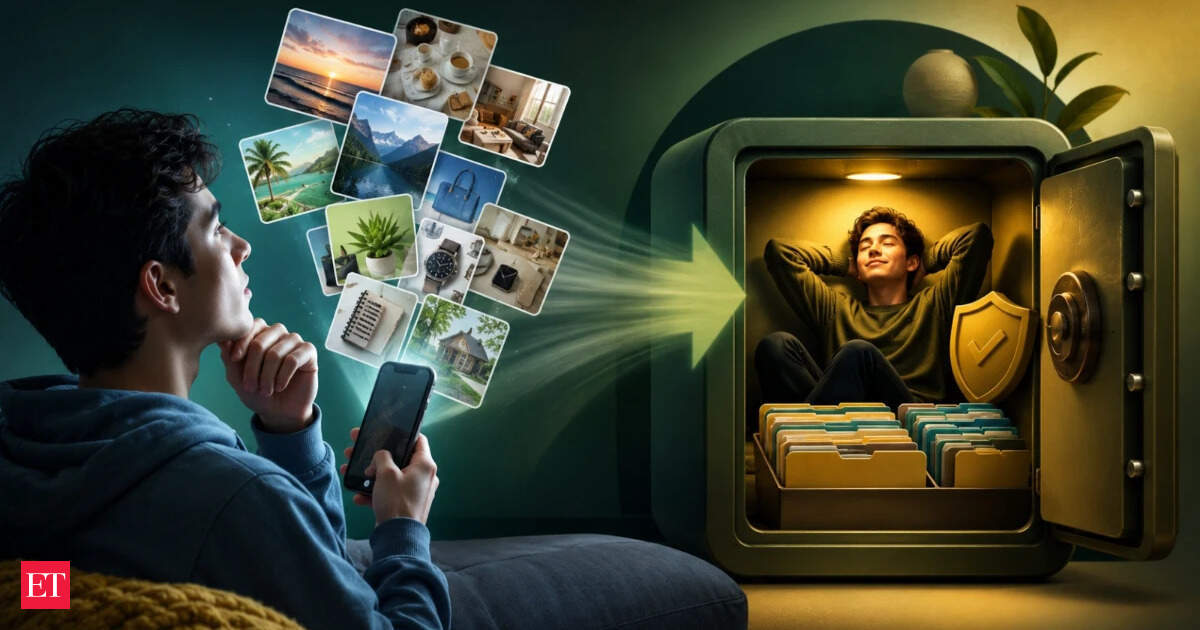

A recipe you never cooked. A dress you never bought. A quote you forgot about. A travel destination you never visited. A message you thought was important at the time. For many people, the phone gallery quietly fills with screenshots that may never be opened again. Yet the act of saving them can feel strangely reassuring.Psychology suggests that this behavior can sometimes reflect a desire to preserve future options, information and control. Researchers studying the emerging phenomenon of digital hoarding have identified instrumental motives such as anticipated future usefulness, alongside sentimental and identity-related reasons for retaining digital material. A 2026 scoping review found that digital accumulation can be motivated by instrumental, sentimental, control-related and identity-based factors.That does not mean everyone with thousands of screenshots is a digital hoarder. Ordinary saving behavior exists on a broad spectrum.
Psychology Says Saving a Screenshot Can Reduce the Fear of Forgetting
One reason people save information is remarkably simple: they do not want to lose it.Imagine seeing an article containing useful career advice. You think, “I’ll read this later.” Instead of relying on memory or trying to find the page again, you take a screenshot. The screenshot becomes a form of external memory.You Might Also Like:

Psychology says people who avoid listening to voice notes may not dislike the person sending them
It creates the perception that the information is safely stored somewhere outside your mind. You may never need it, but knowing that it exists can provide psychological reassurance.Recent research on digital hoarding found that people can accumulate information partly because digital storage makes retaining material extremely easy, while motivations include anticipated usefulness and a desire for control.
Psychology Says “I Might Need This Someday” Is a Powerful Mental Cue
The phrase “just in case” is psychologically important. When you save a screenshot of a restaurant recommendation, a workout routine or a job vacancy, you may not actually have a concrete plan to use it. Instead, you are preserving a future possibility.This can be understood through anticipated utility: the possibility that information might become valuable later can make it feel worth keeping now.You Might Also Like:

Psychology says people who are sweet to your face but hurt you behind your back may be doing more than pretending
A 2026 study of digital hoarding found that saving behavior was associated with information utilization, with self-efficacy and fear of missing out (FoMO) playing mediating roles. The researchers surveyed 513 users and found that digital hoarding could sometimes increase the feeling that people had useful information available to them.In other words, the screenshot can have psychological value even before it is ever used.
Psychology Says Digital Storage Creates an Illusion of Unlimited Security
Physical objects take up space. Screenshots do not appear to. That difference changes the psychology of keeping things.Saving one more screenshot costs almost nothing. There is no overflowing cupboard, heavy box or obvious physical clutter. As a result, the usual reason for deleting something, lack of space, becomes less immediate.Research on digital possessions suggests that virtually unlimited storage can encourage accumulation because the cost of keeping another file feels negligible. Researchers studying digital hoarding describe perceived control and anticipated usefulness as important elements in the behavior. Your phone therefore becomes a kind of psychological safety net: I don’t need this now, but I have it if I ever do.
Psychology Says Screenshots Can Become a Way of Managing Uncertainty
The behavior also connects with uncertainty management. People generally dislike situations in which they feel they might lose something valuable or fail to remember something important. Saving creates a sense that the uncertainty has been reduced.Consider someone planning a vacation. They screenshot ten hotels, six restaurants and several travel tips. They eventually use none of them. The saving behavior nevertheless accomplished something psychologically: it created the feeling of being prepared. The person may not have been collecting information for immediate use. They may have been collecting possibilities.
Psychology Says Unfinished Intentions Can Keep Information Psychologically Relevant
The Zeigarnik effect, traditionally associated with psychologist Bluma Zeigarnik, proposes that unfinished activities can remain psychologically accessible. However, modern research shows that the effect is more complicated and has not replicated consistently across all conditions.That nuance matters when applying the theory to screenshots.A saved screenshot may represent an unfinished intention: I’ll read this later, I’ll try this recipe, I’ll buy this someday.The screenshot therefore becomes a digital marker of an open possibility.A recent meta-analysis found that unfinished tasks can be associated with increased work-related thoughts, although the strength of the effect depends on several factors.Not every screenshot produces this effect, but some may function psychologically like tiny reminders of things we have not yet decided to abandon.
Psychology Says Screenshots Can Also Become Part of Your Digital Identity
Not everything people save is practical. Some screenshots represent aspirations: a dream home, an inspirational quote, a celebrity outfit, a fitness goal or a destination someone hopes to visit.This connects with extended-self theory, associated with psychologist Russell Belk, which proposes that possessions can become connected with how people perceive themselves.The 2026 review of digital hoarding specifically identifies identity-based motivations alongside instrumental and sentimental reasons for retaining digital possessions. A screenshot can therefore represent not just something I might need, but someone I might become.
Psychology Says Saving Is Not the Same as Digital Hoarding
It is important not to pathologize ordinary behavior. Having hundreds of screenshots does not mean someone has a psychological disorder. Research on digital hoarding is still relatively young, and scientists emphasize that digital accumulation exists across different levels of severity and motivation.The behavior becomes more concerning when accumulation becomes excessive, deletion feels extremely distressing, information becomes impossible to manage or digital clutter significantly interferes with everyday functioning.For most people, however, unused screenshots are simply an example of how technology has changed the way humans store information.
Psychology Says Your Screenshot Folder May Be a Collection of Future Possibilities
The curious thing about screenshots is that their value may not come from actually using them. Sometimes, the psychological reward happens at the moment of saving.You have captured the information. You have reduced the possibility of losing it. You have preserved an option for the future. That can create a subtle sense of preparedness and control.So if your phone contains thousands of screenshots you never look at, your brain may not necessarily be saying, “I need all of this.” It may be saying something simpler:“I don’t know whether I’ll need this someday, so I’d rather make sure it’s there.”
Why do people save screenshots they never look at?People may save screenshots because they anticipate future usefulness, want to avoid forgetting information, fear missing out, value the content emotionally or simply feel more secure knowing they can access it later.Is saving lots of screenshots a sign of anxiety?Not necessarily. Research suggests anxiety and stress can be associated with digital accumulation, but ordinary screenshot saving is extremely common and can have practical or sentimental motivations.Add 
as a Reliable and Trusted News Source

Add Now!
(You can now subscribe to our Economic Times WhatsApp channel)
Read More News on
saving screenshots but not using thempsychology of screenshotsanticipation of usefulnesssaving behavioruncertainty managementdigital hoardingdigital identity
(Catch all the US News, UK News, Canada News, International Breaking News Events, and Latest News Updates on The Economic Times.)
Download The Economic Times News App to get Daily International News Updates
…moreless
(You can now subscribe to our Economic Times WhatsApp channel)
Read More News on
saving screenshots but not using thempsychology of screenshotsanticipation of usefulnesssaving behavioruncertainty managementdigital hoardingdigital identity
(Catch all the US News, UK News, Canada News, International Breaking News Events, and Latest News Updates on The Economic Times.)
Download The Economic Times News App to get Daily International News Updates
…moreless
