



Research and Innovation
Seeing Beyond the Eyes: Bascom Palmer Eye Institute Researchers Advance Understanding of Cerebral Visual Impairment
By: Natali Christi Latorre | August 31, 2026 | 8 min. read |
A Bascom Palmer Eye Institute research team is studying cerebral visual impairment (CVI), a leading cause of childhood blindness, to develop better diagnostic tools and improve outcomes for children affected by the condition
Cerebral visual impairment (CVI) is the leading cause of childhood blindness in developed countries, yet it remains one of the most misunderstood and underdiagnosed vision conditions in pediatrics. Unlike eye diseases that stem from problems within the eye itself, cerebral visual impairment occurs when the brain has difficulty processing visual information, even when the eyes appear healthy
At Bascom Palmer Eye Institute, researchers are working to help close that gap
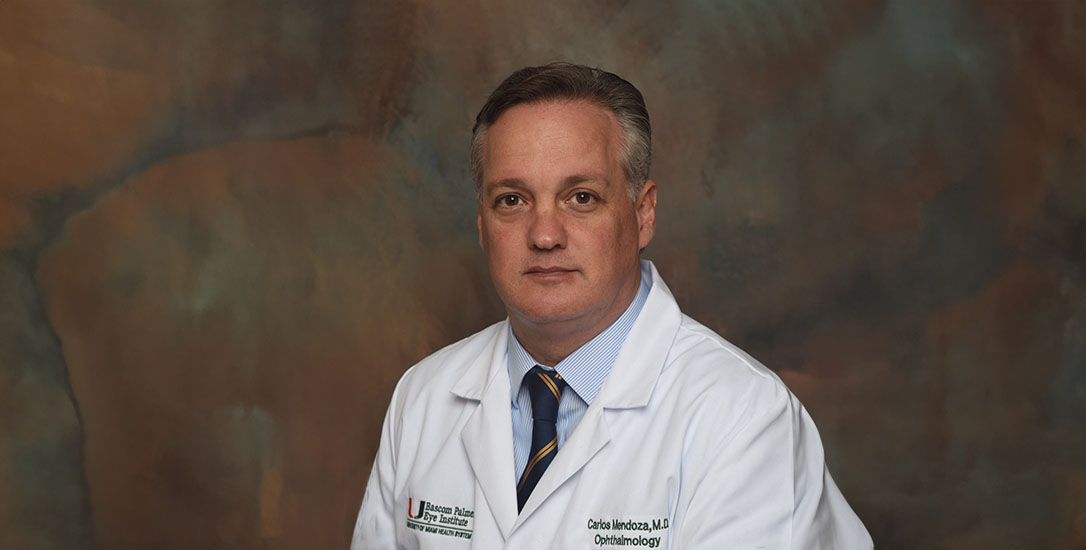
A neuro-ophthalmology team led by Carlos Mendoza‑Santiesteban, M.D., Ph.D., is conducting a comprehensive study aimed at improving how cerebral visual impairment is diagnosed, classified and, ultimately, managed in children. The study, “Functional and Anatomic Biomarkers of Cortical Visual Impairment (CVI),” brings together advanced eye imaging, brain imaging, functional vision testing and genetics to better understand this complex, brain‑based visual disorder
A Common Condition That Is Often Missed
Cerebral visual impairment occurs when visual pathways in the developing brain are damaged or fail to develop normally. This damage may occur before birth, during delivery or early in life, often related to premature birth, lack of oxygen to the brain, brain hemorrhage, genetic conditions or congenital brain malformations
Children with cerebral visual impairment may experience difficulties with:
• Recognizing faces or objects
• Navigating crowded or visually complex environments
• Seeing contrast, colors or fine detail
Because these challenges vary widely, and traditional eye exams may appear normal, fewer than 20 percent of children with cerebral visual impairment receive an accurate diagnosis
Cerebral visual impairment also frequently co‑occurs with other neurological conditions, including cerebral palsy, epilepsy, intellectual disability and motor impairments. These overlapping diagnoses can further complicate detection, as visual processing difficulties may be attributed solely to developmental or neurological conditions rather than recognized as a distinct visual disorder. As a result, children may face delays in receiving appropriate vision‑specific therapies, accommodations and rehabilitation.
Rethinking How Cerebral Visual Impairment Is Diagnosed
“One of the biggest challenges with CVI is that there is no single test that can define or confirm the diagnosis,” said Dr. Mendoza‑Santiesteban, a professor of clinical ophthalmology at Bascom Palmer Eye Institute. “Children present very differently depending on how and when the brain was affected.”
This variability and the lack of standardized diagnostic protocols have made it difficult for clinicians to diagnose cerebral visual impairment consistently or track outcomes over time. The Bascom Palmer study directly addresses this gap by taking a whole‑system approach to evaluation
Rather than relying on a single measurement, researchers integrate multiple
• Functional vision testing, such as visual acuity, contrast sensitivity, depth perception and visual perception
• Advanced retinal and optic nerve imaging, including optical coherence tomography (OCT)
• Brain MRI, to examine visual processing pathways
• Visual evoked potentials (VEPs), which measure how the brain responds to visual stimuli
• Genetic analyses, to explore relationships between specific genes and CVI patterns
Together, these data may serve as biomarkers, objective indicators that can help clinicians identify cerebral visual impairment earlier, classify it more accurately and assess response to interventions
Illuminating the Role of Genetics
Growing evidence suggests that genetic factors play a significant role in a substantial subset of children with cerebral visual impairment, yet genetic testing is still not routinely incorporated into clinical evaluation
By including genetic analyses alongside eye and brain assessments, the Bascom Palmer Eye Institute team hopes to better understand how genetic variations influence the presentation and progression of cerebral visual impairment. This approach may also help explain why CVI looks so different from one child to the next and eventually support more individualized diagnostic and care strategies.
Improving Outcomes Through Earlier Detection
The study includes children ages 3 to 17 who have a clinical diagnosis of cerebral visual impairment and are seen across pediatric ophthalmology, retina and neuro‑ophthalmology clinics
Ultimately, the researchers aim to:
• Improve early and accurate diagnosis of CVI
• Support the development of more consistent, evidence‑based testing protocols
• Enhance classification systems that reflect real‑world visual function
• Inform individualized rehabilitation, educational and support strategies
• Improve quality of life for children and families affected by CVI
“As awareness of CVI grows, it’s critical that we develop evidence‑based tools clinicians can actually use,” said Dr. Mendoza‑Santiesteban. “Our goal is to ensure children receive the right diagnosis and the right support at the right time.”
Findings from this work may also inform care across neurology, pediatrics, genetics, rehabilitation and education, fields that frequently intersect in the care of children with cerebral visual impairment
From Chemical Engineering to Medicine: AJ Hernandez Chooses Miller School’s M.D./M.B.A. Path
Incoming M.D./M.B.A. student AJ Hernandez discusses engineering, physician leadership, pediatric ophthalmology and returning home to Miami
Read more

UHealth’s Commitment to Exceptional Patient Care Fuels Historic Rise in U.S. News Rankings
UHealth earned its highest U.S. News & World Report rankings ever, with five nationally ranked specialties
Read more

Bascom Palmer Ophthalmologist First in South Florida to Implant Newly FDA-Approved Trifocal Lens
A UHealth ophthalmologist is the first in South Florida to implant the FDA-approved FineVision HP trifocal lens
Read more
Dr. Guillermo Amescua Named Inaugural Holder of the Dr. John A. Strobis Endowed Chair in Ophthalmology
Guillermo Amescua, M.D., is the inaugural holder of the Dr. John A. Strobis Endowed Chair, advancing research and innovation at Bascom Palmer
Read more
Tags:Bascom Palmer Eye Institute, Carlos Mendoza‑Santiesteban, eye diseases, Newsroom, ophthalmology, vision impairment, vision loss
