


Inevitable yet ignored: Prison policies disregard the realities of menopause behind bars | Prison Policy Initiative
HELP US END MASS INCARCERATIONThe Prison Policy Initiative uses research, advocacy, and organizing to dismantle mass incarceration. We’ve been in this movement for 25 years, thanks to individual donors like you.
Can you help us sustain this work?
Thank you,
Peter Wagner, Executive DirectorDonate
Inevitable yet ignored: Prison policies disregard the realities of menopause behind bars
Our survey of state and federal prison policies shows just how little institutional attention is paid to menopause-related healthcare and education behind bars, despite the growing population of aging incarcerated women
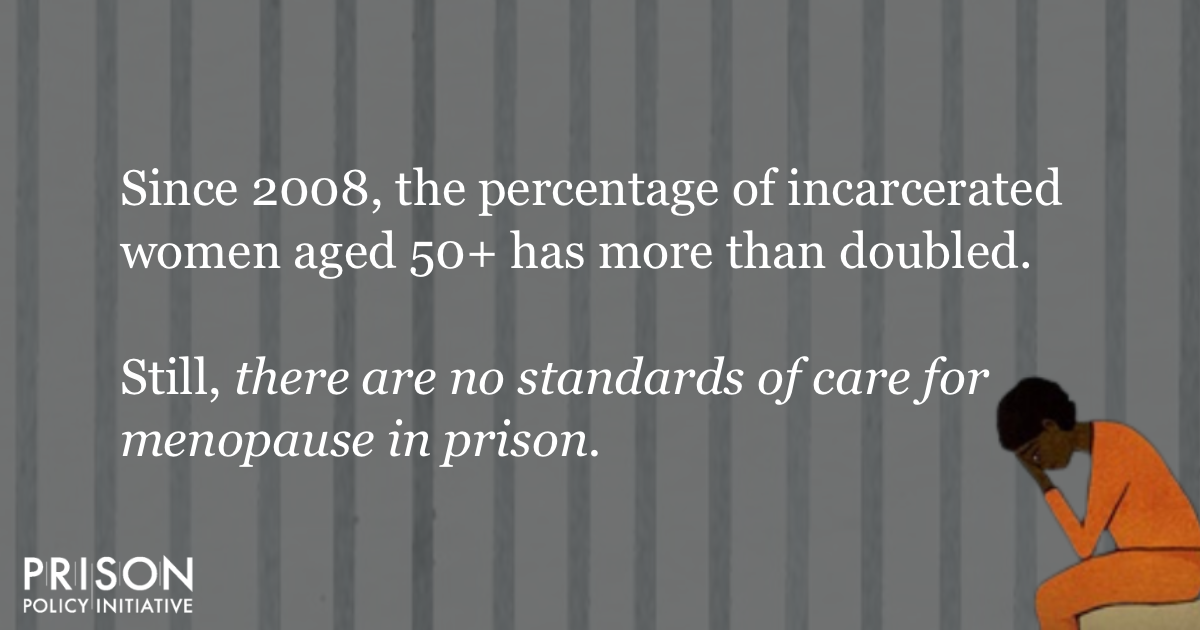
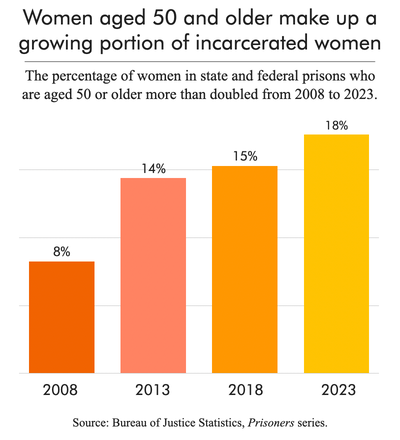
With thousands of women over the age of 50 incarcerated in state and federal prisons, health changes related to menopause should be a significant part of the conversation around prison healthcare.1 Unfortunately, while advocates and healthcare providers are discussing menopause education, advocacy, and healthcare access, incarcerated women are almost entirely left out of the picture. Their exclusion is particularly troubling because women’s incarceration has grown even more rapidly than men’s, and since 2008, the percentage of women in prison who were 50 or older has more than doubled.2
Given the serious need, what is the state of menopause care and education behind bars? To find out, we reviewed the existing research and, while we found a number of illuminating qualitative research studies about the experience of menopause during incarceration, there are almost no quantitative data regarding symptoms or medical management behind bars. So, we reviewed every state and federal prison system’s policies in search of clues regarding health or educational services that specifically address menopause. Ultimately, we found an alarming lack of institutional policies about a major and unavoidable life stage that a significant portion of incarcerated women will experience. It’s worth noting that just because we did not find any mention in a state’s publicly available policy or other materials does not necessarily mean that there are no menopause-related policies or practices in place in these facilities (and likewise, just because something is written into policy does not mean it is actually practiced in an institution). However, transparency about prison policies, healthcare, and education is crucial — especially for accountability purposes — so we take it as a bad sign that we couldn’t find much information about practices and resources for people experiencing menopause.3
Prison policies frequently ignore menopause
Because the U.S. prison system was primarily designed to incarcerate men, women’s particular healthcare needs are often ignored. Currently, there are no existing national or international standards of care for menopause in prison.4
Our analysis of prison policies in every state, Washington, D.C., and the federal Bureau of Prisons produced little information about menopause in department of corrections’ policies, including in policy handbooks specifically for women’s prisons. We found mentions of “menopause” in only ten states’ documentation, and of those, none spell out what medical care, education, or reuse or menopause
| State | Do the materials specifically address menopause? | Findings | Source type | Source |
|---|---|---|---|---|
| Alabama | Yes | “Preventative screening” for menopause; “abnormal results” will lead to “appropriate and timely follow-up testing and medical intervention.” | Request for proposal (RFP) for correctional healthcare services | RFP No. 2022-04: Comprehensive Inmate Healthcare Services |
| Alaska | Yes | General screening for “changes in menstrual pattern” and if the individual is “post-menopausal.” | Policy, medical intake screening | DOC 807.14a Criminal Booking Screen & DOC 804.14d Health History |
| Arizona | No | Screening for osteoporosis; mentions elevated risk for menopausal people over 65 years old. | Policy, DOC Clinical Practice Guidelines | TM 1101 — DOC Clinical Practice Guidelines (2024) |
| Maryland | No | Cholesterol education handout mentions elevated risk for perimenopausal or postmenopausal people. | Educational handout | DOC Cholesterol Education Handout (2024) |
| Mississippi | Yes | “Preventative screening” for menopause; “abnormal results” will lead to “appropriate and timely follow-up testing and medical intervention.” | Request for proposal (RFP) for correctional healthcare services | RFP No. 3120002800: Comprehensive Correctional Healthcare Services (2023) |
| Nevada | No | “Appropriate medical care to include screening, diagnostic, therapeutic, and supportive care” for “medical problems unique to women.” | Policy | AR 623: Health Care for Women (2023) |
| Oklahoma | Yes | “Health services are provided” to address menopause. | Policy | MSRM 140117.02: Management of Pregnancy (2022) |
| Oregon | Yes | A report commissioned by the DOC on “Gender Informed Practices.” Includes recommendations regarding menopause-related medical care (hormone replacement therapy) and diet. | Center for Effective Public Policy report, 2023 | Gender Informed Practices Assessment, Center for Effective Public Policy (2023) |
| Rhode Island | No | Screening for menstrual cycle and “unusual” bleeding. | Policy, medical intake screening | Policy No. 18.53-3 Gynecological Care Policy (2020) |
| South Carolina | No | Policy about involuntary psychiatric hospitalizations and requiring a pregnancy test prior to admission “unless postmenopausal.” | Policy | HS 18.13: Health Screening and Exams (2008) |
Of these ten states, only five actually have information explicitly about menopause, while the remaining five states only mention it in the context of other health-related concerns.5 In four of these states (Alabama, Alaska, Mississippi, and Oklahoma), the language in these documents suggests that departments of corrections are simply slotting the word “menopause” into vague policy templates6 as though it is a preventable condition like pregnancy or a communicable disease like tuberculosis, rather than a distinct physiological inevitability7 for half of the global population. Ultimately, none of the documents we reviewed can serve as adequate examples of policies, practices, or recommendations to address menopause-related health concerns for incarcerated people.
Punished, delayed, and dismissed: how prisons neglect menopause
Globally, there are significant gaps in menopause care despite the direct impact this natural part of the aging process has on millions of people each year. Even outside of prison walls, women are frequently dismissed and unsupported by medical providers and face limited access to accurate information about menopause and treatment options, often exacerbated by racial, socioeconomic, and geographic disparities
While there is little information available on the prevalence of menopausal symptoms in prison, and what menopausal care (if any) is available to the more than 15,000 women who are at least 50 years old in state and federal prisons, we can assume that they face these same — if not more insurmountable — barriers to care as women in the general public.8 The existing quantitative research on the subject shows that many women are experiencing serious perimenopausal and menopausal symptoms behind bars, often in combination with multiple chronic health conditions. Imprisoned older Black women — who are overrepresented in prison populations — report “menopause problems” at a higher rate than their incarcerated white peers. The most effective treatment (hormone therapy) has been historically underused, and it’s even more inaccessible for women in prison: in North Carolina prisons, for example, researchers analyzed prescribed medications and found that less than 5% of women in custody were receiving estrogen-containing medications.9 While limited, these quantitative studies betray an appalling lack of health and education services regarding menopause in prisons across the country.

Menstruation as misconductPrisons punish people for periods
Meanwhile, a robust body of qualitative research — that is, research focused on experiences, perceptions, and behavior rather than numbers — offers a detailed look at the experience of menopause in prison. The perimenopause and menopause symptoms incarcerated women experience10 may be the same as those experienced around the world, but the carceral context itself restricts access to common remedies like air conditioning and over-the-counter medications. The findings from these qualitative studies bring to light a number of troubling patterns:
- Lack of education and information.Women are almost entirely reliant on their peers for information about menopause11 and, while peer support is important, it should not be the only avenue for information and care available to incarcerated women. In addition, without the support necessary to help people understand their symptoms, feelings of shame and stigma can and do arise, which can have serious adverse consequences for mental and physical health.
- Delayed identification and dismissal of symptoms. Incarcerated women also lack resources to determine if their symptoms (such as mood changes) are even related to menopause or, for example, a response to the trauma of incarceration. This ultimately impedes their ability to seek healthcare, which can be a long, complicated process in prison as-is. When incarcerated women do seek out medical care, they report that providers and staff dismiss their symptoms as not severe enough to require intervention, or as a ploy to get out of work or obtain medication.
- Prison context and loss of control. On a basic level, prisons restrict individual agency over one’s decisions, actions, and environment. Incarcerated people experiencing menopause describe this loss of control — as well as a lack of privacy — as an impediment to managing their symptoms because they are unable to use common remedies freely (like showers or menstrual products) and do not have full access to their usual support systems and coping skills.
- Discipline and punishment. Incarcerated women describe being punished for symptoms (or their efforts to manage those symptoms), including receiving disciplinary infractions for soiled clothing or bedding. In addition, some women shared a perception that experiencing menopause in prison is, in and of itself, part of their punishment.
Filling the gaps: Kwaneta Harris & the Menopause Project
The growing campaign for menopause research, education, advocacy, and medical care outside of prisons offers a unique opportunity to extend this work behind prison walls. Here, we highlight two significant efforts to do just that: Kwaneta Harris’ personal testimonies and the guide she created on menopause behind bars, and the Menopause Project at Impact Justice, which works to expand education and reroviders
Kwaneta Harris, an incarcerated journalist, has shared her experience of perimenopause and menopause behind bars in mainstream media, which closely parallels the qualitative research findings on the subject. “The carceral system wasn’t built for people going through menopause,” Harris explains. “It was built to contain and control, not to care and nurture.” For example, she describes being unable to escape the heat during hot flashes in a prison without air conditioning, a lack of access to home remedies like ice packs or over-the-counter medications, and numerous accusations of being “medication-seeking” or pursuing “special treatment.” She also outlines how little treatment is available: after years without medication, prison medical workers provided her with hormone therapy for two months with no prescription refill, even though menopause symptoms persist for about seven years on average. Harris created a guide to navigating perimenopause and menopause in prison, which The Marshall Project published in July 2026. This guide provides detailed information about what menopause and perimenopause are, what symptoms to expect and when to expect them, how to advocate for medical care during incarceration, what non-medical options may be accessible for symptom relief in prison, and what kinds of medical interventions incarcerated people can pursue.
In California, the Menopause Project has created an extensive program to overcome the lack of information on menopause in prisons, producing physician guides and trainings, educational material for providers and incarcerated people, and “town halls” and workshops to empower incarcerated women to better understand and advocate for their own health. When the Project began this work with the California Correctional Health Care Services, they identified serious issues that likely exist across all U.S. prison systems, including:
- inadequate training for medical providers regarding identification, management, and treatment of menopause-related symptoms;
- an absence of tools for incarcerated people to advocate for their needs for symptom management; and
- outdated provider training opportunities and formulary guidance.
The early results from this program include a number of successes: training sessions for providers, well-attended educational sessions for incarcerated people, greater access to hormone therapy, and the creation of a formal peer support program. Preliminary data collected by the Project suggest that the program improved connections between individuals and necessary medical care, closed the knowledge gap among providers, and greater awareness of menopause and related symptoms among staff and incarcerated women. The Menopause Project is expanding beyond California — currently in Arizona and South Carolina — and other states can partner with them or follow their lead in working with incarcerated women.
Recommendations
Researchers and advocates have an opportunity to help incarcerated women better understand menopause and obtain the treatments they need. Based on the work from incarcerated advocates and the early results from the Menopause Project in California, there are a number of important steps that prisons should take, including:
- education and training for medical providers;
- specialized training for prison staff;
- education and advocacy tools for incarcerated people;
- peer support programs;
- expanding prescription formulary to include hormone therapy, antidepressants, and other updated, evidence-based treatments; and
- research and evaluation of implemented programs.
These changes need to be standardized and incorporated into correctional policies to promote equitable access to menstrual healthcare and retheir loved ones, and the public about healthcare in carceral settings
Footnotes
These changes begin during perimenopause, the potentially years-long transitional period before menopause, marked by serious symptoms including emotional changes, temperature dysregulation, insomnia, and more. It typically begins when someone is in their 40s and, in the U.S., the median age of menopause (i.e., when a person has gone 12 consecutive months without menstruation) is 52.5 years old. ↩
According to the Bureau of Justice Statistics, between 2008 and 2023, the population of women in state and federal prisons who were aged 50 or older nearly doubled from 8,700 to 15,100. Among women in state and federal prisons in 2008, 8.3% were 50 or older, while in 2023, this proportion grew to 17.6%. ↩
In addition, if something is not documented in prison policy, it’s unlikely to be adequately reevances when their basic needs are not met. ↩
TheUnited Nations’ standards of detention do not mention menopause-related care, and while the International Review Red Cross briefly mentions the need for more training among corrections staff, there is no clear international guidance for menopause-related care in carceral settings. This glaring omission is prevalent in the United States as well: while theU.S. Commission on Civil Rights includes menopause as an issue faced by incarcerated women, it does not provide or reference any guidelines for care or best practices. In a magazine edition dedicated to menstrual health, the National Commission of Correctional Health Care offers basic background information about what menopause is, but noticeably fails to tie it to any specific healthcare practices for the growing, aging population of incarcerated women. Even if international or national standards did exist, compliance would be voluntary, without oversight, and essentially unenforceable. ↩
For example, in Maryland’s policies and online documents, the only mention of menopause that we were able to find was a Department of Public Safety and Correctional Services’ educational handout regarding cholesterol that includes “being a woman who is going through menopause or has complete [sic] menopause” as a risk factor for heart disease. ↩
For example, the relevant sections of the requests for proposals (RFPs) for correctional healthcare services in Mississippiand Alabama are identical and refer to “preventative screening for osteoporosis, menstrual abnormalities, ovarian and cervical abnormalities, and menopause.” There is no “preventive” screening for menopause and — given that this is the only mention of menstrual health or menopause in the entire document (and there are no other mentions in prison policies) — it appears to be more than just a clerical oversight. In addition, both RFPs say, “Inmates with abnormal results will be informed of their screening/test results and receive appropriate and timely follow-up testing and medical intervention,” but there is no information in these documents or state prison policies about what the Department of Correction considers an “abnormal” result of a menopause screening, or what kinds of “medical intervention” are available to perimenopausal or menopausal women. In Alaska, the Department of Corrections’ medical intake screening and history includes general questions about changes in menstrual patterns (which would include menopause) and if the individual is “post-menopausal.” However, it includes no mention of, or reference to, screening for perimenopause (which is when symptoms are likely to begin) or any common symptoms beyond irregular menstruation, such as temperature dysregulation, sleep issues, mood changes, or fatigue. In Oklahoma, the Department of Corrections’ “Management of Pregnancy” policy states that “health services are provided to address the unique needs of female inmates with regard to health maintenance, pregnancy, prenatal care, postpartum care, contraceptive needs, preventative health care, chronic health care, and menopausal/postmenopausal needs.” While the policy includes a number of details about pregnancy-related care including abortion, counseling, adoption, high-risk obstetrical care, nutrition, substance use disorder treatment and more, there is no mention of what the “health services” are for people with “menopausal/postmenopausal needs.” ↩
It is worth explicitly noting that while almost all data regarding the carceral system is steeped in a sex-based binary (male and female), menopause can affect anyone with at least one functional ovary, including people who have had a hysterectomy, transgender men, nonbinary people, and people born with ovaries without a uterus. ↩
In a 2008 study, researchers received responses from 65 U.S. prison facilities indicating that in 98% of those prisons, menopause was a topic in their initial medical intake or during routine physical examinations. While this is an important part of identifying people in need of menopause-related care, it is only the most basic first step that facilities need to take in order to provide adequate menopause-related healthcare to incarcerated older women. ↩
Interestingly, the most common prescription that could be used to treat menopause symptoms were selective serotonin reuptake inhibitors (commonly known as SSRIs), which can be used to treat menopausal hot flashes (but are also regularly prescribed for non-menopausal women’s mental health conditions). The researchers also found that many older women in custody were prescribed medications (like hypertension, cardiovascular, or mental health medications) that could exacerbate menopause symptoms or conflict with medications that could be used to treat menopause symptoms. ↩
Some of the most common menopause-related symptoms include irregular periods, hot flashes, night sweats, sleep issues, mood changes, brain fog, urinary urgency, dry skin, joint and muscle pain, racing heart, and headaches. Prisons are full of barriers to all forms of healthcare, but especially to menstrual health and hygiene; prisons tend to severely restrict basic remedies for these symptoms (like ice packs, air conditioning, pain medications, sleep-related medications) and rarely provide work or programming accommodations. ↩
Outside of the prison context, researchers have found that nearly one-third of women feel they “lack important knowledge about menopause” and only half of women in perimenopause, menopause, or post-menopause have consulted a medical provider regarding these changes. ↩
Emily Widra is a Senior Research Analyst at the Prison Policy Initiative. (Other articles | Full bio | Contact)
Share on 𝕏Donate
