


Abstract
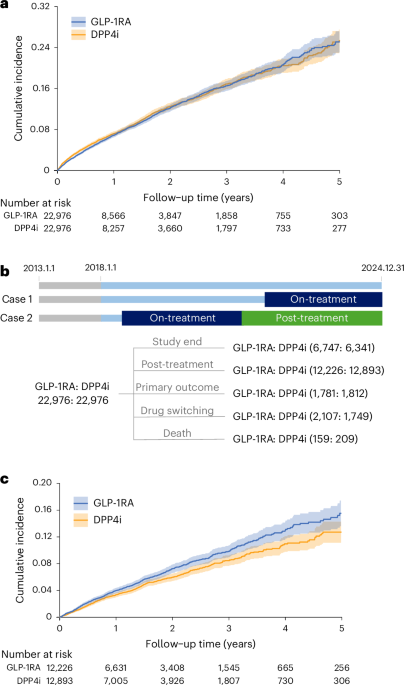
The psychiatric safety profile of glucagon-like peptide-1 receptor agonists (GLP-1RAs) is characterized by inconsistent findings during active treatment and remains largely unexplored after cessation. Here we show that GLP-1RA discontinuation is associated with an increased risk of psychiatric events. Using large-scale electronic health records from the Shanghai Hospital Link Database, we investigate incident depressive and anxiety disorders during GLP-1RA treatment and after its discontinuation in people with type 2 diabetes, compared with dipeptidyl peptidase-4 inhibitors (DPP4is) or sodium–glucose cotransporter-2 inhibitors (SGLT2is). During treatment, GLP-1RAs show a neutral risk compared with DPP4is and a lower risk compared with SGLT2is. In contrast, after cessation, prior use of GLP-1RAs is associated with a higher risk than prior use of DPP4is or SGLT2is. This increase is modestly mediated by elevated triglyceride levels. These findings highlight the need for clinical vigilance regarding anxiety following GLP-1RA discontinuation.
Access through your institution
Buy or subscribe
This is a preview of subscription content, access
Access options
Access through your institution
- Purchase on SpringerLink
- Instant access to the full article PDF.
39,95 €
Prices may be subject to local taxes which are calculated during checkout
Data availability
The clinical data analysed during the current study are not publicly available due to patient confidentiality and regulations governing the Shanghai Hospital Link Database (SHLD), but they are available from the corresponding authors on reasonable request and with institutional approval.ta are available from the corresponding authors on reasonable request
Code availability
Data processing and statistical analyses were performed using the open-source software R (version 4.5.1). The specific packages used included tidyverse (v2.0.0), survival (v3.8-3), MatchIt (v4.7.2), survminer (v0.5.0), cmprsk (v3.1), WeightIt (v1.2.0) and mediation (v4.5.0). The standard analysis scripts used to generate the results are publicly available in the GitHub repository at https://github.com/tyzhang-lab/GLP1RA-Psychiatric-Analysis and archived on Zenodo (https://doi.org/10.5281/zenodo.20439549)28.
References
Cohen, D. GLP-1 receptor agonists: European drug regulator asks makers for evidence of self-harm. BMJ383, 2906 (2023)
Wang, W. et al. Association of semaglutide with risk of suicidal ideation in a real-world cohort. Nat. Med.30, 168–176 (2024)
Hurtado, I., Robles, C., Peiró, S., García-Sempere, A. & Sanfélix-Gimeno, G. Association of glucagon-like peptide-1 receptor agonists with suicidal ideation and self-injury in individuals with diabetes and obesity: a propensity-weighted, population-based cohort study. Diabetologia67, 2471–2480 (2024)
Ueda, P. et al. GLP-1 receptor agonist use and risk of suicide death. JAMA Intern. Med.184, 1301–1312 (2024)
Shapiro, S. B. et al. Glucagon-like peptide-1 receptor agonists and risk of suicidality among patients with type 2 diabetes: active comparator, new user cohort study. BMJ388, e080679 (2025)
Schoretsanitis, G., Weiler, S., Barbui, C., Raschi, E. & Gastaldon, C. Disproportionality analysis from World Health Organization data on semaglutide, liraglutide, and suicidality. JAMA Netw. Open7, e2423385 (2024)
Bachmann, S. Epidemiology of suicide and the psychiatric perspective. Int. J. Environ. Res. Public Health15, 1425 (2018)
Gamble, J.-M., Chibrikov, E., Midodzi, W. K., Twells, L. K. & Majumdar, S. R. Examining the risk of depression or self-harm associated with incretin-based therapies used to manage hyperglycaemia in patients with type 2 diabetes: a cohort study using the UK Clinical Practice Research Datalink. BMJ Open8, e023830 (2018)
Tsai, W.-H. et al. Decreased risk of anxiety in diabetic patients receiving glucagon-like peptide-1 receptor agonist: a nationwide, population-based cohort study. Front. Pharmacol.13, 765446 (2022)
Tang, H. et al. Glucagon-like peptide-1 receptor agonists and risk for depression in older adults with type 2 diabetes: a target trial emulation study. Ann. Intern. Med.178, 315–326 (2025)
Nishida, K. et al. Psychiatric and psychological adverse effects associated with dulaglutide, semaglutide, and liraglutide: a VigiBase study. Clin. Nutr.51, 252–265 (2025)
Kornelius, E., Huang, J.-Y., Lo, S.-C., Huang, C.-N. & Yang, Y.-S. The risk of depression, anxiety, and suicidal behavior in patients with obesity on glucagon like peptide-1 receptor agonist therapy. Sci. Rep.14, 24433 (2024)
Katranski, J., Liang, S., Morris, D., Suppiah, V. & Lim, C. X. Psychiatric adverse events linked to glucagon-like peptide 1 analogues: a disproportionality analysis in American, Canadian and Australian adverse event databases. Int. J. Clin. Pharm.47, 1739–1747 (2025)
Chang, Y., Hsieh, M.-H., Ju, P.-C. & Chang, C.-C. Risk of depression with GLP-1 receptor agonists use in overweight or obese adults with type 2 diabetes: a new-user, active-comparator cohort study. Diabetes Obes. Metab.28, 197–209 (2026)
Anagnostakis, F., Kokkorakis, M., Anastasiou, G., Nagarajan, S. & Mantzoros, C. S. Association of glucagon-like peptide-1 receptor agonist use with anxiety disorders, depression, self-harm, and suicidality: a large cohort study. Diabetes Res. Clin. Pract.233, 113104 (2026)
West, S. et al. Weight regain after cessation of medication for weight management: systematic review and meta-analysis. BMJ392, e085304 (2026)
Wilding, J. P. H. et al. Weight regain and cardiometabolic effects after withdrawal of semaglutide: the STEP 1 trial extension. Diabetes Obes. Metab.24, 1553–1564 (2022)
Horn, D. B. et al. Cardiometabolic parameter change by weight regain on tirzepatide withdrawal in adults with obesity: a post hoc analysis of the SURMOUNT-4 trial. JAMA Intern. Med.https://doi.org/10.1001/jamainternmed.2025.6112 (2025)
Tzang, C.-C. et al. Metabolic rebound after GLP-1 receptor agonist discontinuation: a systematic review and meta-analysis. EClinicalMedicine90, 103680 (2025)
Scott, K. M. et al. Depression–anxiety relationships with chronic physical conditions: results from the World Mental Health Surveys. J. Affect. Disord.103, 113–120 (2007)
Hubbard, R. A. et al. ‘Target trial emulation’ for observational studies—potential and pitfalls. N. Engl. J. Med.391, 1975–1977 (2024)
Shanghai Municipal Statistics Bureau. 2024 Shanghai Statistical Yearbook (China Statistics Press, 2025); https://tjj.sh.gov.cn/tjnj/20250331/9f8ec62cc2234485b0aa411b8d967c37.html
Qi, J. et al. Cancer risk among patients with type 2 diabetes: a real-world study in Shanghai, China. J. Diabetes11, 878–883 (2019)
Zhang, Z. et al. A network-based study reveals multimorbidity patterns in people with type 2 diabetes. iScience26, 107979 (2023)
Brown, E., Heerspink, H. J. L., Cuthbertson, D. J. & Wilding, J. P. H. SGLT2 inhibitors and GLP-1 receptor agonists: established and emerging indications. Lancet398, 262–276 (2021)
Wennberg, J. E. et al. Observational intensity bias associated with illness adjustment: cross sectional analysis of insurance claims. BMJ346, f549 (2013)
R Core Team. R: a Language and Environment for Statistical Computing (R Foundation for Statistical Computing, 2024)
tyzhang-lab. tyzhang-lab/GLP1RA-psychiatric-analysis: initial release for submission. Zenodohttps://doi.org/10.5281/zenodo.20439549 (2026)
Acknowledgements
We are grateful to the Shanghai Hospital Link Database (SHLD) for providing the electronic health records used in this study
Funding
This work was supported by grants from the National Key R&D Program of China (2022ZD0160700). The funders had no role in study design, data collection and analysis, decision to publish or preparation of the paper
Author information
Author notes
These authors contributed equally: Tingyu Zhang, Ping He, Yunxi Ji, Juan Shi
Authors and Affiliations
Department of Endocrine and Metabolic Diseases, Shanghai Institute of Endocrine and Metabolic Diseases, Ruijin Hospital, Shanghai Jiao Tong University School of Medicine, Shanghai, China
Tingyu Zhang, Yunxi Ji, Juan Shi, Zizheng Zhang, Kan Wang, Haolei Pan, Ruizhi Zheng, Bin Cui, Yifei Zhang, Weiqing Wang & Guang Ning
Shanghai National Clinical Research Center for Metabolic Diseases, Key Laboratory for Endocrine and Metabolic Diseases of the National Health Commission of the People’s Republic of China, Shanghai Key Laboratory for Endocrine Tumor, State Key Laboratory of Medical Genomics, Ruijin Hospital, Shanghai Jiao Tong University School of Medicine, Shanghai, China
Tingyu Zhang, Yunxi Ji, Juan Shi, Zizheng Zhang, Haolei Pan, Bin Cui, Yifei Zhang, Weiqing Wang & Guang Ning
Link Healthcare Engineering and Information Department, Shanghai Hospital Development Center, Shanghai, China
Ping He
Computer Net Center, Ruijin Hospital, Shanghai Jiao Tong University School of Medicine, Shanghai, China
Huayan Yao & Yanbin Xue
Wonders Information Co., Ltd., Shanghai, China
Qingxia Wu
Authors
- Tingyu ZhangView author publications
Search author on:PubMed Google Scholar
- Ping HeView author publications
Search author on:PubMed Google Scholar
- Yunxi JiView author publications
Search author on:PubMed Google Scholar
- Juan ShiView author publications
Search author on:PubMed Google Scholar
- Zizheng ZhangView author publications
Search author on:PubMed Google Scholar
- Kan WangView author publications
Search author on:PubMed Google Scholar
- Haolei PanView author publications
Search author on:PubMed Google Scholar
- Huayan YaoView author publications
Search author on:PubMed Google Scholar
- Yanbin XueView author publications
Search author on:PubMed Google Scholar
- Ruizhi ZhengView author publications
Search author on:PubMed Google Scholar
- Qingxia WuView author publications
Search author on:PubMed Google Scholar
- Bin CuiView author publications
Search author on:PubMed Google Scholar
- Yifei ZhangView author publications
Search author on:PubMed Google Scholar
- Weiqing WangView author publications
Search author on:PubMed Google Scholar
- Guang NingView author publications
Search author on:PubMed Google Scholar
Contributions
G.N. and B.C. contributed to the conception and design of the study. P.H., H.Y. and Y.X. contributed to data collection and management. T.Z., R.Z. and K.W. contributed to the statistical methodology. W.W., Y.Z. and J.S. contributed to clinical experience and support. T.Z., Y.J., Z.Z., H.P. and Q.W. performed data extraction, curation and statistical analyses. P.H., Y.X., W.W. and Z.Z. contributed to quality control and support. T.Z., K.W., R.Z., B.C. and G.N. interpreted the findings and contributed to the discussion. B.C., Y.Z., W.W. and G.N. provided supervision. T.Z. and B.C. drafted the initial paper. G.N., R.Z. and K.W. critically revised the paper. All authors contributed to the acquisition or interpretation of data, reviewed the paper for accuracy and intellectual content, and approved the final version for submission. B.C., Y.Z., W.W. and G.N. are the guarantors of this work and take full responsibility for the integrity of the data and the accuracy of the data analysis.
Ethics declarations
Competing interests
The authors declare no competing interests
Peer review
Peer review information
Nature Metabolism thanks Hamlet Gasoyan, Jason Halford and the other, anonymous, reviewer(s) for their contribution to the peer review of this work. Primary Handling Editor: Jean Nakhle, in collaboration with the Nature Metabolism team
Additional information
Publisher’s note Springer Nature remains neutral with regard to jurisdictional claims in published maps and institutional affiliations
Extended data
Extended Data Fig. 1 Study Flow Diagram for Selecting Patients Initiating Glucagon-Like Peptide-1 Receptor Agonist (GLP-1RA) or Dipeptidyl Peptidase-4 Inhibitor (DPP-4i)
Flowchart illustrating the sequential patient selection process for the GLP-1RA and DPP-4i study cohorts from the Shanghai Hospital Link Database (SHLD)
Extended Data Fig. 2 Study Flow Diagram for Selecting Patients Initiating Glucagon-Like Peptide-1 Receptor Agonist (GLP-1RA) or Sodium-Glucose Cotransporter-2 Inhibitor (SGLT-2i)
Flowchart illustrating the sequential patient selection process for the GLP-1RA and SGLT-2i study cohorts from the Shanghai Hospital Link Database (SHLD)
Extended Data Fig. 3 Prespecified Subgroup Analyses of Depressive and Anxiety Disorders (GLP-1RA vs DPP-4i)
Hazard ratios and 95% CIs are shown for prespecified subgroups during the on-treatment and post-treatment periods. For analyses by molecular structure, each individual GLP-1RA type was separately matched 1:1 with DPP-4i comparators using propensity scores. Exact P values for interaction were calculated using two-sided Wald tests for multiplicative interaction terms within the Cox proportional hazards models. No adjustments were made for multiple comparisons.P values for interaction were calculated using multiplicative interaction terms. Data are presented as point estimates of hazard ratios (HRs) as the measure of centre, with error bars defining the 95% confidence intervals (CIs).CI indicates confidence interval; DPP-4i, dipeptidyl peptidase-4 inhibitor; GLP-1RA, glucagon-like peptide-1 receptor agonist; HR, hazard ratio.
Source data
Extended Data Fig. 4 Prespecified Subgroup Analyses of Depressive and Anxiety Disorders (GLP-1RA vs SGLT-2i)
Hazard ratios and 95% CIs are shown for prespecified subgroups during the on-treatment and post-treatment periods. For analyses by molecular structure, each individual GLP-1RA type was separately matched 1:1 with SGLT-2i comparators using propensity scores. Exact P values for interaction were calculated using two-sided Wald tests for multiplicative interaction terms within the Cox proportional hazards models. No adjustments were made for multiple comparisons.P values for interaction were calculated using multiplicative interaction terms. Data are presented as point estimates of hazard ratios (HRs) as the measure of centre, with error bars defining the 95% confidence intervals (CIs). GLP-1RA, glucagon-like peptide-1 receptor agonist; SGLT-2i, sodium-glucose co-transporter-2 inhibitor.
Source data
Supplementary information
Supplementary Information (download PDF )
Table of contents, Supplementary Figs. 1–6 and Supplementary Tables 1–15
Reporting Summary (download PDF )
Source data
Source Data Fig. 1 (download XLSX )
Statistical
Source Data Fig. 2 (download XLSX )
Statistical
Source Data Extended Data Fig. 3 (download XLSX )
Statistical
Source Data Extended Data Fig. 4 (download XLSX )
Statistical
Rights and permissions
Springer Nature or its licensor (e.g. a society or other partner) holds exclusive rights to this article under a publishing agreement with the author(s) or other rightsholder(s); author self-archiving of the accepted manuscript version of this article is solely governed by the terms of such publishing agreement and applicable law
About this article
Cite this article
Zhang, T., He, P., Ji, Y. et al. Association of GLP-1RA discontinuation and risk of depressive and anxiety disorders in people with type 2 diabetes: a cohort study.
Nat Metab (2026). https://doi.org/10.1038/s42255-026-01567-z
Received:22 September 2025
Accepted:11 June 2026
Published:09 July 2026
Version of record:09 July 2026
DOI
:https://doi.org/10.1038/s42255-026-01567-z
