


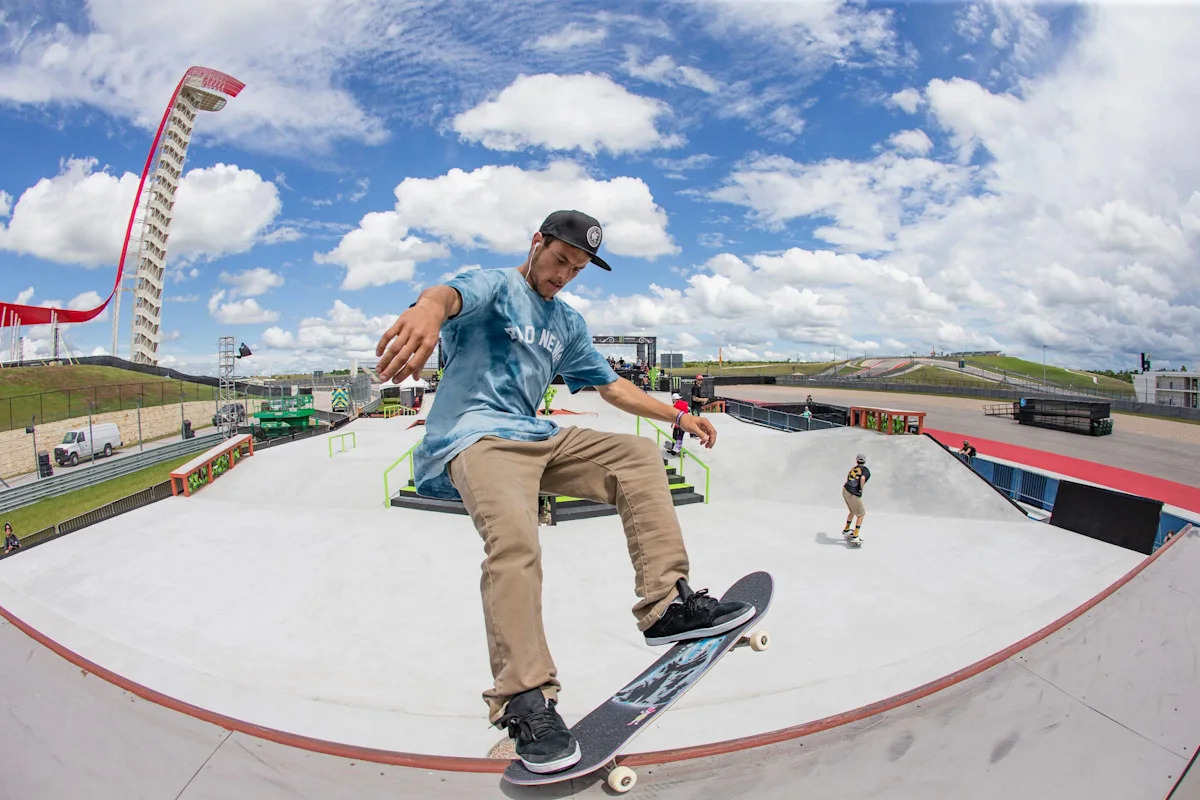
Nailing fancy tricks on a skateboard takes far more than just time spent practicing. From flips and spins to maintaining balance at high speeds, professional skateboarding demands strength, power, and balance, something anyone who has ever stepped on a skateboard can appreciate. For Chris Joslin, a four-time X Games medalist, Men’s Skate Street & Street Best Trick champion, and 2025 Thrasher Magazine Skater of the Year, staying competitive requires a commitment to training beyond the skateboard.
Joslin doesn’t follow a strict training program, nor does he work with a personal trainer. But he incorporates a variety of exercises into his routine that prepare him to perform at the highest level. With the Rockstar Energy Open and MoonPay X Games in New Orleans on the horizon, Joslin focuses on structured conditioning to stay injury-free, alongside exercises that allow him to land tricks with consistent power. Below, he shares a few of his go-to exercises that improve his athletic performance and keep his body primed.
Advertisement
“The overall goal for these specific exercises is to keep skating as long as I can at a high level with as little to no amount of pain in my body as possible,” Joslin says. “One of the goals is longevity in the sport of skateboarding, but the main goal is longevity in life. I’ve also got three kids to run around and play with, and that ain’t easy!”
Chris Joslin’s Go-To Exercises
BOSU Exercises
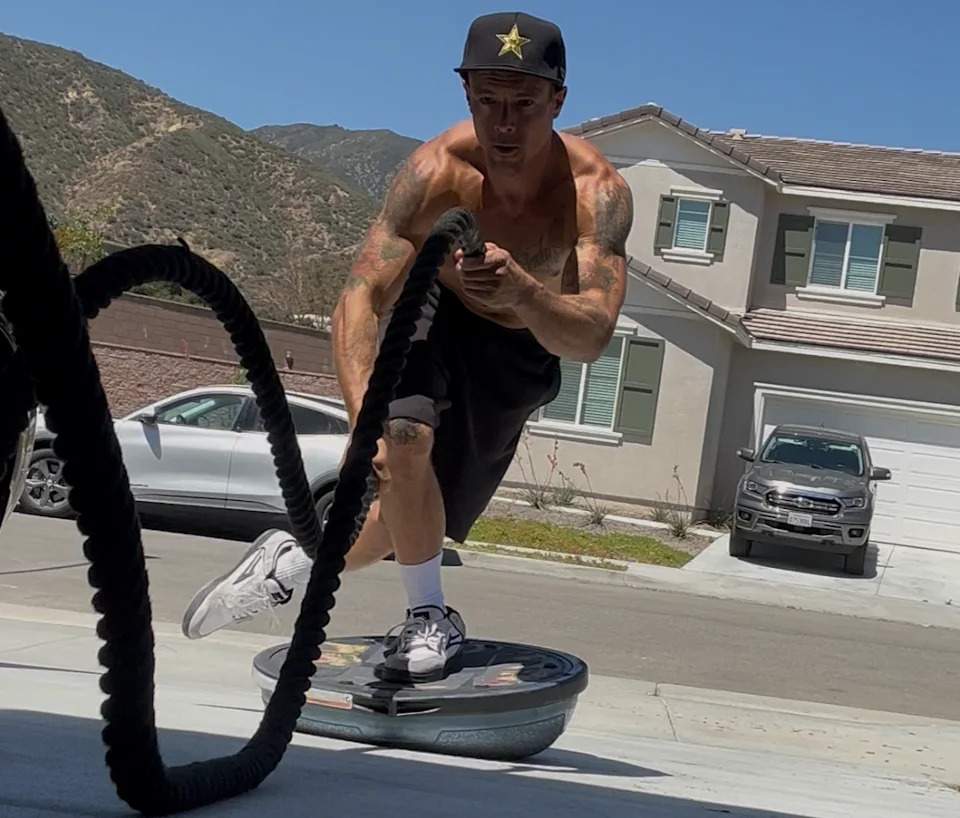
BOSU stands for “both sides up,” and it’s truly all in the name. BOSUs can be used with either the flat platform or the dome side facing up. Movement experts, like Doug Bertram, M.S., L.Ac., MTCM, founder and CEO of Structural Elements®, call the BOSU one of the most underrated training tools around because it challenges balance, proprioception, and reflexive core stability. By forcing the body to make constant adjustments, working with a BOSU can improve coordination and control, two qualities that translate directly to skateboarding.
Advertisement
“I prefer to use the BOSU because it really forces me to use the entire leg and allows me to get to the point of actually working my leg muscles quicker,” Joslin says
Cossack Squats
“I think Cossack squats are the most beneficial workouts for skating because it helps strengthen the mobility of the ankles and hips, along with strengthening the knees,” Joslin explains
You may have done Cossack squats in a warmup, but they’re also a great exercise for building both lower-body mobility and strength. The side-to-side movement pattern targets the hips, adductors, and quads while improving your ability to move through different planes of motion. Cossack squats can be progressed by holding a weight at the chest or increasing range of motion
Uphill Sprints
Cardio is an integral part of Joslin’s training, with uphill sprints being a staple in his workouts. You might think sprints are reserved for athletes who spend their time on a field or track, but for skateboarders, explosive speed and power are just as important. Sprinting, especially uphill, develops lower-body strength and anaerobic capacity. In skateboarding, that translates to quicker reactions and performing tricks without losing control
Advertisement
“The simplest way to rebuild sprint speed is to pick a set distance that’s convenient for you and build your speed gradually over three months,” says Zach Smith, D.P.T., founder and owner of HIDEF Physical Therapy. “Start very easy at 50 percent or so and go up by 10 percent each week for four weeks. Slowly start pushing harder past 80 percent as you feel good.”
Lunge Variations
Joslin begins each workout session with a lunge variation to get a sense of how his body feels on that respective day. From walking and reverse lunges to lateral lunges, Joslin notices that this classic lower-body exercise helps correct any muscular instabilities or imbalances, bringing attention to weaker areas that may need more attention
“Unilateral exercises like Bulgarian split squats, reverse lunges, and anything involving single-leg balance require significant amounts of balance and neuromuscular control,” says Troy Hurst, P.T., D.P.T., of Flow Feet Orthopedic Shoes. “While it may require dropping the weight initially to maintain balance, the long-term benefits to foot and ankle stability are well worth the ego check.”
Advertisement
Related: BMX Star Marcus Christopher Reveals the Brutal Training Behind His X Games Comeback
This story was originally published byMen’s Journalon Jul 9, 2026, where it first appeared in theFitnesssection. Add Men’s Journal as aPreferred
