


By Nora Toscanonora.toscano@newsday.comUpdated July 10, 2026 5:41 am
Satellite images are being used to discover how climate change is affecting penguin diets and the broader Antarctic ecosystem, Stony Brook University researchers said
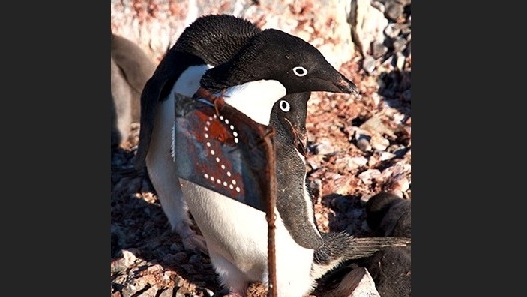
In a study, published Tuesday, the researchers used NASA satellite images to examine large groupings of Adélie penguin excrement, the color of which shows whether the penguins have eaten fish or krill. Understanding the penguins’ diets allowed the researchers to better grasp wider environmental dynamics in Antarctica and the consequences of melting sea ice
“This is the first study, the first time we’ve been able to study food web dynamics from satellites, and we’re doing it at these continental, multi-decadal scales,” Casey Youngflesh, the lead researcher, said
After examining satellite images from 1984 to 2013, researchers found a shift toward a krill-based diet, which is poorer for the penguins’ health. The researchers say less fish availability is a consequence of melting sea ice and a warning sign of climate change’s impact on the entire ecosystem
Heather Lynch, a Stony Brook professor and another researcher, said sea ice was like the “conductor” of the Antarctic ecosystem and the shift in the penguins’ diets was the “canary in the coal mine” for how the ecosystem was changing
“It’s certainly very concerning that the whole orchestra is at risk of going off the rails here. It’s not just one or two species. It’s really the whole environment,” Lynch said
Previously, scientists have used satellite imagery to monitor population movement, but not diet. Youngflesh traveled to Antarctica multiple times to collect samples of guano, or penguin excrement, and match its color to penguin diet. Pink guano resulted from a krill-based diet, while white guano indicated a fish-based diet
“Because penguins are sitting on their nests just pooping all day long, their colonies become — basically we call them a pink poop polygon,” Lynch said. “It becomes like a big patch on the Earth that is covered in guano, and so it’s big enough that we can see it from space.”
Work begins at Stony Brook
Youngfleshbegan work on the project after receiving a NASA fellowship in 2016 to conduct the research, which he began in Lynch’s lab while pursuing a Ph.Din ecology at Stony Brook. Their work, which included collaboration with four other researchers, continued after Youngflesh finished his doctorate in 2018 and began teaching. He is now a professor at Clemson University in South Carolina
Youngflesh, whose Clemson lab is beginning to research how walrus populations have changed over time, said ecology was essential to understanding how humans fit into the global ecosystem
“You have changes in the physical environment, so primarily driven by warming temperatures, that is impacting all of these other subsequent levels of ecosystems. And I think trying to understand those consequences is a big part of what we’re doing in ecology,” Youngflesh said
This study’s findings are important “to understand how the natural world is changing and what we’re going to do about it at the end of the day,”
“People need to remember that humans are a part of these ecosystems, and … they provide a lot of what we might call ecosystem services,” Youngflesh said
For example, fishers collect Antarctic krill for use in omega-3 supplements, which provide many human health benefits
The researchers found that penguin populations with krill-dependent diets were more likely to be declining. In regions with more sea ice, fish were more available; less sea ice meant more krill
“Unfortunately, the future is not bright when it comes to Antarctic sea ice,” Lynch said. “That we know because of climate change, that we have both observed less sea ice over the last decade, but all the forecasts would suggest that this will continue to happen.”
By Nora Toscanonora.toscano@newsday.com
More on this topic
Researchers find Antarctic penguin breeding is heating up sooner, and that’s a problem
3m read
Streaming Now
Credit: Brian Jingeleski, Randee Daddona
Out East Show: LI Aquarium, Patty’s Berries and Bunches, Palmer VineyardsNewsdayTV’s Doug Geed shows us some great spots ‘Out East’ to visit this summer
Get more on these and other NewsdayTV stories
Streaming Now
Credit: Brian Jingeleski, Randee Daddona
Out East Show: LI Aquarium, Patty’s Berries and Bunches, Palmer VineyardsNewsdayTV’s Doug Geed shows us some great spots ‘Out East’ to visit this summer
Get more on these and other NewsdayTV stories
