


Covering health disparities using a solutions journalism approach
- Moderator: Wilson Lievano, program manager at Solutions Journalism Network
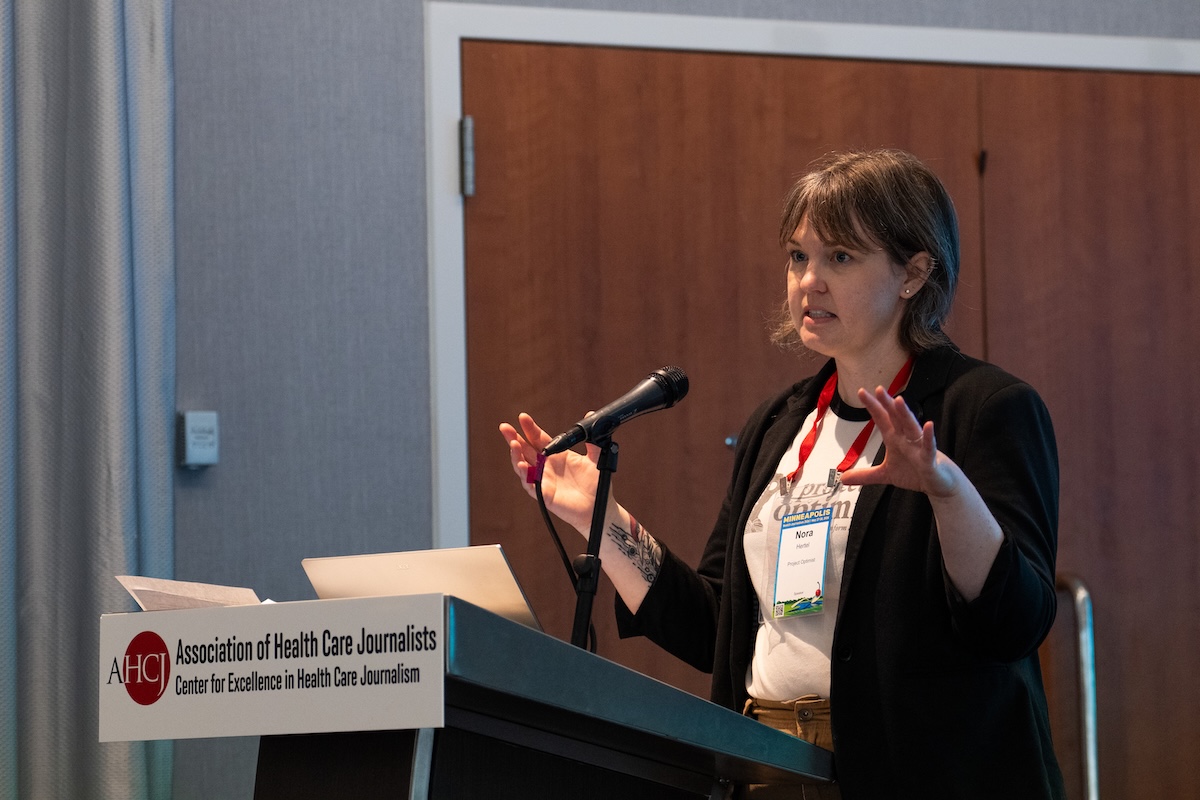
- Nora Hertel, founder and executive director at Project Optimist
As trust in media hits a new low, two panelists at HJ26 discussed the importance of news coverage with a solutions journalism approach, which involves a critical analysis of a solution to a particular social problem instead of advocacy journalism or writing inspirational stories about philanthropists.
This strategy is especially important at a time when people are experiencing burnout from news consumption, the panelists said. Case in point: The Reuters Institute’s 2024 Digital News Report showed 39% of people globally tend to avoid the news because of the negativity, while 60% of respondents said they feel helpless about the information they receive from the news.
“That really takes the air out of my lungs because it feels like, ‘Okay, we’re not doing enough here,’” said Wilson Lievano, the program manager at Solutions Journalism Network, a nonprofit, nonpartisan organization that aims to support the kind of journalism it calls “hope with teeth.”
Lievano said that the journalist’s job does not end at identifying a problem in society and exposing it through a story. Writing stories that provide alternative models to address those problems can help mitigate the hopelessness that communities often feel when consuming news, he said.
Lievano explained the four tenets at the core of solutions journalism: response, evidence, insight and limitations.
The first pillar examines a response to the problem the reporter is covering by analyzing both qualitative and quantitative data and then collecting evidence about whether that approach has been successful. “We’re not de a good look at this and not just being cheerleaders about the work that other people are doing,” Lievano said.
This particular approach to journalistic work also involves a deep dive into how other communities or groups are responding to similar issues to provide insights to the audience about actionable lessons, takeaways and replicable knowledge. However, journalists should approach the stories critically to identify the limitations and contextualize them with the story, Lievano said.
Nora Hertel, the founder and executive director at Project Optimist, produces solutions journalism and explanatory stories focused around business, environment and social issues in the rural parts of Minnesota. Through the Solutions Journalism Network, Hertel also trains reporters, community members and nonprofits in solutions journalism in the upper Midwest. Hertel provided a tipsheet for print, audio, radio and television journalists on how to ask sources the right questions to ensure a solid solutions journalism story.
“One of the places to start the solutions [journalism story] is to look for positive de
Hertel handed out a zinewith a checklist of relevant questions that reporters can ask themselves for a solutions journalism story. Hertel recommended slowing interviews down to clearly understand howat the track record is. She cautioned against comparing disparate problems and encouraged contextualizing the metrics every step of the way.
The Solutions Journalism Network has many res Journalism Story Tracker, which hosts over 17,000 solutions journalism stories. The tool helps reporters keep track of stories published by other journalists on their beat, as well as allow them to submit a solutions story for the network to review and upload. The organization also offers free webinars to anyone interested in learning more about solutions journalism.
Debadrita Sur is a reporter for Central Current and a Report for America corps member based in Syracuse, NY.
