


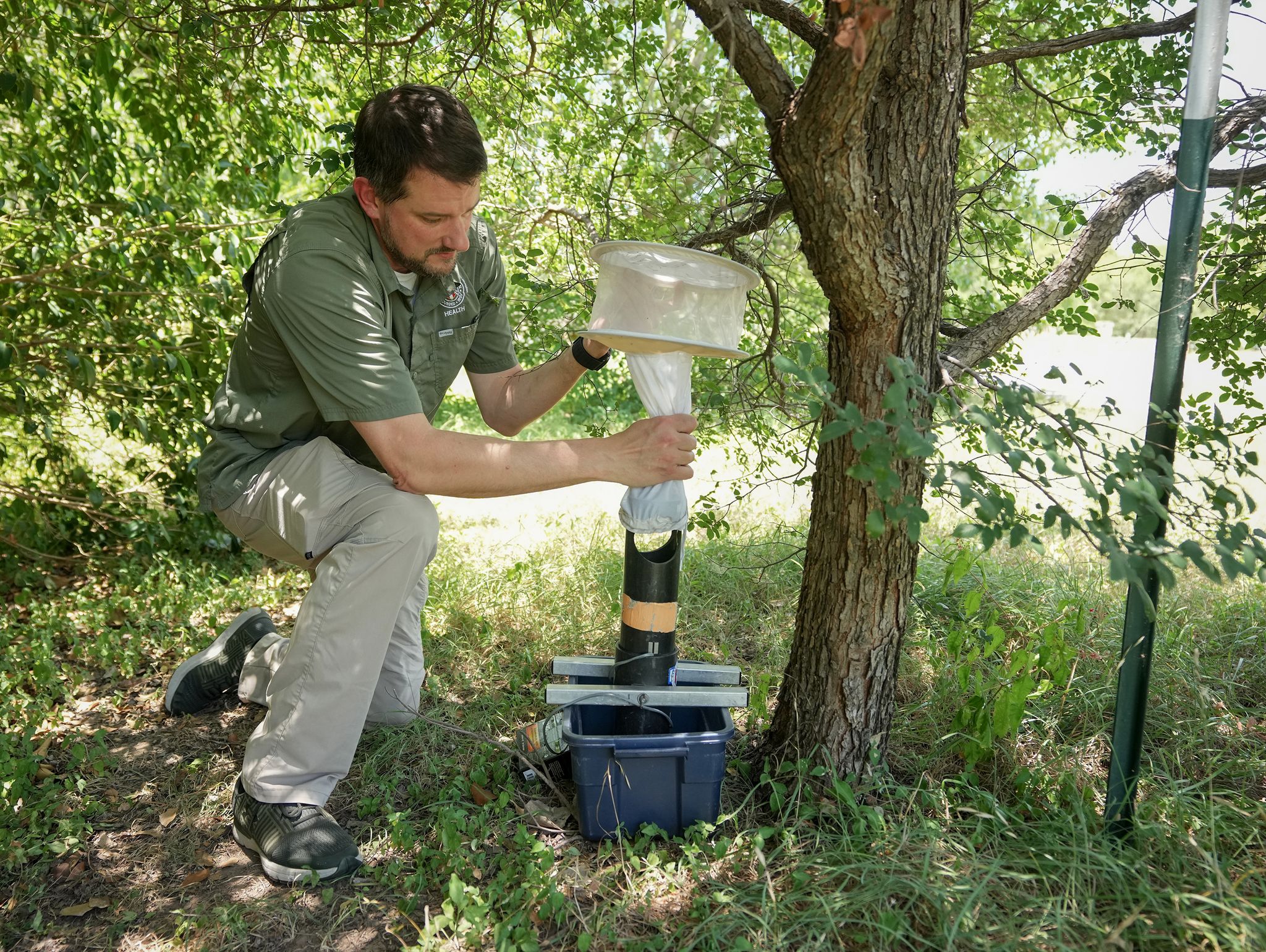
From May through November, Austin Public Health collects mosquitoes from sites throughout the county and sends the samples to be tested for three illnesses mosquitoes can transmit to humans: West Nile virus, St. Louis encephalitis and Eastern equine encephalitis
Aaron Urbanek, a senior environmental health officer who studied entomology in college, is one of five specialists who each week place 30 mosquito traps one day and then collect them the next day to bring them to the state lab for testing
This is just part of his job. His team also conducts restaurant health inspections, too, and monitors other environmental health risks. Before Urbanek started this job nine years ago, he worked as a veterinary technician at Austin Animal Services helping with surgeries at the local animal shelter.
Article continues below this ad
What kind of a mosquito season is Austin having?
Mosquitoes have loved Austin’s wetter spring and cooler temperatures. ButAustin’s weather recently shifted into a traditional Texas dry spell with temperatures reaching 100 degrees. That dry spell reduces the number of mosquitoes flying about because mosquitoes really don’t like the heat, Urbanek said
One rain event and the mosquitoes will be back in business. Their eggs are resting dormant in the ground just waiting for a few drops of water. Mosquitoes need water for the eggs to hatch and the larvae to thrive
Expected rain could turn a relatively pest-free backyard into a mosquito swamp in a matter of days
Article continues below this ad
What diseases are Texas mosquitoes carrying?
This year, Travis County has had one positive mosquito sample for West Nile virusin the 78733 ZIP code in West Austin between Bee Cave and theBarton Creek and Steiner Ranch neighborhoods. Williamson County has had eight positive samples for West Nile that were collected in Cedar Park, Georgetown and Hutto. Hays County recently had two mosquito traps test positive in the 78666 ZIP code near San Marcos. Bastrop County has not had a positive test yet. Bastrop County has not had a positive case of West Nile for the year.
Around Texas,the July 5 report had 462 mosquito samplesthat tested positive for West Nile and five human cases
Article continues below this ad
Texas has also had four cases of dengue fever in people and two cases of chikungunya. These are mosquito-borne illnesses that have started showing up in Texas from Central and South America, Africa, Asia and the Middle East. The state has not yet recommended testing mosquito pools for these diseases.
Why is Austin concerned with West Nile?
In some people, especially older adults, West Nile virus can become deadly if the body cannot fight off the infection
Article continues below this ad
About 80% of people with West Nile virus have no symptoms. When symptoms do appear, they are usually mild and might include fever, headache, body and joint aches, swollen lymph nodes, vomiting, diarrhea or a rash. West Nile infections can be confirmed with a blood test or a spinal fluid test.
Which mosquitoes does Austin Public Health collect?
Female Culex mosquitoes carry West Nile, St. Louis encephalitis and Eastern equine encephalitis because they feed on birds before biting humans. Male mosquitoes feed on nectar and do not transmit these viruses
“Humans are dead-end hosts,” Urbanek said, meaning the virus isn’t spread from human to human. And a mosquito that bites a person with West Nile will not spread it to the next person it bites. It has to pass from the bird’s blood first to the mosquito to the human
Article continues below this ad
Dengue, chikungunya and Zika are all carried by a different type of mosquito: the Aedes variety, which is now in Texas, but not in the same numbers as the Culex mosquitoes.
How does Austin Public Health collect, test mosquitoes?
The 30 mosquito traps are placed on public land throughout the county. If you see a trap, it doesn’t necessarily mean that area has infected mosquitoes. It’s just being tested and you should leave it alone, Urbanek said
Article continues below this ad
To attract the mosquitoes, the health department creates a special blend of stagnant water containing hay and brewer’s yeast. That replicates the kind of water mosquitoes are looking for: stagnant and smelling good to them. In nature, mosquitoes especially like water that’s been left in leaf litter under trees and bushes, water left in toys or planting pots, and water that results from backed-up French drains or gutters
The trap has a container of the stagnant water at the bottom with a fan that sucks the mosquitoes into a netted container. On a busy day, there can be 300 to 400 in one trap.
Urbanek then lifts the trap off the fan and tube leading to the netted container. He holds the bottom closed with his hand or closes the drawstring. He then brings the trap to his truck and uses a modified vacuum to suck up collected mosquitoes and put them into a new glass container. He labels each container with the date and location of the collection and drives them to the state lab to be analyzed for viruses
The state lab pulls 50 of the female Culex mosquitoes from each sample, spins them into a ball and tests the combined blood meal for West Nile and the two encephalitises. Within 48 hours, it alerts Austin Public Health with the results
Article continues below this ad
What happens if Austin has a lot of West Nile cases?
Right now, Central Texas has cases of West Nile appearing earlier in year than in some previous years, but not at a rate that is unusual.
Texas had an alarming outbreak in 2012, with 1,868 human cases and 89 people dying
Article continues below this ad
Every year, Austin Public Health and the Austin-Travis County Health Authority combat mosquitoes by trapping and testing the insects as well as conducting an education campaign to reduce the conditions where mosquitoes thrive
If the number of West Nile cases increases, especially in humans, Austin Public Health might consider spreading larvicide in public spaces to kill the larvae
If cases continue to increase, Austin Public Health and the health authority use guidance from the state and the Centers for Disease Control and Prevention to determine if spraying public areas with insecticide to kill adult mosquitoes is necessary. The spraying happens at night and the public is notified in advance
How can you prevent mosquito bites?
Article continues below this ad
- Wear insect repellent with DEET.
- Wear clothing that covers your skin such as long sleeves and long pants. Lighter-colored clothing attracts mosquitoes less.
- Avoid going out at dusk and dawn, when mosquitoes are most active.
Urbanek collects mosquitoes in the heat of the day and wears DEET and long pants to lessen his chance of being bitten.
How can people lessen the amount of mosquitoes in their yards?
- Dump out any source of standing water in your yard.
- Regularly clean out anything that needs to have water, such as birdbaths. Use mosquito dunks or mosquito fish in ponds to eat mosquito larvae.
- Make sure rain barrels are covered.
- Move potted plants indoors. Create drains in planter boxes to avoid standing water.
- Look for drainage problems in your yard and fix them with a French drain.
- Plant lemon balm, mint, chrysanthemums, marigolds, basil, garlic, eucalyptus, lavender, rosemary or lemongrass around your yard. Or use oils and candles with those scents to discourage mosquitoes.
- Scatter coffee grounds in the soil wherever there have been drainage problems. They deprive mosquito eggs in the soil of oxygen.
- Install lights around the yard that mosquitoes don’t like, such as LED lights, yellow bug lights or sodium lamps.
- Use fans on the patio to discourage mosquitoes from flocking there.
- Hire a professional service to treat your yard. Make sure the employees know whether you have pets or children who crawl around in the yard.
