


Download PDF
Abstract
Background
Air pollution is an established risk factor for cardiovascular and metabolic diseases, but evidence on chronic kidney diseases (CKD) remains limited
Objective
We aim to examine the association between long-term exposure to air pollutants and CKD incidence
Methods
We followed 24,581 female nurses from the Danish Nurse Cohort, recruited in 1993 or 1999, for their first-ever hospital contact with a primary or secondary CKD diagnosis until 2018. We estimated annual mean levels of particulate matter with a diameter < 2.5 µm (PM2.5) and 10 µm (PM10), nitrogen dioxide (NO2), and black carbon (BC) at nurses’ residential addresses using the DEHM/UBM/AirGIS modeling system. We used Cox regression models to examine the association of 14-year running means of air pollutants with CKD incidence and to explore the effect modification of this association by lifestyles.
Results
Over 521,211 person-years of follow-up, 429 nurses developed CKD. We found positive associations of modest magnitude between long-term exposure to air pollutants and CKD, with hazard ratios (95% confidence intervals) per interquartile range: 1.18 (0.93–1.50) per 2.86 µg/m3 for PM2.5, 1.14 (0.93–1.40) per 3.33 µg/m3 for PM10, 1.13 (0.99–1.28) per 8.09 µg/m3 for NO2, and 1.09 (1.00–1.20) per 0.34 µg/m3 for BC. The associations between long-term exposure to NO2 and CKD incidence were greater in never smokers than in ever-smokers. Associations with NO2 and BC remained unchanged in two-pollutant models, whereas those with PM10 and PM2.5 attenuated.
Significance
Our study adds important new findings to the growing evidence suggesting that air pollution may be associated with CKD incidence
Impact statement
This study provides longitudinal evidence that long-term exposure to ambient air pollution contributes to chronic kidney disease (CKD) incidence, even in a relatively healthy occupational cohort and at comparatively low pollution levels. Although effect sizes were modest, consistent positive associations, particularly for NO2 and black carbon, highlight traffic-related pollution as a potential renal risk factor. Stronger associations among never-smokers suggest that environmental exposures may independently influence kidney health. These findings reinforce the need to integrate air pollution into CKD risk assessment and prevention strategies. Strengthening air quality policies and reducing long-term residential exposure could help lower CKD burden and protect kidney health at the population level.
Introduction
Chronic kidney disease (CKD) is an abnormality in kidney structure or function lasting at least three months, with health implications. It can be classified by its cause, glomerular filtration rate (GFR), and indicators of kidney damage, such as albuminuria [1]. CKD is a major public health concern worldwide, with prevalence and incidence rates steadily increasing globally, largely due to population aging and increasing exposure to risk factors [2]. Between 1990 and 2017, global mortality attributable to CKD rose by 41.5% [2]. In 2017, an estimated 697.5 million people were living with CKD, corresponding to a global prevalence of 9.1%. That same year, CKD accounted for 35.8 million disability-adjusted life-years and 1.2 million deaths, ranking as the 12th leading cause of death globally [2]
Air pollution is a major environmental stressor and the second leading risk factor for mortality globally. Despite robust evidence linking long-term exposure to air pollution with major chronic respiratory, cardiovascular, cerebrovascular, and metabolic diseases, as well as cancer [3], its impact on the renal system remains less explored. Notably, the World Health Organization’s 2021 Air Quality Guidelines did not address kidney diseases in their review, due to a lack of evidence at the time of the review, assessing the literature up until 2018 [4]. Similarly, the recently published Kidney Disease: Improving Global Outcomes (KDIGO) 2024 Clinical Guideline for the Evaluation and Management of Chronic Kidney Disease, acknowledges general “environmental factors” affecting the renal system, but without explicitly recognizing air pollution as a determinant of disease risk [5]. As air pollution is now a well-recognized risk factor for cardiovascular diseases and type-2-diabetes [6], both of which are significant risk factors for CKD, there has been growing interest in a better understanding of the potential direct contribution of air pollution to CKD incidence. Proposed biological pathways include air pollution-induced systemic oxidative stress and inflammatory responses that can impair endothelial function and contribute to renal structural damage, such as reduced glomerular and tubular lumen volume, reduced mesangial expansion, and elevated blood urea nitrogen levels [7,8,9,10]. Since the first epidemiological cohort study on the long-term exposure to air pollution and CKD incidence was published in 2017, there are now twelve studies and one meta-analysis [11], out of which eleven report adverse associations, with most studies investigating particulate matter with a diameter < 2.5 µm (PM2.5), and less with particulate matter with a diameter < 10 µm (PM10) and nitrogen dioxide (NO2) [12,13,14,15,16,17,18,19,20,21,22]. Moreover, evidence remains limited for black carbon (BC), with only two studies to date, suggesting a strong adverse association and a null association [21, 23]. BC is a pollutant of emerging concern, as identified by the WHO 2021 Guideline, calling for more evidence [4]. Furthermore, BC is both a harmful pollutant originating from incomplete combustion (diesel engines, residential wood and coal burning, waste and agricultural residue burning) and a climate forcer contributing to global warming [24]. It is important to evaluate contributions from all pollutants and identify relevant ones and their sources, in order to guide policy and mitigation measures.
In this context, BC remains particularly under-investigated. Conducting high-quality cohort studies with extended exposure windows, long follow-up periods, relatively low exposure levels, and adjustments for potential confounders and co-pollutants is essential. Expanding the evidence on the incidence of CKD associated with long-term exposure to air pollution, especially for BC alongside PM2.5, PM10, and NO2, is crucial for clarifying its role in renal pathophysiology. Such evidence will be vital for informing future guidelines that shape public health policies aimed at preventing kidney disease and reducing exposure to health risks.
Here, we examine associations between long-term exposure to PM2.5, PM10, NO2, and BC and incident CKD in the Danish Nurse Cohort, a well-characterized population with long follow-up and detailed residential histories. While evidence on PM2.5 and NO2 is growing, prospective cohort evidence on BC remains limited. We therefore aimed to replicate previous findings for common regulated pollutants and to extend the evidence base by evaluating BC as an emerging combustion-related pollutant and exploring potential effect modification by lifestyle factors to identify susceptible subgroups.
Methods
Study population
The Danish Nurse Cohort (DNC) was established in the 1990s, inspired by the US Nurses’ Health Study [25], to study the long-term effects of oral contraceptive hormone therapy among nurses [26]. Through the Danish Nurse Organization, approximately 95% of nurses in Denmark were invited to join the cohort. Female nurses aged ≥44 years were recruited in 1993 and 1999. The cohort comprises a total of 28,731 individuals for whom behavioral, social, economic, and biological information was collected via questionnaires.
We excluded nurses who had an existing diagnosis of CKD at baseline (1993 or 1999), those with missing information on covariates at baseline, and those without exposure data for the entire follow-up period
The DNC was approved by the Scientific and Ethical Committee of Copenhagen and Frederiksberg Municipalities (approval number [KF] 01-103/93) and the Danish Data Protection Agency (J. number 1993-1110-1151). All methods were performed in accordance with the relevant guidelines and regulations. The nurses who were included in the original DNC provided informed written consent
Outcome definition
CKD diagnoses were identified through the Danish National Patient Register [27], which includes information on hospital contacts since 1977, linked to each participant via their unique personal identification number. Incident cases of CKD were defined as the first hospital contact with a primary or secondary diagnosis of CKD, using the International Classification of Diseases (ICD), 8th Revision (ICD-8) code 792.99 (before December 31, 1993) and ICD-10th Revision (ICD-10) codes N18 and N19 (from January 1, 1994, onwards).
ICD-10 codes were selected based on a German validation study of CKD diagnoses, which demonstrated a good balance among sensitivity, specificity, and positive and negative predictive values, particularly with longer follow-up periods [28]. To harmonize ICD-10 codes with ICD-8 codes, we used a mapping and matching tool developed by Pedersen et al. [29], (referred to as Definition I for the main health outcome). Additionally, we applied an alternative CKD definition based on a Danish study to compare various algorithms for identifying CKD patients in medical databases [30], referred to as Definition II. Detailed descriptions of both CKD definitions (I and II) are provided in the supplementary material (Tables S1 and S2).
Exposure assessment
We estimated individual-level exposure to ambient air pollution at each residential address by linking the Danish Civil Registration System to the DEHM/UBM/AirGIS, a multiscale, integrated air pollution modeling system [31,32,33]. The Danish Eulerian Hemispheric Model (DEHM) is a regional chemistry-transport model, which uses nesting capabilities to obtain higher resolution at areas of interest. Here, the model is set up with four domains, where the inner domain covers Denmark with a 5.6 km x 5.6 km resolution. The Urban Background Model (UBM) is a local-scale model, using output from the DEHM as boundary conditions, and covering Denmark with a 1 km x 1 km resolution. AirGIS is an Air Geographic Information System that uses output from UBM as boundary conditions and runs the Operational Street Pollution Model (OSPM) at all addresses in Denmark. AirGIS combines data on street configurations, building heights, and traffic, and prepares data as input for OSPM [31,32,33,34].
The DEHM/UBM/AirGIS system has been extensively validated, showing strong agreement with measured concentrations of PM2.5, PM10, NO2, and BC across multiple spatial and temporal resolutions, including hourly, daily, monthly, and annual averages [34, 35]
For each participant, we calculated the annual weighted mean concentrations of PM2.5, PM10, NO2, and BC at their residential addresses between 1979 and 2018, considering their residential histories (Text S1). Specifically, monthly concentrations at each address were modeled and used to calculate the annual weighted mean for participants who had a registered residential address in Denmark at least 85% of the time in that year, ensuring adequate coverage of residential history. Participants who did not meet this threshold (85%) were excluded from the exposure assessment for that year. In addition, individuals with missing exposure estimates due to the unavailability of air pollution model predictions at their recorded addresses were excluded from the analysis (n = 148).
Covariates
We utilized a Directed Acyclic Graph (DAG) to systematically identify and select covariates, ensuring that all relevant confounding variables were accounted for in our analysis of the relationship between air pollution exposure and chronic kidney disease incidence (Fig. S1). Information on lifestyle and socioeconomic status covariates was obtained at baseline from the DNC data collected in either 1993 or 1999 and was treated as time-invariant. The variables included marital status (single, married, separated/divorced, widowed), occupational status (employed, homeworking, retired, unemployed/other), and vegetable consumption (rarely, weekly, daily). Additionally, alcohol consumption was categorized as none (no weekly alcohol consumption), moderate (1–14 drinks per week), or heavy ( ≥15 drinks per week). Body mass index (BMI) was classified into underweight ( <18.5 kg/m²), normal weight (18.5–24.9 kg/m²), overweight (25.0–29.9 kg/m²), and obese ( ≥30 kg/m²). Physical activity levels were categorized as low, moderate, or high, while smoking status was classified as never, former, or current smoker. Information regarding family income was obtained from the Danish Civil Registration System for the year 2000 and categorized into quintiles.
Statistical analysis
We applied time-varying Cox proportional hazards models to investigate the association between long-term exposure to PM2.5, PM10, NO2, and BC and the incidence of CKD. In these models, age was used as the underlying time scale rather than follow-up time to directly account for the biological impact of aging on disease risk and to minimize residual confounding by age. Participants were followed from the time of recruitment (1993 or 1999) until the first occurrence of CKD diagnosis, death, emigration, or the end of follow-up on December 31, 2018. The proportional hazards assumption was assessed using Schoenfeld residuals, which indicated the assumption was met (Table S3).
We fitted three models, which differed in the adjustment for relevant confounders suggested by the WHO risk of bias instrument for air pollution and health studies [36]. Model 1 was adjusted for age as the underlying timescale with baseline year (1993 or 1999) and calendar year of follow-up as strata. Model 2 was additionally adjusted for marital status, work status, vegetable consumption, alcohol consumption, smoking status, BMI, physical activity, and family income. Model 3 (the main model) was further adjusted for the municipality-level mean income in 2000.
Exposure to air pollution was included as a time-varying variable, using 14-year moving-average windows to capture long-term cumulative exposure, consistent with the slow development and progression of CKD. The 14-year window was selected because it represents the longest consistently available exposure period in this cohort, based on recruitment timing and the availability of modeled historical air pollution data, thereby allowing assessment of prolonged cumulative exposure
We estimated exposure-response functions for each pollutant using penalized smoothing splines with 3 degrees of freedom, following adjustments for covariates in Model 3. We further tested for non-linearity by comparing spline-based models with linear models using the likelihood ratio test
We also fit two-pollutant models, including each pair of pollutants for PM2.5, PM10, NO2, and BC, with a Spearman correlation coefficient <0.7
To assess the potential effect modification, we included interaction terms between an exposure and a covariate of interest and tested statistical significance using the likelihood ratio test. Potential effect modifiers included alcohol consumption, BMI, physical activity, and smoking status
We conducted several sensitivity analyses. First, we examined the association of CKD incidence with alternative air pollution exposure windows for all four pollutants, with 1-, 5-, and 10-year moving averages. Finally, given the cohort’s age distribution and the long follow-up period, death may preclude a CKD diagnosis and could bias cause-specific hazard estimates if the competing event is related to air pollution exposure. In a sensitivity analysis, we employed the Fine-Gray model to evaluate the impact of competing risks while accounting for all-cause mortality.
All analyses were conducted using R (version 4.4.2). Results are reported as hazard ratios (HRs) with 95% confidence intervals (CIs) per interquartile range (IQR) increase in pollutant concentrations: 2.86 µg/m3 for PM2.5, 3.33 µg/m3 for PM10, 8.09 µg/m3 for NO2, and 0.34 µg/m3 for BC
Results
Among 28,731 nurses in the DNC, we excluded 10 participants who were diagnosed with CKD before baseline (1993 or 1999). In addition, we excluded 3859 nurses for missing covariate data and 281 for missing exposure data. Thus, we included 24,581 nurses in the final analysis (Fig. S2). Compared with those excluded from the study, participants included in the analysis were generally younger at baseline, more likely to be employed and married, and reported higher rates of alcohol consumption; however, the incidence of CKD during follow-up was similar between the two groups (Table S4).
Participants contributed a total of 521,211 person-years of follow-up, with a mean of 21.2 years per nurse. During this period, 429 nurses developed CKD. The number of annual diagnoses increased over time, from fewer than 5 cases in 1993 to about 25 by the end of the follow-up period. A geospatial visualization of aggregated incident CKD cases per region is presented in Fig. S3
Compared with nurses who did not develop CKD during the follow-up, those who did were older, single or widowed, not employed, overweight or obese, current smokers, in the lowest quintiles of family income, and reported weekly vegetable consumption and no alcohol consumption (Table 1). Similar patterns were observed in the population using the alternative CKD definition (II) (Table S5)
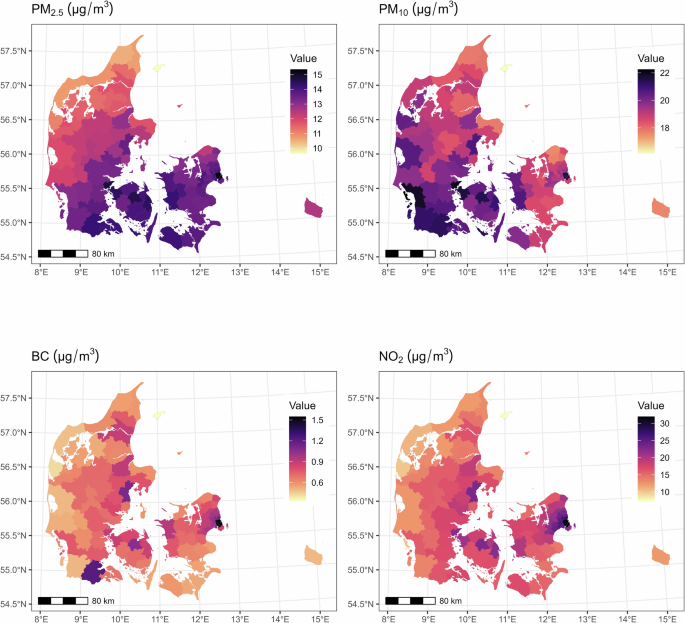
Means of air pollution exposure for PM2.5, PM10, BC, and NO2 at baseline were 13.3 µg/m3, 19.7 µg/m3, 0.9 µg/m3, and 19.5 µg/m3, respectively (Table S6), but a decreasing trend was observed for all pollutants over the years. Exposure concentrations for the population identified using the alternative CKD definition are shown in Table S7, with similar patterns to those of the main study population. Additionally, Fig. 1 presents a geospatial distribution of baseline air pollution exposure by municipality for each pollutant, linked to participants’ residential addresses.
PM₂․₅ particulate matter with a diameter of ≤2.5 µm, PM₁₀ particulate matter with a diameter of ≤10 µm, BC black carbon, NO₂ nitrogen dioxide
The relationship between long-term exposure to air pollution and CKD incidence was not visually linear; however, we observed increasing slopes at low exposure levels and heterogeneous directions, with wider CIs at high exposure levels (Fig. 2). For PM2.5 and BC, the likelihood ratio test did not provide evidence of a statistically significant difference between linear and non-linear modeling (P-values: 0.08 and 0.35, respectively), whereas for PM10 and NO2, significant differences were found (P-values: 0.02 and 0.03, respectively).
Exposure-response functions were modeled using penalized splines with 3 degrees of freedom. Models were adjusted for age as the underlying timescale, baseline year (1993, 1999), year of follow-up, marital status, work status, vegetable consumption, alcohol consumption, smoking status, body mass index (BMI), physical activity, family income, and mean income of the municipality of residence in the year 2000. PM₂․₅ particulate matter with a diameter of ≤2.5 µm, PM₁₀ particulate matter with a diameter of ≤10 µm, BC black carbon, NO₂ nitrogen dioxide.
Long-term exposure to PM2.5, PM10, BC, and NO2 was associated with an increased risk of developing CKD. Positive associations were observed for all pollutants, and these associations were similar in direction across models (Table S8). In the fully adjusted model (Model 3), the HRs (95% CIs) per IQR increase were 1.18 (0.93–1.50) per 2.86 µg/m3 for PM2.5, 1.14 (0.93–1.40) per 3.33 µg/m3 for PM10, 1.09 (1.00–1.20) per 0.34 µg/m3 for BC, and 1.13 (0.99–1.28) per 8.09 µg/m3 for NO2. In addition, results using an alternative CKD definition (Definition II) yielded similar findings to those in the main results using Definition I (Table 2).
In two-pollutant models with the pair of pollutants with a Spearman correlation coefficient <0.7 (Fig. S4), the association of CKD incidence with BC and NO2 remained positive and consistent after adjusting for PM2.5 and PM10. However, for PM2.5 and PM10, the association with CKD incidence attenuated to near null after adjustment for BC and NO2 (Table 3)
We observed stronger associations among individuals with healthier lifestyles than among those with less healthy lifestyles, except for physical activity. Specifically, the association between long-term NO2 exposure and CKD was more pronounced among never-smokers than among former or current smokers (interaction P-value = 0.034). In contrast, individuals with high levels of physical activity showed protective associations between long-term air pollution exposure and CKD, although this difference was not statistically significant (Fig. 3).
Hazard Ratios (HR) and 95% confidence intervals (CIs) were estimated per interquartile range increase: 2.86 µg/m3 for PM2.5, 3.33 µg/m3 for PM10, 0.34 µg/m3 for BC, and 8.09 µg/m3 for NO2. Models were adjusted for age as the underlying timescale, baseline year (1993, 1999), year of follow-up, marital status, work status, vegetable consumption, alcohol consumption, smoking status, body mass index (BMI), physical activity, family income, and mean income of the municipality of residence in the year 2000. PM₂․₅ particulate matter with a diameter of ≤2.5 µm, PM₁₀ particulate matter with a diameter of ≤10 µm, BC black carbon, NO₂ nitrogen dioxide.
Associations were generally consistent in direction across 1-, 5-, 10-, and 14-year exposure windows, although estimates for shorter windows were less precise and, in some cases, included the null (Table S9). The Fine-Gray model results indicated that the sub-distribution hazard ratios (sHR) were similar to those in the main model, as shown in Table S10, even after accounting for competing risks
Discussion
Summary and interpretation
In this cohort of older Danish female nurses followed for more than two decades, long-term exposure to air pollution was positively but modestly associated with an increased incidence of CKD. In multi-pollutant models, BC and NO2 remained positively associated with CKD after adjustment for particulate mass indicators, suggesting that combustion-related pollutant mixtures may be particularly relevant for CKD risk in this setting, although this interpretation should be made cautiously
Our findings are broadly consistent with previous cohort studies reporting adverse associations between long-term exposure to PM2.5, PM10, BC, or NO2 and CKD incidence (Table S11) [12,13,14,15,16,17,18,19,20,21,22]. However, the confidence intervals in our study were wider than those observed in large administrative cohorts, likely reflecting the smaller number of CKD events. The HR for CKD associated with PM2.5 exposure fell within the range of estimates from earlier studies [15, 22]. In contrast, the estimated risk associated with BC exposure was lower than that reported by Xu et al. [21] (HR [95% CIs] per 1 µg/m3: 1.30 [0.99–1.71] in the present study vs. 2.11 [1.15–3.90] in Xu et al.). The discrepancy likely stems primarily from differences in participant characteristics and CKD incidence: Xu et al. observed 1706 events among 30,396 participants (5.6%) in Malmö, Sweden, whereas our study had 429 events among 24,581 nurses (1.7%), reflecting a healthier, occupational, predominantly female population, factors that could attenuate the BC-CKD association despite similar mean BC levels and age distribution. Taken together, these findings add to the growing body of evidence linking air pollution, particularly BC, to adverse renal outcomes and underscore the need for further large-scale studies to better characterize the magnitude and precision of these associations.
Evidence linking BC exposure to CKD remains limited. As a marker of combustion-related particles and traffic emissions, BC may better capture the more toxic components of particulate mixtures than PM2.5 mass alone [24]. In our two-pollutant models, the associations for BC and NO2 remained relatively robust, while those for PM2.5 and PM10 were attenuated. These findings support the hypothesis that combustion-related pollutants may contribute more strongly to CKD development than particle mass indicators in this setting.
The stronger association observed among never-smokers, particularly for NO2, should be interpreted cautiously and may reflect differential susceptibility or differences in baseline CKD risk. Because smoking itself is a strong CKD risk factor, associations among smokers may be more difficult to detect due to competing pathways, exposure misclassification, or differential survival. This finding should be considered hypothesis-generating and warrants replication. On the other hand, individuals reporting higher levels of physical activity appeared to have attenuated associations, although estimates were imprecise. Thus, physical activity may act as a protective factor, reducing both the overall risk of CKD and the additional risk associated with air pollution exposure.
Our comparison of methods with prior studies revealed significant heterogeneity in the definitions of CKD. There was general agreement on the use of blood sample biomarkers, such as estimated glomerular filtration rate (eGFR), in accordance with KDIGO guidelines [5], as employed in seven previous studies (Table S11). Nevertheless, four other studies [18,19,20,21], employed alternative case definitions based on different ICD codes referring to CKD, limiting direct comparability (Table S11). Such variability in outcome definition has also been noted in general CKD research [28].
Despite these differences in CKD definitions (Definitions I and II), our results showed consistent results. For PM2.5, HRs (95% CI) were slightly higher with the alternative CKD definition, increasing from 1.18 (0.93–1.50) per IQR in the main analysis (Definition I) to 1.20 (0.99–1.46) in the analysis with Definition II. For PM10 and BC, associations attenuated under the Definition II but remained positive [PM10: 1.05 (0.88 – 1.26), BC: 1.05 (0.97–1.14)], compared to the original estimates of 1.14 (0.93–1.40) and 1.09 (1.00–1.20) in the main analysis (Definition I), respectively. The association between NO2 and CKD incidence showed minimal differences across CKD definitions (Table 2). These heterogeneities in health outcome definitions underscore the need for standardized diagnostic algorithms in epidemiological studies using registry data to improve comparability across studies. The consistency remained evident even after accounting for the competing risk of all-cause mortality.
Strengths and limitations
Our study contributes to the scientific literature by providing additional evidence on the associations between PM2.5, PM10, and NO2 and the risk of CKD incidence, and by offering novel insights into the role of BC. This evidence is supported by a well-characterized cohort, which provides detailed information on individual characteristics, including behavioral, social, economic, and biological factors. Moreover, our study features one of the longest follow-up periods, with a mean duration of 21.2 years per participant, and one of the longest retrospective exposure windows, up to 14 years, enabling assessment of long-term cumulative exposure relevant to CKD pathogenesis with high spatial and temporal resolution. This was possible due to unique access to Danish historical address registers and air pollution exposure data, which have been available since 1979.
Several limitations must be acknowledged when interpreting our findings. First, using hospital registry data to identify CKD cases may underrepresent early-stage disease, which is often asymptomatic and undiagnosed in clinical practice [30]. Consequently, our findings are likely to reflect associations with moderate-to-severe CKD. However, the potential misidentification is unlikely to be differentially associated with air pollution exposure, thereby reducing the risk of systematic bias. Second, because the DNC recruited only female nurses, although the cohort includes rich individual data, its gender, occupational, and educational homogeneity may limit our ability to fully generalize the results and compromise the interpretability of our effect modification analysis. In particular, the lack of male representation may obscure potential gender-specific effects that could be significant in a more varied population. Despite these limitations, the study maintains high internal validity due to its rich individual-level data, which controls confounding variables, and a homogeneous population that allows for more controlled analyses. Although the findings are not broadly generalizable, they provide a solid foundation for future research involving more diverse populations. Third, air pollution exposure was estimated from annual means at residential addresses, without accounting for commuting or occupational exposures or other indoor environments. However, a review comparing residential address-based to dynamic time-activity-based long-term air pollution exposures reported high to very high correlations across populations [37]. Therefore, substantial bias is unlikely, although some exposure misclassification cannot be excluded. Fourth, the limited number of CKD cases reduced statistical power and precision, resulting in wide confidence intervals that often included the null value. Therefore, the observed associations, particularly for PM2.5 and NO2, should be interpreted cautiously. Fifth, although attenuation patterns in two-pollutant models may indicate a stronger contribution of combustion-related pollutants, residual collinearity and differential exposure measurement error cannot be ruled out. Moreover, the combined or interactive effects of air pollutants should be considered in future research to better capture real-world exposure mixtures and clarify their joint impact on health outcomes. Sixth, given the multiple interaction tests conducted, the observed effect modification by smoking status may reflect chance findings, and replication in independent cohorts is warranted before drawing firm conclusions. Seventh, although we adjusted for a range of socioeconomic and lifestyle factors that correlate with these conditions, residual confounding, particularly from unmeasured clinical risk factors, cannot be excluded. Moreover, as our cohorts comprised two sub-cohorts, with covariate information collected from different baseline years (1993 or 1999), there may exist certain systematic differences in covariates, such as income. However, we have tried to partially account for this by treating the baseline year as a stratum in the models, in which sub-cohort-specific baseline hazards were modeled separately. We also acknowledge that such approaches may not fully account for potential differences. Finally, although we found no strong evidence of differential outcome risk between included and excluded participants, we cannot rule out selection bias, as the complete-case analysis relies on assumptions about the mechanism of missingness.
Conclusion
In this long-term prospective cohort study of Danish nurses, long-term exposure to ambient air pollution was positively associated with CKD incidence. Results are broadly consistent with prior cohort findings for PM2.5, PM10, and NO2 and provide additional suggestive evidence for BC as a potentially relevant combustion-related pollutant. The stronger association observed among never-smokers highlights a potentially susceptible subgroup and warrants further investigation. Overall, these findings support continued efforts to reduce air pollution exposure as part of broader strategies to prevent chronic disease.
Data availability
The analyses were conducted using individual-level health data accessed through Statistics Denmark research servers and cannot be shared directly due to legal and confidentiality restrictions. R codes used for the analysis are not publicly available. However, R codes can be made available under reasonable request
References
Levin A, Stevens PE, Bilous RW, Coresh J, De Francisco AL, De Jong PE, et al. Kidney Disease: Improving Global Outcomes (KDIGO) CKD Work Group. KDIGO 2012 clinical practice guideline for the evaluation and management of chronic kidney disease. Kidney Int Suppl. 2013;3:1–150
Bikbov B, Purcell CA, Levey AS, Smith M, Abdoli A, Abebe M, et al. Global, regional, and national burden of chronic kidney disease, 1990–2017: a systematic analysis for the Global Burden of Disease Study 2017. Lancet. 2020;395:709–33
Health Effects Institute. State of Global Air 2024: Special Report, 2024
World Health Organization. WHO global air quality guidelines: particulate matter (PM2.5 and PM10), ozone, nitrogen dioxide, sulfur dioxide and carbon monoxide. 2021
Stevens PE, Ahmed SB, Carrero JJ, Foster B, Francis A, Hall RK, et al. KDIGO 2024 Clinical Practice Guideline for the Evaluation and Management of Chronic Kidney Disease. Kidney Int. 2024;105:S117–S314
Rajagopalan S, Brook RD, Salerno PRVO, Bourges-Sevenier B, Landrigan P, Nieuwenhuijsen MJ, et al. Air pollution exposure and cardiometabolic risk. Lancet Diab Endocrinol. 2024;12:196–208
Aztatzi-Aguilar OG, Uribe-Ramírez M, Narváez-Morales J, De Vizcaya-Ruiz A, Barbier O. Early kidney damage induced by subchronic exposure to PM2.5 in rats. Part Fibre Toxicol. 2016;13:68
Hsu Y-H, Chuang H-C, Lee Y-H, Lin Y-F, Chen Y-J, Hsiao T-C, et al. Traffic-related particulate matter exposure induces nephrotoxicity in vitro and in vivo. Free Radic Biol Med. 2019;135:235–44
Tamagawa E, Bai N, Morimoto K, Gray C, Mui T, Yatera K, et al. Particulate matter exposure induces persistent lung inflammation and endothelial dysfunction. Am J Physiol Lung Cell Mol Physiol. 2008;295:L79–L85
Tavera Busso I, Mateos AC, Juncos LI, Canals N, Carreras HA. Kidney damage induced by sub-chronic fine particulate matter exposure. Environ Int. 2018;121:635–42
Xu W, Jia L, Lin Y, Zhang C, Sun X, Jiang L, et al. Association of air pollution and risk of chronic kidney disease: A systematic review and meta-analysis. J Biochem Mol Toxicol. 2024;38:e23610
Blum MF, Surapaneni A, Stewart JD, Liao D, Yanosky JD, Whitsel EA, et al. Particulate Matter and Albuminuria, Glomerular Filtration Rate, and Incident CKD. Clin J Am Soc Nephrol. 2020;15:311–9
Bowe B, Xie Y, Li T, Yan Y, Xian H, Al-Aly Z. Associations of ambient coarse particulate matter, nitrogen dioxide, and carbon monoxide with the risk of kidney disease: a cohort study. Lancet Planet Health. 2017;1:e267–e76
Bowe B, Xie Y, Li T, Yan Y, Xian H, Al-Aly Z. Particulate Matter Air Pollution and the Risk of Incident CKD and Progression to ESRD. J Am Soc Nephrol. 2018;29:218–30
Chan T-C, Zhang Z, Lin B-C, Lin C, Deng H-B, Chuang YC, et al. Long-Term Exposure to Ambient Fine Particulate Matter and Chronic Kidney Disease: A Cohort Study. Environ Health Perspect. 2018;126:107002
Duan J-w, Li Y-l, Li S-x, Yang Y-p, Li F, Li Y, et al. Association of Long-term Ambient Fine Particulate Matter (PM2.5) and Incident CKD: A Prospective Cohort Study in China. Am J Kidney Dis. 2022;80:638–47.e1
Li F-R, Zhu B, Liao J, Cheng Z, Jin C, Mo C, et al. Ambient air pollutants and incident microvascular disease: a cohort study. Environ Sci Technol. 2022;56:8485–95
Li J, Dai L, Deng X, Zhang J, Song C, Xu J, et al. Association between long-term exposure to low level air pollutants and incident end-stage kidney disease in the UK Biobank: A prospective cohort. Chemosphere. 2023;338:139470
Lin S-Y, Ju S-W, Lin CL, Hsu W-H, Lin C-C, Ting I-W, et al. Air pollutants and subsequent risk of chronic kidney disease and end-stage renal disease: A population-based cohort study. Environ Pollut. 2020;261:114154
Wang J, Li D, Sun Y, Tian Y. Air pollutants, genetic factors, and risk of chronic kidney disease: Findings from the UK Biobank. Ecotoxicol Environ Saf. 2022;247:114219
Xu Y, Andersson EM, Krage Carlsen H, Molnár P, Gustafsson S, Johannesson S, et al. Associations between long-term exposure to low-level air pollution and risk of chronic kidney disease—findings from the Malmö Diet and Cancer cohort. Environ Int. 2022;160:107085
Zeng Y, Lin C, Guo C, Bo Y, Chang L-y, Lau AKH, et al. Combined effects of chronic PM2.5 exposure and habitual exercise on renal function and chronic kidney disease: A longitudinal cohort study. Int J Hyg Environ Health. 2021;236:113791
Wen F, Xie Y, Li B, Li P, Qi H, Zhang F, et al. Combined effects of ambient air pollution and PM2.5 components on renal function and the potential mediation effects of metabolic risk factors in China. Ecotoxicol Environ Saf. 2023;259:115039
Fu B, Gasser T, Li B, Tao S, Ciais P, Piao S, et al. Short-lived climate forcers have long-term climate impacts
Hundrup YA, Simonsen MK, Jorgensen T, Obel EB. Cohort Profile: The Danish nurse cohort. Int J Epidemiol. 2012;41:1241–7
Bao Y, Bertoia ML, Lenart EB, Stampfer MJ, Willett WC, Speizer FE, et al. Origin, Methods, and Evolution of the Three Nurses’ Health Studies. Am J Public Health. 2016;106:1573–81
Schmidt M, Schmidt SAJ, Sandegaard JL, Ehrenstein V, Pedersen L, Sørensen HT. The Danish National Patient Registry: a review of content, data quality, and research potential. Clin Epidemiol. 2015;7:449–90
Bothe T, Fietz A-K, Schaeffner E, Douros A, Pöhlmann A, Mielke N, et al. Diagnostic Validity of Chronic Kidney Disease in Health Claims Data Over Time: Results from a Cohort of Community-Dwelling Older Adults in Germany. Clin Epidemiol. 2024;ume 16:143–54
Pedersen MK, Eriksson R, Reguant R, Collin C, Pedersen HK, Sørup FKH, et al. A unidirectional mapping of ICD-8 to ICD-10 codes, for harmonized longitudinal analysis of diseases. Eur J Epidemiol. 2023;38:1043–52
Vestergaard SV, Christiansen CF, Thomsen RW, Birn H, Heide-Jørgensen U. Identification of Patients with CKD in Medical Databases: A Comparison of Different Algorithms. Clin J Am Soc Nephrol. 2021;16:543–51
Brandt J. Operational air pollution forecasts from European to local scale. Atmos Environ. 2001;35:91–8
Brandt J, Christensen JH, Frohn LM, Berkowicz R. Air pollution forecasting from regional to urban street scale–implementation and validation for two cities in Denmark. Phys Chem Earth, Parts A/B/C. 2003;28:335–44
Jensen SS, Berkowicz R, Sten Hansen H, Hertel O. A Danish decision-support GIS tool for management of urban air quality and human exposures. Transp Res Part D Transp Environ. 2001;6:229–41
Frohn LM, Geels C, Andersen C, Andersson C, Bennet C, Christensen JH, et al. Evaluation of multidecadal high-resolution atmospheric chemistry-transport modelling for exposure assessments in the continental Nordic countries. Atmos Environ. 2022;290:119334
Khan J, Kakosimos K, Raaschou-Nielsen O, Brandt J, Jensen SS, Ellermann T, et al. Development and performance evaluation of new AirGIS – A GIS based air pollution and human exposure modelling system. Atmos Environ. 2019;198:102–21
Centre for Environment & Health (BON) LWEL. Risk of bias assessment instrument for systematic reviews informing WHO Global Air Quality Guidelines, 2020
Hoek G, Vienneau D, De Hoogh K. Does residential address-based exposure assessment for outdoor air pollution lead to bias in epidemiological studies? Environ Health. 2024;23:75
Funding
This study was funded by the Clean Air Fund. The Clean Air Fund had no role in study design, analysis, interpretation, or manuscript preparation. Open access funding provided by Copenhagen University
Author information
Authors and Affiliations
Section of Environmental Health, Department of Public Health, University of Copenhagen, Copenhagen, Denmark
Gonzalo B. Helitano, Marie Bergmann, Zorana Jovanovic Andersen & Youn-Hee Lim
Department of Environmental Science, Aarhus University, Roskilde, Denmark
Jørgen Brandt & Matthias Ketzel
iClimate, interdisciplinary Centre for Climate Change, Aarhus University, Roskilde, Denmark
Jørgen Brandt
Division of Occupational and Environmental Medicine, Lund University, Lund, Sweden
Tanya Andersson Nystedt, Cale Lawlor, Kajsa Pira, Ebba Malmqvist & Anna Oudin
Authors
- Gonzalo B. Hevia-RamosView author publications
Search author on:PubMed Google Scholar
- Jiawei ZhangView author publications
Search author on:PubMed Google Scholar
- Stéphane TuffierView author publications
Search author on:PubMed Google Scholar
- Rina SoView author publications
Search author on:PubMed Google Scholar
- George NapolitanoView author publications
Search author on:PubMed Google Scholar
- Marie BergmannView author publications
Search author on:PubMed Google Scholar
- Jørgen BrandtView author publications
Search author on:PubMed Google Scholar
- Tanya Andersson NystedtView author publications
Search author on:PubMed Google Scholar
- Cale LawlorView author publications
Search author on:PubMed Google Scholar
- Kajsa PiraView author publications
Search author on:PubMed Google Scholar
- Matthias KetzelView author publications
Search author on:PubMed Google Scholar
- Ebba MalmqvistView author publications
Search author on:PubMed Google Scholar
- Anna OudinView author publications
Search author on:PubMed Google Scholar
- Zorana Jovanovic AndersenView author publications
Search author on:PubMed Google Scholar
- Youn-Hee LimView author publications
Search author on:PubMed Google Scholar
Contributions
All authors contributed to background research, study planning, and manuscript review. GHR conducted the statistical analyses and drafted the original manuscript. JZ, MB, RS, GN, JB, TAN, CL, KP, MK, SL, EM, AO, and ZJA contributed to evidence review and critical proofreading. YHL was responsible for data interpretation, manuscript writing, and coordination of the review process
Ethics declarations
Competing interests
The authors declare no competing interests
Additional information
Publisher’s note Springer Nature remains neutral with regard to jurisdictional claims in published maps and institutional affiliations
Supplementary information
R1f_4. Supplementary Information DNC CKD_clean (download DOCX )
Rights and permissions
Open Access This article is licensed under a Creative Commons Attribution 4.0 International License, which permits use, sharing, adaptation, distribution and reproduction in any medium or format, as long as you give appropriate credit to the original author(s) and the source, provide a link to the Creative Commons licence, and indicate if changes were made. The images or other third party material in this article are included in the article’s Creative Commons licence, unless indicated otherwise in a credit line to the material. If material is not included in the article’s Creative Commons licence and your intended use is not permitted by statutory regulation or exceeds the permitted use, you will need to obtain permission directly from the copyright holder. To view a copy of this licence, visit http://creativecommons.org/licenses/by/4.0/.
About this article
Cite this article
Here to air pollution and chronic kidney disease incidence in adults: The Danish Nurse Cohort.
J Expo Sci Environ Epidemiol (2026). https://doi.org/10.1038/s41370-026-00943-x
Received:12 February 2026
Revised:26 June 2026
Accepted:30 June 2026
Published:11 July 2026
Version of record:11 July 2026
DOI
:https://doi.org/10.1038/s41370-026-00943-x
