


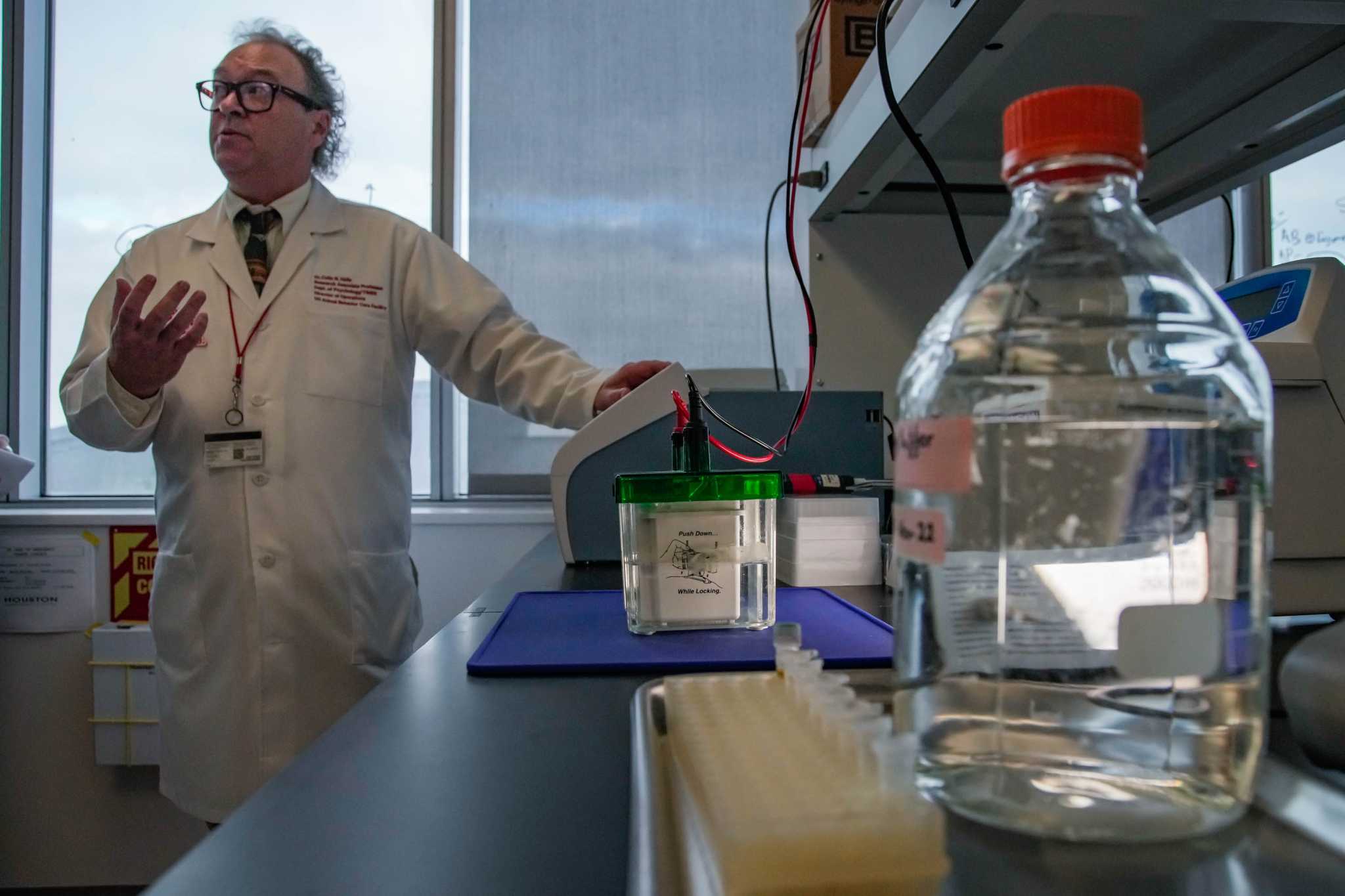
University of Houston launched “UH Health” on Wednesday, a new hub for teaching and research that brings together physicians, nurses, social workers and others to address growing healthcare challenges in the city and state.
Experts say the move could help shape healthcare in the region, make UH more competitive for research grants and potentially foster more innovation in the Texas Medical Center
The new consortium builds on years of efforts to boost the university’s profile in the Texas Medical Center and its influence in healthcare. UH opened the Tilman J. Fertitta Family College of Medicine and the Gessner College of Nursing in 2020 and 2015, respectively, and recently expanded its nursing, medicine and pharmacy programs to the Rio Grande Valley in partnership with DHR Health
Article continues below this ad
All those colleges and initiatives are now part of UH Health, along with the colleges of pharmacy and optometry
“From opening the state’s first college of optometry to developing groundbreaking vaccines, improving the health of all Texans has been a UH priority for decades,” UH President Renu Khator said in a news release. “Now, with the launch of UH Health, we are bringing together the full strength of our health enterprise to expand our reach, advance research and transform the future of health for our communities.”
Make us a Preferred Source on Google to see more of us when you search.
Add Preferred Source
The hub also includes UH Population Health, the Human Integrated Health Science Institute and researchers in health-related fields, such as psychology, biomedical engineering and social work
BREAKTHROUGH:UH engineers find smarter semiconductor cooling for AI
Article continues below this ad
Center aims to bring researchers together
Almost 50% of UH’s research is health-related, but much of it has been isolated across departments and colleges, he said. As a result, many faculty were researching different aspects of the same topic but didn’t realize they could support each other
For example, more than 100 faculty are currently researching different areas of brain health, with $62.5 million in active grants, according to the university. UH researchers also have over $11 million in funding from the Cancer Prevention and Research Institute of Texas.
“This is a deliberate attempt to pull all these pieces together into something that … is able to better act where we want to, in terms of education, clinical care delivery, community engagement, research,” said Jonathan McCullers, vice president for health affairs and dean of the medical school
University officials say UH Health reflects a shift to a more collaborative structure in healthcare. By creating a central location, faculty and staff can connect more easily while researching conditions such as dementia, cancer, infectious diseases and substance use disorders. Students in clinics can work in teams, as they’ll be expected to do in the workforce
Article continues below this ad
On the student side, the psychology department has worked in community health spaces, but not with the medical or nursing colleges, McCullers said
The new consortium could allow UH to centralize some administrative functions, such as budgeting, compliance and reporting for research projects and the institutional review boards that monitor those efforts, said Dr. Heidi Russell, the director of the Center for Health Policy at Rice University’s Baker Institute for Public Policy
Bringing all of the university’s health-related teaching and research under the UH umbrella could also help its researchers secure competitive research grants, Russell said
“They can demonstrate that they have this bigger and more established consortium with all of these re
HIGHER ED:Delays in federal research funding hit Texas universities
Article continues below this ad
Workforce shortages and competition in health research
UH has pursued advancements in the health space against the backdrop of healthcare workforce shortages and challenges with a population that’s both growing and aging
It has also been competing with other public universities in the Texas Medical Center. Many institutions in the world-renowned center have longstanding relationships with other universities, even as UH has partnered with HCA Healthcare, Memorial Hermann Hospital, Baylor College of Medicine and MD Anderson Cancer Center
That reality led UH to ask the state last year to build a hospital in East Harris County to give students more training opportunities and to work with community members who don’t have as much access to healthcare. The Texas Legislature didn’t provide the funding.
McCullers said he believes the new UH Health will allow the university to collaborate with and be “recognized in the same breath” as other universities in healthcare.
Article continues below this ad
Russell believes there is opportunity for UH Health to thrive alongside other Texas Medical Center institutions because Houston needs more healthcare workers to keep pace with rapid population growth in the city and its suburbs. The university’s efforts to bolster its reputation in the medical research space could also foster healthy competition that could eventually lead to better outcomes for patients, she said
“It’s not going to hurt any of the programs that we have,” Russell said. “It’s probably just going to drive innovation.”
MEDICAL MYSTERY:New Houston Chronicle series ‘Medical Mystery Files’ investigates puzzling symptoms, elusive diagnoses
UH plans building projects, more initiatives
In addition to the new consortium, UH is pursuing major building projects for its health initiatives, including a $30.5 million renovation to its facility in the medical center. It will house UH Population Health, which uses data, science and public policy to solve community health problems.
UH is also breaking ground this summer on a 56,000-square-foot medical research building behind the Fertitta Family College of Medicine, at an expected cost of around $87 million. The new building will largely house UH Health and include laboratories, a clinical trials space, a virtual reality behavioral suite and a makerspace for engineers.
Next year, UH plans to ask lawmakers to designate a separate “health science center” for its health professions colleges, McCullers said. That would still fall under the umbrella of UH Health.
