


Download PDF
Abstract
Background/Objectives
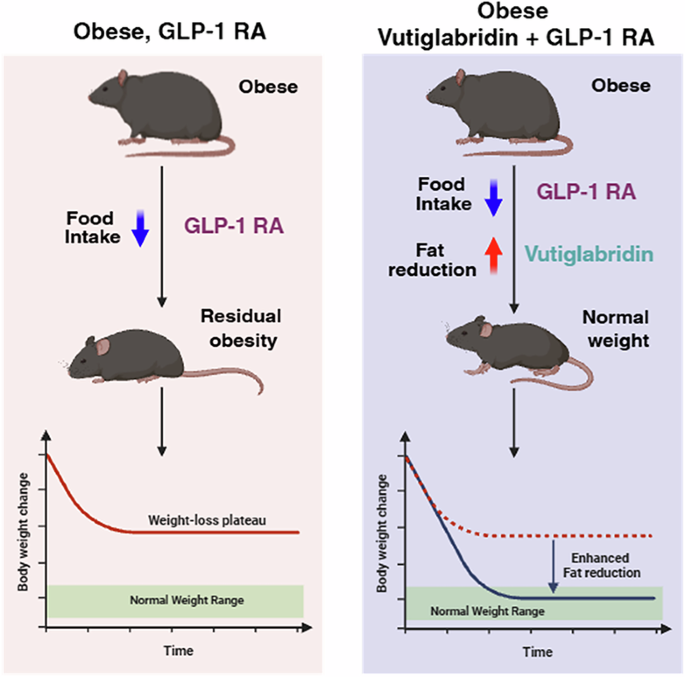
Although glucagon-like peptide-1 receptor agonists (GLP-1 RAs) are highly effective for body weight reduction, there remains a critical unmet need for complementary strategies that drive selective fat loss and sustain long-term weight reduction. This study aimed to investigate whether Vutiglabridin, a novel oral small-molecule anti-obesity drug, complements GLP-1 RAs to enhance therapeutic efficacy by selectively reducing fat mass and achieving normal body composition
Subjects/Methods
6-week-old mice were fed a high-fat diet (60 kcal% fat) for 11 weeks to generate mice with diet-induced obesity (DIO) and then treated with GLP-1 RAs (Semaglutide, Liraglutide, or Exenatide) either alone or in combination with Vutiglabridin for 3–4 weeks
Interventions/Methods
Body weight, food intake, fat mass, and lean mass were evaluated during treatment. For the drug discontinuation study, mice were administered Vutiglabridin, Semaglutide, or the combination for 4 weeks, after which treatment was withdrawn on Day 28 and body weight regain was monitored for 21 days
Results
In DIO mice treated with Semaglutide, weight loss attenuated, and body weight was maintained at a constant level after 2 weeks. In contrast, co-administration of Vutiglabridin overcame this attenuation of efficacy, enabling continuous weight reduction and achieving normal body composition. Vutiglabridin also resolved the diminishing weight-loss effect when combined with comparatively less potent appetite-suppressing GLP-1 RAs, including liraglutide and exenatide. In addition to normalizing body composition, Vutiglabridin mitigated the body weight and fat-mass regain that occurs following Semaglutide discontinuation.
Conclusions
These findings demonstrate that Vutiglabridin can normalize body composition in combination with multiple GLP-1 RAs, highlighting its potential as a novel therapeutic option for obesity treatment
Introduction
Obesity is a multifactorial disease with diverse causes. However, most anti-obesity medications primarily rely on appetite suppression as their mechanism of action. Glucagon-like peptide-1 receptor agonists (GLP-1 RAs), such as semaglutide, show robust weight loss efficacy in clinical practice. Tirzepatide, a dual glucose-dependent insulinotropic polypeptide (GIP) and GLP-1 receptor agonist, further expands the therapeutic potential of incretin-based approaches [1,2,3]. Their proven efficacy has driven the development of novel obesity pharmacotherapies targeting GLP-1 receptor activity [4,5,6]. However, even more potent GLP-1 RAs have limitations, including gastrointestinal adverse events and loss of lean mass [7].
Real-world evidence suggests that early-onset side effects are common; they account for <10% of therapy discontinuations within the first 3 months [8]. However, long-term adherence remains limited, with discontinuation rates increasing after 6 months, exceeding 70% of patients within the first year [9]. Notably, most patients discontinuing treatment after 6 months are those whose initial robust weight loss has transitioned into a maintenance phase, where further reduction is no longer achieved [2, 9]. Following discontinuation, a considerable proportion of these patients subsequently regain body weight and fat mass, often returning to their baseline levels within 1–2 years [10]. Furthermore, ~40% of patients who discontinued eventually reinitiate treatment [9]. This cycle of weight loss and regain can further exacerbate obesity. In this study, we define the ‘weight-loss plateau’ as the stage at which the efficacy of further body weight and fat reduction attenuates despite continued therapy [11, 12], and we emphasize the clinical need for novel approaches capable of complementing GLP-1 RAs to achieve normal body composition [10, 13].
Obesity arises from an imbalance between energy intake and energy expenditure, and the weight-loss plateau similarly reflects disruption in this balance [14, 15]. In particular, this is driven by three primary mechanisms: (i) appetite feedback gain, (ii) energy-expenditure (EE) adaptations and (iii) energy density of weight change. First, appetite feedback increases after weight loss, driven by coordinated neuroendocrine adaptations, receptor-level changes, and recalibration of the brain’s reward circuitry [16,17,18,19,20]. Second, reductions in lean mass and neuroendocrine signals lower metabolic rate and overall EE [20]. Lastly, the energy density of weight change is determined by the amount of energy expended through the fat reduction, which provides more energy (9 kcal/g) than glycogen or protein (4 kcal/g), a sustained fat loss is therefore required to sustain metabolic expenditure [21, 22]. When this contribution declines, metabolic rate stabilizes at a lower steady state [23]. Together, these mechanisms indicate that therapeutic approaches that suppress the appetite feedback prevent the decline in energy expenditure and ultimately sustain fat reduction may help to overcome the weight-loss plateau.
Vutiglabridin is a novel anti-obesity drug that promotes fat-selective weight loss, as shown in DIO mice [24]. The condition of obesity directs reduced PON2 activity and mechanistically, Vutiglabridin restores paraoxonase 2 (PON2) activity in the adipose tissue, activating AMPK-mediated lipophagy and lipid degradation. Additionally, this is accompanied by an increase in whole-body EE, suggesting that the fatty acids are preferentially utilized as metabolic fuel rather than stored ectopically or released to blood to induce hyperlipidemia conditions. However, compared with appetite-suppressing drugs, Vutiglabridin produces a slower onset and a smaller magnitude of weight loss [24, 25]. Furthermore, as it does not directly suppress appetite, its efficacy as monotherapy may be limited in obesity driven by hedonic overconsumption [26].
Nevertheless, Vutiglabridin’s fat-reducing mechanism complements GLP-1 RA-mediated appetite suppression, enhancing adiposity reduction and overcoming weight-loss plateaus. In this study, combination therapy with semaglutide, liraglutide, and exenatide normalized body composition and attenuated post-discontinuation weight regain. highlighting plateau resolution as key to achieving normal fat mass
Materials and methods
Test compounds and administration
Vutiglabridin and Vutiglabridin-d11 were prepared by Glaceum Inc. (Suwon, Republic of Korea) according to the protocol in patent US9783551B2. At the time of administration, the doses were calculated in mg/kg based on the daily animal body weight. Vutiglabridin doses of 30 and 50 mg/kg/day were selected based on previous studies demonstrating dose-dependent anti-obesity effects in DIO mice [24, 25]
Semaglutide (Novo Nordisk A/S, Denmark) dose was calculated in nmol/kg based on daily body weight and administrated subcutaneously using an insulin syringe at a final volume of 5 mL/kg. For dose justification, Semaglutide exhibited dose-dependent anti-obesity effects at doses ranging from 0.3 to 30 nmol/kg, and the maximum effective dose of 30 nmol/kg/day was selected from prior DIO mice studies [27]. In the study administering Semaglutide at 30 nmol/kg/day (n = 11 for Vehicle group; n = 10 for Semaglutide group), dose escalation was performed as follows: Day 0, 0.3 nmol/kg/day; Days 1–2, 1.0 nmol/kg/day; Days 3–5, 10.0 nmol/kg/day; Days 6–28, 30.0 nmol/kg/day. In the study administering Semaglutide at 3 nmol/kg/day (n = 8 per group)., dose escalation was performed as follows: Day 0, 0.3 nmol/kg/day; Day 1–8, 1.0 nmol/kg/day; Day 9–19, 1.5 nmol/kg/day; Day 20–21, 1.7 nmol/kg/day; Day 22–25, 2.0 nmol/kg/day; Day 26–28, 3.0 nmol/kg/day.
Exenatide (PT302) was provided by Peptron Inc. (Daejeon, Republic of Korea). was dosed similarly, administrated subcutaneously at 1 mg/kg/week using a 1 cc syringe with the final volume of 4 mL/kg. The 1 mg/kg/day dose was selected based on the previous study of exenatide in mice (n = 8 per group) [28]
Liraglutide (Saxenda, MP5E414, Novo Nordisk) was dosed similarly, administeredUSA, BD), with the final administrated volume of 5 mL/kg at weekly intervals. The 0.3 mg/kg/day was selected based on prior studies in DIO mice (n = 6 per group) [29]
Animal model
For the diet-induced obesity mouse efficacy study, male C57BL/6J mice (6 weeks old) were purchased from Jackson Laboratory (Bar Harbor, ME, USA). Mice were fed a high-fat diet (60% kcal fat; D12492, Research Diets) or a normal diet (10% kcal fat; PicoLab5053, LabDiet). At 17 weeks, mice were acclimatized for 1 week, then underwent 1 week of cage adaptation and 2 weeks of drug administration adaptation. Mice were housed at 22 ± 2 °C, 50 ± 10% humidity, 12-h light/dark cycle (dark: 7 PM–7 AM) in individually ventilated cages (IVC Rack, 13 × 34 × 14 cm, UREATAC, Korea). Groups were stratified by body weight and fat mass. At study end, mice fasted 14–16 h and were sacrificed under isoflurane anesthesia. The normal body weight reference used 6-week-old chow-fed mice over 4 weeks, which were age matched to the DIO mice (mean ± SD, Fig. S1). All procedures at Lee Gil Ya Cancer and Diabetes Institute (Gachon University) were approved by Institutional Animal Care and Use Committee (LCDI-2021-0010, -0042, -0108; LCDI-2023-0047). Animals were assigned to treatment groups in a manner intended to minimize baseline differences; formal randomization or blinding was not performed.
Body weight, organ/tissue weight and food intake assessment
Body weight (measured with an FX‑2000i precision balance, A&D, 0.01–2200 g) and food intake (measured with a CSG201F balance, OHAUS, 0.1–200 g) were recorded daily from the start of drug administration. Daily dietary intake (in g) was calculated as the difference between food supplied and food remaining for each animal. After 16 h of fasting, animals were anesthetized with inhalational gas, and organs and tissues were collected and weighed
Whole body fat mass and lean body mass measurements
Whole‑body fat and lean mass were measured on Day 0 (baseline), the last day of drug administration, and the last day of the discontinuation period. Mice were placed in an NMR analyzer (Mini‑spec, IF‑90II, Bruker Optics GmbH; Billerica, MA, USA) without anesthesia for 5 min per scan
Statistical analysis
Statistical analyzes were conducted using GraphPad Prism 9.5.1 (GraphPad Software Inc., San Diego, CA, USA). Data were analyzed by Ordinary one-way ANOVA followed by Tukey’s test as appropriate. The p value of <0.05 was considered statistically significant
Results
Semaglutide reached weight-loss plateau before achieving normal body weight
DIO mice received semaglutide at its maximal efficacious dose (30 nmol/kg) for 3 weeks using dose escalation: Day 0 (0.3 nmol/kg/day); Days 1–2 (1.0 nmol/kg/day); Days 3–5 (10.0 nmol/kg/day); Days 6–28 (30.0 nmol/kg/day) [27]. At the end of the treatment period, the semaglutide group exhibited a −22.1% mean reduction in body weight compared with the Vehicle group (Fig. 1A). Although semaglutide induced rapid initial body weight loss post-treatment initiation, but efficacy progressively declined, stabilizing despite mice remaining in obesity condition. Body weight changes, analyzed in 3-day intervals throughout treatment, defined plateau as ~0 g change over 3 days while exceeding normal mouse body weight. (Figs. 1B and S1). Using this criterion, semaglutide reached weight-loss plateau by Day 12 despite maximal dosing, precluding further reduction. As semaglutide primarily acts via appetite suppression, food intake was monitored throughout. Cumulative intake was 33.9% lower versus vehicle control. (Fig. 1C). Daily intake analysis further showed that semaglutide markedly decreased food consumption during the early phase of treatment, followed by a partial recovery after approximately 10 days (Fig. 1D). Taken together, semaglutide produces rapid weight loss accompanied by strong early-phase reductions in food intake. However, its appetite-suppressing effects gradually wane, leading to a weight-loss plateau despite the mice remaining obese.
Anti-obesity effect of semaglutide (30 nmol/kg) treatment in mice with diet-induced obesity (DIO). Mice were fed a high-fat diet for 11 weeks to induce obesity, followed by 21 days of semaglutide treatment (n = 11 for Vehicle group; n = 10 for semaglutide group). A Daily body weight change; B Average weight change (Δg) calculated over 3-day intervals throughout treatment; C Cumulative food intake; D Daily food intake change. Each data point represents mean ± SEM. P-value was calculated using Student’s t-test for comparisons between Vehicle group and Semaglutide group: *P < 0.05, **P < 0.01 and ***P < 0.
Vutiglabridin mitigates the weight-loss plateau under calorie-restriction conditions
To evaluate its anti-obesity efficacy, DIO mice were treated for 3 weeks with 50 mg/kg Vutiglabridin, a dose effective in a previous study [24]. At treatment end, the Vutiglabridin group showed −18.7% mean body weight reduction versus Vehicle (Fig. 2A). Although significant weight loss occurred by study end, minimal change was seen in the first 6 days, distinct from semaglutide’s rapid onset (Figs. 1A and 2A). Three-day weight change intervals revealed steady, continuous reduction from Day 7 without plateau (Fig. 2B). Body composition analysis showed Vutiglabridin selectively reduced fat mass by 36.4% relative to Vehicle, with unchanged lean mass (Fig. 2C, D). This pattern aligned with food intake, showing no significant differences from Vehicle throughout (Fig. S2A, B).
Anti-obesity effect of Vutiglabridin (50 mg/kg) treatment in mice with diet induced obesity (DIO). Mice were fed a high-fat diet for 11 weeks to induce obesity, followed by 21 days of Vutiglabridin treatment (n = 11 for vehicle and Vutiglabridin group). A Daily body weight change; B Average weight change (Δg) calculated over 3-day intervals throughout treatment; C Fat mass change; D Lean mass change. Anti-obesity effect of food restriction and food restriction combined with Vutiglabridin (50 mg/kg) in DIO mice. Mice were fed a high-fat diet for 11 weeks to induce obesity, followed by 21 days of food restriction and Vutiglabridin treatment (n = 6 for food restriction and food restriction combined with Vutiglabridin group). In the food-restriction group, mice were provided only 1.7 g of food daily (compared with the average 3 g daily intake in DIO mice). E Daily body weight change; F Average weight change (Δg) calculated over 3-day intervals throughout treatment. Each data point represents mean ± SEM. P-value was calculated using Student’s t-test comparing Vutiglabridin, food restriction, and food restriction combined with Vutiglabridin to the vehicle group: *P < 0.05, **P < 0.01 and ***P < 0.001.
To assess plateau under forced calorie restriction, unlike Semaglutide’s appetite suppression in DIO mice received 1.7 g food/day (~60% of 3.0 g average intake) for 3 weeks (Fig. 2E). Daily and 3-day interval analyzes indicated rapid initial weight loss, then diminishing efficacy; by Day 18, no further change occurred, confirming plateau (Fig. 2E, F). In contrast, 50 mg/kg Vutiglabridin with food restriction yielded continuous loss without plateau. The combination group achieved 7.2% additional body weight reduction versus restriction alone (Fig. 2E, F). Overall, Vutiglabridin overcomes food restriction-induced plateau, enabling sustained weight reduction under calorie-restricted conditions.
Vutiglabridin overcomes the semaglutide-associated weight-loss plateau
Vutiglabridin overcomes the semaglutide-associated weight-loss plateau. DIO mice received semaglutide alone (30 nmol/kg) or combined with Vutiglabridin (50 mg/kg). Initial 4-day body-weight changes were comparable. From Day 5, trends diverged and the combination group showed synergy, reaching normal body-weight range by Day 9 (Fig. 3A). Three-day interval analysis confirmed semaglutide monotherapy plateaued after ~2 weeks, while combination avoided plateau (Fig. 3B). In addition to reaching a normal body-weight range without a plateau, Body composition analysis revealed that the combination treatment markedly reduced fat mass than either vehicle or semaglutide monotherapy, while lean mass remained unchanged in all groups (Fig. 3C, D). Further analysis of regional fat depots, including epididymal and retroperitoneal fat, showed significantly reduced fat weights in the combination group (Fig. 3E, F). In addition, liver weight decreased, consistent with our previous findings (Fig. 3G) [30]. Semaglutide alone markedly suppressed daily food intake post-initiation, with significantly reduced cumulative intake over 3 weeks versus Vehicle. Despite greater body weight and fat mass reductions than semaglutide monotherapy, combination showed no reductions in daily or cumulative intake (Fig. 3H, I). Post-Day 9 normal-weight attainment, combination trended toward higher intake than semaglutide. Collectively, Vutiglabridin overcomes semaglutide-induced plateau, enabling additional fat-selective weight reduction without further food intake suppression.
Anti-obesity effect of semaglutide (30 nmol/kg) and the combination of Vutiglabridin (50 mg/kg) and semaglutide (30 nmol/kg) in mice with diet-induced obesity (DIO). Mice were fed a high-fat diet for 11 weeks to induce obesity, followed by 21 days of semaglutide alone or semaglutide combined with Vutiglabridin treatment (n = 11 for vehicle group; n = 10 for semaglutide and combination group). A Daily body weight; B Average weight change (g) calculated over 3-day intervals throughout treatment; C Fat mass change; D Lean mass change; E Epididymal fat weight (mg); F Retroperitoneal fat weight (mg); G Liver weight (mg); H Cumulative food intake; I Daily food intake change. Each data point represents mean ± SEM. P-value was assessed by one-way ANOVA with Tukey’s multiple comparison test: *P < 0.05, **P < 0.01, ***P < 0.001 and ****P < 0.0001.
Vutiglabridin overcomes the weight-loss plateau of low-potency GLP-1RAs
Vutiglabridin overcomes the weight-loss plateau of low-potency GLP-1RAs. DIO mice were treated with liraglutide (0.30 mg/kg) alone or combined with Vutiglabridin (50 mg/kg) for 3 weeks. Liraglutide monotherapy reduced body weight by 18.6% versus Vehicle; combination achieved 38.0% reduction (Fig. 4A). Three-day intervals showed liraglutide plateaued by Day 4, while combination continued loss to normal range by Day 9, with minimal further loss thereafter (Fig. 4B). Analysis of regional adipose depots, including epididymal and retroperitoneal fat, revealed significantly reduced fat mass in the combination group, consistent with previous findings (Fig. 4C, D). Liver weight was also decreased, in line with prior results (Fig. 4E). Liraglutide alone reduced cumulative intake 23.8% versus Vehicle; combination enhanced to 40.8% (Fig. 4F). Daily intake suppression by liraglutide waned after Day 6, but combination sustained it as approximately 10 days until normal weight, then normalized to Vehicle levels (Fig. 4G).
Anti-obesity effect of liraglutide (0.3 mg/kg) and the combination of Vutiglabridin (50 mg/kg) and liraglutide (0.3 mg/kg) in mice with diet-induced obesity (DIO). Mice were fed a high-fat diet for 11 weeks to induce obesity, followed by 21 days of liraglutide alone or liraglutide combined with Vutiglabridin treatment (n = 6 per group). A Daily body weight change; B Average weight change (g) calculated over 3-day intervals throughout treatment; C Epididymal fat weight (mg); D Retroperitoneal fat weight (mg); E Liver weight (mg); F Cumulative food intake; G Daily food intake change. Each data point represents mean ± SEM. P-value was assessed by one-way ANOVA with Tukey’s multiple comparison test: *P < 0.05, **P < 0.01, ***P < 0.001 and ****P < 0.0001.
Vutiglabridin-mediated mitigation of the weight-loss plateau and its synergistic effects on body-weight reduction were also observed when combined with exenatide. Exenatide was administered using PT302, a long-acting formulation designed for once-weekly injection [28]. Notably, similar synergy occurred with exenatide (PT302 long-acting, 1 mg/kg weekly) plus Vutiglabridin (30 mg/kg) over 4 weeks. Exenatide alone yielded 12.5% weight reduction; combination reached 32.1%, normalizing by Week 3 (Fig. 5A). Exenatide showed minimal change; combination had negligible early change then continuous loss to Day 21 without plateau, slowing post-normalization (Fig. 5B). Fat mass dropped selectively while lean mass remained unchanged (Fig. 5C, D). A similar effect on the regional fat depots and liver weights also observed (Fig. 5E–G). Food-intake analyzes further supported these effects. Cumulative food intake decreased by 6.0% in the exenatide group relative to the vehicle group, whereas the combination group induced a greater food intake reduction of 16.9% (Fig. 5H). Combination sustained significant daily food intake reductions versus both groups (Fig. 5I).
Anti-obesity effect of exenatide (4 mg/kg) and the combination of Vutiglabridin (30 mg/kg) and exenatide (4 mg/kg) in mice with diet-induced obesity (DIO). Mice were fed a high-fat diet for 11 weeks to induce obesity, followed by 21 days of exenatide alone or Exenatide combined with Vutiglabridin treatment (n = 8 per group). A Daily body weight change; B Average weight change (Δg) calculated over 3-day intervals throughout treatment; C Fat mass change; D Lean mass change; E Epididymal fat weight (mg); F Retroperitoneal fat weight (mg); G Liver weight (mg); H Cumulative food intake; I Daily food intake change. Each data point represents mean ± SEM. P-value was assessed by one-way ANOVA with Tukey’s multiple comparison test: *P < 0.05, **P < 0.01 and ***P < 0.001.
Low-dose semaglutide (3 nmol/kg final, escalated as previous) alone gave 9.9% reduction after 4 weeks; combination with Vutiglabridin (30 mg/kg) achieved 27.1%, normalizing by Week 3 (Fig. 6A). Semaglutide monotherapy stayed near baseline while combination minimal early and then continuous loss Day 7–28 without plateau (Fig. 6B). Consistent with findings from the Exenatide combination, body-composition analysis demonstrated Fat mass reduced 62.6% and lean mass preserved (Fig. 6C, D). Food-intake analysis further revealed that semaglutide 3 nmol/kg decreased cumulative food intake by only 9.2% relative to Vehicle. In contrast, the combination group showed a 21.7% reduction (Fig. 6E). Daily intake patterns indicated that semaglutide 30 nmol/kg group resulted in little or no sustained appetite suppression throughout the 4-week period, whereas the combination group exhibited significantly reduced food intake across the same duration (Fig. 6F). Taken together, these results demonstrate that Vutiglabridin overcomes the weight-loss plateau not only of semaglutide but also of other low-potency GLP-1 RAs, including liraglutide and exenatide. Moreover, even at a lower dose (30 mg/kg), Vutiglabridin synergizes with multiple GLP-1 RAs to enhance fat-selective weight reduction and achieve the normal body-weight range.
Anti-obesity effect of semaglutide (3 nmol/kg) and the combination of Vutiglabridin (30 mg/kg) and semaglutide (3 nmol/kg) in mice with diet induced obesity (DIO). Mice were fed a high-fat diet for 11 weeks to induce obesity, followed by 21 days of semaglutide alone or semaglutide combined with Vutiglabridin treatment (n = 8 per group). A Daily body weight change; B Average weight change (g) calculated over 3-day intervals throughout treatment; C Fat mass change; D Lean mass change; E Cumulative food intake; F Daily food intake change. Each data point represents mean ± SEM. P-value was assessed by one-way ANOVA with Tukey’s multiple comparison test: *P < 0.05, **P < 0.01 and ***P < 0.001.
Vutiglabridin attenuates body weight regain after semaglutide discontinuation
Another limitation of GLP-1 RAs, including semaglutide, is the occurrence of body weight regain after drug discontinuation[10]. In this study, We examined 9-day body-weight changes post-discontinuation of semaglutide (after 4-week dose escalation: 0.3–3.0 nmol/kg/day) or Vutiglabridin (30 mg/kg) in DIO mice. Semaglutide triggered marked regain (39.9 g to 43.6 g), while Vutiglabridin showed minimal gain (38.6 g to 39.2 g) (Fig. 7A). Daily food-intake analysis revealed a substantial rise in consumption in the semaglutide group during the discontinuation phase, whereas food intake in the Vutiglabridin group remained comparable to Vehicle levels (Fig. 7B). To further assessment, Vutiglabridin (30 mg/kg) and semaglutide (3 nmol/kg) were administered for 4 weeks before monitoring discontinuation responses for 21 days. When both drugs were discontinued, body weight increased sharply from 32.2 g at treatment end to 39.5 g by Day 21. However, when only semaglutide was discontinued while Vutiglabridin treatment was maintained, body weight initially increased but gradually declined after Day 8, resulting in a modest net increase from 32.2 g to 34.9 g (Fig. 7C, D). Daily food-intake patterns supported these findings: mice in the dual-discontinuation group exhibited a rapid and sustained increase in food intake throughout the 21-day period. Similarly, mice in the semaglutide-discontinuation/Vutiglabridin-continuation group also showed an acute elevation in food intake immediately after semaglutide discontinuation, followed by persistently elevated levels (Fig. 7E). Despite increased food intake post-semaglutide discontinuation, continued Vutiglabridin attenuated fat accumulation, unlike dual discontinuation, which fully rebounded fat mass to baseline by Day 21. Lean mass remained unchanged across all groups. (Fig. 7F, G). Overall, these results suggest that Vutiglabridin mitigates body weight regain following semaglutide discontinuation by suppressing fat accumulation.
Body weight changes following discontinuation of Vutiglabridin (30 mg/kg) and semaglutide (3 nmol/kg) in mice with diet-induced obesity (DIO). Mice were fed a high-fat diet for 11 weeks to induce obesity, followed by 28 days of Vutiglabridin or semaglutide treatment. Body-weight regain was assessed for 9 days beginning on Day 28. A Daily body weight change; B Daily food intake change. Body-weight changes following discontinuation of semaglutide (3 nmol/kg) alone or the combination of Vutiglabridin (30 mg/kg) and semaglutide (3 nmol/kg) in mice with diet induced obesity (DIO). Mice were fed a high-fat diet for 11 weeks to induce obesity, followed by 28 days of semaglutide or combined Vutiglabridin and semaglutide treatment. Body weight regain was assessed for 21 days beginning on Day 28. C Experimental design; D Daily body weight change; E Daily food-intake change; F Fat mass change; G Lean mass change. Each data point represents mean ± SEM. Groups with different letters statistically differ (for the discontinuation period compared to treatment period: *p < 0.05, **p < 0.01; for the treatment period compared to baseline: #p < 0.05, ##p < 0.01). P-value was assessed by one-way ANOVA with Tukey’s multiple comparison test.
Discussion
Appetite suppression via GLP-1 RAs remains the most effective and widely employed pharmacological strategy for obesity. Semaglutide, in particular, has demonstrated robust and clinically meaningful weight-loss efficacy across human trials by suppressing appetite through central mechanisms in the hypothalamus and brainstem [2, 18, 31,32,33]. Following semaglutide, numerous anti-obesity drugs have been developed to improve the pharmacological properties of GLP-1 RAs, such as prolonging appetite suppression, increasing potency, or mitigating adverse effects, including gastrointestinal symptoms and lean mass loss [34, 35]. In this context, our study provides the first in vivo evidence that overcoming the GLP-1 RA-associated weight-loss plateau may represent a new strategy for more complete obesity resolution. In DIO mice, Vutiglabridin co-administration eliminated GLP-1 RA weight-loss plateaus, synergistically enhancing anti-obesity efficacy and enabling normal body composition beyond appetite suppression limits alone.
In addition to GLP-1, other hormone targets are being explored to enhance appetite suppression, including amylin analogs such as cagrilintide and melanocortin-4 receptor agonists [35, 36]. Simultaneously, therapies designed to increase EE are under development, featuring glucagon receptor agonists and multi-receptor agonists that target GIP and glucagon receptors [5, 37]. Among these diverse hormone-based therapies, tirzepatide, a dual GLP-1 and GIP receptor agonist with activity biased towards GIP, has demonstrated superior weight-loss efficacy across multiple clinical trials [38]. Oral GLP-1 RAs have been introduced to improve convenience, although their weight-loss efficacy is generally lower and gastrointestinal adverse effects tend to be more pronounced than with injectable formulations [39, 40]. Despite their diversity and potential synergy with GLP-1 RAs, these therapies commonly encounter weight-loss plateaus that limit further reduction before normal body composition is achieved [3, 38, 41].
Another approach to obesity treatment involves increasing energy expenditure to modulate the underlying energy imbalance [14, 15]. β3-adrenergic agonists enhance thermogenesis by activating Uncoupling Protein 1 (UCP1) in brown adipose tissue, which stimulates PKA-mediated lipolysis and increases energy expenditure [42]. Thyroid hormone receptor agonists mimic endogenous T3 signaling, promoting mitochondrial biogenesis across multiple tissues and raising basal metabolic rate to increase systemic energy consumption [43]. Additional strategies include promoting muscle growth through myostatin and activin blockade [34] as well as enhancing adipocyte lipolysis to induce fat reduction with drugs such as Vutiglabridin [24]. Although these therapies offer distinct mechanisms, their clinical translation remains limited by safety concerns, poor translatability, and inadequate weight-loss efficacy as monotherapies.
Although GLP-1 RAs are highly effective for weight loss, their efficacy often plateaus during continued treatment, with no further loss and sometimes weight regain [2]. This plateau likely reflects metabolic adaptation to sustained appetite suppression. Vutiglabridin, through its direct fat-reducing mechanism, helps overcome this limitation and supports sustained weight loss until normal body weight is reached
In this study, we evaluated Vutiglabridin’s synergy with GLP-1 RAs in DIO mice. GLP-1 RAs induce initial rapid weight loss via appetite suppression but plateau after sustained administration. Vutiglabridin overcomes this plateau across GLP-1 RAs, including liraglutide and exenatide, which plateau earlier despite higher doses, and enabling normal body composition. Pair feeding experiments indicate Vutiglabridin exerts an additional effect beyond food intake suppression, consistent with its distinct metabolic action on fat mass. The fat-selective mechanism driven by PON2 activation, AMPK signaling and lipophagy in adipose tissue complements GLP-1 RAs, representing a novel strategy for complete obesity resolution [24].
In prior work, Vutiglabridin increased energy expenditure in DIO mice, while adipose AMPK/PON2 signaling enhanced lipophagy and reduced adipogenesis [24]. Importantly, the previous results also showed increased VO2 and VCO2, indicating that the fatty acid released by Vutiglabridin driven fat loss are likely utilized as metabolic fuel [24]
The present study also suggests that the complementary action between Vutiglabridin and GLP-1RAs depends on the potency and dose of the GLP-1RA used. At higher, maximally efficacious semaglutide doses, food intake suppression appears to approach a physiological lower limit of approximately 1 g/day, beyond which additional anorectic effect is minimal [27]. Under these conditions, Vutiglabridin mainly contributed to further fat-mass reduction rather than additional food intake suppression. In contrast, with lower-dose semaglutide or lower-potency GLP-1RAs such as liraglutide and exenatide, Vutiglabridin further reduced food intake beyond the effect of GLP-1RA alone, consistent with an obesity-dependent secondary metabolic effect. This effect is not interpreted as direct central satiety center action, but rather as a secondary response to sustained fat reduction, potentially involving improved leptin sensitivity in the setting of leptin resistance [24].
Another limitation of GLP-1 RAs is that discontinuation commonly leads to substantial body weight regain, and many patients who regain weight subsequently restart GLP-1 RA therapy, resulting in a recurrent cycle of body weight loss and gain [10]. In our DIO mouse study, semaglutide discontinuation caused rapid increases in food intake and marked weight regain. In contrast, continued Vutiglabridin attenuated post-withdrawal rebound and suppressed the associated fat regain, consistent with its fat-reducing mechanism and obesity-dependent metabolic effects (Fig. 7A, B). A similar pattern was observed in the combination-treatment study. When both drugs were discontinued, food intake increased, leading to rapid weight regain. However, continued administration of Vutiglabridin after semaglutide withdrawal attenuated body weight regain and suppressed rebound-associated fat accumulation (Fig. 7D, E), possibly in line with the previously observed lower plasma leptin levels [24]. Collectively, these findings suggest that Vutiglabridin may provide a useful adjunct for sustaining weight-loss efficacy after GLP-1RA discontinuation.
Excessive weight loss beyond normal BMI risks adverse effects like impaired immunity, hormonal dysregulation, and reduced bone density are key considerations when overcoming plateaus for sustained reduction [44]. To assess safety of sustained weight reduction with Vutiglabridin with Semaglutide combination, we conducted an 8-week study in normal rats using more than 3 times efficacious mouse doses, monitoring body weight, food intake, and safety parameters. Semaglutide monotherapy reduced food intake and body weight gain vs. controls; the combination showed no further reductions in either (Fig. S3A, B). Moreover, necropsy performed in Week 8 revealed no toxicological findings attributable to the combination treatment. Vutiglabridin selectively enhances lipid metabolism in dysfunctional adipocytes of animals with obesity but minimally impacts body weight in the lean physiological range (Fig. S3). Similar patterns occurred with semaglutide/liraglutide combinations, where weight loss continued in mice but plateaued at normal body weight (Figs. 3A and 4A). In addition, stable lean mass was observed with both GLP-1 RA monotherapy and combination, with greater fat-mass loss in combination. Together, these findings indicate that the combination of Vutiglabridin with GLP-1 RAs promotes sustained and safe weight reduction until the normal body-weight range is reached, without inducing excessive or undesirable weight loss beyond physiological limits focusing mainly on fat mass reduction.
The current study has several limitations. First, we did not directly measure EE or substrate utilization in the combination regimen. Although prior work showed that Vutiglabridin increases whole-body EE, the contribution of this effect in the present combination study remains to be formally tested by indirect calorimetry. Second, although our data indicate that Vutiglabridin and GLP-1 RAs act through complementary mechanisms, the detailed molecular crosstalk between these pathways has not yet been fully elucidated. Future studies will be needed to define how Vutiglabridin influences adipose remodeling, appetite regulation, and metabolic adaptation in combination with GLP 1RAs.
In conclusion, Vutiglabridin overcomes GLP-1 RA weight-loss plateaus in DIO mice and supports normalization of body composition. Its benefits appear to arise primarily from selective fat reduction, with additional obesity dependent effects on food intake at submaximal GLP 1RA doses and attenuation of rebound weight gain after GLP 1RA withdrawal. Together, these findings support Vutiglabridin as a promising adjunct for sustained obesity treatment
Data availability
Additional supporting data the findings of the study are available from the lead contact, Sang-Ku Yoo (skyoo@glaceum.com), upon reasonable request
References
Müller TD, Blüher M, Tschöp MH, DiMarchi RD. Anti-obesity drug discovery: advances and challenges. Nat Rev Drug Discov. 2022;21:201–23
Wilding JPH, Batterham RL, Calanna S, Davies M, Van Gaal LF, Lingvay I, et al. Once-weekly semaglutide in adults with overweight or obesity. N Engl J Med. 2021;384:989–1002
CAS
PubMed
Google ScholarJastreboff AM, Aronne LJ, Ahmad NN, Wharton S, Connery L, Alves B, et al. Tirzepatide once weekly for the treatment of obesity. N Engl J Med. 2022;387:205–16
CAS
PubMed
Google ScholarZheng Z, Zong Y, Ma Y, Tian Y, Pang Y, Zhang C, et al. Glucagon-like peptide-1 receptor: mechanisms and advances in therapy. Signal Transd Target Ther. 2024;9:234
Jastreboff AM, Kaplan LM, Frías JP, Wu Q, Du Y, Gurbuz S, et al. Triple–hormone-receptor agonist retatrutide for obesity — a phase 2 trial. N Engl J Med. 2023;389:514–26
CAS
PubMed
Google ScholarJastreboff AM, Ryan DH, Bays HE, Ebeling PR, Mackowski MG, Philipose N, et al. Once-monthly maridebart cafraglutide for the treatment of obesity – a phase 2 trial. N Engl J Med. 2025;393:843–57
CAS
PubMed
Google ScholarPillarisetti L, Agrawal DK. Semaglutide: double-edged sword with risks and benefits. Arch Intern Med Res. 2025;8:1–13
Aronne LJ, Horn DB, le Roux CW, Ho W, Falcon BL, Gomez Valderas E, et al. Tirzepatide as compared with semaglutide for the treatment of obesity. N Engl J Med. 2025;393:26–36
CAS
PubMed
Google ScholarRodriguez PJ, Zhang V, Gratzl S, Do D, Goodwin Cartwright B, Baker C, et al. Discontinuation and reinitiation of dual-labeled GLP-1 receptor agonists among US adults with overweight or obesity. JAMA Netw Open. 2025;8:e2457349
Wilding JPH, Batterham RL, Davies M, Van Gaal LF, Kandler K, Konakli K, et al. Weight regain and cardiometabolic effects after withdrawal of semaglutide: The STEP 1 trial extension. Diab Obes Metab. 2022;24:1553–64
CAS
Google ScholarStrohacker K, Carpenter K, McFarlin B. Consequences of weight cycling: an increase in disease risk? Int J Exerc Sci. 2009;2:191–201
Simonds SE, Pryor JT, Cowley MA. Repeated weight cycling in obese mice causes increased appetite and glucose intolerance. Physiol Behav. 2018;194:184–90
CAS
PubMed
Google ScholarAronne LJ, Sattar N, Horn DB, Bays HE, Wharton S, Lin WY, et al. Continued treatment with tirzepatide for maintenance of weight reduction in adults with obesity: the SURMOUNT-4 randomized clinical trial. JAMA. 2024;331:38–48
Spiegelman BM, Flier JS. Obesity and the regulation of energy balance. Cell. 2001;104:531–43
CAS
PubMed
Google ScholarHill JO, Wyatt HR, Peters JC. Energy balance and obesity. Circulation. 2012;126:126–32
Ronveaux CC, Tomé D, Raybould HE. Glucagon-like peptide 1 interacts with ghrelin and leptin to regulate glucose metabolism and food intake through vagal afferent neuron signaling. J Nutr. 2015;145:672–80
Marzook A, Tomas A, Jones B. The interplay of glucagon-like peptide-1 receptor trafficking and signalling in pancreatic beta cells. Front Endocrinol. 2021;12:678055
Zhu Z, Gong R, Rodriguez V, Quach KT, Chen X, Sternson SM. Hedonic eating is controlled by dopamine neurons that oppose GLP-1R satiety. Science. 2025;387:eadt0773
Farr OM, Upadhyay J, Rutagengwa C, DiPrisco B, Ranta Z, Adra A, et al. Longer-term liraglutide administration at the highest dose approved for obesity increases reward-related orbitofrontal cortex activation in response to food cues: Implications for plateauing weight loss in response to anti-obesity therapies. Diab, Obes Metab. 2019;21:2459–64
CAS
Google ScholarHall KD. Physiology of the weight-loss plateau in response to diet restriction, GLP-1 receptor agonism, and bariatric surgery. Obesity. 2024;32:1163–8
Dragoo JL, Shapiro SA, Bradsell H, Frank RM. The essential roles of human adipose tissue: Metabolic, thermoregulatory, cellular, and paracrine effects. J Cartil Jt Preserv. 2021;1:100023
Chouchani ET, Kajimura S. Metabolic adaptation and maladaptation in adipose tissue. Nat Metab. 2019;1:189–200
Martin A, Fox D, Murphy CA, Hofmann H, Koehler K. Tissue losses and metabolic adaptations both contribute to the reduction in resting metabolic rate following weight loss. Int J Obes. 2022;46:1168–75
CAS
Google ScholarLee HM, Lee JH, Kim SH, Marakkalage KG, Hur J, Park HS, et al. Vutiglabridin ameliorates obesity by directly reducing fat mass through AMPK/lipophagy activation in adipocytes. Biomed Pharmacother. 2025;193:118759
CAS
PubMed
Google ScholarNa JY, Yoon DY, Yoo H, Lee S, Yu KS, Jang IJ, et al. Safety, tolerability, pharmacokinetic, and pharmacodynamic characteristics of vutiglabridin: a first-in-class, first-in-human study. Clin Transl Sci. 2022;15:2744–57
Moschonis G, Trakman GL. Overweight and obesity: the interplay of eating habits and physical activity. Nutrients. 2023;15:2896
Gabery S, Salinas CG, Paulsen SJ, Ahnfelt-Rønne J, Alanentalo T, Baquero AF. Semaglutide lowers body weight in rodents
Bader M, Li Y, Lecca D, Rubovitch V, Tweedie D, Glotfelty E, et al. Pharmacokinetics and efficacy of PT302, a sustained-release Exenatide formulation, in a murine model of mild traumatic brain injury. Neurobiol Dis. 2019;124:439–53
CAS
PubMed
Google ScholarKim JH, Lee GY, Maeng HJ, Kim H, Bae JH, Kim KM, et al. Effects of glucagon-like peptide-1 analogue and fibroblast growth factor 21 combination on the atherosclerosis-related process in a type 2 diabetes mouse model. Endocrinol Metab. 2021;36:157–70
CAS
Google ScholarShin GC, Lee HM, Kim N, Hur J, Yoo SK, Park YS, et al. Paraoxonase-2 agonist vutiglabridin promotes autophagy activation and mitochondrial function to alle717–42
CAS
PubMed
Google ScholarRyan DH, Lingvay I, Deanfield J, Kahn SE, Barros E, Burguera B, et al. Long-term weight loss effects of semaglutide in obesity without diabetes in the SELECT trial. Nat Med. 2024;30:2049–57
Kadowaki T, Isendahl J, Khalid U, Lee SY, Nishida T, Ogawa W, et al. Semaglutide once a week in adults with overweight or obesity, with or without type 2 diabetes in an East Asian population (STEP 6): a randomised, double-blind, double-dummy, placebo-controlled, phase 3a trial. Lancet Diab Endocrinol. 2022;10:193–206
CAS
Google ScholarRubino D, Abrahamsson N, Davies M, Hesse D, Greenway FL, Jensen C, et al. Effect of continued weekly subcutaneous semaglutide vs placebo on weight loss maintenance in adults with overweight or obesity: the STEP 4 randomized clinical trial. JAMA. 2021;325:1414–25
Nunn E, Jaiswal N, Gavin M, Uehara K, Stefkovich M, Drareni K, et al. Antibody blockade of activin type II receptors preserves skeletal muscle mass and enhances fat loss during GLP-1 receptor agonism. Mol Metab. 2024;80:101880
Carvas AO, Leuthardt A, Kulka P, Lommi G, Hassan S, Coester B, et al. Cagrilintide lowers bodyweight through brain amylin receptors 1 and 3. eBioMedicine. 2025;118:105836
Nargund RP, Strack AM, Fong TM. Melanocortin-4 receptor (MC4R) agonists for the treatment of obesity. J Med Chem. 2006;49:4035–43
CAS
PubMed
Google ScholarKim T, Pearson MJ, Hong H, Nason S, Seck K, Antipenko J, et al. Bile acid binding resins improve glucagon receptor agonist-mediated weight loss in diet-induced obese mice. Obesity. 2025;34:428–438
Tan B, Pan XH, Chew HSJ, Goh RSJ, Lin C, Anand VV, et al. Efficacy and safety of tirzepatide for treatment of overweight or obesity. A systematic review and meta-analysis. Int J Obes. 2023;47:677–85
CAS
Google ScholarWharton S, Aronne LJ, Stefanski A, Alfaris NF, Ciudin A, Yokote K, et al. Orforglipron, an oral small-molecule GLP-1 receptor agonist for obesity treatment. N Engl J Med. 2025;393:1796–806
CAS
PubMed
Google ScholarWharton, Lingvay S, Bogdanski I, Vale P, RDd, Jacob S, et al. Oral semaglutide at a dose of 25 mg in adults with overweight or obesity. N Engl J Med. 2025;393:1077–87
CAS
PubMed
Google ScholarLau DCW, Erichsen L, Francisco AM, Satylganova A, le Roux CW, McGowan B, et al. Once-weekly cagrilintide for weight management in people with overweight and obesity: a multicentre, randomised, double-blind, placebo-controlled and active-controlled, dose-finding phase 2 trial. Lancet. 2021;398:2160–72
CAS
PubMed
Google ScholarCero C, Lea HJ, Zhu KY, Shamsi F, Tseng Y-H, Cypess AM. β3-adrenergic receptors regulate human brown/beige adipocyte lipolysis and thermogenesis. JCI Insight. 2021;6:e139160
Sinha RA, Singh BK, Zhou J, Wu Y, Farah BL, Ohba K, et al. Thyroid hormone induction of mitochondrial activity is coupled to mitophagy
Roh L, Braun J, Chiolero A, Bopp M, Rohrmann S, Faeh D. Mortality risk associated with underweight: a census-linked cohort of 31,578 individuals with up to 32 years of follow-up. BMC Public Health. 2014;14:371
Acknowledgements
This study was supported by the Glaceum Inc. The authors gratefully acknowledge Peptron Inc. (Daejeon, Korea) for providing PT302 (Exenatide) used in this study, and the Korea Mouse Metabolic Phenotyping Center at the Lee Gil Ya Cancer and Diabetes Institute, Gachon University College of Medicine (Incheon, Korea) and NDIC Co., Ltd. for conducting the animal experiments
Funding
This research received no specific grant from any funding agency in the public, commercial, or not-for-profit sectors
Author information
Authors and Affiliations
Glaceum Inc., Suwon, Republic of Korea
Hyeong Min Lee, Kamindu Gayashan Marakkalage, Sang Hyo Kim, Soonje Lee, Jae Ho Lee, Hyung Soon Park & Sang-Ku Yoo
Authors
- Hyeong Min LeeView author publications
Search author on:PubMed Google Scholar
- Kamindu Gayashan MarakkalageView author publications
Search author on:PubMed Google Scholar
- Sang Hyo KimView author publications
Search author on:PubMed Google Scholar
- Soonje LeeView author publications
Search author on:PubMed Google Scholar
- Jae Ho LeeView author publications
Search author on:PubMed Google Scholar
- Hyung Soon ParkView author publications
Search author on:PubMed Google Scholar
- Sang-Ku YooView author publications
Search author on:PubMed Google Scholar
Contributions
Hyeong Min Lee: Conceptualisation, Methodology, Formal analysis, Writing–Original Draft, Writing–Review & Editing. Kamindu Gayashan Marakkalage, Sang Hyo Kim, Soonje Lee, Jae Ho Lee: Methodology, Data Curation, Validation, Software, Writing–Review & Editing. Hyung Soon Park: Writing—Review & Editing. Sang-Ku Yoo: Supervision, Conceptualisation, Writing–Review & Editing
Ethics declarations
Competing interests
The authors declare the following financial interests/personal relationships which may be considered as potential competing interests: Sang-Ku Yoo has patent Pyranochromenyl phenol derivative, and pharmaceutical composition for treating metabolic syndrome or inflammatory disease issued to US9783551B2. HML, KGM, SHK, SL, JHL, HSP and S-KY are current employees of Glaceum Inc. and hold Glaceum’s stocks/shares. Glaceum Inc. holds the intellectual property rights of Vutiglabridin
Ethics approval
All procedures involving animals at Lee Gil Ya Cancer and Diabetes Institute (Gachon University) were approved by the Institutional Animal Care and Use Committee (Approval No. LCDI-2021-0010, LCDI-2021-0042, LCDI-2021-0108; LCDI-2023-0047). The studies were conducted in accordance with local legislation and institutional requirements
Additional information
Publisher’s note Springer Nature remains neutral with regard to jurisdictional claims in published maps and institutional affiliations
Supplementary information
Revised Supplementary Information (download DOCX )
Rights and permissions
Open Access This article is licensed under a Creative Commons Attribution-NonCommercial-NoDerivatives 4.0 International License, which permits any non-commercial use, sharing, distribution and reproduction in any medium or format, as long as you give appropriate credit to the original author(s) and the source, provide a link to the Creative Commons licence, and indicate if you modified the licensed material. You do not have permission under this licence to share adapted material derived from this article or parts of it. The images or other third party material in this article are included in the article’s Creative Commons licence, unless indicated otherwise in a credit line to the material. If material is not included in the article’s Creative Commons licence and your intended use is not permitted by statutory regulation or exceeds the permitted use, you will need to obtain permission directly from the copyright holder. To view a copy of this licence, visit http://creativecommons.org/licenses/by-nc-nd/4.0/.
About this article
Cite this article
Lee, H.M., Marakkalage, K.G., Kim, S.H. et al. Vutiglabridin overcomes the GLP-1 RA-associated weight-loss plateau to achieve normal body weight.
Int J Obes (2026). https://doi.org/10.1038/s41366-026-02161-9
Received:13 March 2026
Revised:15 June 2026
Accepted:05 July 2026
Published:15 July 2026
Version of record:15 July 2026
DOI
:https://doi.org/10.1038/s41366-026-02161-9
