



Jul 15, 2026Michelle Mohney
The Problem
As predictive health tools become more accurate and personalized, much less is known about what people expect from these systems or what they need to confidently use them
Our Idea
Researchers worked directly with pregnant people to align the support capabilities of future prenatal stress management systems with end user expectations
Why it Matters
Users of just-in-time adaptive interventions may engage more meaningfully with technology when they understand its logic
Our Team
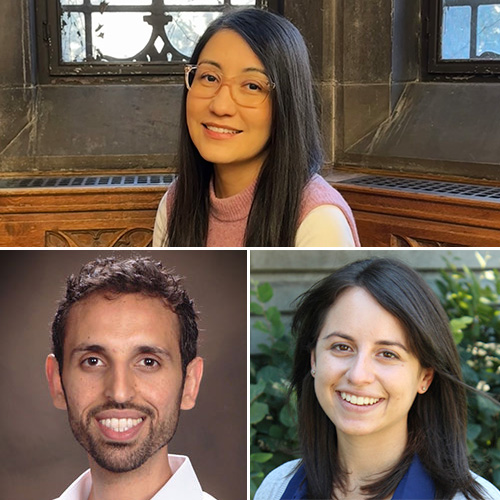
Professor Nabil Alshurafa, Professor Maia Jacobs, PhD students Negar Kamali and Mara Ulloa, Glenn Fernandes (PhD ‘26, MS ’22); research assistant Elizabeth Soyemi, and former postdoc Miranda L. Beltzer
A smartwatch buzzes, alerting the user to take a short walk. A bedtime app recommends calming breathing exercises before sleep. Just-in-time adaptive interventions (JITAIs) like these provide personalized support at the moments people are most likely to benefit. Advances in machine learning (ML) are making these tools more powerful by enabling them to predict users’ needs and tailor recommendations in real time
“Even the most sophisticated patient health tools are limited by people’s willingness to engage with them,” said Maia Jacobs, assistant professor of computer science and preventive medicine. “While research and industry have focused on making these systems more accurate and personalized, much less is known about what people expect from predictive health tools or what they need to confidently use them.”
Addressing this gap, researchers from Northwestern University’s Health Aware Bits (HABits) Lab and Personalized and Adaptive Technology for Health (NU-PATH) Lab explored how pregnant people envision interacting with future predictive stress management tools. They are co-designing a JITAI system called Lowering Unwanted Cortisol Activity (LUCA), working directly with pregnant individuals to align its support capabilities with end user expectations, preferences for when and how to use the technology in daily routines, and concerns regarding functionality and algorithmic uncertainty.
In the study “I Don’t Like Being Told Just What to Do; I Need to Know Why,” the team found that participants wanted more than personalized recommendations: they wanted the technology to help them build an understanding of how it works, enabling them to decide when to trust and rely on its guidance
“By placing lived experience at the center, our philosophy is to collaboratively shape the future of ML-driven health tools around how pregnant people perceive and understand these systems,” said Mara Ulloa, a PhD student in computer science at Northwestern Engineering and first author of the study
Ulloa explained that the study revealed two critical requirements: a desire for a coherent mental picture of how the system operates and a need for personal autonomy
“Just as patients engage better with medical care when they are actively included by their doctor, JITAI users may also engage more meaningfully with technology when they understand its logic,” she said
Ulloa presented the paper at the inaugural ACM Interactive Health Conference, held July 5-8 in Porto, Portugal, where she also presented a series of doctoral colloquium workshops. Co-authors of the study, published April 27 in ACM Transactions on Computing for Health’s Special Issue on Human Centered Computing in Healthcare, include Jacobs; Nabil Alshurafa, associate professor of preventive medicine and (by courtesy) computer science and electrical and computer engineering; PhD student in computer science Negar Kamali; Glenn Fernandes (PhD ‘26, MS ’22); Elizabeth Soyemi, research assistant at Northwestern University Feinberg School of Medicine; and Miranda L. Beltzer, former postdoc at Feinberg’s Center for Behavioral Intervention Technologies.
Making meaningful impact
Building on more than a decade of foundational research on the impact of prenatal stress reduction on maternal well-being and early life neurodevelopment, the HABits Lab and NU-PATH collaboration launched in 2023 with support from Northwestern’s Center for Advancing Safety of Machine Intelligence
Alshurafa and the HABits Lab team first developed an ML algorithm that incorporates wearable devices and app-based surveys to predict a pregnant person’s next-day stress and offer preventive cognitive behavioral therapy (CBT)-based interventions
In this new work led by Ulloa as part of her dissertation research, the NU-PATH and HABits Lab team aimed to translate the potential into meaningful impact, recruiting 20 pregnant people to explore their interest in and expectations of an ML-driven JITAI and incorporate their viewpoints and attitudes into future system design
“As the predictive algorithms capable of forecasting stress advance, our understanding of what people actually want and need from those algorithms must advance at the same pace,” Ulloa said. “The true contribution of this paper is ensuring that human-centered needs dictate the direction of prenatal preventive health technology, rather than letting the technology dictate the human experience.”
Drawing on participatory design principles, the researchers developed storyboards illustrating the types of functionality and interactions that are technologically feasible. In collaborative design sessions, they guided the participants through a relatable story of a pregnant individual, “Aria,” and “LUCA,” a text-based agent embodying an ML model, capable of predicting future instances of stress and delivering timely CBT and mindfulness recommendations
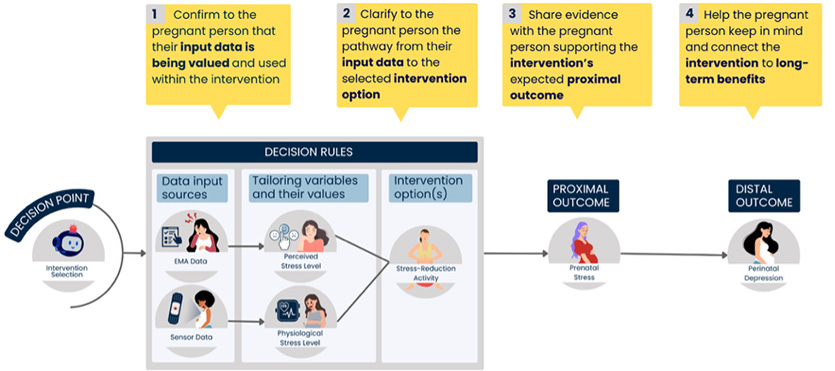
Participants viewed interaction with these tools as a two-way process. Just as they wanted the technology to help them understand its recommendations, they also wanted opportunities to help the AI understand their decisions by distinguishing intentional choices from situations where they simply could not act or explicitly disagreed
“People recognize that AI learns from their behavior,” Jacobs said. “Participants wanted ways to tell the system the difference between ‘I couldn’t do this’ and ‘I chose not to do this,’ so the technology could better understand their preferences rather than making incorrect assumptions.”
Practical application
Moving from co-design to implementation, Ulloa and the research team are now building a functional mobile application prototype that directly incorporates the study participants’ design requirements. The goal of this phase is to evaluate whether supporting the mental models and control that users explicitly requested leads to a measurable increase in sustained transparency and engagement. Ulloa also hopes to identify any new or unresolved user issues
In the next phase, the team plans to deploy the prototype directly into the daily lives of pregnant individuals. Participants will download the application and use it continuously in their natural environments to provide the researchers with high-fidelity data on how the system holds up against the unpredictable rhythms, stressors, and routine changes of pregnancy
This initial deployment is designed to lay the foundation for a multi-year research exploration in the NU-PATH lab, with the data, user feedback, and other insights gained ultimately feeding into a large-scale randomized controlled trial to clinically validate human-centered, ML-driven prenatal care
“Integrating human-computer interaction, behavioral science, and machine learning with real-world users has been incredibly rewarding,” Ulloa said. “What distinguishes this work is that it empowers pregnant individuals to define how personal technology should function to be truly valuable for them. Ultimately, the most impactful health technologies are the result of genuine collaboration across research disciplines and, most importantly, with the people we hope they ultimately serve.”
