


Natalie Harp’s Cancer Story: The Controversial Bone Cancer Case, Trump, and Right to Try
Natalie Harp, a 35-year-old executive assistant to former President Donald Trump, has become a prominent figure in U.S. politics not only for her proximity to the president but also for her public account of surviving stage 2 bone cancer. She credits Trump’s 2018 Right to Try Act with giving her access to life-saving treatment, a claim that has been amplified in political messaging but questioned by oncologists and fact-checkers
This article reconstructs what is known about Harp’s cancer journey from her own statements, contemporaneous reporting, and expert commentary, and places it in the context of U.S. access pathways for experimental and off-label therapies
Timeline and Key Claims in Harp’s Narrative
Harp has described a 2015 medical error in which she was accidentally infused with sterile water instead of appropriate IV fluids, an event she says left her severely ill and eventually housebound. In later accounts, she has linked this period to the development of a “rare form of bone cancer,” although she has not publicly specified the exact histologic subtype, anatomic site, or treating institution
2015–2018: Standard Therapy, Trial Exclusion, and Palliative Recommendations
According to Harp’s own descriptions, she was diagnosed with stage 2 bone cancer, underwent two chemotherapy regimens that she says failed, and was denied entry to clinical trials. She has also said that her care team shifted toward palliative and end-of-life options, including opioids, medical marijuana, “Death With Dignity” counseling, and information about voluntarily stopping eating and drinking. These elements form the emotional core of her account: a young patient who says she was told that conventional disease-directed options had been exhausted.
2018–2019: Right to Try and “Experimental” Treatment
The federal Right to Try Act was signed into law in May 2018. The law was designed to provide certain patients with life-threatening diseases a pathway to access eligible investigational drugs outside the FDA’s traditional expanded-access process. Under the federal framework, eligible investigational drugs must have completed at least a Phase 1 clinical trial and must not be approved or licensed by the FDA for any use
In 2019, Harp began speaking publicly about her experience as a purported beneficiary of the law. She appeared on Fox & Friends and at the Faith & Freedom Coalition’s Road to Majority conference, where Trump introduced her on stage. She described learning about Right to Try and obtaining an “experimental” medication that changed the trajectory of her illness. She portrayed Trump as a “Good Samaritan” who intervened when she believed the medical and political establishments had failed her.
In a 2019 Liberty University article, Harp was quoted saying that after using the “experimental drug,” her numbers and pain level were stabilizing
2020 and Beyond: Political Use of Her Story
Harp’s story subsequently became closely associated with political messaging surrounding Right to Try. She spoke at the 2020 Republican National Convention, joined Trump’s campaign advisory board, and remained a visible supporter. In 2026, as a White House aide during Trump’s second term, her cancer story again attracted attention as journalists revisited the medical and regulatory claims surrounding her treatment
What Natalie Harp Has Said About the Treatment Itself
Across interviews, opinion pieces, and public speeches, Harp has provided some information about her treatment, although important details remain unpublished. She has said that after failing two chemotherapy regimens, she “located another oncologist willing to explore a different option.” She has described that treatment as an “FDA-approved immunotherapy drug for an unapproved application”, which would generally be characterized as an off-label use of an approved medication. She has also described her condition as “living with cancer,” with stabilizing laboratory results and pain, rather than consistently presenting herself as definitively cured.
However, her public accounts do not identify:
- The precise tumor subtype
- The anatomical site of the tumor
- The chemotherapy agents she received
- The immunotherapy drug used off-label
- The hospitals or physicians involved
Without these details, independent medical verification of her case is extremely limited
What Oncologists and Fact-Checkers Question
Beginning in 2020 and continuing into 2026, journalists and medical experts have questioned whether Harp’s treatment could actually have been provided through the federal Right to Try pathway
1. The Drug She Describes May Not Qualify Under Right to Try
The federal Right to Try statute applies to eligible investigational drugs that have completed Phase 1 testing but have not been approved or licensed by the FDA for any use. Harp, however, has described her treatment as an FDA-approved immunotherapy used for an unapproved indication
If that description is accurate, the treatment would not meet the federal statutory definition of an eligible investigational drug under Right to Try because an FDA-approved medication is not an investigational drug that lacks FDA approval for all uses. An oncology expert cited in the draft has also pointed to three issues: Harp’s statements that she received an FDA-approved treatment, references in some accounts to essential thrombocytosis, and the fact that some descriptions of her condition and treatment predated the federal law’s passage.
2. Timeline Inconsistencies
Some of Harp’s earliest public descriptions of her illness and treatment predate the May 2018 signing of the federal Right to Try Act.That creates an important question: if key treatment decisions or access to the medication occurred before the federal law existed, Right to Try could not have been the mechanism that enabled those decisions
3. No Verifiable Clinical Details
Several important clinical details remain unavailable publicly. The hospital, exact cancer subtype, treatment names, treating physicians, and objective outcomes have not been adequately documented in the public record reviewed for this article. The White House also has not provided sufficient clinical information to independently establish which treatment Harp received or precisely how she accessed it. Without those details, it is difficult to determine whether her case represents a rare bone malignancy, an off-label immunotherapy response, an expanded-access treatment, or another clinical scenario.
Right to Try vs. Off-Label Use vs. Expanded Access: Why the Distinction Matters
Harp’s story sits at the intersection of three different regulatory and clinical pathways
Right to Try
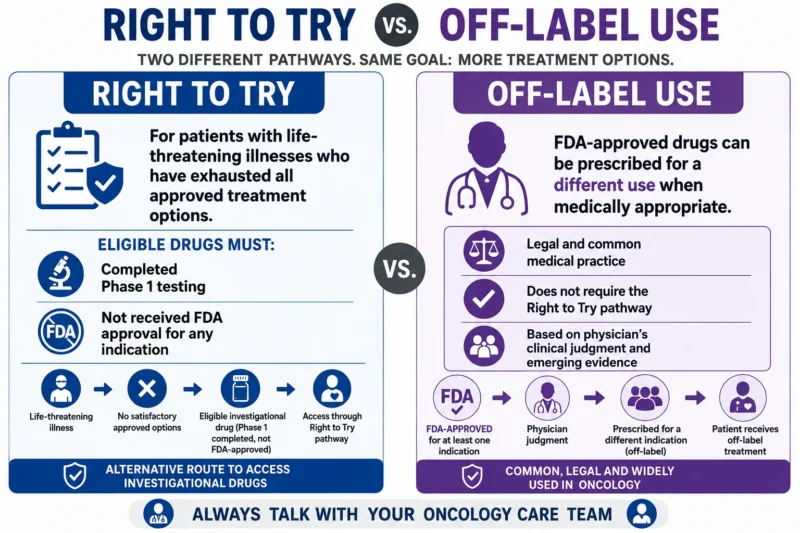
The federal Right to Try pathway is intended for certain patients with life-threatening illnesses who have exhausted approved treatment options. Eligible drugs must have:
- Completed Phase 1 testing
- Not received FDA approval for any indication
The pathway was created as an alternative route for accessing certain investigational drugs without following the traditional FDA expanded-access process
Off-Label Use of FDA-Approved Drugs
Off-label prescribing is different. Once a medication has FDA approval for at least one indication, physicians can legally prescribe it for another indication when they believe that use is medically appropriate. Such prescribing does not require the Right to Try pathway. Off-label treatment is common in oncology, particularly when emerging evidence supports a treatment before a new indication has been formally incorporated into the drug’s FDA labeling
Expanded Access
Expanded access, sometimes called compassionate use, provides another pathway for patients with serious or life-threatening diseases to receive investigational drugs outside clinical trials. Unlike off-label prescribing, expanded access concerns investigational products that have not received FDA approval. The process generally involves FDA authorization along with support from the manufacturer and treating institution. This distinction is central to Harp’s story. If her description of receiving an FDA-approved immunotherapy for an unapproved use is accurate, that would describe off-label treatment, not treatment obtained through the federal Right to Try pathway.
Medical Plausibility: What Could “Stage 2 Bone Cancer” Mean?
Harp has repeatedly used the phrase “stage 2 bone cancer,” but this description is not sufficiently precise for medical interpretation. Bone-related malignancies encompass several distinct diseases with different biology, staging systems, prognoses, and treatments. These can include:
Harp’s reported “bone cancer” could potentially refer to several different types of malignancy, including primary bone sarcomas such as osteosarcoma, Ewing sarcoma, and chondrosarcoma; hematologic malignancies involving bone, including multiple myeloma and some leukemias and lymphomas; or metastatic cancer involving bone, which can originate from cancers such as breast, prostate, or lung cancer. Some accounts have also associated Harp’s story with essential thrombocytosis, a myeloproliferative neoplasm involving abnormal platelet production; however, this condition is not ordinarily described simply as “stage 2 bone cancer.”
Because the precise diagnosis has not been publicly established, it is impossible to determine whether her reported chemotherapy history corresponds to standard treatment for a specific malignancy, whether clinical-trial exclusion was unusual, or whether an off-label immunotherapy would have been medically plausible. This diagnostic ambiguity is therefore a major limitation when attempting to interpret her experience as a clinical case
How Harp’s Story Has Been Used Politically
Harp’s cancer story has become more than a personal medical narrative. It has also been used as a political symbol. Her experience has been presented as human-interest evidence that Right to Try can help patients who have exhausted conventional options. It has also been incorporated into broader political arguments surrounding patient autonomy, experimental treatments, and healthcare regulation
At the same time, critics have highlighted the apparent discrepancies between her description of receiving an FDA-approved drug and the statutory requirements of the federal Right to Try pathway. For medical communicators, the case illustrates how an individual patient story can become a powerful policy argument even when the underlying clinical information is incomplete
Implications for Oncology Communication and Patient Education
Harp’s case offers several important lessons for oncology communication
Distinguish Anecdote From Evidence
Her story represents a patient advocacy narrative, not a peer-reviewed clinical case report. It can illustrate what it feels like for a patient to face limited treatment options, difficulties accessing clinical trials, or discussions about palliative and end-of-life care. However, an individual patient’s experience cannot establish that a particular treatment is effective or that a specific policy caused a clinical outcome
Clarify Access Pathways
Patients and readers should understand the difference between:
- Right to Try
- Off-label prescribing
- FDA expanded access
- Clinical-trial participation
Right to Try does not apply to ordinary off-label use of FDA-approved medications. Similarly, receiving a treatment that sounds “experimental” does not necessarily mean that the patient used a Right to Try pathway
Encourage Discussions With Care Teams
When standard treatment options become limited, patients can ask their oncology teams about clinical trials, emerging evidence, off-label treatment options, and expanded-access programs. These discussions should include potential benefits, risks, uncertainties, costs, and the strength of available evidence
Be Cautious With “Miracle Cure” Framing
Harp’s descriptions of her health have varied, including language around being “cured” and “living with cancer.” At the same time, objective long-term clinical data have not been made publicly available. A more scientifically appropriate description would therefore be: One patient’s report of disease stabilization after off-label immunotherapy, in the context of a rare bone tumor and exhausted standard options. This framing acknowledges her experience without presenting it as proof that a particular drug or regulatory pathway is responsible for her outcome.
What Remains Unknown
Despite extensive media coverage, several critical questions about Harp’s case remain unanswered, including the precise histologic subtype and site of her reported “bone cancer,” the chemotherapy agents she received, the specific immunotherapy used, and the regulatory pathway through which she accessed the treatment—whether through off-label prescribing, expanded access, a state Right to Try law, or another mechanism. Objective outcomes, including response measurements, progression-free survival, and her current disease status, have also not been publicly documented. Until these details are independently documented or credibly disclosed, her story is best understood as a politically significant patient narrative rather than a clinically verifiable case report.
You Can Also Read Trump Chief of Staff Susie Wiles Faces Early Breast Cancer Battle by OncoDaily
Written by Aharon Tsaturyan, MD, Editor at OncoDaily Intelligence Unit
FAQ
What type of cancer did Natalie Harp have?
Natalie Harp has publicly described having stage 2 bone cancer and has referred to it as a rare form of cancer. However, she has not publicly provided enough clinical information to independently establish the exact histologic diagnosis or tumor site. Because of this, more specific claims about her cancer should be treated cautiously
What happened to Natalie Harp?
Harp has said that she developed serious health problems following a medical error in 2015 and was subsequently diagnosed with bone cancer. She has described undergoing two chemotherapy regimens before pursuing another treatment approach. Her account later became closely associated with Donald Trump’s Right to Try law
Did Donald Trump save Natalie Harp’s life?
Harp has publicly credited Trump with helping save her life through the Right to Try Act. However, medical experts have questioned that claim because she has described receiving an FDA-approved immunotherapy for an unapproved use, which would generally be considered off-label treatment rather than a Right to Try treatment
What is the Right to Try Act?
The Right to Try Act is a U.S. federal law signed in May 2018 that allows certain eligible patients with life-threatening diseases to seek access to specific investigational drugs. The drug must have completed Phase 1 testing and must not have been FDA-approved for any use. The law is different from both clinical-trial participation and off-label use of an already approved medication
Did Natalie Harp use the Right to Try Act?
Harp has said that Right to Try allowed her to obtain an experimental cancer treatment. However, reporting has raised questions about this account because she also described receiving an FDA-approved immunotherapy for an unapproved indication. If that description is accurate, the treatment would fall under off-label use, not the federal Right to Try pathway
What cancer treatment did Natalie Harp receive?
Harp has said that she underwent two chemotherapy regimens before receiving another treatment that she described as an FDA-approved immunotherapy used for an unapproved purpose. She has not publicly identified the specific chemotherapy drugs or immunotherapy. Without those details, her treatment history cannot be independently evaluated against a specific cancer diagnosis
What is off-label cancer treatment?
Off-label use means that a physician prescribes an FDA-approved medication for a medical condition, patient population, or purpose that is not included in its approved labeling. This practice is legal and occurs frequently in medicine, including oncology. Importantly, off-label use is not the same as using an unapproved investigational drug through Right to Try
What is the difference between Right to Try and expanded access?
Both pathways can provide access to investigational treatments outside conventional clinical trials, but they operate differently. Right to Try applies to specific eligible investigational drugs that have completed Phase 1 testing and have not been FDA-approved for any use, while expanded access is an FDA pathway for certain patients with serious or life-threatening conditions who cannot participate in clinical trials
Is Natalie Harp cured of cancer?
There is not enough publicly available medical information to independently establish that Harp is cured. In public statements, she has described herself as “living with cancer” and has discussed stabilization in laboratory results and pain rather than providing detailed evidence of complete remission. Her current objective disease status and long-term clinical outcomes have not been publicly documented in sufficient detail
Why is Natalie Harp’s cancer story controversial?
The controversy centers primarily on how her treatment was accessed and the role she attributes to Right to Try, rather than on whether she experienced serious illness. Harp has credited Trump’s law with helping her receive treatment, while reporting and medical experts have questioned that explanation because the treatment she described appears to have been an FDA-approved drug used off-label. The lack of publicly available details about her exact diagnosis and treatment also makes independent medical assessment difficult.
- Celebrities and Cancer
Bone cancercancer carecancer controversyCancer PolicyCancer researchcancer treatmentclinical trialsDonald Trumpexpanded accessExperimental Cancer TreatmentimmunotherapyNatalie HarpNatalie Harp canceroff-label treatmentOncologyPatient AdvocacyRight to Try ActRight to Try lawTrumpWhite House
