


This story is part of the WHYY News Climate Desk, bringing you news and solutions for our changing region
From the Poconos to the Jersey Shore to the mouth of the Delaware Bay, what do you want to know about climate change? What would you like us to cover? Get in touch
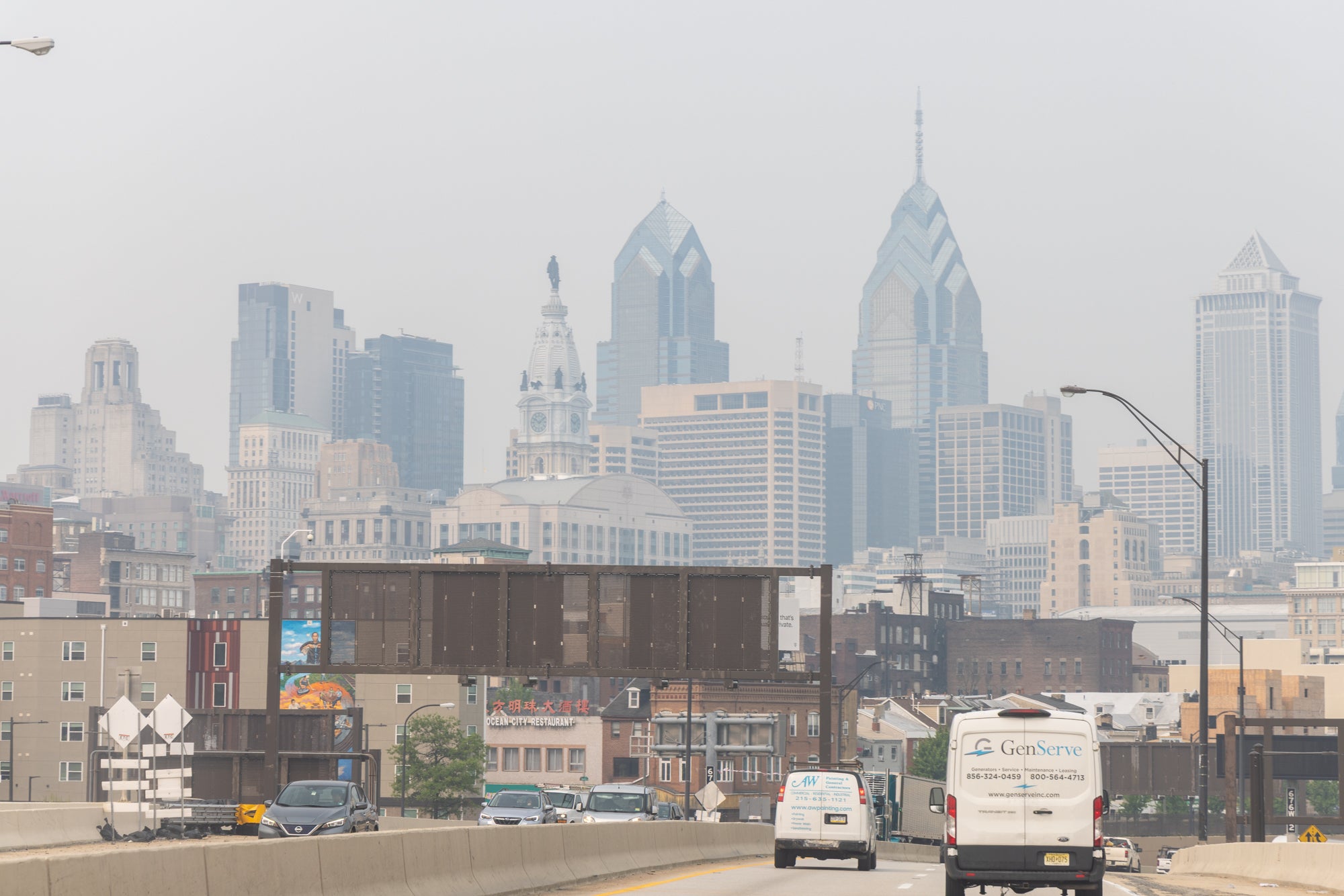
The Pennsylvania Department of Environmental Protection said air quality will worsen Thursday evening, and is urging people to limit their time outdoors as wildfire smoke from Canada continues to blanket the region with dangerous levels of air pollution
Pennsylvania declared a Code Purple Air Quality Alert for Friday, meaning levels of particulate matter will be dangerous to everyone, including those who are healthy. Some areas could be even worse – tipping into the “hazardous” maroon category, according to the DEP. The agency said conditions can vary by zip code, advising residents to check AirNow for conditions in their local area
These fine, tiny particles, known as PM 2.5, are 30 times smaller than the width of human hair, and are easily inhalable. The particles can settle deep in the lungs and enter the bloodstream
Breathing in particulate matter can cause respiratory and cardiovascular problems, and impact vulnerable populations like children, the elderly and people with health conditions such as asthma
“Wildfire smoke is among the most toxic air pollution that we can have,” said Ruth McDermott-Levy, co-director of the Mid-Atlantic Center for Children’s Health and the Environment at Villanova University College of Nursing
“That’s because it burns things like wood and other things that are not meant to be burned and breathed,” she said
“It could be a camper, it could be a refrigerator, all kinds of things then become toxic pollutants that we breathe in, and as the wildfire travels, it picks up the other pollutants.”
More than 180 wildfires are burning in Canada, causing severe levels of smoke to travel more than 1,000 miles — impacting multiple states in the U.S. Several wildfires are also burning in northern Minnesota
Code Red alerts issued in Philadelphia region
At least 17 states have issued red air quality alerts, including Pennsylvania, New Jersey and Delaware
“As the airflow has turned more from the north and northwest in the lower levels and in the upper levels of the atmosphere, that has directed some of the smoke south and eastward, getting as far south as the mid-Atlantic area and places like Philadelphia,” said Paul Fitzsimmons, lead meteorologist at the National Weather Service in Mount Holly
“Up until yesterday, the effects were largely to our north, at least in terms of any surface smoke,” he said. “But when we had a weak cold front come through last night, that caused the winds to shift more to the northwest, and that’s what brought the smoke down into this area.”
Fitzsimmons said possible thunderstorms late Thursday could improve air quality if they blow the smoke out. However, any subtle change in wind direction or atmospheric temperatures could cause conditions to change on an hourly basis, he said
Without a storm, Thursday afternoon forecasts indicate air quality conditions could worsen Thursday evening as peak concentrations of smoke drift southward toward Philadelphia, said New Jersey’s state climatologist John Krasting
“Unfortunately, we should see the peak of this in terms of the worst air quality later tonight into early tomorrow morning,” he said
As the air quality worsens, even healthy people could feel the effects. A report by the New Jersey Department of Health found a spike in emergency room visits for new diagnoses of asthma when the 2023 Canadian wildfires led to poor air quality for several days in New Jersey, Pennsylvania and Delaware
“The bad [air] quality due to the wildfires can increase allergic diseases, and one of them is asthma,” saidDr. Sadia Benzaquen, a pulmonologist at Jefferson Einstein Medical Center.“That means that patients who already have the diagnosis of asthma, may be more prone to have exacerbation of their asthma, and it may also happen that patients that never have been diagnosed with asthma will be diagnosed.”
People with cardiovascular conditions are also more likely to experience worsened symptoms. Those with respiratory problems, heart conditions and other illnesses such as cancer are more prone to develop infections such as pneumonia, Benzaquen said
The Philadelphia area is also facing a heat advisory as temperatures rise to the upper 90s, with humidity causing temperatures to feel like 100 degrees. The poor air quality and the heat are a potentially deadly combination, McDermott-Levy said
She said during this time, people can experience a scratchy throat, irritated eyes and a runny nose. People should go to the emergency department if they experience chest pain and shortness of breath, McDermott-Levy said
She encourages people to limit their time outdoors and avoid strenuous activity, and to set their air conditioning settings to recirculate at home and in their cars
Many outdoor workers said they had no choice but to go about their day as usual. Philadelphia tour guide Jacob Kain said he made adjustments, like wearing a mask. However, he said the heat made wearing the mask difficult, and his glasses fogged up
“In the morning it sucked, because there wasn’t much of a breeze, but now that the wind is going, it’s not so bad,” he said Thursday afternoon. “It’s still a little bit tough for people who have asthma and things like that, but it is what it is. Gotta make rent money somehow.”
The heat also impacted sales at businesses because the conditions scared customers away
“It’s so terrible today,” said Moses Khan, who operates a food card in Center City. “The customer quantity is quite low today because no one is coming here, to be honest, because it’s smoke[y] and so hot.”
Richard Hanrahan, general manager of the Gateway Garden Center in Hockessin, Delaware said it was business as usual for him and his employees. As an outdoor worker, he’s accustomed to working in the heat and humidity. But the smokey air has caused him to feel congested
“It’s not harder to breathe, but maybe a little more effort to breathe normally with just the air being so thick,” Hanrahan said
If people must go outside, they can reduce their exposure with surgical or N95 masks. The caveat is that in order to be effective, masks must fit properly, meaning they’re snug on the nose and mouth, Benzaquen said
McDermott-Levy also advises people to check on their neighbors, including people who might experience feelings of depression because they’re stuck indoors
People should also avoid using gas-powered lawn equipment, eliminate the use of fireplaces and wood stoves, and avoid burning leaves, trash and other materials
Philadelphia is no stranger to wildfire smoke. In 2023, the region was plagued by smoky, unhealthy air for five days, prompting schools to switch to virtual learning and causing delays at Philadelphia International Airport
Scientists say climate change will cause more wildfires, as regions further north like Canada become much hotter. High temperatures can also dry out trees and plants, increasing the risk of forest fires. Trapped stagnant air can make these conditions and air pollution worse, Krasting said
“The indication of how these will bear out under climate change is not settled yet,” he said. “There’s low confidence in our ability to understand whether we’re going to see more or less of these events or whether the [air trapping] will be more intense or less intense. But the main question about whether or not we will see more wildfires — the answer is most likely yes, as a result of the warmer temperatures to our north.”
The U.S. Environmental Protection Agency’s Air Quality Index issues color codes to report daily air quality. Green signifies good air quality, while yellow means moderate air quality. Orange represents unhealthy pollution levels for sensitive groups, and red warns of unhealthy pollution levels for all
“When things start to clear out … there still could be significant pollution left over that you’re not able to detect with your eyes, but will still cause health problems going forward,” Krasting said
Sophia Schmidt contributed to this reporting

Get daily updates from WHYY News!
The free WHYY News Daily newsletter delivers the most important local stories to your inbox
WHYY is yournprofit organization, we rely on financial support from readers like you. Please give today
