


- Two U.S. biotech companies are testing experimental GLP-1 weight-loss treatments for overweight cats.
- It marks one of the earliest attempts to bring the blockbuster drug class into pet medicine.
- Analysts say the idea of GLP-1s for animals fits into a much larger transformation already reshaping the $200 billion U.S. pet economy.
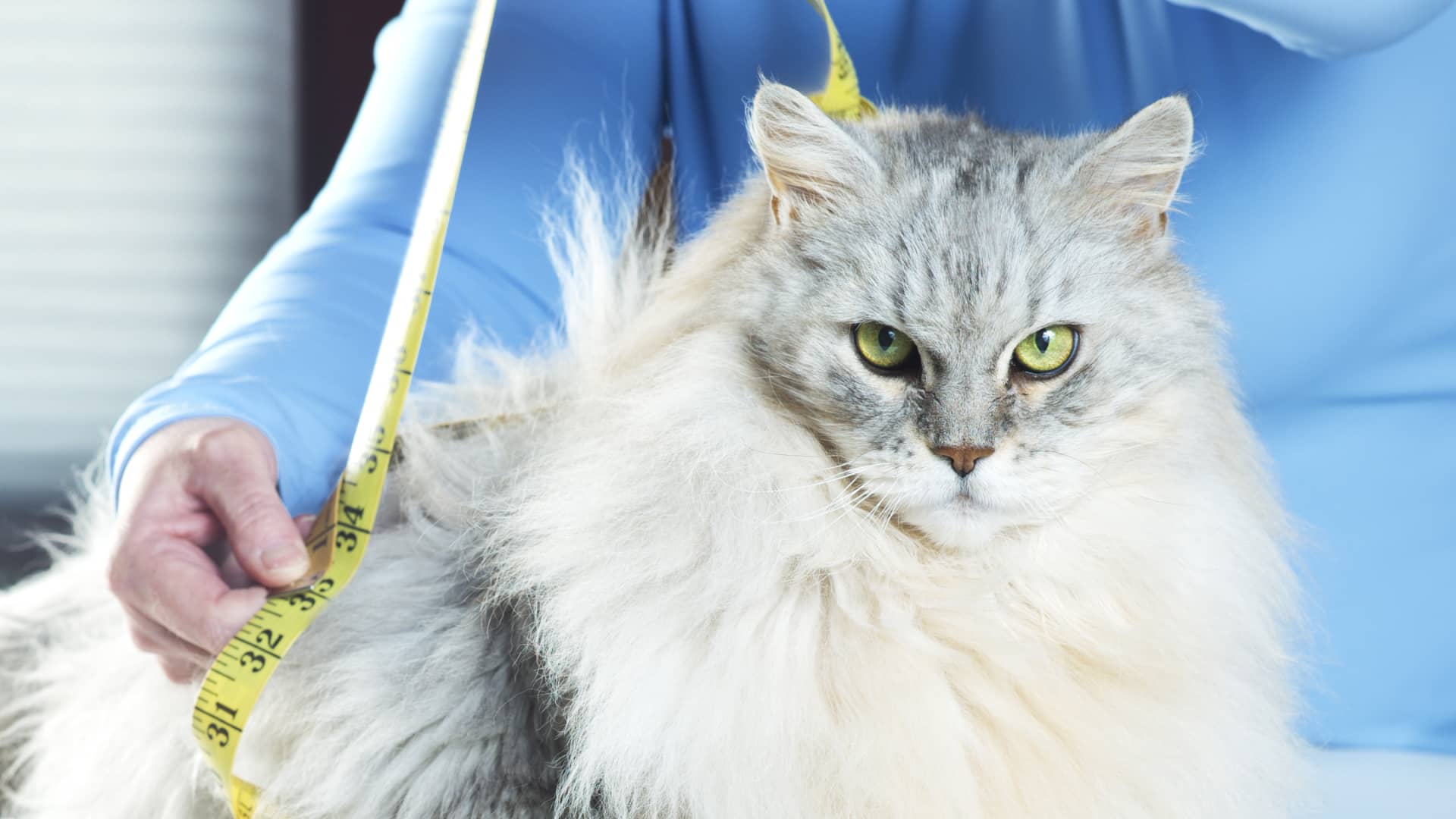
A beautiful, but over weight Maine Coon Cat gets measured around the belly by a vet.
Ryersonclark | E+ | Getty Images
Felix is five years old, loves food, and refuses to lose weight
His owner, Amy in Dallas, has tried cutting back on meals, but with two cats in the house, “he just gobbles down all the food,” she said. The extra pounds worry her because she knows obesity can shorten a cat’s life and strain its joints and heart
“I’ve actually thought about it,” she said of the potential of weight loss drugs for pets. “If they can make one for my cat, that would be great.”
It may sound far-fetched, but the idea is already moving from wishful thinking toward veterinary research. Two U.S. biotech companies are testing experimental GLP-1 weight-loss treatments for overweight cats, marking one of the earliest attempts to bring the blockbuster drug class into pet medicine
Meanwhile, some of the world’s largest pet-food makers are investing heavily in nutrition and longevity products aimed at many of the same health problems
Ozempic for cats?
The GLP-1 boom spearheaded by Novo Nordisk and Eli Lilly has already reshaped how millions of people think about obesity, diabetes, and food. Now, the same class of drugs is spilling over into a new market: household pets
Akston Biosciences is sponsoring a Cornell University clinical study of a once-weekly GLP-1 therapy for overweight and obese cats, while San Francisco-based OKAVA Pharmaceuticals has begun testing a long-acting implant designed to deliver the medicine continuously for up to six months
Neither product is approved, and there is currently no commercial “Ozempic for cats.” Both remain early-stage clinical trials that will need to demonstrate they are safe and effective before reaching veterinarians
The studies point to a broader shift already underway in pet care. As owners spend more on premium food, supplements, diagnostics and veterinary treatments, it’s creating new opportunities for biotech alongside traditional pet-food companies
According to the Association for Pet Obesity Prevention, 61% of cats and 59% of dogs evaluated by U.S. veterinary professionals in 2022 were classified as overweight or obese, highlighting the scale of a problem long familiar to veterinarians
Cats present a particularly difficult challenge. Unlike dogs, they cannot simply be taken on longer walks, often resist dietary changes, and can be difficult to medicate consistently, making GLP-1 therapies potentially attractive if clinical trials prove successful
The cat Felix struggles to lose weight, his owner Amy says.
“Feline obesity is one of the most common yet least effectively treated health issues in veterinary medicine,” Akston CEO Todd Zion said in November as the company announced the clinical trial for GLP-1 for pets
The Akston-sponsored trial carried out by Cornell University will evaluate about 70 overweight or obese cats over roughly three months. OKAVA’s study is testing an implantinserted by a veterinarian that is designed to release medication for up to six months in a trial called “MEOW-1.”
With respect to the commercial opportunity, pet obesity is one of the most significant unmet medical needs in companion animal health, an Okava spokesperson told CNBC, however, they said it would be premature to comment on future sales expectations
Both companies are betting that medicines modeled on human GLP-1 drugs can help regulate appetite in pets, and top-line results of their clinical trials are expected to be released later this year.
From premium pet food to medical care
Whether GLP-1 drugs eventually become commonplace in veterinary medicine remains uncertain. But industry analysts say they fit into a much larger transformation already reshaping the $200 billion U.S. pet economy
“I would describe this as an expansion from premiumization into medicalization, rather than owners abandoning premium food,” Morgan Stanley analyst Simeon Gutman told CNBC
Consumers increasingly buy pet food marketed around healthier and fresh ingredients, and therapeutic nutrition, he said, while veterinary care, diagnostics, and pharmacy services are taking a growing share of household pet spending
Morgan Stanley estimates U.S. pet food will total roughly $65 billion in 2026, while overall U.S. pet spending is projected to grow from about $196 billion in 2025 to more than $240 billion by 2030
Rather than replacing specialized diets, obesity drugs would likely become another tool within a broader healthcare ecosystem that includes veterinary services, diagnostics and therapeutic nutrition
Gutman cautioned that investors should not assume pet GLP-1s will mirror the explosive commercial success of human obesity drugs
“The most overhyped part is the assumption that pet obesity drugs will replicate the human GLP-1 market in terms of penetration and pricing,” he said, noting that veterinary medicine remains largely an out-of-pocket expense for owners and that affordability will likely constrain uptake
Instead, he said the more credible near-term scenario is that growth will come from the broader obesity ecosystem, including structured weight-management programs, prescription diets and treatment of obesity-related conditions, with a standalone GLP-1 market for pets likely to take longer to emerge
Food companies are already moving
The industry’s biggest players are not waiting for obesity drugs to arrive
Nestlé’s latest pet product strategy centers on what it calls “Personalized Health,” with new products targeting digestive health, healthy aging and longevity. The strategy illustrates how large pet-food companies increasingly see nutrition as part of preventive health care rather than simply feeding pets
Nestlé has highlighted several long-term trends supporting that strategy, including cat ownership growing roughly three times faster than dog ownership in recent years and premium cat food outpacing premium dog food growth.
Cats in particular are becoming a more attractive growth opportunity as younger consumers gravitate toward lower-cost and lower-maintenance pets, Gutman said. While dogs remain the larger spending category, “cats represent an attractive whitespace opportunity rather than the larger market,” he added.
Nestlé also says newer nutritional products can extend healthy lifespan in cats by more than a year
Purina cat food products, manufactured by Nestle SA, arranged in London, U.K., on Monday, July 26, 2021. Nestle report their half-year results on July 29. Photographer: Hollie Adams/Bloomberg via Getty Images
Bloomberg | Bloomberg | Getty Images
Meanwhile, the global pet supplements and nutrition market is estimated to be worth several billion dollars and continues to expand rapidly as owners increasingly seek proactive ways to improve their animals’ health
Gutman said longevity is becoming the industry’s next major theme
“We think the industry is increasingly focused on extending healthy lifespan through earlier diagnostics, higher-value therapeutics and therapeutic nutrition,” he said. “Longevity is likely to become an overarching theme that ties these categories together.”
That convergence is drawing together businesses that once occupied separate corners of the market, from consumer staples companies selling food to biotech firms developing medicines and veterinary providers offering increasingly sophisticated care
Animal-health companies including Zoetis, Elanco and IDEXX are positioned to benefit through therapeutics and diagnostics, while Nestlé Purina, Colgate-Palmolive subsidiary Hill’s and Freshpet are expanding health-focused nutrition, Gutman said. Online retailer Chewy has also broadened into pharmacy subscriptions and veterinary clinics
Would owners embrace it?
Whether owners would pay for obesity drugs may ultimately depend less on the science than on price
For Felix’s owner, Amy, cost would be the deciding factor, and it would have to be much cheaper than human GLP-1 drugs. “It would have to be affordable.”
That affordability question may determine whether GLP-1s become a mainstream veterinary treatment or remain a niche option for some owners
For now, the technology remains firmly in the experimental stage. But the arrival of multiple feline clinical trials suggests one of the pharma industry’s most influential drug class is beginning to cross into veterinary medicine – even as established pet-food companies race to convince owners that healthier diets, supplements and longevity-focused nutrition can deliver many of the same benefits before prescription drugs ever reach the market
