


In 1998, Women’s Health Research at Yale launched its pilot project program, granting Yale researchers funding for studies that advance understanding of the health of women or the influence of sex differences on health. Since then, they’ve awarded more than $6 million
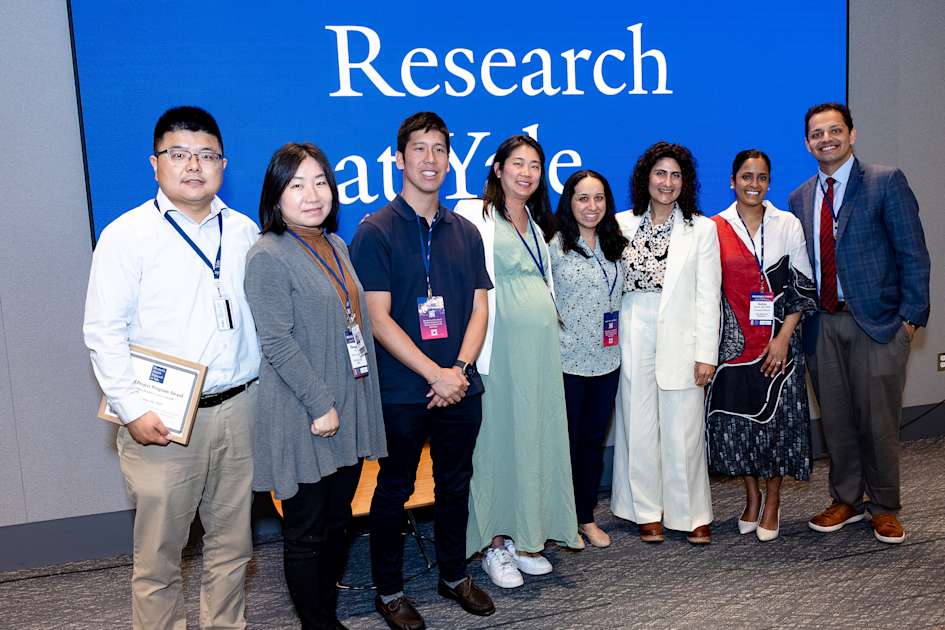
This year, Women’s Health Research at Yale expanded its annual program to support five projects, which it announced at its recent symposium. Two projects received General Awards, two received the newly established Women’s Health and Cancer Research Awards—co-funded by Yale Cancer Center—and one received the Wendy U. and Thomas C. Naratil Pioneer Award
At the symposium, Carolyn Fredericks, MD, assistant professor of neurology at Yale School of Medicine (YSM) and co-chair of the pilot project program’s scientific review committee, shared that the committee received the largest number of letters of intent it ever has. The 43-person committee—also co-chaired by Stacy Malaker, PhD, associate professor of chemistry in Yale’s Faculty of Arts and Sciences—reviewed a robust roster of applications focused on this year’s priority areas: aging and longevity, autoimmune diseases, brain health, and cancer.
Women’s Health Research at Yale has now supported 115 researchers through its program. To date, pilot program investigators have gone on to receive more than $124 million in external grants to continue the work established in their pilot projects
“Women’s Health Research at Yale aims to fuel cutting-edge interdisciplinary research, expand the focus of women’s health, and accelerate discovery,” says Basmah Safdar, MD, director of Women’s Health Research at Yale, Norma Weinberg Spungen and Joan Lebson Bildner Professor of Women’s Health Research, and professor of emergency medicine. “We revamped our application and review process leaning on the expertise and time of our reviewers to ensure a rigorous, transparent, and equitable selection process. Thanks to the leadership of our co-chairs, we were able to provide written feedback to all solicited grants applicants.
“The projects chosen this year are innovative, use rigorous scientific methods and leverage existing Yale reing together researchers and clinicians from different disciplines. We can’t wait to see how they move the field of women’s health forward.”
General Awards: Studying obesity and ovarian aging, and new predictors to diagnose diabetes in young adults
This year, two projects received General Award funding, one led by the interdisciplinary team of Hattie Chung, PhD, assistant professor of medicine (cardiology), and Ken Loh, PhD, assistant professor of comparative medicine, and the other led by Stephanie Samuels, MD, assistant professor of pediatrics (endocrinology), all of YSM
Chung and Loh will explore how obesity relates to ovarian aging, which affects women’s reproductive and overall health. Ovarian aging contributes to infertility, increased risks for cardiovascular disease, and osteoporosis. Obesity, meanwhile, can disrupt ovarian function, but it remains unknown whether obesity accelerates natural ovarian aging or initiates its own disease state
Through their project, Chung and Loh will compare obese mice with naturally aged mice, evaluating the molecular and cellular makeup of their ovarian tissue. They will then assess whether a GLP-1 receptor antagonist affects molecular pathways within ovarian tissue
The second General Award project, led by Samuels, aims to identify factors that predict the development of diabetes in young adult women and men for earlier diagnosis and treatment. As the prevalence of childhood obesity increases, there is a pressing need to understand the drivers of diabetes development among people with obesity. This is particularly critical as the transition from prediabetes to type 2 diabetes in adults usually occurs over 5-10 years while youth experience faster progression. Samuels will complete this project in collaboration with Clare Flannery, MD, who recently launched the Yale Legacy Collaborative to study metabolic health across the lifespan.
For her study, Samuels will assess how many people have developed type 2 diabetes among an existing large longitudinal cohort of patients currently in their 20s, 30s, and early 40s who participated in a previous National Institutes of Health-funded Yale study led by Sonia Caprio, MD, as adolescents with obesity. Determining factors that predict rapid progression to diabetes in later adolescence and young adulthood will inform preventive and therapeutic strategies for those at highest risk, says Samuels.
Women’s Health and Cancer Research Awards: Uncovering new ovarian cancer biomarkers and drivers of early-onset breast cancer
The Women’s Health and Cancer Research Award—newly introduced this year—was established in partnership with Yale Cancer Center and supports research assessing sex differences in cancer or female-specific cancers. The two awards granted this year are to a project on ovarian cancers from the interdisciplinary YSM team of Katyayani Papatla, MD, MPH, assistant professor of obstetrics, gynecology, and reproductive sciences, and Sanjay Aneja, MD, associate professor of therapeutic radiology, and a project on early-onset breast cancer led by Xiaomei Ma, PhD, professor of epidemiology (chronic diseases) at Yale School of Public Health.
“This partnership between Yale Cancer Center and Women’s Health Research at Yale will help us accelerate essential cancer research and reduce the time between lab discoveries and treatments for patients,” says Eric Winer, MD, director of Yale Cancer Center, president of Smilow Cancer Hospital, Alfred Gilman Professor of Pharmacology, and professor of medicine (medical oncology). “The projects funded with this inaugural co-funded award are addressing critical needs in our understanding of and ability to treat cancers that predominantly affect women.”
Papatla and Aneja have teamed up to bring their interdisciplinary expertise to find new imaging biomarkers to risk-stratify ovarian cancers, which carry a disproportionately high mortality rate because most cases are diagnosed at advanced stages
Imaging offers a promising low-cost option for predicting cancer progression. However, there are relatively few studies applying deep learning to ovarian cancer. Building on prior work developing imaging biomarkers in other cancers, the researchers aim to create and validate a deep learning biomarker for ovarian cancer prognosis to better identify patients at highest risk of recurrence and who may benefit most from personalized therapy
Ma is interested in early-onset breast cancer and why it has become more prevalent over the past 30 years. The incidence and mortality of breast cancer among children and young adults have increased, but the cause is not clear
For her study, Ma will examine a broad array of biological, lifestyle, and environmental factors in relation to the risk of breast cancer in children and young adults, using data from a population-based case-control study with over 2,200 individuals who were diagnosed with breast cancer under the age of 40 years. Findings from the study will shed light on the risk factors for breast cancer in children and young adults, says Ma, and pave the way for preventive strategies and interventions to reduce incidence and mortality.
Wendy U. and Thomas C. Naratil Pioneer Award: Unraveling women’s predisposition to autoimmunity through a sex-specific lens
The Wendy U. and Thomas C. Naratil Pioneer Award, funded by Wendy and Thomas Naratil, supports highly innovative proof-of-concept research. The Naratils, who are Yale College alumni, established the award in 2013 in celebration of their 30th Yale reunion
“Many transformative scientific discoveries begin as small pilot projects that have difficulty attracting funding. We wanted to help Yale researchers generate the data needed to pursue larger grants,” says Wendy Naratil. “Through Women’s Health Research at Yale’s thoughtful and strategic disbursement of our gift, Tom and I are fortunate to have helped fund research focused on cancer, neuroscience, cardiovascular disease, metabolism, mental health, and sex differences in disease
“This year, we are excited that our Pioneer Award will enable Shangqin Guo to investigate why women are disproportionately affected by autoimmune diseases.”
Shangqin Guo, PhD, associate professor of cell biology and a researcher at the Yale Stem Cell Center, will study a protein called HMGN5, which affects how tightly DNA is wound in cells. Guo’s research suggests elevated levels of this type of protein loosen DNA in a way that increases the likelihood that inflammation-related genes activate or persist. The gene encoding HMGN5 is located on the X chromosome, and this, she says, may lead to more HMGN5 proteins in female cells and prime them for inflammation.
Her project will dig into this further, identifying how HMGN5 exerts this effect and examining its expression in the stem cells that form the immune systems of both men and women. The findings could enable deeper understanding of autoimmune disease susceptibility, biomarker-based risk assessment, and development of therapies aimed at preventing irreversible inflammatory tissue damage before disease fully manifests
“This year, as a signature program for Women’s Health Research at Yale, we are proud to support an even broader range of excellent ideas from a group of interdisciplinary investigators across career stages, all invested in improving the lives of women for the benefit of all,” says Safdar
