


Trumbo: Imagining a regional food system in the RGV that’s more connected, more efficient, and more resilient – Rio Grande Guardian
Skip to main content



1Border Life
Trumbo: Imagining a regional food system in the RGV that’s more connected, more efficient, and more resilient
Shelly Trumbo, COO of Blue Zones. (Photo: RGG/Steve Taylor)
Posted
Tuesday,July 21, 20268:43 am
By Shelly Trumbo
Throughout our conversations across the Rio Grande Valley, one thing became very clear, which we love, and that is that this community cares very deeply about making sure that families have enough to eat. We met with so many leaders and advocates and nonprofit organizations that are really doing incredible work to address food insecurity. So we certainly did not see a lack of commitment.
What we did see was opportunity for greater coordination. So today, many of these organizations, they’re approaching and solving the same challenges from different directions, from different chairs, and Blue Zones can really help serve as that new open convenor that brings partners together around a shared strategy, improving communication, aligning reat the end of the day, more families get healthy food.
We’re imagining potentially something like a regional food recovery coalition, where organizations like food banks, grocery stores, restaurants, health systems, they can work together to build one coordinated network. So instead of building separate systems, we’re sharing information. We’re coordinating logistics. We’re finding new ways to connect the healthy surplus food to the people that need it most. And grocery retailers could be a really important part of a strategy like that.
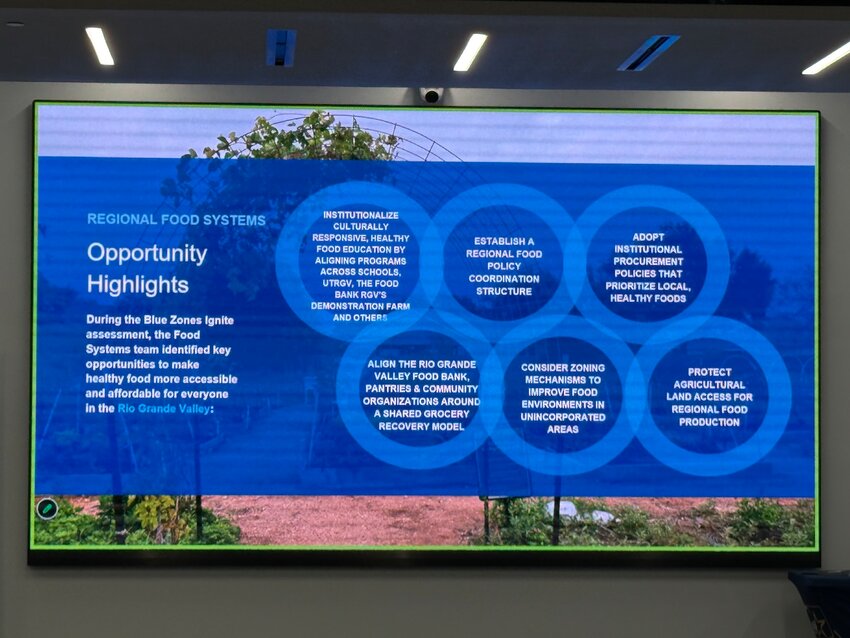 A slide from a power point presentation made by Shelly Trumbo of Blue Zones in Mission and Pharr on July 20, 2026.
So, it’s not simply about feeding more people today, but it’s about creating a more resilient regional food system that would support healthier eating for the long term, and I really I love how with an initiative like that… again that is just an idea; this is team sitting around a table thinking. But I love how, with initiatives like that, everyone wins. So the families gain access to healthier food, grocery stores get to reduce waste.
Potentially, if it’s a regional food hub, community organizations might strengthen their impact and achieve their goals. Healthcare partners are addressing one of the key root causes of poor health, which is low food quality or low food access. And then together, the entire Valley is building a food system that’s more connected, more efficient, more resilient than any one organization could create alone.
Also, I want to stress here that there were several identified opportunities to strengthen in Pharr, and that is the inspiration from PSJA (ISD) that’s already demonstrating what’s possible. So we’ve learned that over the past several years, they have become a regional leader in the local food procurement, that the district’s build new relationships.
Local growers. There are innovative purchasing strategies that make it easier for local farmers. This is so exciting and something that definitely can be built upon for building tremendous momentum. Thinking about a regional local food purchasing collaborative, potentially, so that everything that the district has learned about how to do this can spread and bring it to other institutions and other organizations throughout the Valley.
I want to pause here on this slide. It’s an important one to consider because food access looks different in the colonias than it does in other part of the Rio Grande Valley, and we really learned that from all of you as a part of our work. So we want to begin by understanding how people already access food, and in many of the colonia neighborhoods, we learned that families rely on convenience stores, mobile vendors, maybe school meal programs, food pantries, churches. They’re not necessarily going into traditional grocery stores. So rather than asking families to change those realities, to change their behaviors, we want to build on them.
So, one of the core principles of Blue Zones is meeting people where they are. Schools are a great example of that. In many of the colonias, the school is much more than a place where children learn. It’s where one of the most trusted gathering places, and where they’re already accessing healthy behaviors, healthy foods. So we can see opportunities to work alongside school districts, nutrition departments, healthcare organizations, and nonprofits to strengthen those programs that already exist. Maybe expanding participation in some of the programs that the schools are already offering, and just as important, especially in the colonias, are those trusted community voices can help us connect families to resources in ways that are culturally relevant.
Editor’s Note: The above remarks were delivered by Shelly Trumbo, COO of Blue Zones, during a Blue Zones-Methodist Healthcare Ministries of South Texas presentation at the Pharr One Center on July 20, 2026. Blue Zones and Methodist Healthcare Ministries of South Texas held events in Mission and Pharr on July 20 and are slated to make presentations in McAllen and Edinburg on July 21.
