


Download PDF
Abstract
Background
A prospective randomized controlled trial of exclusive human milk nutrition (EHM) in infants with single-ventricle physiology (SVP) was previously published. This study evaluates growth and health outcomes at 3–6 months
Methods
Demographics, anthropometrics, and clinical outcomes were collected prospectively. Anthropometric z-scores were calculated using WHO standards
Results
One hundred seven infants were randomized to EHM or control diet, with 23 infants meeting predefined exclusion criteria, 8 infants withdrawn/died, leaving 76 infants at discharge. At 3–6 months, 74 infants completed follow-up. Infants with hypoplastic left heart syndrome (HLHS) were similar (control 73%, EHM 86.5%; p = 0.24). Growth, z-scores, and hospitalization did not differ between groups up to 6 months. Median growth velocity was 25 (IQR: 20.24–30.99) and 22 (IQR: 18.76–23.94) g/day from birth to 3–6 months. Overall, 50–60% of infants achieved 100% PO intake by 3–6 months of age.
Conclusions
Neonates with SVP receiving an EHM diet from birth to 30 days post-surgery had similar growth at 3–6 months of age compared to the control diet. Infants with SVP benefit from a protocolized nutritional approach, as evidenced by normal growth velocities in infancy. Centers may consider delaying gastrostomy tube placement until after the Glenn operation
Trial registration
This trial is registered with ClinicalTrials.gov (www.clinicaltrials.gov, Trial ID: NCT02860702)
IRB approval
This trial was approved by the Institutional Review Board of the University of Texas Health Sciences Center at San Antonio (ID: HSC20150779H)
Impact
This multicenter RCT demonstrates the long-term benefits of exclusive human milk nutrition in infants with SVP, with improved growth and reduced necrotizing enterocolitis
A multidisciplinary approach and a well-thought-out nutritional algorithm can optimize growth in infants with complex congenital heart disease, similar to healthy term infants up to 6 months of age
The majority of infants with SVP requiring an operation within the first month of life are able to achieve 100% of their intakeplacement until after the Glenn operation may be considered
Introduction
Infants with congenital heart disease have significant challenges with growth faltering, especially those with single-ventricle physiology (SVP) after first-stage palliation prior to the Glenn procedure, known as the interstage period. Reports over the last decade have shown that up to 50% of infants with SVP have suboptimal growth in the interstage period, with significant variations between centers.1 Protocols to standardize nutritional management during the interstage period and optimize nutrition are based on retrospective data; therefore, guidelines remain scarce. Infants with poor nutrition have increased risk of infection, length of stay, days on mechanical ventilation and mortality.2
Nutrition algorithms for infants with HLHS and SVP are usually focused on the neonatal and early infancy period from birth through the interstage period.3,4 A recent study reported improved growth from birth to discharge after first-stage palliation when a prospective protocol with EHM was utilized compared to the standard of care patients.5 Long-term follow-up studies evaluating the impact of nutritional interventions on health outcomes and growth are limited in infants with SVP; therefore, interstage nutritional guidelines for optimal growth are needed.
A prospective randomized trial of 107 infants with SVP receiving EHM nutrition demonstrated higher growth velocity and a lower incidence of necrotizing enterocolitis (NEC) in those receiving an EHM diet.6 The secondary objectives of this randomized controlled trial (RCT) were growth velocity (weight, length, and FOC) by 6 months of age and other health outcomes. This follow-up evaluation aims to review the 3- and 6-month outcomes of the surviving patients
Methods
We conducted a multicenter, single-blinded, randomized, controlled trial from January 2016 to December 2020.6 Patients were randomized within study sites using a permuted block design and allocated to treatment groups in a 1:1 ratio. Data were collected and entered on a centralized database by study personnel from each participating center. The trial was approved by the Institutional Review Board at the University of Texas Health Science Center, San Antonio (coordinating center) and by local institutional review boards at all participating sites. Term newborns (37 weeks of gestation and above) with a SVP referred for initial surgical palliation within 30 days of age were eligible if enrollment occurred within 7 days of birth and were fed an exclusive maternal human milk or donor human milk before randomization. Infants were ineligible for any of the following reasons: cardiopulmonary resuscitation or extracorporeal membrane oxygenation before surgical repair, major congenital or organ system anomalies affecting survival, chromosomal abnormalities, heterotaxia, metabolic disorders affecting growth, and/or intracerebral hemorrhage with intraventricular hemorrhage grade 3 or higher. Detailed information on inclusion/exclusion criteria and feeding algorithms preoperatively and post-operatively was previously published in the figures section and supplementary text.6
Three- and six-month follow-up data were collected prospectively during scheduled visits regarding any demographic changes, new diagnoses, hospitalization/re-hospitalization events, feeding methods, and anthropometric measurements were recorded by the participating sites. Weight, FOC, and length z-scores were calculated from World Health Organization growth curves. Withdrawals during the initial post-randomization treatment phase and prior to discharge due to exclusion criteria set a priori from the study were categorized as conditions affecting growth, such as NEC, hematochezia, genetic conditions, significant clinical deterioration causing inability to follow the feeding protocol or any other illness where the treating physician deems unsafe to continue the feeding protocol. Infants lost to follow-up (no shows, lost contact), transferred to another facility (hospital or institution), or deceased were accounted for in the initial sample size calculation. Patients were characterized based on their randomization groups as indicated: fed Mother’s own Milk (MOM) only vs MOM + bovine formula; feeding strategies post-discharge were recorded as prescribed and/or parental preference. The type of bovine formula utilized is specified as non-hydrolyzed, partially hydrolyzed or elemental. Average calorie ranges were recorded from 20 to 26 Cal/oz in both groups and averaged at each post-discharge visit. The formula amount was calculated as the average volume range given during the day multiplied by frequency (every 3 h = 8 feeds/day). Total caloric intake was calculated by taking into consideration the caloric intake (per ml) multiplied by the total amount of the intake (in ml) and divided by the weight of the patient (kg). Formula routes were recorded as PO (oral), NG (Nasogastric), NJ (Nasojejunal), GT (gastrostomy) or combined when two or more routes were used. Glenn’s surgical data was collected for the patients for whom data were available retrospectively.
Statistical analysis
The data were analyzed using IBM SPSS, version 29.0 and R, version 4.5.0, statistics packages. We utilized descriptive statistics to summarize baseline characteristics and other key variables for patients. For the initial primary outcome of growth velocity and weight z-score at 30 days after initiation of feeds post-operatively. For the primary outcome, a sample size of 42 patients per group was needed. Additional patients were enrolled to account for withdrawals or deaths. Missing data from patients who died or met exclusion criteria set a priori and post-randomization during their initial inpatient treatment were excluded from statistical analyses. All survivors who remained on study and were discharged were included in the analyses. To examine relationships between categorical variables, such as treatment assignment and demographic data, crosstab analysis was performed, a two-sided Fisher exact test was utilized when appropriate. For continuous outcomes, an independent samples t-test was used to compare the means between the treatment and control groups, assessing the statistical significance of any observed differences. In the case of a non-parametric approach, the Mann-Whitney test was employed.
Results
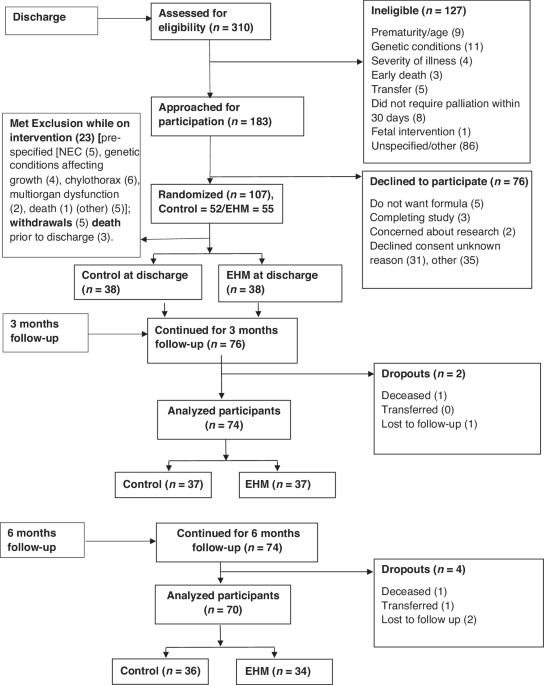
Of the original 107 patients randomized, 76 patients completed the study at discharge due to 23 infants meeting a priori exclusion criteria and 8 infants withdrawn/died. Patients who met the exclusion criteria during the initial inpatient post-randomization treatment phase and prior to discharge were off study and therefore did not continue in the 3–6 months follow-up as per protocol. The predefined exclusion criteria included NEC (5), genetic conditions affecting growth (4), chylothorax (6), multiorgan dysfunction (2), death while on intervention (1) and other/multiorgan dysfunction (5). Additional details of patients approached and enrolled are shown in Fig. 1. A total of 74 patients completed follow-up between 3 and 6 months of age, with only 2 infants lost to follow-up. Therefore, 97 and 92% of infants from the original intervention who completed the study at discharge were followed up at 3–6 months of age, respectively. Demographic characteristics of infants completing follow-up were similar. Of the 74 patients completing the 3 and 6 months follow-up visits, the ethnic distribution was: Asian (1.4%), African-American (12.2%), Hispanic (21.6%), White (62.2%), and Other (2.7%) (p = 0.49). There were 62% males in the control group vs 73% in the EHM groups (p = 0.32). The diagnosis of HLHS in patients completing the follow-up was similar between groups (73% in the control and 86.5% in the EHM group) (p = 0.24). Growth parameters were similar between groups at discharge, 3 and 6 months of age, and there was no difference in changes in z-scores over time (Table 1). Growth was analyzed in 51 infants with data from the End of Study to 3 months of age. Infants in the lowest quartile for growth velocity gained 15 ± 4.6 g/kg/day compared to 27±4.3 g/kg/day in the top three quartiles. Infants with lower growth velocity had their Glenn operation at 3.5 ± 0.8 months, while others had it at 4.2 ± 1.1 months (p = 0.04). The nutritional and caloric intake, as well as the feeding route received from discharge to 6 months of age, are described in Table 2. Feeding approach in control and EHM groups at the time of surgery, post-operatively and at discharge is illustrated in Supplementary Table S1. Feeding intolerance during the initial hospital stay has been published.6
Schematic diagram of participant enrollment, 3 and 6 months follow-up
Demographic characteristics were similar between control and EHM groups (p = 0.31) during the first 6 months of follow-up. Physical, occupational, or speech therapies were provided and were similar between groups, with 51 and 61% in the control group compared to 47 and 45% in the EHM group at 3 and 6 months, respectively (p = 0.72, p = 0.27). Eczema was reported in zero cases of controls vs 3% in the EHM group over the 6-month period (p = 0.32). Re-hospitalization rates were 39% in the control group and 41% in the EHM group at 3 months (p = 0.84) and 61% in the control group and 70% in the EHM group at 6 months (p = 0.45). Details of the second stage surgical palliation (Glenn) were available in 53 patients who remained on study through the first surgical palliation; details are shown in Table 3. Two patients underwent heart transplantation in the control group and were excluded. Private insurance was in place for 49% in the control group and 49% in the EHM group (p = 0.69).
Discussion
To date, this is the first multicenter, prospective RCT to report 6 months of detailed feeding, nutrition, and growth velocities in neonates with SVP requiring surgical intervention shortly after birth. The rate of growth in infants receiving EHM nutrition was higher than in controls from birth to the end of the initial study period.6 Growth velocities remained excellent from the end of the study to 3 and 6 months, comparable to those of healthy infants (Table 1). The excellent growth outcomes (growth velocities of 20–25 g/day during the first 6 months of life) in infants with SVP highlight the importance of intensive nutrition monitoring and care during the interstage period. The caloric intake recorded for these infants is detailed in Table 2 and can serve as a guideline for caloric goals at the interstage period. The support provided by dietitians, nursing staff and physicians, along with individualized nutritional plans involving daily weight monitoring and detailed caloric intake tracking, likely played a crucial role in ensuring adequate growth. This rate of growth is remarkable considering the multiple complications and surgeries infants with SVP typically encounter. However, this finding may also reflect a potential Hawthorne effect, whereby participants and caregivers modify their behavior due to awareness of being observed within a research setting. Increased monitoring, more frequent follow-up, and heightened engagement with the clinical team may have led to improved adherence to feeding recommendations and overall care practices.
Since there is limited literature on growth patterns in infants with SVP during the first 6 months of life, growth z-scores were compared to those expected in healthy infants.7,8 In contrast to previous studies, where faltering growth was reported almost universally by the 2nd palliative surgery,9 the rate of weight gain observed in our large RCT trial in infants with SVP is extraordinary, as it showed similar growth velocities of healthy infants. Our current study utilized the multidisciplinary approach and a well-thought-out nutritional algorithm aimed at maximizing growth; thus, the combined effects of these interventions may be considered. Notably, in our study, the nutrition algorithms were developed collaboratively by a multidisciplinary team of dietitians, pharmacists, neonatologists, pediatric intensivists, pediatric cardiologists, pediatric advanced practice providers with expertise in nutrition, and pediatric cardiothoracic surgeons from all participating centers.
Median Z-score for weight, length and head circumference at discharge were in the range of normalcy, and changes from birth to 3 months in weight and FOC Z-scores were only −0.1 to −0.2, which has never been reported in this population.9 In contrast, in a recent retrospective study of 57 infants with SVP, the z-score change from birth to the time when stage 2 palliation was performed decreased from −1.3 to −1 even after implementation of home monitoring; this is a 10-fold worse change in z-score compared to our study population.10 As previously mentioned, it is possible these infants benefited from study participation, as there was a high emphasis on mothers’ own milk utilization along with high involvement of dietary and research personnel, which in turn, could have contributed to the positive effect. All Z-score changes from birth to 6 months were positive for length and head circumference. Weight Z-scores were slightly negative at −0.2 in the control group and −0.02 in the EHM group but there were no statistically significant differences. It is likely if the EHM diet were continued for longer (after 30 days post-op and/or post-discharge) the differences in growth between groups would have persisted.
There were no differences in caloric intake between groups during the first 6 months of life, with infants receiving mostly enteral feeds fortified to 24 cal/oz throughout this period, and only 6–10% of infants being exclusively breastfed at 3 months. It is important to note that ~75% of infants received either hydrolyzed or elemental formula after discharge throughout their first 6 months of age and stayed off solids until 6 months of age (Table 2). This was the standard of care at most institutions as these infants had many feeding difficulties (previously published data6). It is unlikely this is due to non-IgE-mediated allergy since the rate of eczema remained at less than 5% by 6 months of age in both groups. A limitation of the study is that no challenge was performed with intact protein-based formulas to identify infant’s tolerance; this was not feasible due to the high-risk population therefore, standard of care was followed. This study shows that infants with SVP requiring an operation within the first month of life can achieve PO feeds in up to 50% of cases during the pre-operative period (prior to 2nd palliation) and, less than 10% received gastrostomy tubes at the time of discharge after the first palliation. Furthermore, up to 50–60% of infant survivors were able to achieve 100% of their intake via PO at 3–6 months of age, and less than 20% received gastrostomy tubes. This is much lower than previously reported where up to 59% of infants with SVP require g-tubes by their 2nd palliation.11 Furthermore, this study demonstrates that infants with complex congenital heart conditions may be able to achieve full oral feeds after transitioning to a non-shunt-dependent circulation and should be considered on a case-by-case basis. Although significant variations in feeding practices have been previously reported between large centers, translating into differences in growth,12 many of these centers participated in the current study. In a study of 555 infants with SVP from 15 centers enrolled in the Pediatric Heart Network Single Ventricle Reconstruction Trial, 432 infant survivors requiring Norwood operation who were fed PO by the time of discharge had a higher mean pre-stage II weight-for-age z-score when compared to those infants fed via NG and g-tube feeds, even after adjusting for site.12 In summary, the ability to feed via PO might be a result of initial approach and improved nutrition and growth, which translated into long-term PO success and adequate growth in infants with SVP.
In terms of timing of 2nd stage palliation, most of the infants in the study had a diagnosis of HLHS and had a Glenn operation by 6 months of age, with a median age of 4 months. There were no differences in growth in the control and EHM groups (Table 3), but in a sub-analysis of all infants, those in the lower quartile for growth had their Glenn operation at an earlier age of 3.5 ± 0.8 vs 4.2 ± 1.1 months when compared to infants on the top three quartiles for growth. In the initial results of the trial, infants had better growth in the EHM arm due to higher caloric intake at the end of the study period, with increased caloric intake and less suspected NEC/confirmed NEC. The differences between groups did not persist at 3 and 6 months which was likely due to the conclusion of the study intervention in the initial hospitalization, and therefore all patients were receiving similar caloric intake with either maternal breastmilk and/or formula with the addition of formula to increase calories during the follow-up period. Perhaps the differences in earlier Glenn in infants with the lowest growth velocity might be due to severity of illness and the need to move towards earlier operation. When evaluating mechanical ventilation after the Glenn operation, infants in the EHM group spent less time on the ventilator than those in the Control (p = 0.04). This might be due to the initial benefits of EHM nutrition or the smaller sample size since a few infants did not undergo the Glenn operation or died (Table 3). There were no differences in the ICU days, hospital length of stay, or mortality between groups.
In summary, neonates receiving an EHM diet from birth to up to 30 days post-surgical operation had similar growth at 3 and 6 months of age compared to those receiving a control diet. Infants with SVP benefit from a protocolized nutritional approach, as evidenced by normal growth velocity in infancy despite significant morbidity and re-hospitalization. Lastly, given the findings of the ability of infants with complex congenital heart conditions to achieve full PO feeds post-second stage operation, centers may consider delaying gastrostomy tube placement until after the Glenn operation.
Data availability
Deidentified individual participant data (including data dictionaries) will be available upon request. The data will be available upon publication to researchers who provide a methodologically sound proposal. Proposals should be submitted to C.B. at blanco@uthscsa.edu
References
Anderson, J. B. et al. Variation in Growth of Infants with a Single Ventricle. J. Pediatr.161, 16–21.e3 (2012)
Marino, L. V. et al. Improving growth of infants with congenital heart disease using a consensus-based nutritional pathway. Clin. Nutr.39, 2455–2462 (2020)
Slicker, J. et al. Nutrition algorithms for infants with hypoplastic left heart syndrome; birth through the first interstage period. Congenit. Heart Dis.8, 89–102 (2013)
Kataria-Hale J. et al. Nutrition for infants with congenital heart disease. Clin. Perinatol.50, 699–713 (2023). https://www.sciencedirect.com/science/article/pii/S0095510823000489
Horsley, M. et al. Evaluation of growth and feeding tolerance in infants with single-ventricle physiology receiving retrospective standard of care feeding regimens compared with protocolised formula or exclusive human milk feeding regimens. Cardiol. Young34, 2170–2177 (2024). https://www.cambridge.org/core/product/5D3859F148EB2929096D39BEB02D4047
Blanco, C. L. et al. A randomized trial of an exclusive human milk diet in neonates with single ventricle physiology. J. Pediatr.256, 105–112.e4 (2023)
Who Multicentre Growth Reference Study Group, De Onis, M. WHO Child Growth Standards based on length/height, weight and age. Acta Paediatr.95, 76–85 (2006)
Villar J. et al. International standards for newborn weight, length, and head circumference by gestational age and sex: the Newborn Cross-Sectional Study of the INTERGROWTH-21st Project. Lancet384, 857–868 (2014)
Anderson J. B. et al. Predictors of poor weight gain in infants with a single ventricle. J. Pediatr.157, 407–413 (2010)
Scott, A. E., Johnson, M. J., Bharucha, T. & Marino, L. V. Single ventricle infants: outcomes and impact of home monitoring programme enrolment. Cardiol. Young3, 568–574 (2025)
Piggott, K. D. et al. Risk factors for gastrostomy tube placement in single ventricle patients following the norwood procedure. Semin. Thorac. Cardiovasc. Surg.30, 443–447 (2018)
Lambert, L. M. et al. Variation in feeding practices following the Norwood procedure. J. Pediatr.164, 237–42.e1 (2014)
Funding
Funding was provided by Prolacta Bioscience, CA (Contact: Martin Lee, email MLee@prolacta.com, phone 18188079365)
Author information
Authors and Affiliations
University of Texas Health Science Center at San Antonio, San Antonio, TX, USA
Cynthia L. Blanco, Dauren Alimbetov & Krista Bonagurio
University Hospital, University Health, Texas, San Antonio, USA
Cynthia L. Blanco & Krista Bonagurio
The Heart Institute, Cincinnati Children’s Hospital Medical Center, Cincinnati, OH, USA
Lindsey B. Justice & David S. Cooper
Texas Children’s Hospital, Baylor College of Medicine, Houston, TX, USA
Dantin Roddy & Amy B. Hair
University of Cinicnnati College of Medicine, Ohio, Cincinnati, USA
David S. Cooper
Oklahoma University, Norman, OK, USA
Patricia K. Williams
University of Florida, Gainesville, FL, USA
Desiree Machado & Nicole Cacho
Ann & Robert H. Lurie Children’s Hospital of Chicago, Chicago, IL, USA
Bradley S. Marino & John M. Costello
Cook Children’s Medical Center, Fort Worth, TX, USA
Annie Chi
Children’s Hospital of Los Angeles; University of Southern California, Los Angeles, CA, USA
Cheryl Takao & Jay D. Pruetz
UT Southwestern Medical Center, Dallas, TX, USA
Erin Gordon
Children’s Hospital of Orange County, Orange, CA, USA
Amir Ashrafi
Shawn Jenkins Children’s Hospital, Medical University of South Carolina, Charleston, SC, USA
John M. Costello
Authors
- Cynthia L. BlancoView author publications
Search author on:PubMed Google Scholar
- Lindsey B. JusticeView author publications
Search author on:PubMed Google Scholar
- Dantin RoddyView author publications
Search author on:PubMed Google Scholar
- Dauren AlimbetovView author publications
Search author on:PubMed Google Scholar
- David S. CooperView author publications
Search author on:PubMed Google Scholar
- Amy B. HairView author publications
Search author on:PubMed Google Scholar
Consortia
for the Cardiac Neonate Nutrition Study Group
- Krista Bonagurio
- , Patricia K. Williams
- , Desiree Machado
- , Bradley S. Marino
- , Annie Chi
- , Cheryl Takao
- , Erin Gordon
- , Amir Ashrafi
- , Nicole Cacho
- , Jay D. Pruetz
- & John M. Costello
Contributions
All authors contributed to writing the manuscript and critically revising it for significant intellectual content. Each author has reviewed and approved the final version for submission
Ethics declarations
Competing interests
This was an investigator-initiated study supported with grant funding from Prolacta Bioscience
Consent statement
University of Texas Health Sciences center at San Antonio Institutional Review Board approved the study protocol. Written informed consent from a parent or legal guardian was obtained for all neonates participating in the research
Additional information
Publisher’s note Springer Nature remains neutral with regard to jurisdictional claims in published maps and institutional affiliations
Supplementary information
Supplementary Information (download DOCX )
Supplementary Information (download DOCX )
Rights and permissions
Open Access This article is licensed under a Creative Commons Attribution-NonCommercial-NoDerivatives 4.0 International License, which permits any non-commercial use, sharing, distribution and reproduction in any medium or format, as long as you give appropriate credit to the original author(s) and the source, provide a link to the Creative Commons licence, and indicate if you modified the licensed material. You do not have permission under this licence to share adapted material derived from this article or parts of it. The images or other third party material in this article are included in the article’s Creative Commons licence, unless indicated otherwise in a credit line to the material. If material is not included in the article’s Creative Commons licence and your intended use is not permitted by statutory regulation or exceeds the permitted use, you will need to obtain permission directly from the copyright holder. To view a copy of this licence, visit http://creativecommons.org/licenses/by-nc-nd/4.0/.
About this article
Cite this article
Blanco, C.L., Justice, L.B., Roddy, D. et al. A randomized trial of an exclusive human milk diet in neonates with single-ventricle physiology: 3 and 6 months follow-up outcomes.
Pediatr Res (2026). https://doi.org/10.1038/s41390-026-05255-2
Received:09 December 2025
Revised:17 April 2026
Accepted:28 April 2026
Published:21 July 2026
Version of record:21 July 2026
DOI
:https://doi.org/10.1038/s41390-026-05255-2
