


Big Food vs. The People
NEWSROOM: FOOD SYSTEMS
Co-published with










Lucy Jones for Lighthouse Reports
July 22, 2026
We expose Big Food’s 239 lawsuits against life-saving policies
Bad diets kill millions of people globally every year, and lead to tens of billions of dollars in health costs, often placing the heaviest burden on communities who are least able to afford it. Children, with limited decision-making power, are particularly vulnerable to this
Legislators and government officials have worked to rein in this public health crisis by enacting laws that require food companies to be transparent about their ingredients and limit the advertising of unhealthy foods
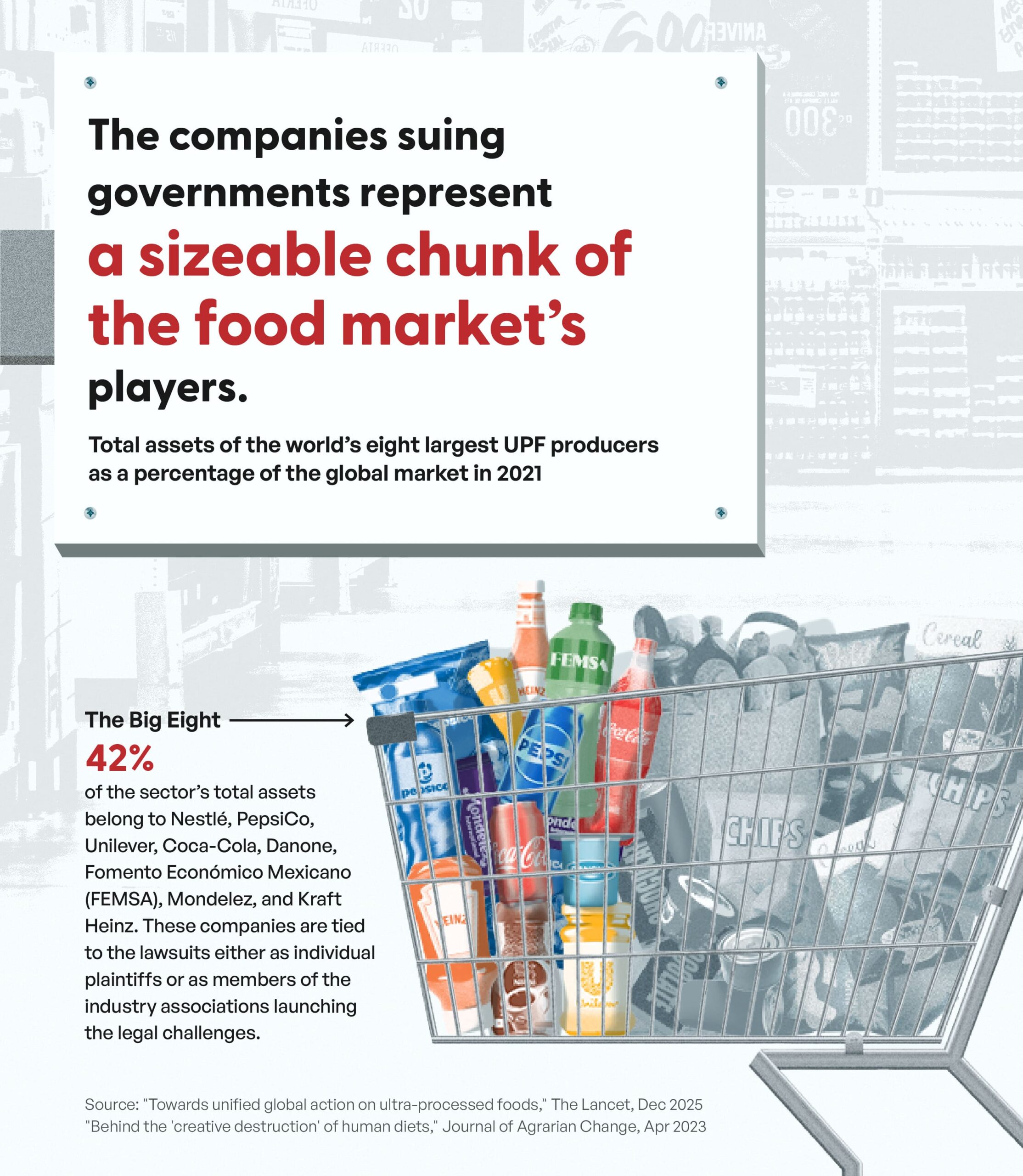
In public, the world’s biggest and richest food companies such as Coca Cola, PepsiCola, and Mondelez say they want to be part of the solution. But behind closed doors, they have taken governments to court to delay, dilute, and derail public health laws, which the companies say violate their rights
This cross border collaboration with health academics and an international media coalition shed light on how transnational corporations use legal tactics – lawsuits and legal threats – to stymie public health efforts in six countries where such tactics are most apparent: Mexico, Brazil, Colombia, India, Britain, and the United States
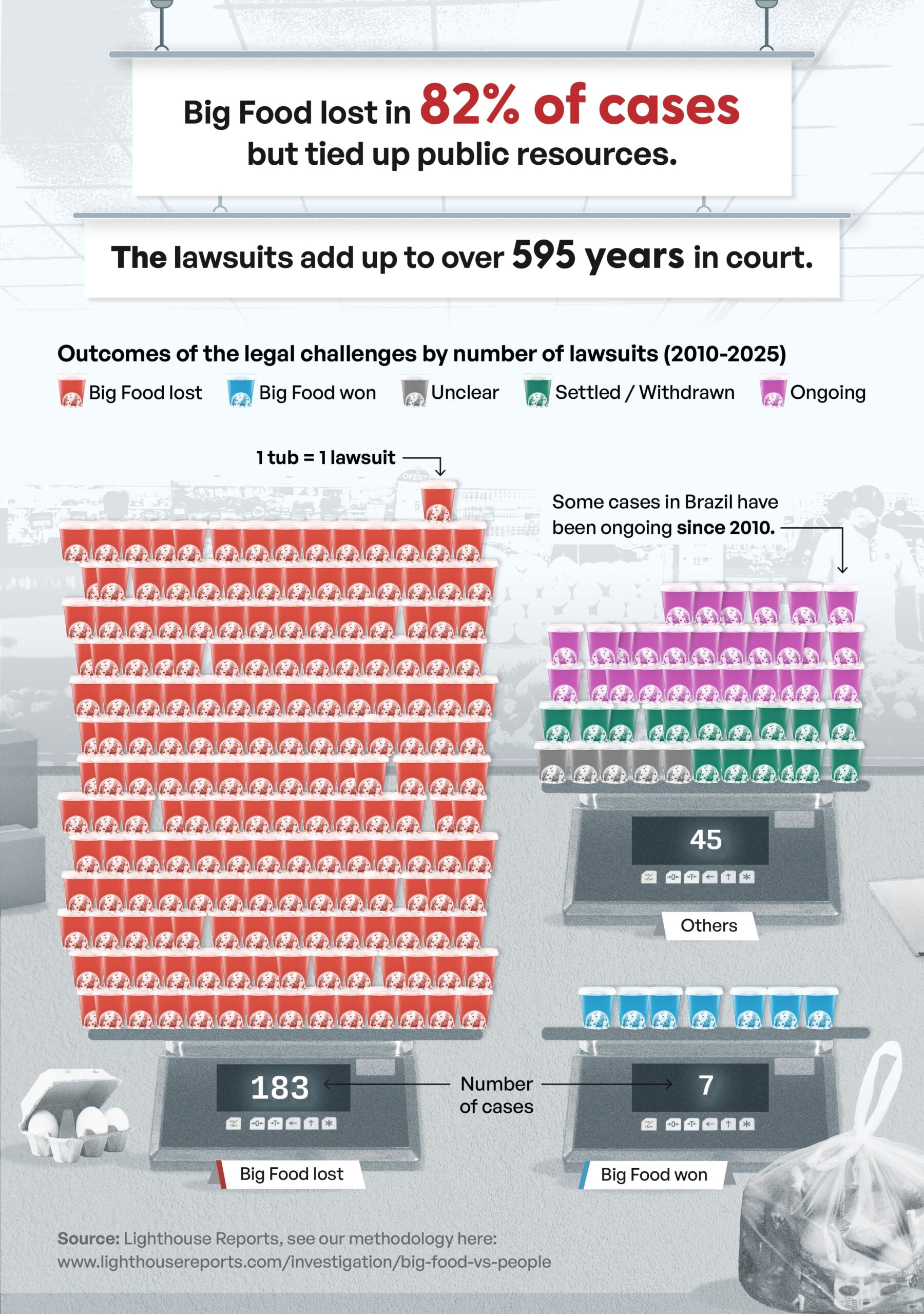
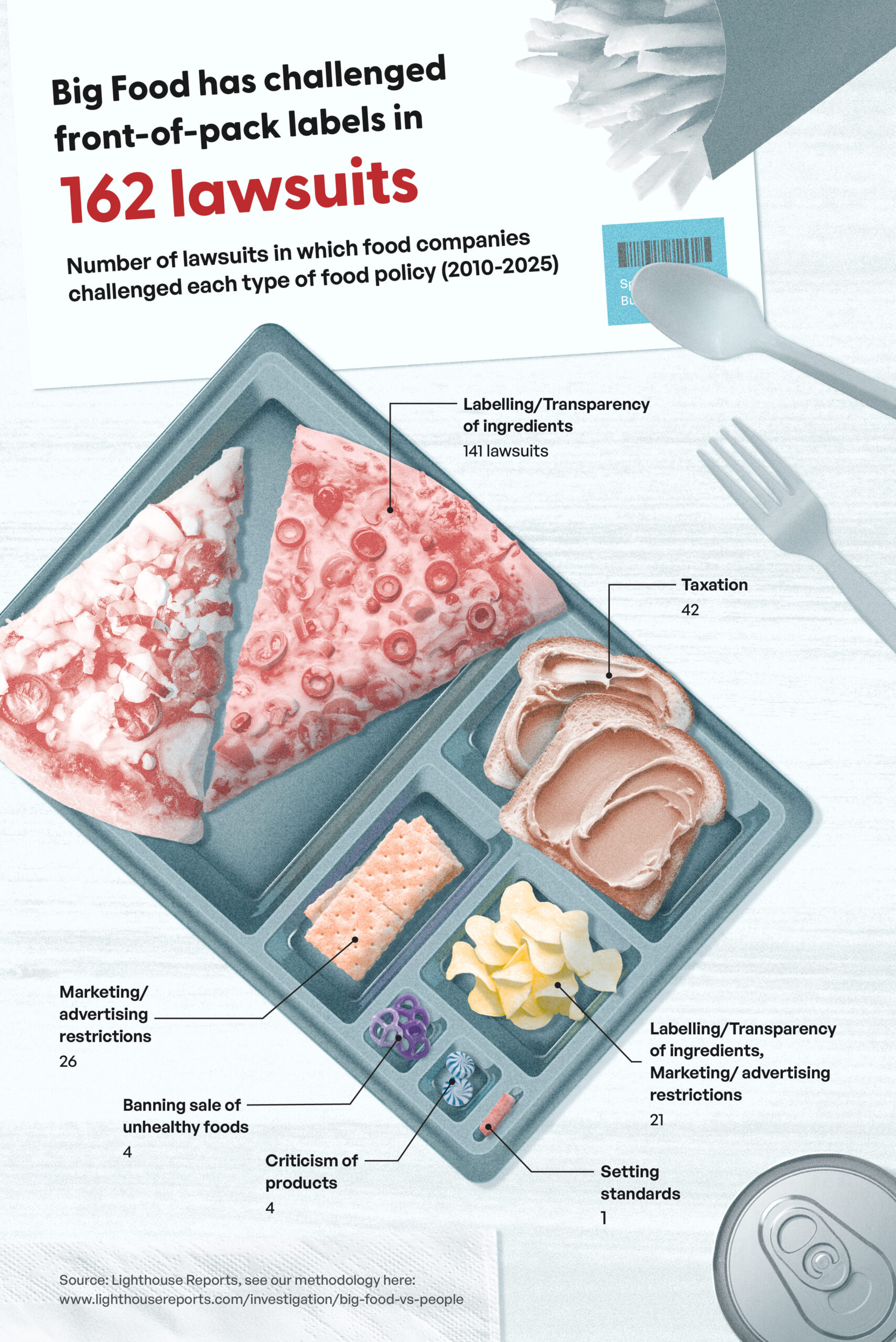
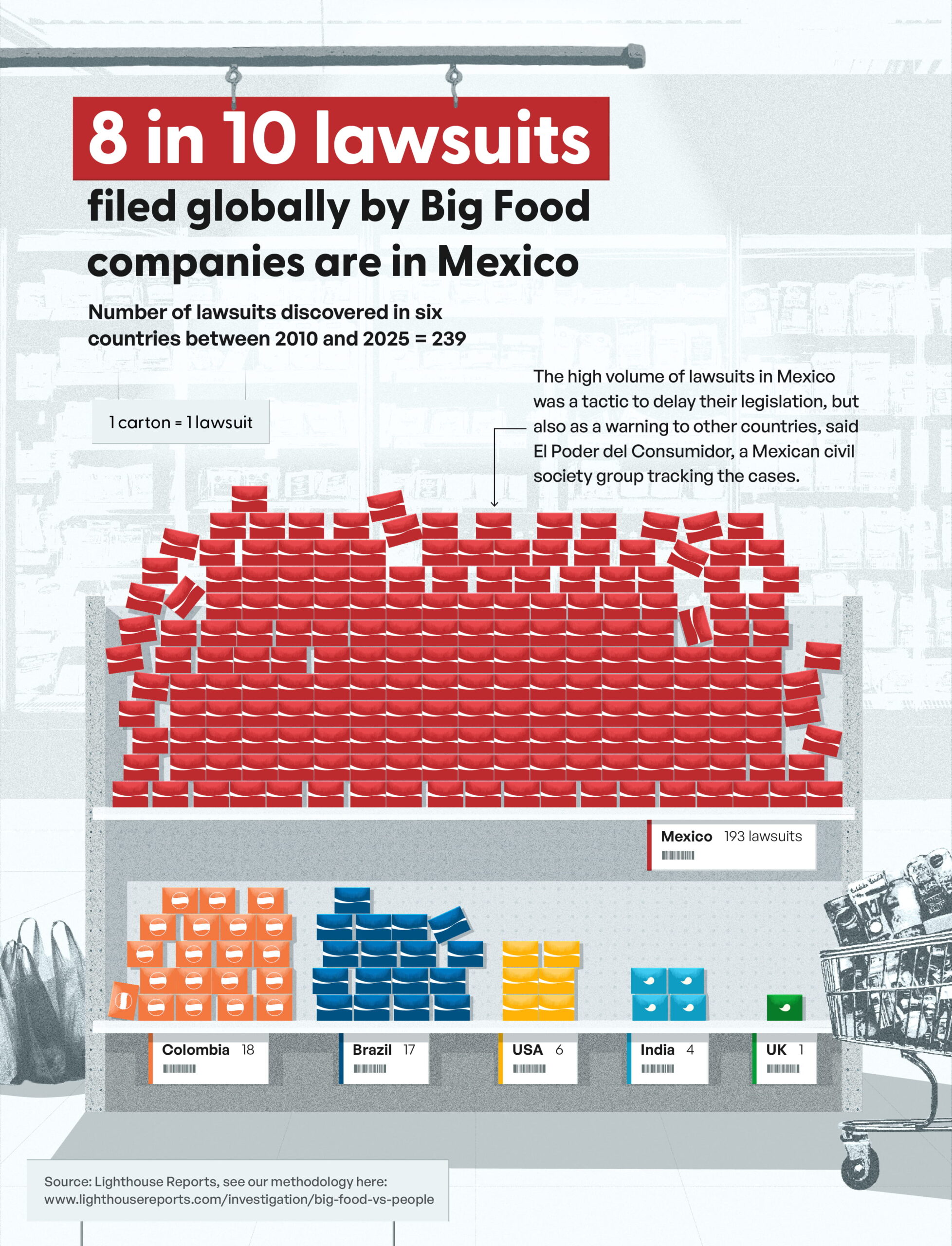
– 239 lawsuits were filed between 2010 and 2025 across Mexico, Colombia, Brazil, the US, the UK, and India against public health policies targeting food and beverages such as front of pack labelling, regulating advertising junk food to children, soda taxes, and taxes on ultra processed foods
– The cases add up to 595 years of litigation, representing a significant burden on the governments defending their health policies
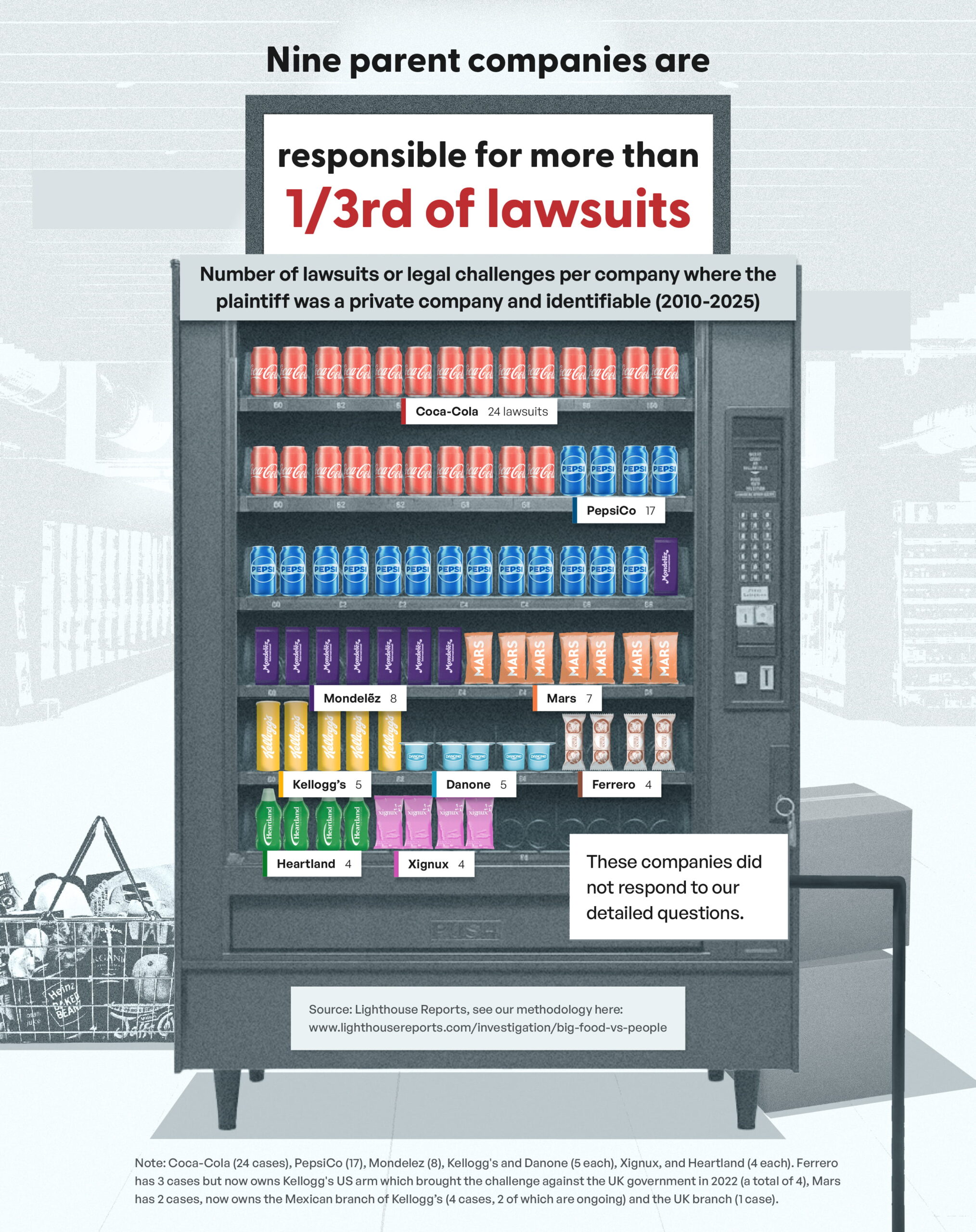
– Of the cases brought by private companies where the plaintiff was identifiable, more than 1 in 3 came from just nine parent groups, led by Coca-Cola, PepsiCo, and Mondelez
Their actions are not only prolonging the public health crisis but also cost countries billions of dollars in both legal and healthcare costs. In addition, they have a chilling effect on policymakers that wish to better their citizens’ health but do not have the re
METHODS
We constructed a dataset of challenges to laws aiming to improve population nutrition between 2010 and 2025 in these countries: Mexico, Colombia, Brazil, U.S., UK, and India
With the exception of India, cases were included when a regulation that sought to improve public health through better nutrition was being challenged (i.e. validity, scope, or implementation). We made an exception for cases in India where influencers were being sued, as they were taking over the role of the government in making the nutritional value of products more transparent
We only included cases that were verifiable through official legal databases, court records, or reputable secondary
We excluded cases solely concerning non-manufacturers such as fresh produce or when companies were appealing fines and other judgments unrelated to public health policies
This research was done in collaboration with researchers from the University of Caldas (Colombia); Robert & Ethel Kennedy Human Rights Center (United States); the University of Sao Paulo (Brazil); and the University of Sydney (Australia). They found more lawsuits through a systematic legal search in Colombia, Brazil and Mexico
An upcoming academic paper will be published alongside the media articles, looking at the dataset from a scientific perspective
This dataset built on the work and insight of El Poder del Consumidor (Mexico), the FULL database developed by the Global Center for Legal Innovation on Food Environments at the O’Neill Institute and the Global Health Advocacy Incubator, CAJAR (Colombia), and ACT (Brazil)
STORYLINES
– Mexico
More than a third of Mexican schoolchildren and 41% of adolescents were overweight according to a 2022 national survey
This is the country where we found the most lawsuits (193 out of 239), many of them were against the country’s labelling regulation. Quinto Elemento Lab reveals the companies’ arguments: that the laws were a violation of their constitutional rights and that the measures “demonized” their products or violated consumer rights. For example, a local Pepsi bottler argued that in certain rural areas of Mexico, it was safer to drink soft drinks than the available water. In court, the judges rejected many of the legal arguments that the companies presented.
– Brazil
According to the UN, in 2022-2024, more than 1 in 4 adults in Brazil were living with obesity while nearly 1 in 9 children were overweight
Some of the 17 lawsuits in Brazil have been dragging on for close to a couple of decades, with no predicted conclusion in sight, according to Agência Pública and O Joio e O Trigo
In all but one, the plaintiffs were industry associations, which experts told us is a way for companies to keep their valuable brand names away from litigation that may harm their image. Some of the world’s largest food companies are members of these Brazilian associations, including Coca-Cola, Ferrero, Kellogg’s local brand, Mars, Mondelez, Nestlé, and PepsiCo. 11 of the lawsuits were against the Brazilian Health Regulatory Agency, ANVISA, which has been hamstrung as a result. The plaintiffs disputed a regulation that required the advertising of food and beverages with low nutritional value to display more information.
– Colombia
More than half of Colombia’s population is overweight, and treating the diseases caused by unhealthy foods cost the country an estimated 1.3 billion euros in 2021
We found 18 lawsuits in Colombia, mostly targeting taxes on unhealthy products and front-of-package labelling. Nearly all of them were constitutional challenges brought about by individual citizens as enabled in the country’s constitution. However, Cuestión Pública finds that many of the plaintiffs were lawyers who had done work for food companies. The submissions also used many of the same arguments wielded by the companies. In 2022, while the creation of the health tax was being debated, sugary beverage and ultra-processed food companies donated 5.85 million Euros to political parties, accounting for 40% of all donations to political parties that year.
– U.S
Two in three adults in the U.S. are overweight and a quarter of adolescents are living with obesity, according to the CDC. The Make America Healthy Again movement supported Trump’s presidency bid
The American Beverage Association sued to overturn a soda tax in Santa Cruz, which it has so far failed to do. Santa Cruz Local uncovers details of the group’s earlier success squashing a soda tax effort in Watsonville, a neighbouring city. The Santa Cruz lawsuit has far-reaching consequences: the recent victory for the city could unlock the ability for charter cities across California to tax sugary beverages. We found that the soda industry recruited and leveraged the credibility of prominent Black and Latino leaders to amplify opposition against public health taxes within their own communities. We have also identified five other lawsuits. The ABA was involved in four of them.
– Europe
In Europe, non-communicable diseases (NCDs) such as cardiovascular diseases, diabetes, or cancer are responsible for 80% of the disease burden, according to the European Commission
Follow The Money discovers that European countries have struggled to pass taxes on sugar-sweetened beverages, as they come under industry pressure. Unlike in Latin America, European governments frequently face legal threats before legislation is adopted. Industry groups repeatedly invoke EU state-aid, competition and internal-market rules, creating uncertainty that can delay or derail policies without a single lawsuit being filed. Plans for a joint European sugar tax have also been weakened
L’Espresso and Il Fatto Alimentare explain the role Italian confectionary giant Ferrero plays around the world in stimying public health laws, and how the family-owned company’s influence both domestically and internationally is connected to the country’s agroindustry rather than its famous cuisine
– India
Nearly one in three Indian women and more than one in four men are overweight or obese. One in five people have high blood sugar levels
The Wire traces the long journey of India’s front of pack labeling regulation, which the Indian food regulator, the FSSAI, has been developing since 2014. Over that time, it has done numerous consultations, studies but it has stalled regulating, blaming a lack of consensus between the industry and civil society. Research by ATNi commissioned by Lighthouse Reports showed that India’s proposed labelling system is actually consistently more lenient compared to similar systems in Australia and France.
Meanwhile, influential instagram celebrities have made videos comparing the nutrition of various products such as instant noodles, baby food, and others. They’ve been sued by the companies whose ingredient labels they were analysing
CO-PUBLICATIONS
- The Guardian: ‘If all else fails, sue’: how ultra-processed food firms are using the courts to obstruct health rules
- Follow the Money: A refined strategy: how Europe’s industry lobby managed to block sugar taxes
- Agência Pública: The People vs. Big Food: How the food industry blocked advertising regulation in the country
- O Joio e O Trigo: How the food industry blocked advertising regulation in Brazil
- The Wire: India Is Delaying Front-of-Pack Food Labels – and Consumers Are Paying the Price
- Il Fatto Alimentare: Big Food vs. Public Health: 239 Lawsuits to Stop Labels, Taxes, and New Rules
