


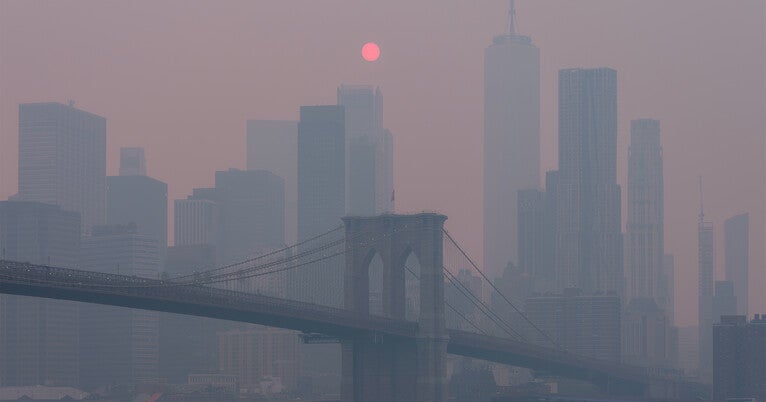
As the climate warms, wildfires are becoming larger, more frequent, and more intense. The smoke now routinely travels hundreds of miles, as was seen when Canadian wildfires this month sent heavy smoke across the Midwest and Northeastern U.S., triggering dangerous air quality across the region
But the health risks of wildfire smoke goes beyond the short-term threat to your lungs. In a new study, Yale researchers found that repeated and cumulative exposure to the fine particles in wildfire smoke is linked to a higher risk of being hospitalized for cardiovascular disease in older adults in the United States.
What does research say about the impact of wildfire smoke on people’s health?
So far, much of the research has focused on the immediate effects of breathing in smoke over a few days or weeks, and it’s mostly looked at the respiratory system, including the lungs. But if you live somewhere that gets hit by smoke season after season, your are also facing a potentially larger problem: cumulative exposure.
How does wildfire smoke impact cardiovascular health?
Over the long run, repeated and cumulative exposure to the fine particles in wildfire smoke is linked to a higher risk of being hospitalized for cardiovascular disease in older adults in the U.S. Even relatively modest levels of smoke were associated with more hospitalizations for conditions like ischemic heart disease, irregular heart rhythms, stroke, and heart failure
Who is most at risk of these cardiovascular health impacts?
People of lower socioeconomic status are more vulnerable, which points to a real equity problem in how this exposure plays out
Looking at more than 65 million Medicare beneficiaries across the continental U.S.,the researchers saw that exposure to even relatively modest levels of smoke, built up over a few years, was associated with more hospitalizations for conditions like ischemic heart disease, irregular heart rhythms, stroke, and heart failure
“In other words, the cardiovascular toll of wildfire smoke reaches well beyond the fire lines and well beyond the day the sky turns orange,” said Kai Chen, associate professor of epidemiology (environmental health sciences) at the Yale School of Public Health and corresponding author of the study.
The study appears in the Journal of the American College of Cardiology.
The heart of it
So far, much of the research into wildfire-related smoke has focused on the immediate effects of breathing in smoke over a few days or weeks, Chen says. And it has mostly looked at the respiratory system, including the lungs. On smoky days, there are more emergency department (ED) visits and hospitalizations, especially for breathing problems like asthma, studies have shown. In the longer term, a small but growing number of studies have also started to connect prolonged wildfire smoke exposure to cardiovascular death and, more recently, to new cases of heart failure and stroke.
But those earlier studies largely didn’t include incidents from more recent years, which is when wildfire activity and smoke exposure has really intensified. And they didn’t look across the full range of heart and blood-vessel conditions, the authors say. So, the long-term cardiovascular picture — especially for specific subtypes like ischemic heart disease and arrhythmias, and for the older adults who are most at risk — was still very much an open question
Because heart disease is the leading cause of death in this country, the researchers decided to look into what that repeated, long-term exposure does to cardiovascular health — and whether some groups of people carry more of that burden than others
To do that, they built a large population-based study using Medicare records for everyone aged 65 and older in the contiguous U.S. from 2017 through 2022 — about 65 million people. Then, for the exposure side, they used a validated model that estimates fine particulate matter related to smoke — what they call “smoke PM2.5” — on a 10-by-10-kilometer grid across the country, using satellite imagery, smoke-plume tracking, and ground monitors.
They then assigned those smoke levels to each person based on the ZIP code where they lived. Because the researchers were more concerned with long-term exposure than exposure during a single bad day, they calculated each person’s cumulative average smoke level over the prior three years, deliberately leaving out the year of hospitalization so they were capturing chronic buildup, not a short-term spike, Chen said
On the health side, they tracked for relevant individuals the first hospitalization for overall cardiovascular disease and for specific subtypes: ischemic heart disease, stroke and other cerebrovascular disease, heart failure, and arrhythmias
Finally, they used statistical models to estimate how risk of hospitalization changed across increasing levels of smoke exposure, carefully accounting for other factors that affect heart health like other kinds of air pollution, temperature, humidity, and a wide range of community-level social and economic factors. They also checked whether risk differed by age, sex, race, and socioeconomic status, and they ran several sensitivity and falsification tests to make sure the findings held up
More than a nuisance
Through this process, the researchers found that long-term wildfire smoke exposure was clearly associated with a higher risk of cardiovascular hospitalization. Heart failure showed the strongest association, with risk more than 20% higher at higher exposure levels. And for stroke, particularly ischemic stroke, the risk just kept rising as exposure went up
Two additional findings stood out to the researchers, Chen said. First, they saw elevated long-term risk even at fairly modest smoke levels, which means communities that are only lightly touched by smoke — not just those near the fires — may still face real cardiovascular risk. Second, the burden wasn’t shared equally: people of lower socioeconomic status were potentially more vulnerable, which points to a real equity problem in how this exposure plays out, they found
“Wildfire smoke should be treated as more than a temporary respiratory nuisance,” said Harlan Krumholz, the Harold H. Hines, Jr. Professor of Medicine at Yale School of Medicine (YSM) and co-author of the study. “This study finds that cumulative exposure is linked to a higher risk of cardiovascular hospitalization in older adults. Clinicians should help high-risk patients prepare for smoke events, and public health leaders should expand timely alerts, clean-air spaces, and access to effective filtration, especially for communities with fewer resources.”
These findings suggest that “the same steps that protect your lungs also help protect your heart,” said Yuan Lu, associate professor of medicine at YSM and co-senior author of the study. That includes checking local air quality, staying indoors when pollution levels are high, running air purifiers or creating what have become known as “clean-air rooms” (a designated space in any building where air quality is maintained), limiting strenuous outdoor activities, and using a well-fitting N95 or KN95 mask when outdoors.
The Yale research team also includes Siqi Zhang and Yongfei Wang

Interview
Mobilizing a system to treat people with sickle cell disease
Jul 22, 2026
Teaching and learning
Training child psychiatrists at Yale: A team-based approach to care
Jul 22, 2026

Frontiers
Yale researchers receive Genesis Mission awards to pursue AI advances
Jul 22, 2026
Sustainability
Removing ‘forever chemicals’ from farmlands — at a fraction of the cost
Jul 22, 2026
