



As U.S. home prices reach historic highs and proposed cuts to the Supplemental Nutrition Program (SNAP) are underway, the health of low-income rural residents is becoming a cause for concern. Meeting nutritional needs is already a challenge in many rural areas, which tend to have higher food prices, less variety, and lower quality fresh meat and produce. How will changes to food assistance alongside rising housing costs impact the health of rural communities?
While housing insecurity and food insecurity are often discussed separately, they are deeply connected. When housing costs rise, residents with limited incomes are forced to cut back on food spending to make ends meet. In rural areas, this trade-off is even harder because healthy, affordable food is often less available and/or harder to access
This tradeoff is more common among lower-income rural households facing tighter budget constraints. Figure 1 shows that, nationally, for households with annual income below $35,000, housing stress (household spending roughly a third of their income on housing) ranges from 68 to 96%.
This high housing stress among low-income households is prevalent across most regions of the U.S., except in a few low-cost-of-living pockets such as the Midwest, Appalachia, and the Delta region (Figure 2). For lower-income households, housing stress is almost unavoidable, which leaves them to make tough choices between shelter, nutrition, and other necessities
Figure 1: Total number and share of housing-stressed households by median income, 2023
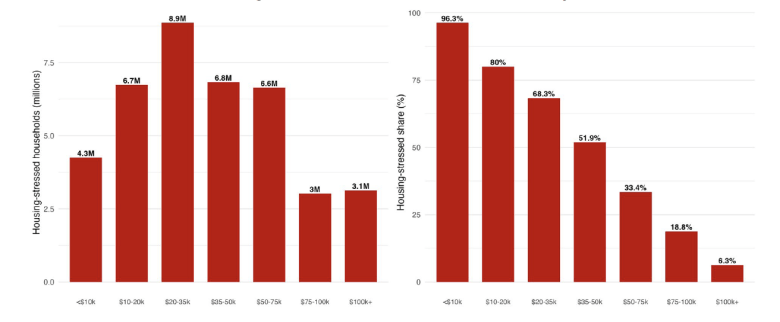
Notes: Data is from the American Community Survey 2019-2023 estimates. Household stress is defined as households spending more than 30% of their income on housing.
Figure 2: County share of housing-stressed households with incomes under $35,000
Notes: Data are from the American Community Survey 2019-2023 estimates. A household is considered housing-stressed if it spends more than 30% of its income on housing-related expenses.
Health Impacts of Choosing Shelter Over Nutrition
In a study by the Rural Livability Project at the University of Wisconsin–Madison, a national pattern shows that housing stress negatively affects rural health in high-poverty rural places, with higher prevalence of obesity, diabetes, stroke, and coronary heart disease. When rural residents face dual stress, the two constraints–housing financial stress and food insecurity–amplify each other’s negative effects on health (Figure 3)
Figure 3: Average prevalence of chronic health conditions by stressors of housing and food insecurity
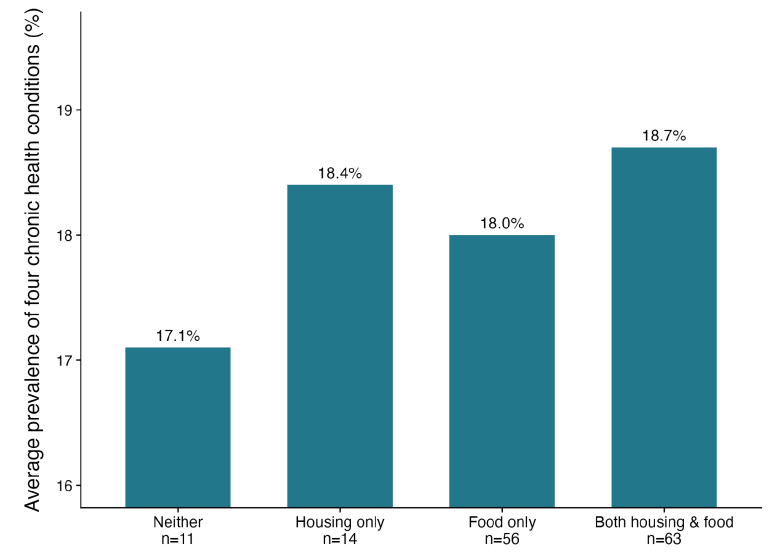
Notes: The average prevalence of four county-level conditions, obesity, diabetes, stroke, and coronary heart disease, where higher values indicate higher prevalence and therefore worse health. Counties are sorted into four mutually exclusive groups based on whether they fall in the top 25 percent of the sample on each stressor, housing stress and food insecurity. A county is high on a stressor if it ranks in the top quartile of that measure, which gives the Neither, Housing only, Food only, and both housing and food groups. Bar labels report the group mean and n is the number of counties.
Interviews with rural residents in Wisconsin reveal how these trade-offs play out in everyday life and potential long-term health implications. Many residents described prioritizing rent or mortgage payments first, often at the expense of their diet.
For some, this meant relying on cheaper food with longer shelf-lives. As one Wisconsin resident said, “I can get packages of ramen from the Dollar Tree for $1.50 and feed myself for over a week on $50 bucks.” While these items may be affordable and last longer, they lack essential nutrients needed to support the long-term health of communities.
In more remote areas, the problem is compounded by distance. Some residents reported traveling over 45 minutes to reach a grocery store, making convenience stores and gas stations their only practical, local option. These stores typically offer highly processed, calorie-dense foods with limited nutritional value.
Food pantries can help fill the gap, but our study identified some limitations. Pantry users reported that donations often consist of canned or packaged goods, with fewer fresh items available. As one Wisconsin food pantry user explained, “When your diet depends on what people are willing to donate, it is going to be mostly sugar, starch, and high fructose corn syrup because they’re cheap.” These dietary patterns can have long-term impacts on rural health outcomes
Over time, these dietary compromises can exacerbate existing health problems. Relying on cheap food items that have longer shelf lives for a prolonged period of time can lead to poor health outcomes, including obesity, type 2 diabetes, cardiovascular disease, and other chronic conditions
The Hidden Role of Stigma
Even where food and other forms of assistance were available, stigma shaped how accessible they were for people experiencing housing financial stress and food insecurity.
In small, tight-knit rural communities, privacy can be hard to maintain. As one participant explained, “If you do something and someone sees it, you can guarantee half the town is going to know about it soon.” Many of the people interviewed for this study mentioned being concerned about being judged if they sought help from food pantries or assistance programs.
At a time when rural communities are grappling with funding changes to food assistance programsand housing affordability, it is important to understand how housing financial stress and food insecurity are interconnected. Housing affordability, access to nutritious food, and social dynamics of stigma all play a role in determining rural health outcomes.
Communities would do well to ensure that housing stress and food insecurity are addressed together through coordinated solutions and co-located services. To address stigma around help-seeking, education and outreach efforts should normalize assistance and offer anonymized support. Residents may be more willing to seek help through anonymous channels such as phone-based support
Erin Gaede is a PhD candidate in the Department of Sociology at the University of Wisconsin-Madison and a research assistant with the Wisconsin Rural Livability Project
Yang Cheng is a postdoctoral researcher in the Department of Agricultural and Applied Economics at the University of Wisconsin-Madison and a research associate with the Wisconsin Rural Livability Project
Tessa Conroy is a Vilas Associate Professor in the Department of Agricultural and Applied Economics and Extension Specialist in the Community Development Institute at the University of Wisconsin-Madison
This work is supported by the Institute for Rural Partnerships, project award no. 2023-70500-38915, from the U.S. Department of Agriculture’s National Institute of Food and Agriculture. Any opinions, findings, conclusions, or recommendations expressed in this publication are those of the authors and should not be construed to represent any official USDA or U.S. Government determination or policy

This story was originally published in the Daily Yonder. For more rural reporting and small-town stories visit dailyyonder.com
